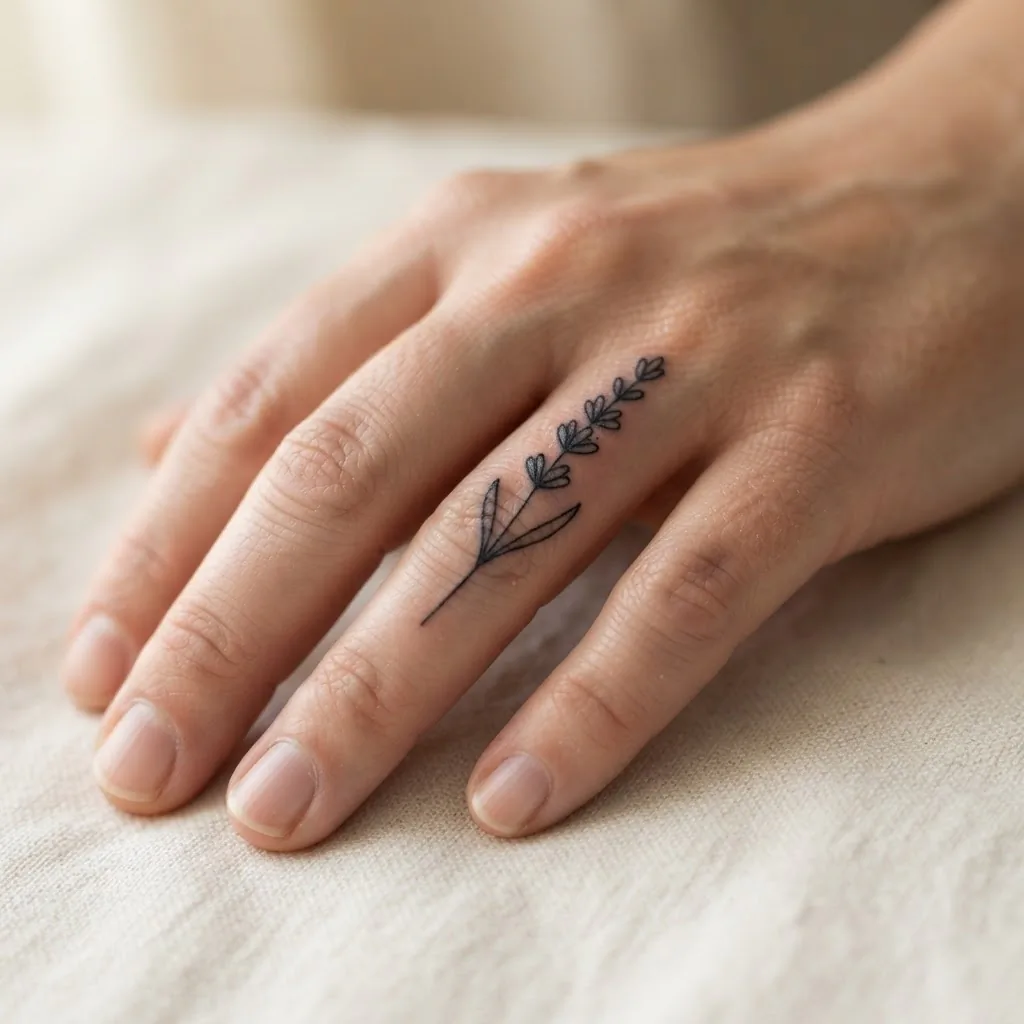
Finger Tattoos: What to Know Before You Book That Appointment
Finger tattoos are one of those ideas that start as a quiet “maybe” and slowly grow into a full Pinterest board. I know the feeling. You keep saving images: a tiny moon on a knuckle, a single floral stem running up the side of a ring finger, a fine-line initial that looks like it was always there. They are understated and personal in a way that bigger pieces sometimes cannot be. Every time you glance down at your hands, there it is. Yours.
But finger tattoos also come with more to think through than most placements. They live in one of the most active, most seen, most washed, most sun-exposed spots on your body. The skin there behaves differently than your inner arm or your shoulder blade. The right information before you book is not just helpful here, it is genuinely the difference between a tattoo you love for years and one that fades into a soft blur in six months.
So let’s go through all of it. Design ideas, placement reality, pain, longevity, what to look for in an artist, and how to walk into your consultation knowing exactly what you want. This is the guide I wish I had before I started asking all these questions myself.
Why Finger Tattoos Are Having a Moment
Finger tattoos have moved well past their “edgy” phase. What used to feel like a bold statement reserved for a very specific aesthetic is now one of the most-searched tattoo placements around, and for good reason. The designs that are trending right now lean soft and intentional: fine-line florals, delicate rings and bands, tiny celestial symbols, single initials in elegant script, and ornamental jewelry-inspired patterns that wrap around the finger like a permanent accessory. These designs feel less like rebellion and more like adornment.
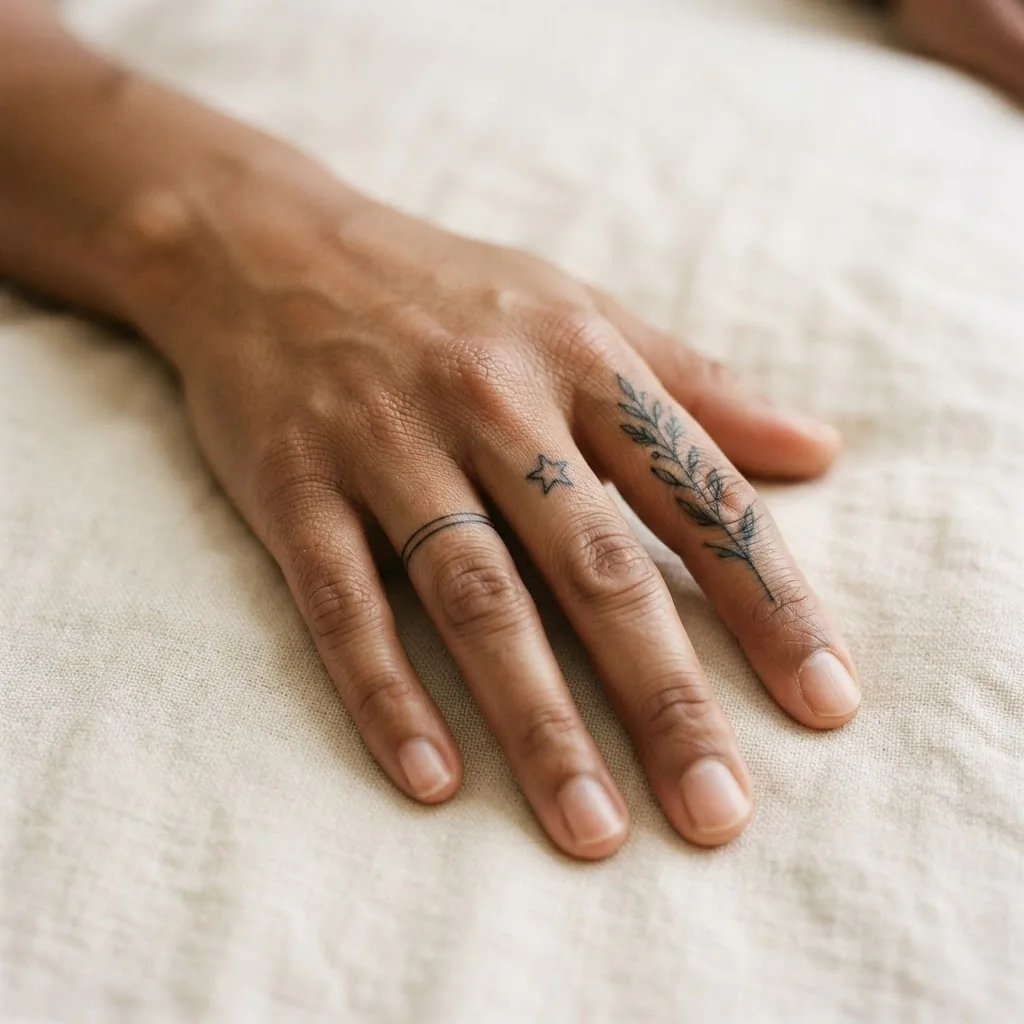
They fit perfectly alongside a stack of real rings or next to a fresh set of nails.
The rise of minimalist tattooing has made fingers an even more appealing canvas. Single-needle and fine-line work, which uses thinner lines and less saturation than traditional or neo-traditional styles, has given artists a way to create incredibly precise, delicate pieces in a very small space. That said, fine-line on fingers comes with a specific consideration we will cover shortly: longevity. The lighter the line, the more nuanced the aging.
13 Finger Tattoo Ideas to Inspire Your Next Piece
These are not ranked, and there is no “best” option here. The right idea is the one that feels genuinely like you. Think of these as a starting point for narrowing your vision before you ever sit down with an artist.
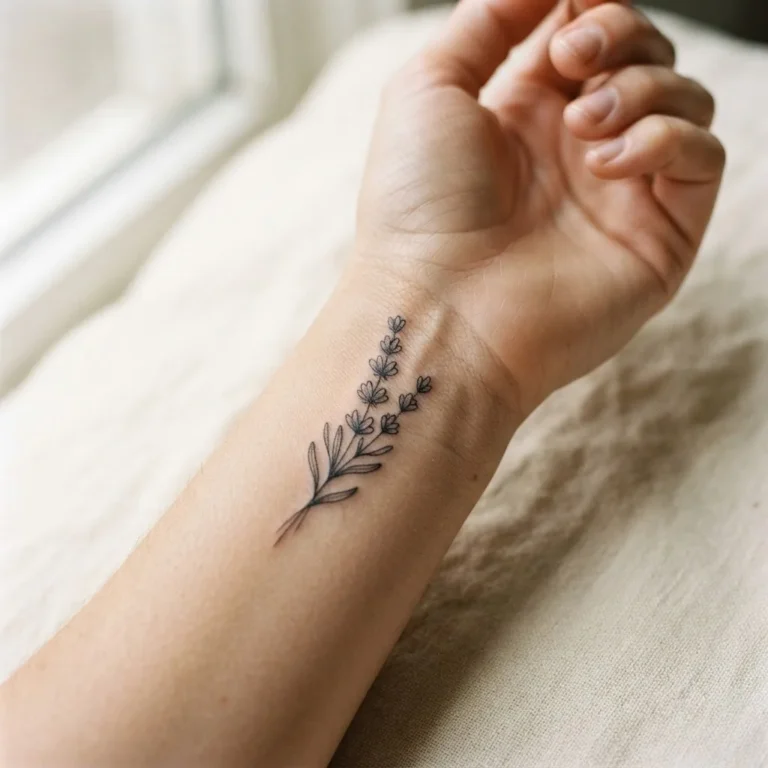
1. A Fine-Line Floral Stem A single botanical stem, whether it’s lavender, a poppy, or a simple rose bud, running along the top of the finger is one of the most consistently beautiful choices I see. The key word here is “simple.”

Small-scale florals look stunning fresh, but the detail needs to be minimal enough to hold over time. Artists consistently recommend avoiding overly intricate petals or multiple overlapping leaves at this scale, because that fine detail tends to blur as the skin naturally shifts and cells renew. A clean, graphic stem ages far more gracefully than a micro-detailed botanical illustration.
2. A Lettering Initial or Word Initial letters and short words have a permanence of meaning that suits the placement. Your own initial, a loved one’s initial, a single word like “calm” or “brave” or even just a punctuation mark that holds personal significance. Gothic script and clean serif fonts tend to translate well at this size. The challenge with fine lettering on fingers is spacing. What reads as elegant at a normal size can become crowded on a narrow strip of skin, so your artist will likely guide you on sizing and font choice during consultation.
3. A Minimalist Ring Band Ring bands are among the most popular finger tattoo choices right now. A thin band, a row of tiny dots, a delicate chain-link pattern, a repeating geometric element that wraps all the way around. These work beautifully as a standalone piece or as a companion to a real metal ring. The ring finger has the longest cultural history as a symbol of commitment and love, but plenty of people choose any finger for a band simply because they love the look. If you are considering a wedding band tattoo as a permanent alternative to a metal ring, that is a meaningful and growing choice, though your artist will want to discuss placement carefully since the inner portion of the ring wraps in an area that fades fastest.
4. A Single Celestial Symbol A crescent moon, a small star, a tiny sun, a single constellation dot-pattern. Celestial symbols are enduringly popular on fingers because they are simple enough to hold well at small scale and they carry layers of personal meaning for many people. A star on the knuckle, a moon near the cuticle, a small comet along the side of the finger. Artists have noted that simple celestial designs look especially good in sets across multiple fingers, giving you a coordinated hand look that still feels subtle and wearable.
5. A Knuckle Word or Letter Set Spelling a word across your knuckles has a long tradition in tattoo culture. It has evolved far beyond the old-school approach though. Now you see knuckle sets that spell words like “wild,” “free,” “love,” or simply a set of initials that are meaningful in a different order. One letter per finger creates a visual rhythm that works even when your hand is partially closed. This is a placement that shows more boldly and is harder to cover, so it is worth sitting with the visibility factor before committing.
6. A Botanical Micro-Piece on the Knuckle A tiny mushroom cap, a small herb sprig, a micro daisy centered on the knuckle. These small nature-inspired pieces have become a distinct aesthetic category of their own, popular among people who love cottagecore and botanical illustration vibes. At this scale, your artist’s experience with micro work really matters. This is where portfolio research becomes especially important, which we will talk through in detail later.
7. A Geometric Shape or Sacred Geometry Element Triangles, circles, diamonds, hexagons. Clean geometric shapes hold up well because their lines are purposeful and their simplicity translates naturally to the narrow canvas of a finger. Geometric elements also lend themselves to meaningful symbolism. A triangle representing past, present, and future. A circle for wholeness or continuity. A diamond for clarity or resilience. These meanings are as personal as you want them to be.
8. An Ornamental Jewelry Design Ornamental tattooing draws from jewelry aesthetics: designs that look engraved, settings that suggest gemstones, chain-like patterns, delicate filigree. Finger tattoos that mimic jewelry are having a genuine moment right now, particularly designs that work as permanent rings or as extensions of a hand-chain aesthetic. These can be some of the most visually striking options, but they require an artist who works in ornamental or jewelry-inspired styles specifically.
9. A Matching or Couple Design Matching finger tattoos between partners, friends, or siblings are deeply personal. A single element that corresponds across two people’s hands, a shape that only makes sense when the two hands are placed together, mirrored initials. If you are planning matching tattoos with someone else, booking the same session with the same artist is usually the smoothest path.
10. A Cuticle or Near-Nail Placement Tiny designs placed near the cuticle or just above the nail bed are a specific sub-category of finger tattoos. A small heart, a single star, a delicate gem shape just above the nail. One practical note here: this area of the finger actually tends to hold ink better than the inner joints, which is worth knowing. The nail bed tissue in the underlying dermis provides a more stable layer, and this spot also sees less friction from daily activity than the pads and inner surfaces of the finger.
11. A Coordinate Set Meaningful coordinates, the latitude and longitude of a place that changed your life, a place you were born, a place you got engaged, work beautifully in a small numeric format along the side of a finger. This is a design that ages well emotionally because the meaning deepens over time. Numerically, the formatting matters, so your artist will help you size and space the digits so they remain readable.
12. A Single Dot or Dot Pattern One of the most minimal options on this list, and genuinely beautiful in its simplicity. Single dots or small dot groupings can carry enormous personal meaning while appearing almost invisible to a casual observer. Three dots in a row. A small triangle of dots. A single black dot near a knuckle. For people who want a tattoo that feels almost private, this is a compelling choice.
13. A Wave, Arc, or Single Line An abstract single line, a flowing wave shape, a simple arc. These minimal linework designs age well when the line is clean and confident, and they feel organic and modern in a way that figurative designs sometimes don’t. A skilled fine-line artist can make a single arc look intentional and striking. The key is working with someone who can execute linework at this scale without wobble, which again comes down to portfolio research.
The Honest Conversation About Fading and Touch-Ups
I want to spend real time on this because it is the thing most people do not fully understand before getting a finger tattoo, and it is the main source of disappointment for those who feel let down later.
Fingers are one of the hardest places on the body to hold a tattoo long-term. This is not a flaw in the art form or the artist. It is anatomy. Your hands are in constant motion. They are washed many more times per day than any other body part. They are exposed to sunlight regularly. The skin on your fingers flexes, folds, and sheds cells at a faster rate than most other areas. All of this works against ink retention in ways that tattooing a shoulder or a thigh simply does not face.
On top of that, fingers have a higher density of sweat glands than most areas. The moisture this creates can affect how the ink heals in the early weeks, and dermatologists have noted that this added moisture can disrupt the normal healing process and contribute to ink disintegration or blurring if aftercare is not diligent.
Placement within the finger matters enormously. The palm-side and inner joints fade the fastest due to constant flexing and skin shedding.

Many experienced artists decline to tattoo this area at all, or they are very clear upfront that ink placed there may not hold well regardless of aftercare. The top of the finger and the area near the cuticle tend to retain ink better, though no finger placement is as stable as most other body locations.
What this means practically: most finger tattoos will need a touch-up. Artists and dermatologists consistently say you should expect at least one or two touch-ups in the first year or two after getting a finger tattoo, and ongoing touch-ups over the life of the piece. Some collectors with finger tattoos treat touch-ups as a regular part of ownership, the same way you might get a car serviced. That is not a bad thing. It is just honest planning.
Many studios include one complimentary touch-up within a certain timeframe (often three to six months after healing). Ask about this policy before you book. Budget for touch-ups from the start. Think of the initial price not as the full cost but as the starting point.
If you want a design that holds as long as possible: choose a placement on the top of the finger or near the cuticle, keep the design relatively simple with clean lines rather than ultra-fine hairlines, and choose an artist who regularly works in this placement and can show you healed examples of their finger tattoos (not just fresh ones) in their portfolio.
What Finger Tattoos Actually Feel Like: Pain, Honestly
Fingers fall into the higher end of the pain scale for most people. The reason is straightforward: there is very little fat cushioning between your skin and the bone underneath. The skin is thin, there are dense nerve networks throughout the hand, and the knuckle areas involve the most bone proximity. According to Healthline’s medically-reviewed tattoo pain chart, hands and fingers are consistently cited as among the most painful areas to get tattooed.
That said, everyone’s pain experience is different, and “more painful” does not mean unbearable. Finger tattoos are also typically among the shortest sessions, because the designs are small. A simple design on a single finger might take fifteen to thirty minutes. The pain is more intense but brief, which many people find very manageable. If you have already gotten a tattoo in a less sensitive area, you have a reference point for how you personally handle it. If this is your first tattoo, a finger tattoo is not the most forgiving starting placement in terms of pain. That doesn’t mean you shouldn’t do it. It just means going in knowing what to expect is important.
Talk to your artist about positioning and breaks if you need them. Being well-rested, well-hydrated, and well-fed before your appointment makes a real difference in how your body handles a session.

Most artists appreciate a client who communicates honestly during the process.
Choosing a Style That Will Age Gracefully
Not all finger tattoo styles age the same way, and this is one of the most important planning decisions you can make before booking.
Fine-line and single-needle designs look spectacular when they are fresh. The delicacy and precision are genuinely stunning. But fine-line tattoos on fingers, especially ultra-thin lines, are the most susceptible to softening and spreading over time. This is not a reason to avoid them entirely. It is a reason to choose a simpler, cleaner version of the fine-line style rather than an extremely detailed one. A delicate but graphic floral stem with clear lines will age more gracefully than a micro-realistic portrait of a flower with twelve shades of shading.
Bold, traditional-weight linework holds up better on fingers than hairline fine work. If longevity is your highest priority, a simple design with intentional, slightly heavier lines will likely serve you better over years. Many artists who specialize in hand and finger work have noted that the pieces that age most gracefully are the ones that were designed with the placement’s realities in mind from the start.
Color behavior matters here too. Some ink pigments are more prone to allergic reactions or fading than others. The Allure article on finger tattoos, which includes input from a board-certified dermatologist, notes that palm-side placements are especially prone to fading. Black and dark gray inks are generally the most stable on fingers. Colored inks, particularly certain reds and lighter pigments, tend to fade faster and can sometimes cause reactions, which the American Academy of Dermatology discusses in detail in their guide to tattoo skin reactions. A peer-reviewed 2024 study published in PubMed Central on cutaneous adverse reactions to tattoo pigments found that granulomatous and allergic reactions have been linked to multiple pigment colors, not just red, which is worth knowing as you plan. If you have a history of skin sensitivities, this is absolutely something to raise with a dermatologist before booking.
How to Find a Finger Tattoo Artist You Can Actually Trust
This step matters more for finger tattoos than for almost any other placement, because not every excellent tattoo artist is excellent at finger and hand work specifically. The canvas is small, the skin behaves differently, and placement decisions require specific experience to get right.
Here is what I tell everyone who asks me about finding the right artist.
Start with the portfolio, but look for the right things. Do not just look at fresh tattoos. Healed tattoo photos tell you how the work actually holds. Ask the artist or look through their social media for healed examples of finger or hand work specifically. If they can only show you fresh pieces, that is useful information too.
Check that the studio is licensed and operating under your local health department’s regulations. Tattoo regulations vary by state and city in the US, but most require artists to hold a current license and bloodborne pathogen certification. In Oregon, where I am based, the Oregon Health Authority licenses and regulates body art practitioners, and you can verify a studio’s status directly. Whatever state you are in, your local health department website will have a similar verification process. A reputable studio will have its license visible on the premises and will not hesitate to answer questions about its hygiene and sterilization standards. Single-use, sterile equipment is a non-negotiable baseline. You are looking for an artist who takes safety as seriously as aesthetics.
Look specifically for artists who note experience with fine-line, minimalist, or hand and finger work in their profile or bio. Some artists genuinely love this placement and have refined their approach to it. Others prefer to avoid it. Booking with someone who is enthusiastic and experienced with fingers specifically is going to give you a better result than booking with a general tattoo artist who has rarely done this placement.
Read reviews that mention the consultation experience, not just the final tattoo. An artist who listens, who explains their recommendations, and who is honest about what will and won’t work at a given size and placement is someone worth traveling for.
Preparing for Your Consultation: What to Bring and What to Say
The consultation is where your Pinterest board becomes an actual plan, and it is where a good artist’s experience really shows. Come prepared and you will get far more out of the conversation.

Bring reference images. A mix of designs you love is better than a single image. If you have some images that show the style you want (fine-line, bold, geometric) and some that show the motif you want (floral, celestial, lettering), your artist can work with that. You don’t need to know exactly what you want. You just need to be able to communicate what appeals to you.
Be ready to talk about placement. Tell the artist where you are imagining the tattoo and why. They may confirm your instinct or they may suggest a nearby placement that will hold the ink better. Listen to that guidance. An artist who suggests a small adjustment for longevity reasons is looking out for you, not overriding your vision.
Ask about sizing. Finger tattoos often end up slightly larger than clients initially envision, because going too small with certain design elements means they will blur into an unreadable shape within a year. Your artist will help you find the right balance between the delicacy you want and the staying power you also want.
Ask about the healing process specific to this placement. Ask what aftercare they recommend, how they handle touch-ups, and what their policy is on complimentary touch-ups. Get comfortable with the conversation before you are in the chair.
Meaning and Symbolism: Making It Personal
Finger tattoos carry meaning in two layers: the symbolism of the design itself, and the symbolism of where on the hand you place it. You do not need your tattoo to have a deep meaning. Plenty of beautiful, lasting finger tattoos exist simply because someone loved the image and it felt right. But if meaning matters to you, here are some considerations.
The ring finger carries the longest cultural history as a symbol of love and commitment across many traditions. A ring band tattoo here is a natural choice for commitment symbolism, though some people simply choose this finger because they love how a band looks against their hand. The index finger is associated in many ring-wearing traditions with authority and self-direction. The middle finger, fittingly, carries associations with balance and responsibility in some traditions, though its other cultural association means visibility matters more here. The pinky finger has associations with affiliation and promise, and pinky tattoos that are only visible when the finger is extended have an intimate quality that appeals to many people.
Botanicals often carry meanings rooted in the language of flowers, a Victorian tradition that many people still draw from. Lavender for calm and serenity, roses for love, wildflowers for freedom, olive branches for peace. Celestial symbols connect to themes of transformation, cycles, navigation, and mystery. Geometric shapes carry mathematical and philosophical symbolism that you can lean into or simply appreciate aesthetically.
The point is that meaning is yours to define. Your artist is not going to quiz you on symbolism. But thinking through why a specific image resonates with you often helps clarify whether it is the right permanent choice.
What to Expect During Your Session and Healing
A simple finger tattoo session is typically short, often between fifteen minutes and an hour depending on the design and the number of fingers involved. The artist will clean the skin, apply a stencil so you can see exactly where the design will sit, and give you a moment to confirm you love the placement before beginning.
Immediately after, the tattooed area will feel tender, slightly swollen, and warm to the touch. This is completely normal. Your artist will give you their specific aftercare instructions, and those instructions are the ones you follow, not generic online advice, because artists tailor their recommendations to their work and their preferred products.
Broadly speaking, keeping a new tattoo clean, moisturized, and out of the sun is the foundation of good healing. For hands and fingers specifically, this is more challenging than most placements because you use your hands constantly. Frequent gentle washing is necessary to keep the area clean without over-saturating it. Avoiding submerging the healing tattoo (no swimming, no long soaks) during the initial healing phase is important. The American Academy of Dermatology’s guide on caring for tattooed skin notes that petroleum-based products can pull ink out of a healing tattoo, and that a water-based moisturizer is the better choice once your artist gives the go-ahead to moisturize. But always defer to what your specific artist recommends.
The surface of a finger tattoo typically heals within two to four weeks.

The deeper layers of skin continue healing for up to two to three months. During this time, you may see peeling, flaking, and some dullness in the ink, which is all normal. After the tattoo is fully healed, protecting it with sunscreen when your hands are in the sun is one of the best things you can do for its long-term appearance. Sun exposure breaks down tattoo ink over time more than almost any other environmental factor.
If at any point during healing you notice signs of infection, meaning increasing redness, warmth, swelling, pus, or fever, contact a doctor or dermatologist promptly. Do not wait and hope it resolves. The FDA’s consumer page on tattoo safety documents that contaminated inks can cause infections, and that allergic reactions to ink pigments are also a real possibility. A reaction that starts as unusual redness or raised bumps in the tattooed area is worth discussing with a doctor, not just your artist. This is rare when you work with a licensed, hygiene-conscious professional, but it is always worth knowing the signs to watch for.
A Few Things Worth Sitting With Before You Book
Finger tattoos are visible in a way that most other placements are not. They are present in every handshake, every photo, every work presentation. For many people, that is exactly the appeal: a small, personal piece of art that goes everywhere with you. For others, the visibility factor is worth thinking through, especially if you work in an environment with professional dress standards or if you are uncertain how you feel about a permanent marker in such a prominent spot.
There is no wrong answer here, and tattoo culture has shifted enormously in terms of workplace acceptance. But thinking honestly about visibility, and about how you will feel about this piece in ten years rather than just ten months, is something I always encourage. A thoughtful pause is not hesitation. It is wisdom.
If you feel genuinely sure, research your artist, book a consultation, and walk in excited. A good finger tattoo on the right placement, done by a skilled and licensed professional, can be an absolutely beautiful piece that you love every single time you glance at your hand.
That’s the whole point. That’s why we do this.