9 Spine Tattoo Designs for Women (And How to Plan Yours Right)
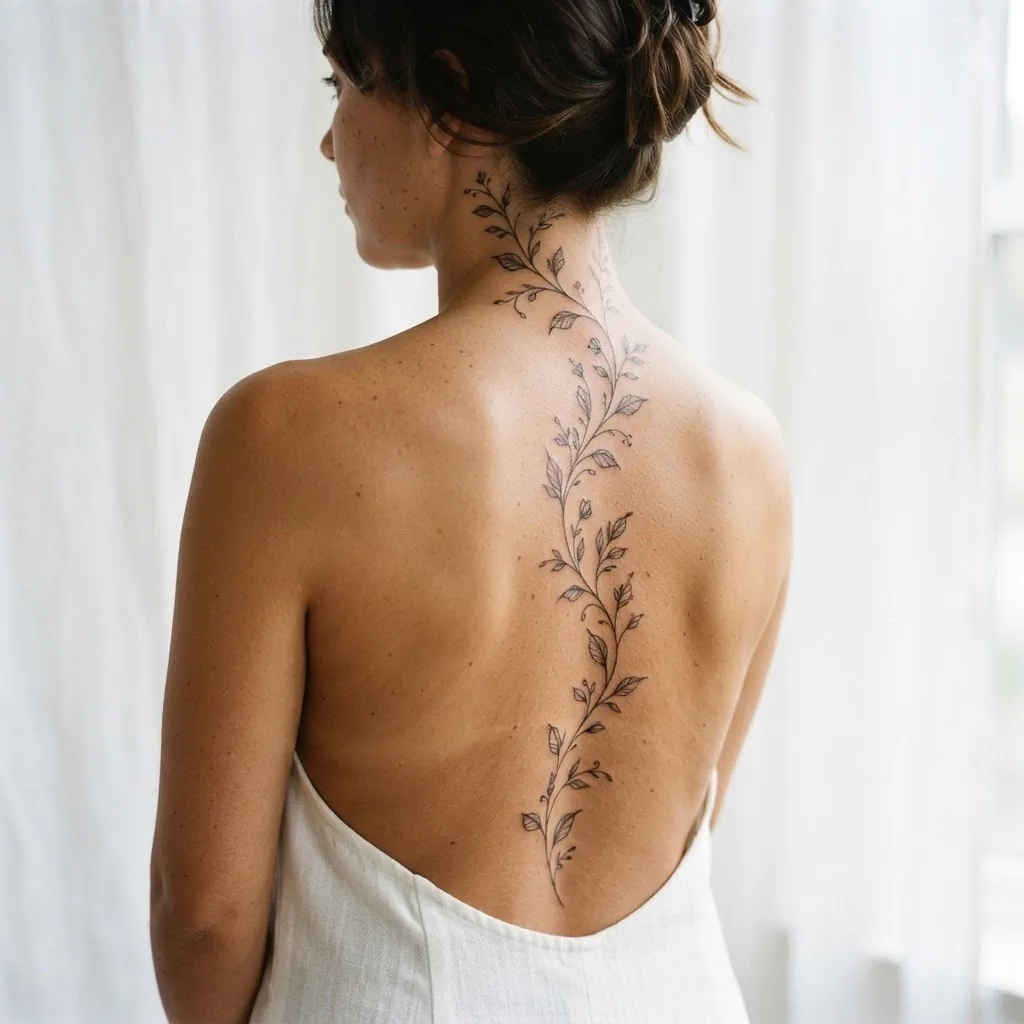
The first time I saw a spine tattoo in person, I was at a backyard party and someone turned around in a sundress. She had a single climbing botanical vine running the full length of her back, each tiny leaf placed with intention, and the whole thing disappeared into her hairline at the top. I remember thinking: that is one of the most considered pieces of body art I have ever seen. It looked like it had always been there.
Spine tattoos have that quality. When they are done well, by an artist who understands the placement and a person who understood exactly what they wanted, they feel inevitable. They feel like part of you. But getting there takes more than saving a Pinterest image. It takes understanding the design, the placement, the artist, and yourself well enough to walk into a studio with real conviction.
That is what this guide is for. Below I am sharing nine designs I think are genuinely worth considering, and then I am walking you through everything you need to know before you book: pain, sizing, how certain styles age, how to find the right artist, and how to prepare so the experience is everything you hoped it would be.
If you are dreaming, this is your next step.
The Nine Designs:
1. The Fine Line Botanical Vine
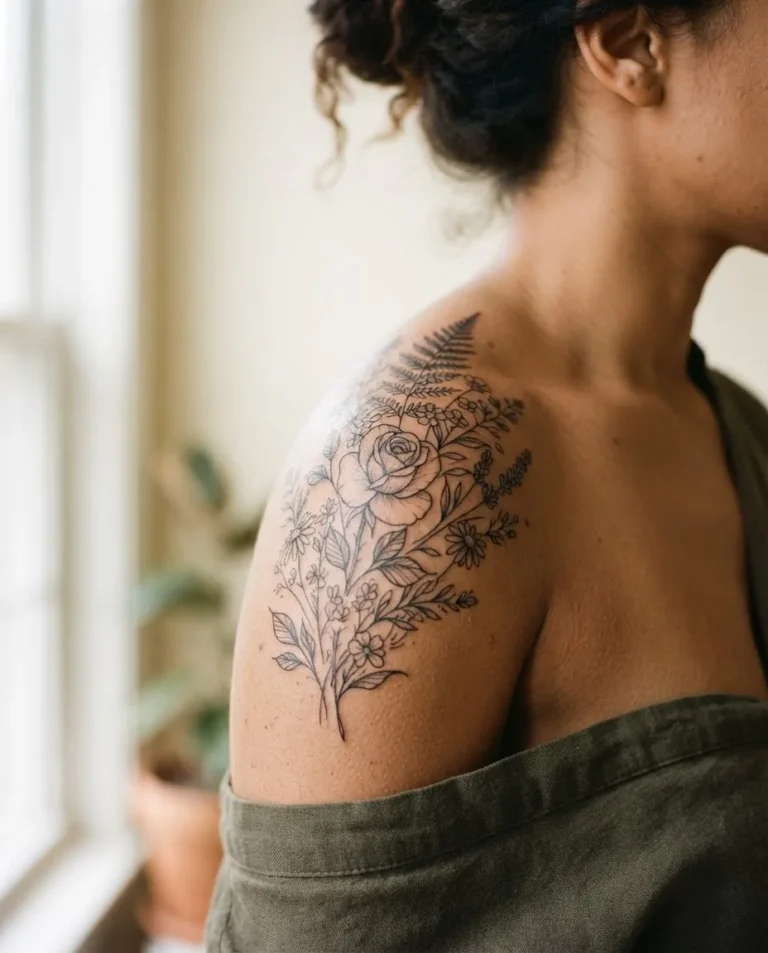
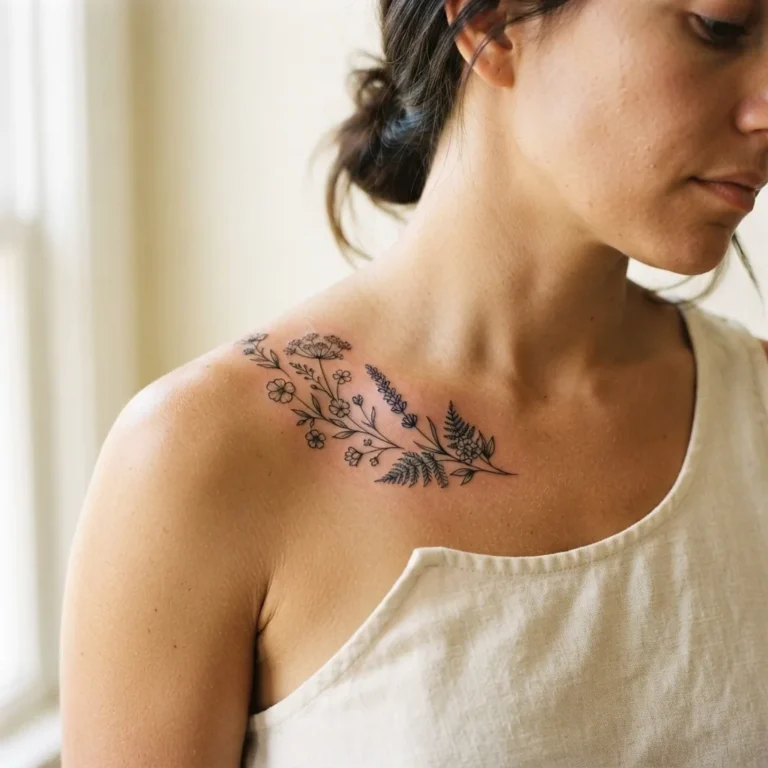
This is probably the design that started your Pinterest spiral, and for good reason. A fine line botanical vine, usually a climbing rose stem, eucalyptus branch, or trailing wildflowers, runs vertically along the spine and uses the natural column of the back as its canvas in a way that feels completely intentional. The line weight is extremely delicate, and at its best, it looks like a botanical illustration etched into skin.
The thing I always tell people who are drawn to this one is to look very carefully at the artist’s healed work, not fresh photos. Fine line tattoos require exceptional precision, and they also require an artist who understands how thin lines behave in skin over time. Because the spine is relatively sun-protected day-to-day (clothing covers it most of the time), this placement is actually kinder to fine line work than, say, a forearm or ankle. That said, fine line tattoos will soften and spread slightly over years, particularly if the initial lines were made too finely. A good artist will build in just enough weight to hold. As one detailed breakdown of how fine line tattoos age over time notes, placement and artist experience are the two biggest factors in how gracefully delicate work holds up.
When you bring this design to a consultation, bring at least five reference images, and be ready to talk about which specific plants or flowers feel meaningful to you.

A great artist will want to customize the arrangement rather than just copy a reference exactly.
2. Fine Line Floral Column
Similar in style to the vine but more structured, the floral column stacks individual blooms, such as peonies, dahlias, jasmine, or simple five-petal wildflowers, in a vertical arrangement with minimal connective linework. Each flower sits as its own moment along the spine, with small stems or leaves bridging the space between them. It is slightly bolder than the botanical vine because the blooms themselves take up more visual real estate, but it is still very much in the fine line family.
This design works especially well for people who have specific flowers that carry meaning. Peonies are often associated with prosperity, good fortune, and feminine strength in East Asian traditions. Dahlias have long symbolized commitment and elegance. If you have a birth flower or a flower tied to someone you love, a floral column is a beautiful, personal way to carry it.
3. Script and Lettering
A word, a phrase, a name, or a line of poetry running vertically down the spine is one of the oldest and most personal spine tattoo ideas. Script tattoos work because the spine already reads as a column, so lettering placed there feels architecturally correct. The most common scripts are elegant serif fonts and hand-lettered styles, often in Latin, English, or a language that carries personal significance.
One honest note here: script tattoos require a lot of trust in your artist’s lettering ability specifically. Not every talented tattoo artist is a lettering specialist. When you are researching for a script piece, look through portfolios specifically for healed lettering work. Crisp, clean letters that have held their form years later are a strong signal. Also be prepared for a meaningful conversation about font choice during your consultation. The artist may have suggestions about which styles will hold up better over time and remain legible as the tattoo settles into the skin.
4. Geometric and Ornamental
Geometric spine tattoos draw on a tradition of sacred geometry and symmetrical pattern-making. Think mandalas stretched vertically, interlocking triangles and diamonds forming a column, or ornamental dotwork arrangements that echo the kind of decorative motifs you see in architectural detail and textile design. These designs are often bold enough to hold strong contrast and can read beautifully from a distance.
Geometric work tends to age more predictably than fine line, since the lines are typically slightly heavier. If you are drawn to the geometric aesthetic but want it to feel organic rather than stark, ornamental dotwork is worth exploring. Dotwork creates shading and texture through individual dots rather than solid fill, giving the piece a softer quality while maintaining strong visual structure.
5. Minimalist Single Motif
Not every spine tattoo needs to span your entire back. A single minimalist motif placed precisely on the spine, perhaps a small moon, a simple arrow, a single feather, or a tiny lotus, can be just as intentional and just as stunning as a full-length piece. These smaller designs are often a wonderful entry point if you are getting your first or second tattoo, because they let you experience the placement without committing to a large project from the start.
The key with minimalist single motifs is placement specificity. The difference between a tattoo that looks intentional and one that looks like an afterthought is often just a few centimeters. Your artist should help you find the exact right spot on your spine for the proportions of the piece, because a tiny moon centered between your shoulder blades will read very differently than the same moon placed slightly off-center or too high or low.
6. Butterfly and Wings
The butterfly holds a deep and widely recognized symbolism: transformation, emergence, and the freedom that comes from becoming who you were always meant to be. On the spine, a single butterfly or a trail of them ascending the vertebral column creates a sense of movement, like something taking flight. This is one of the designs where I genuinely feel the placement and the meaning speak to each other.
Wing designs, whether butterfly, moth, bird, or abstract feather arrangements, also do something visually clever on the spine. They make use of the symmetry of the back in a way that no other placement can quite replicate. A single centrally-placed butterfly with wings extending outward uses the spine as the body of the design, the wings balanced perfectly on either side.
7. Snake or Serpent
The snake is one of the oldest motifs in tattoo art and it is having a genuine cultural moment right now. On the spine, a single sinuous serpent winding its way down the vertebral column is a design that virtually makes itself. The shape of the snake and the shape of the spine are natural partners. Artists who specialize in detailed fine line or blackwork can give a spine serpent incredible life: scaled texture, a raised-looking head at the top of the piece, a tail that tapers elegantly at the lumbar.
Symbolically, the serpent carries meanings that have varied dramatically across cultures and centuries. In many traditions it represents renewal and transformation (tied to the image of a snake shedding its skin), wisdom, and power. In others it carries associations with healing and medicine, which is why the caduceus and Rod of Asclepius are such enduring symbols in healthcare contexts. If symbolism matters to you in your tattoo, the serpent gives you a lot of rich territory to explore with your artist.
8. Celestial Column
Suns, moons, stars, planets, and celestial arrangements have been deeply popular in tattoo culture for years, and they translate beautifully to the spine as a vertical column design. A celestial spine tattoo might feature a crescent moon at the top, trailing into a constellation or starburst arrangement, with tiny planets or asterisks scattered along the length. The visual effect is dreamy and personal.
What I find compelling about celestial designs is how customizable they are to your actual relationship with the sky. Someone who feels deeply connected to her star sign might build the design around that constellation.
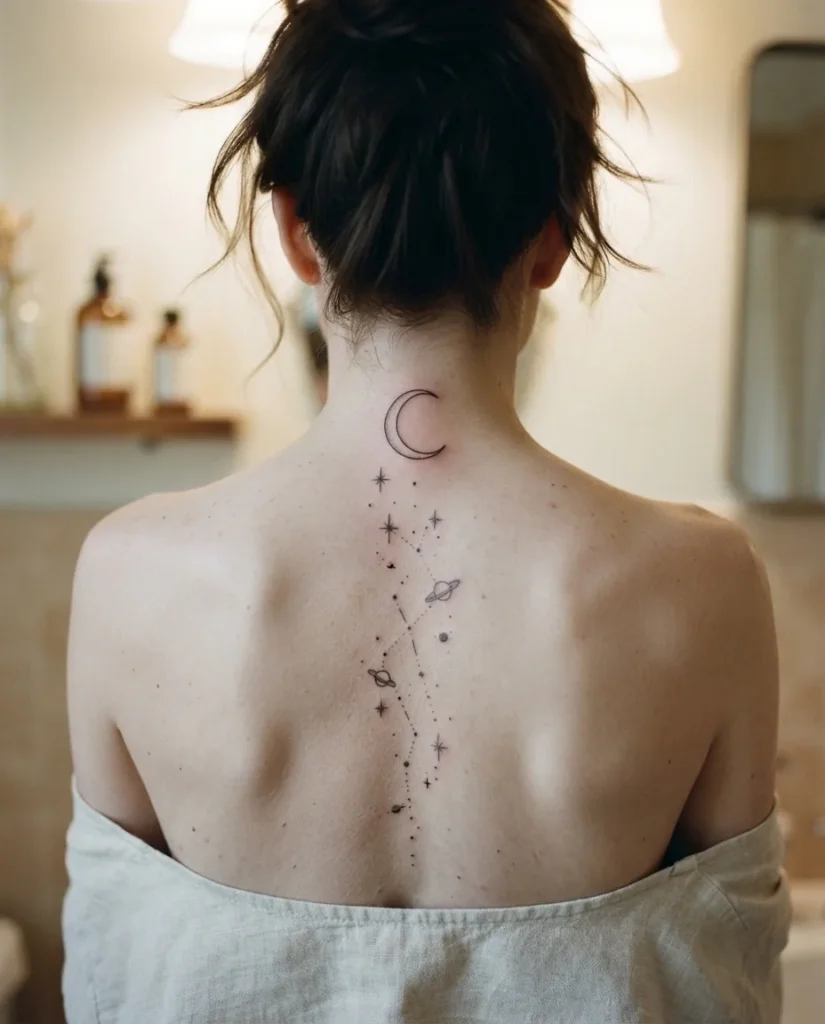
Someone who loves the idea of the moon’s phases might use the progression from new moon to full moon as the organizing principle of the piece. This is one of the designs where bringing your actual sources of meaning to the consultation will lead to a more personal result than any Pinterest image can provide.
9. Abstract Linework and Watercolor
For the person who finds traditional motifs too literal and wants something that reads more like abstract art, loose linework and watercolor-style spine tattoos offer a genuinely different kind of beauty. Abstract linework on the spine might look like flowing brushstroke-style lines that respond to the body’s contours rather than imposing a rigid shape. Watercolor-style tattoos use soft, diffused color and little to no outlines to create an effect that resembles paint on skin.
A few honest things to know about watercolor tattoos specifically: the absence of bold outlining means they tend to soften and fade more quickly than other styles, and they require an artist who has specifically mastered the technique. This is a style where portfolio research matters enormously. When you are looking at an artist’s portfolio, prioritize seeing healed watercolor work from pieces that are at least two to three years old. A fresh watercolor tattoo always looks luminous. A healed one tells you what the work will actually look like on your skin five years from now.
Planning Your Spine Tattoo: Everything You Need to Know Before You Book
Understanding the Placement: Upper, Mid, and Lower Spine
The spine is not a single placement. It is a range of placements along a vertical column, and each section has its own character.
The upper spine, running from the base of the neck down between the shoulder blades (the cervical and upper thoracic area), is typically where shorter designs or single motifs sit. It is one of the more visible sections when you wear lower-cut tops or have your hair up, which makes it a popular choice for smaller, intentional pieces.
The mid spine, running along the thoracic vertebrae, is the section most people picture when they imagine a full-length spine tattoo.
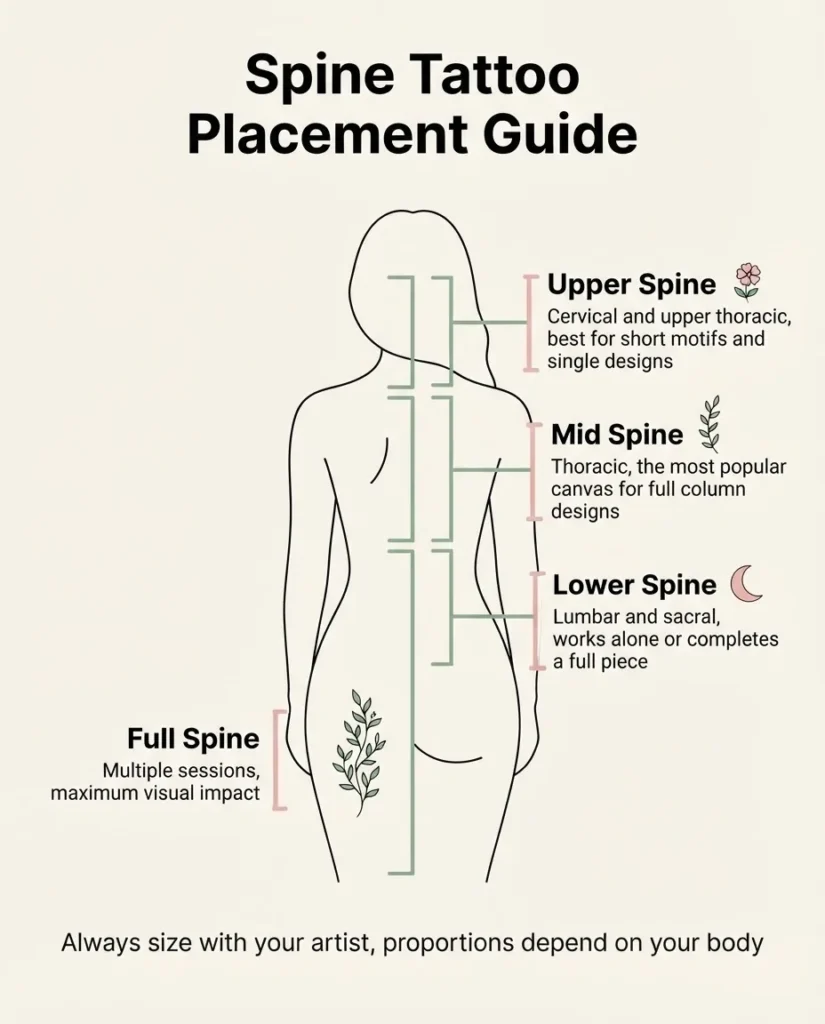
It is the longest continuous stretch of the back’s center line and the most common canvas for botanical vines, floral columns, script, and serpent designs.
The lower spine, along the lumbar vertebrae, connects to the tailbone area and can extend down toward the sacrum. This section is a bit of its own conversation because it follows naturally from mid-spine pieces and completes a full-length design, but it can also stand alone with smaller, delicate work.
Full-spine designs run the entire length from near the base of the neck to the tailbone, and they are among the most committed and visually dramatic pieces in the spine category. They often require multiple sessions.
Sizing: How Big Should Your Spine Tattoo Be?
Sizing a spine tattoo is a conversation your artist should lead, but it helps to arrive with a sense of your own instincts. Your height and the natural proportions of your back matter here. A full-length botanical vine that looks proportional on a 5’8″ frame may feel overwhelming on a 5’2″ one, or it may not extend long enough on a taller frame to feel complete. Many artists will trace the design on your back with a skin-safe marker or use transfer paper to show you the scale before any work begins.
A practical approach is to bring reference images and then ask your artist directly what they recommend given your body’s proportions. Their perspective on scale, after seeing your actual back, is worth more than any general guideline anyone online can give you.
Let’s Talk About Pain: The Honest Version
I will not pretend the spine is an easy placement. It is not. The skin along the spine sits directly over bone, which means there is less cushioning than on fleshier areas. You will feel the vibration of the machine differently here than you would on a thigh or an upper arm. Most people describe the sensation as sharp and buzzy, particularly over the vertebral prominences (the bony points you can feel running down your back).
That said, pain is not uniform along the entire spine. The mid-back (thoracic) section is generally considered more manageable than the upper spine near the neck or the lower spine near the tailbone, where nerve concentration is higher. Most people who have done it say it is entirely doable, especially for shorter sessions. It is uncomfortable. It is not unbearable. Going in knowing that and having a plan for breaks if needed makes a meaningful difference.
Eating a good meal before your appointment, staying well-hydrated, and communicating openly with your artist about how you are feeling during the session are the most practical tools at your disposal. Your artist will check in with you. If you need a moment, you take a moment.
The Question of How Styles Age on the Spine
How your tattoo looks in ten or fifteen years depends largely on two things: the style of the piece and how well you protect it from sun damage over its lifetime. The spine is actually in a relatively favorable position compared to high-friction placements like wrists, fingers, or feet, because it is usually covered by clothing. That is genuinely good news for longevity.
Fine line and watercolor work will soften over time regardless of placement. Lines spread slightly as the skin changes, and colors fade without solid outlining to anchor them. This is not a reason to avoid these styles. It is a reason to choose an artist who has mastered them and can build work with the right weight and depth to hold up, and to protect your healed tattoo with sunscreen whenever it is exposed. Blackwork and ornamental styles tend to age most predictably, because the ink saturation and line weight give them more structural resilience.
Understanding Ink and Skin: A Few Safety Considerations
Because this is a permanent modification to your skin, it deserves a few honest and accurate notes about what can happen.
The FDA, which oversees tattoo inks as cosmetics, has documented reports of infections from contaminated inks and allergic reactions to ink pigments. You can read their full consumer guidance at the FDA’s tattoo safety page. This is not meant to frighten you. It is meant to underscore why choosing a reputable, licensed studio matters so much.
When it comes to pigment reactions, some ink colors carry higher risk of allergic response than others. The American Academy of Dermatology has documented that red ink is among the most common triggers for allergic contact dermatitis and other skin reactions, and you can learn about the range of possible responses at the AAD’s page on unexpected tattoo skin reactions. If you have a history of skin sensitivities or known allergies, talking to a dermatologist before your appointment is a genuinely good idea, not an overreaction.
DermNet NZ, a trusted dermatology reference source, explains that the most common hypersensitivity reactions to tattoo pigments are allergic contact dermatitis and photoallergic dermatitis, meaning some reactions are triggered or worsened by sun exposure on a tattooed area. This is another reason why sunscreen on healed ink is not optional.
One additional consideration worth knowing: certain tattoo ink pigments contain metallic components. If you ever need an MRI, this can occasionally be a factor worth mentioning to your imaging team. Jefferson Health’s health library has a helpful, accessible explanation of how tattoos can sometimes interact with MRI scans. For most people with most tattoos, this is not a serious concern, but it is worth being informed about.
How to Find and Vet a Licensed Professional Artist
This is the part I feel most passionate about, because it is where the difference between a tattoo you love forever and one you regret is actually made.
Start with style specificity. A spine tattoo is a complex placement requiring an artist who understands how to work with the body’s contours and the vertical nature of the canvas. Do not just book with any talented artist. Look for someone whose portfolio includes healed spine work or healed back work in the specific style you want. If you want fine line botanicals, find a fine line botanical specialist. If you want blackwork geometric, find someone whose geometric portfolio is strong and varied.
Licensing matters and is non-negotiable. Tattoo artists in the US are licensed at the state and local level, and requirements vary by location. Your state’s department of health or department of licensing and regulation is the place to verify whether a studio and artist are in good standing. OSHA’s standards for bloodborne pathogens apply to tattoo studios, meaning licensed studios are obligated to follow sterilization and cross-contamination prevention protocols. You can review OSHA’s official interpretation of how the Bloodborne Pathogens Standard applies to tattoo establishments if you want to understand what a compliant studio is required to do. When you walk into a studio, you should see a clean, organized space. Single-use needles, ink poured into disposable caps, and gloved hands are baseline expectations, not extras.
In a consultation, ask the following: Can I see healed examples of this style? How do you approach sizing for a spine placement? What would you recommend given my reference images? What is your aftercare protocol? What should I do if I notice an unexpected reaction during healing? A good artist will answer all of these thoughtfully and may have additional questions for you in return.

What to Bring to Your Consultation
Bring your reference images (five to ten is ideal) organized by what you love about each one: the style, the specific motifs, the composition, the scale, or the mood. Bring any notes about meaning that feel important to you. If you have a specific placement in mind, describe it as clearly as you can and be open to your artist’s input on what will actually work with your anatomy.
Be honest about your pain tolerance, your budget, and your timeline. A full-length spine piece may require more than one session, and your artist needs to know upfront if you have constraints around time or budget so they can design something that works for both of you.
Aftercare: The Basics You Need to Know
Aftercare for a spine tattoo follows the same general principles as any other placement, with a few practical nuances. The back is difficult to reach on your own for cleaning and moisturizing during the first week or two of healing, so plan ahead. Having someone you trust available to help, especially in the first few days, makes a real difference.
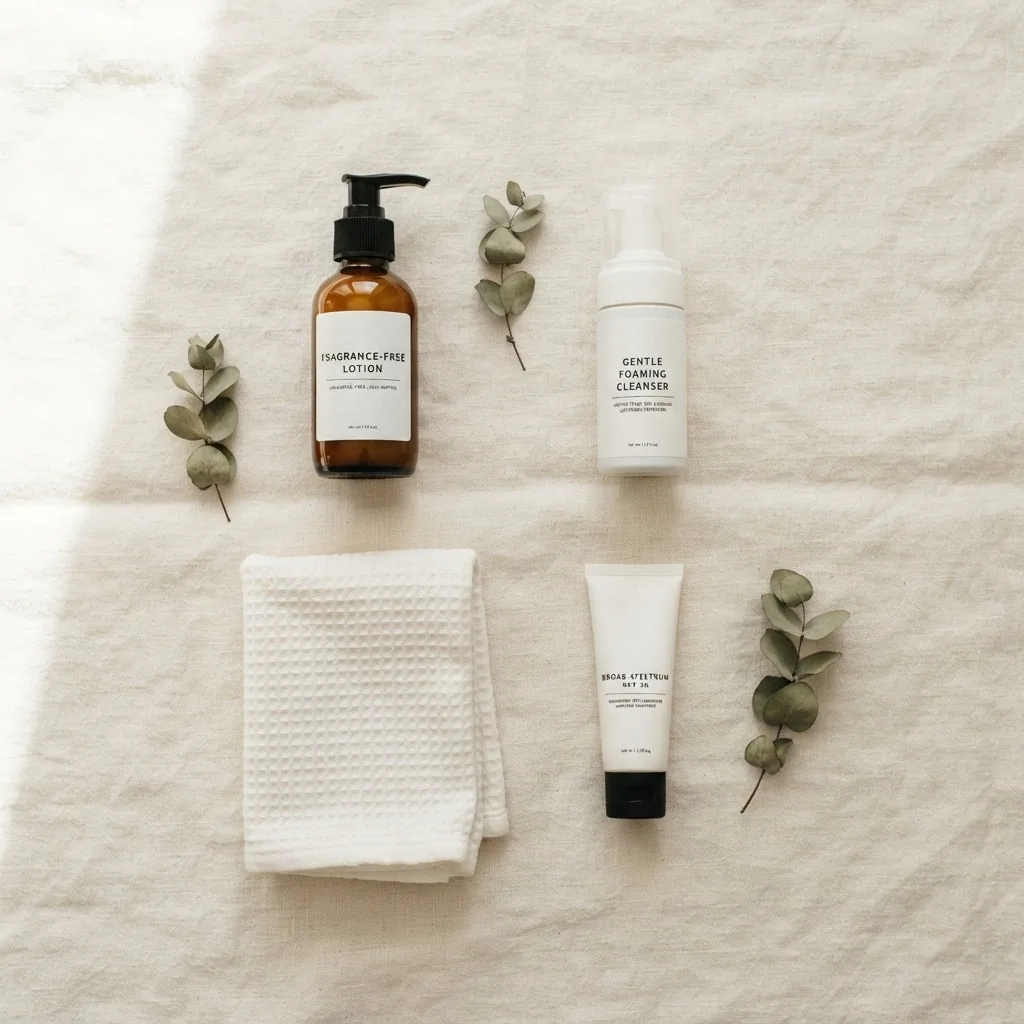
Your artist will give you specific aftercare instructions, and those instructions are your primary guide, always. General dermatologist consensus, as outlined by the American Academy of Dermatology on their tattoo aftercare page, includes keeping the area clean with gentle fragrance-free cleanser, moisturizing with an unscented lotion or artist-recommended product, avoiding submerging the tattoo in water (pools, baths, or open water) until it is fully healed, and protecting it from direct sun exposure.
Clothing choices matter during healing. Loose, soft, breathable fabrics are your best friends for the first few weeks. Tight waistbands, bra straps, and fitted clothing can rub the healing skin, which you want to avoid entirely. Many people find sleeping on their side or stomach easiest during the first few nights of healing to keep pressure off the tattoo.
Surface healing generally takes roughly two to four weeks.
Full dermal healing, meaning the deeper layers of skin fully accepting the ink, can take up to six months. Be patient with the process. If anything looks or feels genuinely wrong during healing, such as increasing redness, swelling, heat, or discharge that goes beyond normal tenderness, contact a doctor or dermatologist rather than waiting it out.
A Final Note Before You Book
Every single person who has a spine tattoo they love went through this same dreaming-and-planning phase you are in right now. They saved images, did research, felt a little nervous, found the right artist, asked good questions, and then they did it.
The planning is not an obstacle between you and your tattoo. It is how you make sure the tattoo you get is the one you will still be proud of in twenty years. Take your time. Find the artist whose healed work makes you feel something. Walk into that studio knowing exactly what you want and why.
That is how good tattoos happen.