What No One Tells You About Getting a Shoulder Tattoo
The shoulder is one of the most-pinned tattoo placements on the internet, and honestly, I get it. A well-placed shoulder tattoo does something that few other spots can: it moves with you, it reveals itself on your own terms, and it has this effortless quality, visible in a tank top, hidden under a blazer, completely up to you. Before my own shoulder piece, I spent weeks saving references and second-guessing every detail. The planning phase is real, and it matters.
What I almost never see in the galleries and listicles is the honest, practical layer underneath the beautiful images. How much does placement actually matter? Which styles hold up a decade from now? What do you actually say to the artist? What should you wear to the appointment? These are the questions my friends always text me, and they are the ones I want to answer here, right alongside the inspiration.
So let’s do both: fifteen design directions worth considering, plus the real context you need to walk into a studio confident, informed, and excited.
Why the Shoulder Is Such a Smart First (or Next) Placement
Before diving into specific styles, it helps to understand what makes the shoulder a genuinely great canvas. The outer deltoid area, which is the rounded cap of your shoulder, is one of the most forgiving spots on the body for a first tattoo. There is enough muscle and soft tissue there that most people describe the sensation as manageable, somewhere in the range of a persistent scratching or a mild burning sensation, rather than the sharper intensity you get near bone or thin skin.
That said, the word “shoulder” covers a bigger area than most people realize, and the experience changes depending on where exactly you land. According to the Healthline tattoo pain chart, the outer deltoid and upper arm consistently rate in the low-to-moderate range, while spots closer to the armpit, the inner arm, or the bony crest of the collarbone are noticeably more sensitive. The shoulder blade area, which is beautiful for certain flowing designs, involves working over a bone with relatively thin skin, so it tends to feel more intense than the fleshy outer cap.
This matters for planning because where you place your design is not just an aesthetic choice. It is also a comfort decision.
The four main shoulder zones to know:
- The shoulder cap (outer deltoid) is the classic spot: rounded, muscular, good for bold standalone pieces or the starting point of a sleeve. Generally lower pain, heals well, and suits a wide range of sizes from a small meaningful symbol all the way up to a large botanical wrap.
- The shoulder blade (scapula area) is stunning for larger flowing designs, florals, and symmetrical work. It can be trickier to sit still for because you need to either lean forward or have someone stabilize the area, and the sensation over the bone is more noticeable.
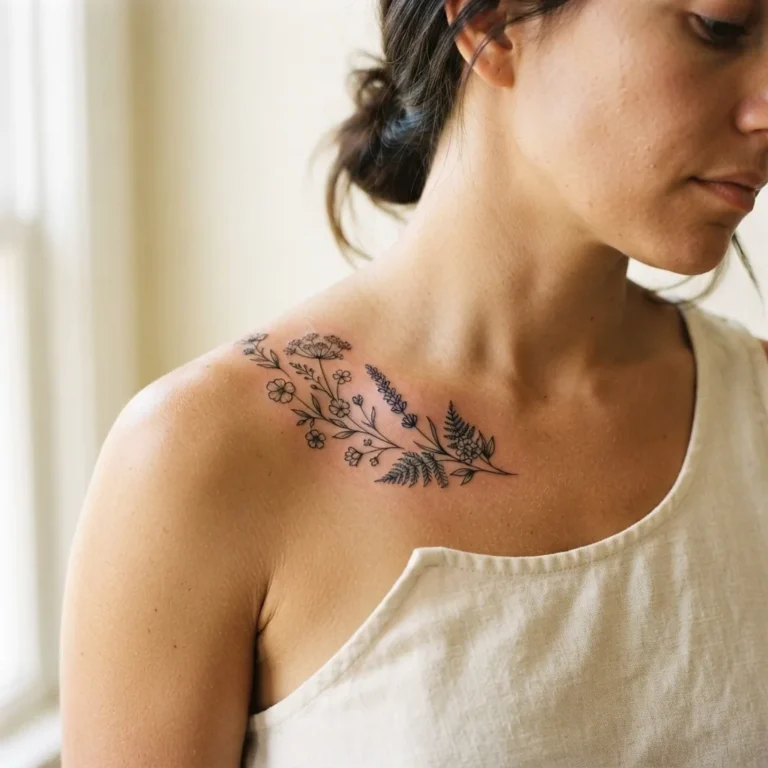
- The front deltoid and collarbone drape is increasingly popular for feminine floral and fine-line work. It photographs beautifully, but the closer you get to the actual collarbone, the more tender it becomes.
- The upper arm wrap, where a piece starts at the shoulder and flows down into the bicep, is the natural foundation for a half-sleeve. This gives you a lot of canvas and flexibility to build on later.
Understanding these zones before your consultation will help you have a much more specific conversation with your artist, and specific conversations produce better tattoos.

15 Shoulder Tattoo Styles Worth Considering
These are not ranked, because the “best” design is entirely personal. What I have tried to do is give you a real sense of what each style looks like, what it requires in terms of size and artist specialization, how it tends to age, and who it tends to suit. Think of this as a planning menu, not a ranking.
1. Fine-Line Florals
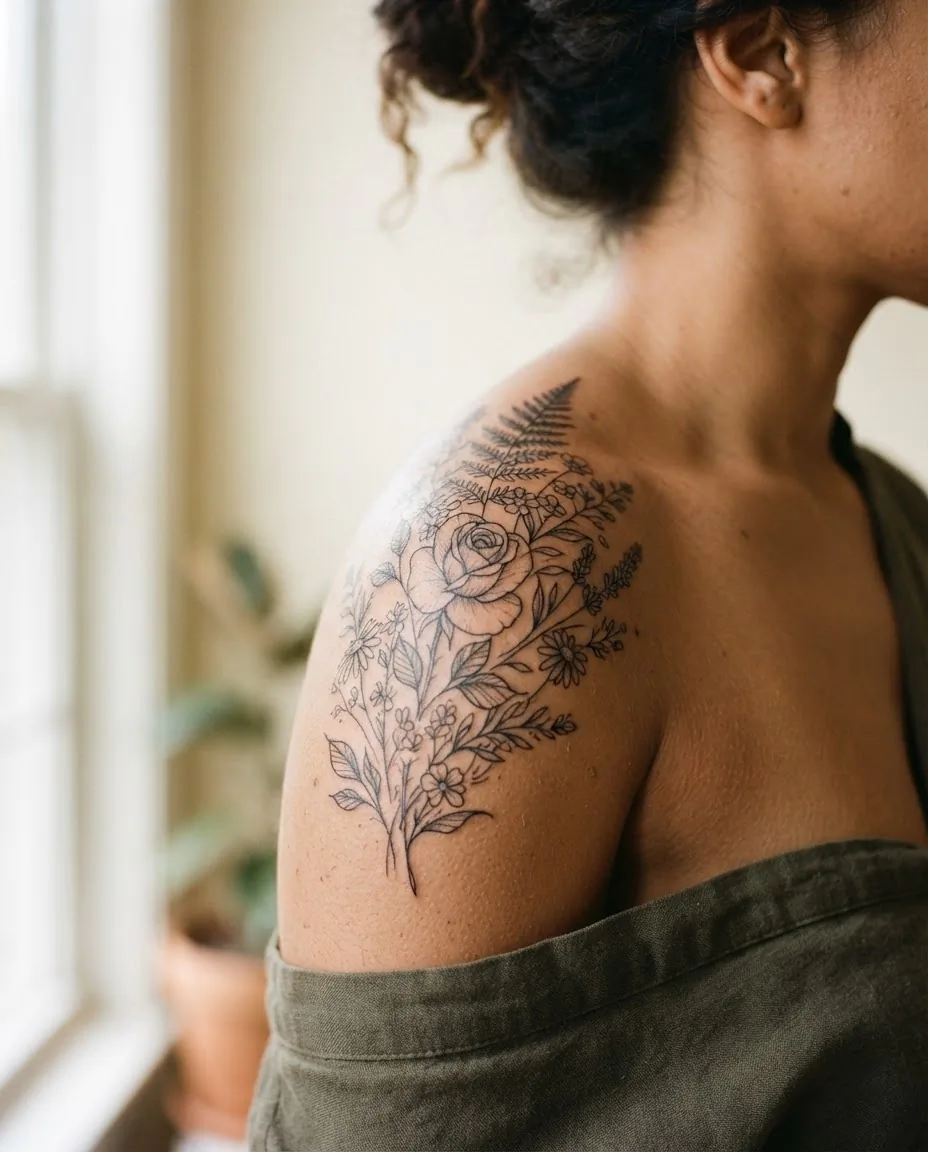
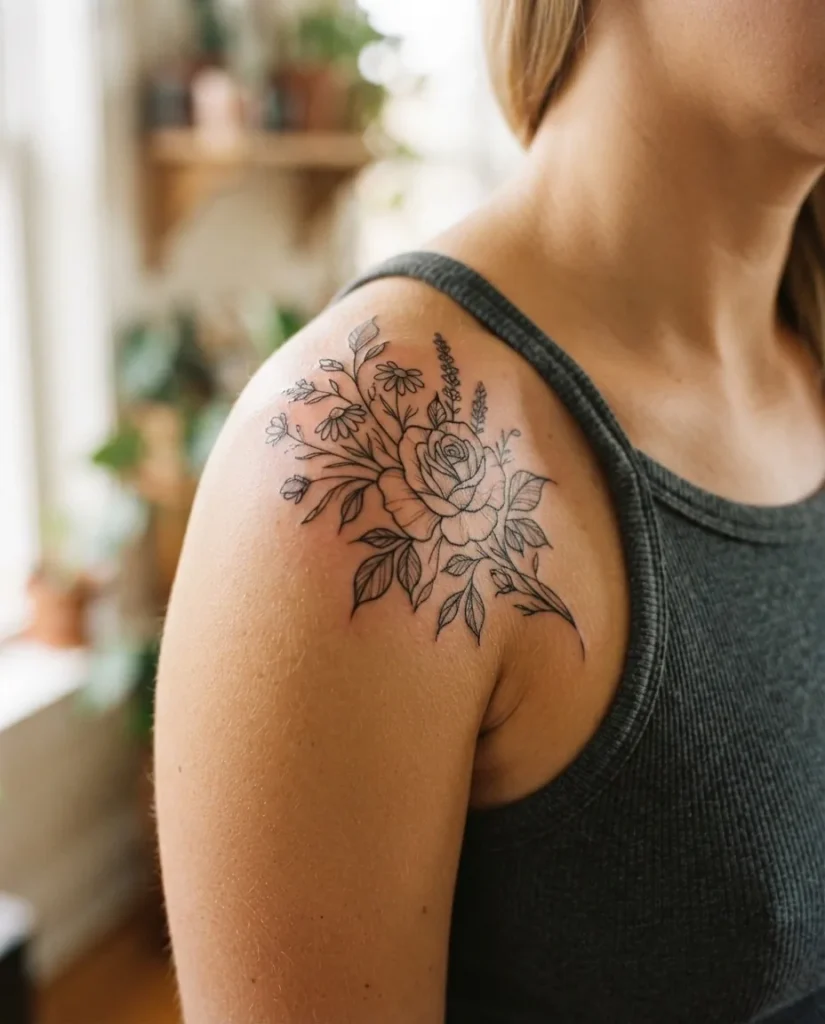
Delicate roses, peonies, wildflowers, or botanicals rendered in single, hair-thin lines are among the most requested shoulder designs right now, and for good reason. At their best, they are breathtaking. They suit the curve of the shoulder beautifully and can be sized anywhere from a small 2-inch sprig to a full shoulder cap wrap.
The honest note on fine-line work that I always share: it requires a highly skilled artist who specializes in the style, and it requires a real conversation about longevity. Fine lines, especially very thin ones, can spread or soften over time as the skin naturally changes. According to this detailed breakdown of how fine-line tattoos age, factors like placement, skin type, sun exposure, and artist technique all influence how well the lines hold over years. For a shoulder placement, which sees more sun than almost anywhere else on the body, sun protection after healing is genuinely important for preserving those crisp lines.
Ask your artist specifically to show you healed examples of their fine-line work, not just fresh-ink photos. Fresh tattoos always look sharp. The healed photos tell you the real story.
2. Minimalist Single-Line or Silhouette Designs
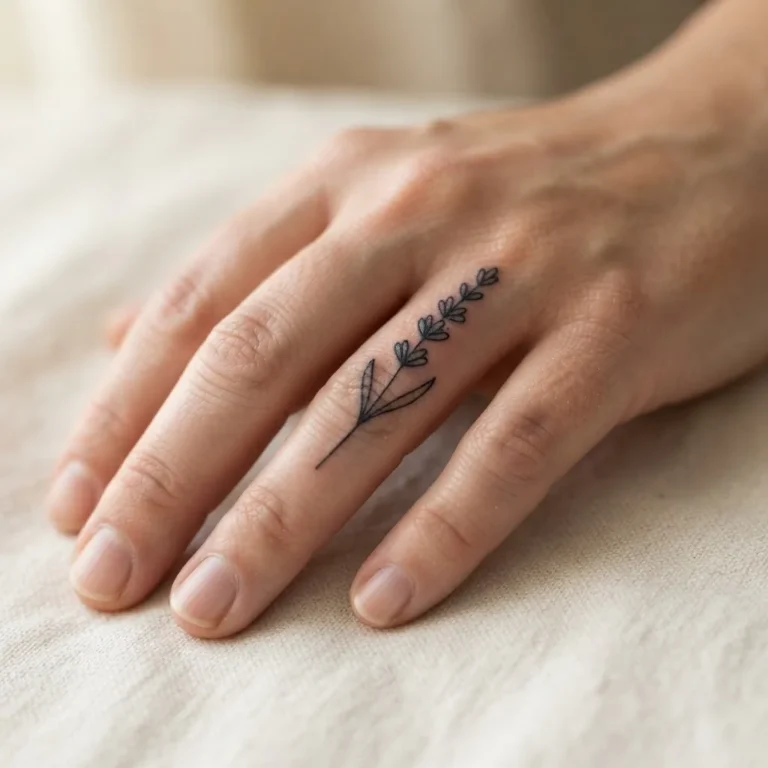
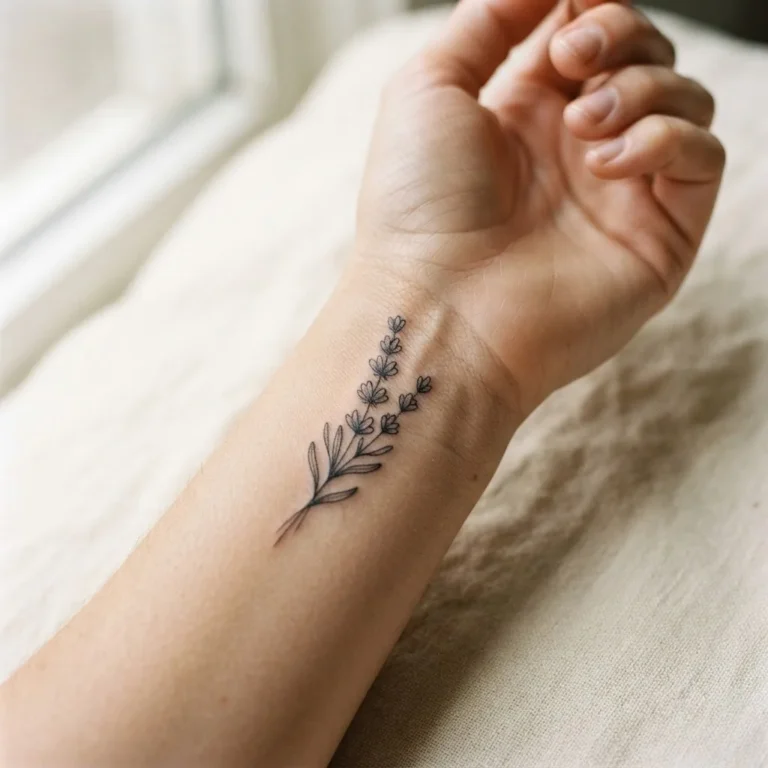
A mountain range, a single wave, a bird in flight, a simple geometric shape. These small-but-significant pieces suit people who want something meaningful without visual weight. They work beautifully on the outer cap or the collarbone drape area. The key to making a small minimalist piece work is precision: the simpler the design, the less room there is for inconsistency. This makes artist selection especially important. Look for an artist whose portfolio shows clean, confident linework on simple pieces, because simplicity is much harder to execute well than complexity.
3. Bold Black Botanical Wraps
Where fine-line goes delicate, bold black botanical work goes lush and graphic. Think large magnolias, orchids, or tropical leaves in confident solid black or black-and-grey, wrapping across the shoulder cap or flowing from the shoulder toward the upper chest or down the upper arm. This style ages exceptionally well. The bolder the line, the more gracefully it holds its shape over decades. If you love the botanical aesthetic but want something that will look strong and intentional thirty years from now, bold black work is worth serious consideration.
4. Geometric and Sacred Geometry
Mandalas, geometric florals, and sacred geometry patterns sit beautifully centered on the shoulder cap or shoulder blade. These designs benefit from the shoulder’s roundness, which mirrors the circular shapes naturally. They tend to be medium-to-large in size to accommodate the complexity of the linework. Be realistic about sizing here: a geometric mandala that is too small will lose its intricate detail and look muddy as lines are crowded together. Your artist can help you find the minimum size that keeps the design reading clearly.
5. Blackwork and Neo-Traditional
Bold, graphic, and deeply intentional, blackwork pieces including heavy outlines, solid fills, and dramatic contrast translate powerfully to the shoulder. Neo-traditional work adds color and slightly stylized, illustrative elements to traditional bold linework. Both styles age with remarkable dignity, and both suit people who want a tattoo that reads as a statement. The shoulder cap is a natural home for a strong standalone image: a portrait, an animal, a symbolic object.
6. Japanese-Influenced Designs
Koi fish, chrysanthemums, cranes, waves, dragons, and tigers all find a natural home on the shoulder in the Japanese Irezumi tradition. These designs often extend down the arm and are built to flow with the body’s movement and anatomy. A skilled Japanese-style artist will think about how the design wraps and moves as you lift your arm or turn your body. This is genuinely important for placement decisions, and a consultation with an artist who knows this style well is essential.
7. Watercolor Style
Soft, painterly, pigment-wash effects without visible outlines create a dreamy quality that photographs stunningly. The honest thing I always tell friends: watercolor tattoos, especially those without dark outlines to anchor the design, can fade and diffuse more quickly than outlined work. This does not mean avoid them. It means go in with accurate expectations, choose an artist who is genuinely experienced with the style, and understand that touch-ups may be part of the long-term story.
8. Meaningful Micro-Tattoos
A small compass, a single word, a date in Roman numerals, a tiny symbol with significant personal meaning. These sit beautifully at the top of the shoulder or nestled near the collarbone. They are a popular choice for a first tattoo because they feel manageable and low-stakes, but please do not rush the design just because it is small. Permanence is permanence regardless of size, and a thoughtfully chosen small piece will bring you more joy than a rushed one every single time.
9. Fine-Line Portrait or Figure Work
A face, a figure in motion, or a figurative scene rendered in delicate grey-wash and fine lines is a more advanced and specialized style. Artist selection here is critical. Portrait work specifically requires an artist who has a deep portfolio of portrait pieces, ideally healed ones. The shoulder provides enough canvas for a well-proportioned portrait, but the quality ceiling on this style is almost entirely determined by the artist’s skill. Do not choose an artist for this style based on their floral work. Make sure the portraits are there in their portfolio.
10. Celestial and Astrology Designs
Moon phases, constellations, planets, and sun motifs work beautifully on the shoulder, particularly wrapping from the shoulder cap toward the collarbone or down the upper arm. These designs have been extremely popular for several years and remain so because they carry personal meaning easily. A constellation of your birth chart, a moon phase that corresponds to a significant date, or a solar system arrangement that means something to you gives a celestial design staying power beyond the trend.
11. Animal and Creature Work
Birds in flight, butterflies mid-spread, foxes, wolves, and big cats all translate powerfully to the shoulder. The placement allows for natural movement in the imagery, a bird whose wings align with your shoulder’s curve, a fox whose pose mirrors the angle of your collarbone drape. Talk to your artist about how to orient the animal relative to your body’s anatomy. An artist who thinks carefully about this will always produce a more satisfying result than one who simply centers the image without considering how it lives on the body.
12. Floral Sleeve Starters
If a full sleeve is a distant dream but you want to start building toward one, a shoulder cap floral piece is one of the smartest starting points. It establishes the upper anchor of what could eventually flow down into the elbow, forearm, and wrist. Even if you never add more, a strong shoulder piece reads as intentional and complete on its own. Ask your artist to design it with future expansion in mind if that possibility interests you.
13. Text and Script
A meaningful phrase, a name, a lyric, or a single word in beautiful lettering. Script on the shoulder tends to work best when it follows the natural curve of the shoulder cap or flows along the collarbone. Straight-line text on a curved surface can look off when the arm moves, so discuss orientation carefully with your artist. Also consider font size honestly: very small script tattoos can become difficult to read clearly over time, so your artist can guide you toward a size that will stay legible.
14. Cultural and Heritage Motifs
Polynesian, Celtic, Indigenous-inspired, or other cultural pattern work. If a cultural design carries genuine personal heritage or meaning for you, it can be extraordinarily powerful on the shoulder. If it does not, I would encourage you to think carefully about whether it is the right choice and to research the cultural context before committing. Your artist, particularly one who specializes in or shares that heritage, can be a valuable guide in that conversation.
15. Abstract and Brushstroke Work
Bold, expressive, non-representational designs in black-and-grey or color are a growing niche in tattooing, and the shoulder gives this work enough canvas to breathe. Abstract tattoos are highly personal because they do not “mean” something that can be looked up. They mean what they mean to you. If you are drawn to this style, look for an artist who specializes in it and review their specific body of abstract work, because this is one of the most artist-dependent styles on this list.
The Honest Conversation About Aging and Longevity
One of the things I wish someone had told me early on is that all tattoos change over time, and that is not a failure. It is just the nature of permanent ink in living skin. The shoulder, which gets more sun exposure than most spots on the body, is a placement where this matters more than average.
In general terms, bolder lines and higher-contrast work will hold their visual integrity longer than ultra-fine lines or very light pigments. That does not mean fine-line work is a mistake. It means you go in knowing what you are choosing. Many people find that a fine-line tattoo at five or ten years still looks beautiful, just softer and more organic than it did the day it was done. Others want to touch up. Both are valid.
What helps on the shoulder specifically is consistent sun protection after your tattoo has fully healed.

Most artists recommend a broad-spectrum SPF 30 or higher on any healed tattoo exposed to sunlight. This is not a vanity tip. UV exposure breaks down pigment over time, and the shoulder is simply one of the most UV-exposed spots on the human body. Once your tattoo is fully healed (typically at least a few months out), making sunscreen part of your routine genuinely makes a difference.
What to Know About Safety Before You Book
This is the section I care about most, because a good tattoo starts with a safe experience.
Tattooing introduces pigment into the skin, which means there is real potential for reactions if the right precautions are not taken. The FDA’s consumer guidance on tattoo safety notes that reactions from contaminated inks and allergic responses to pigments have both been documented. The FDA has not approved any pigments specifically for injection into the skin, which makes choosing a studio with rigorous hygiene standards all the more important, because the safety net is primarily in the professional standards of the artist and studio, not in regulatory pre-approval of the ink.
Reactions can range from temporary redness and swelling, which is normal in the first days, to more persistent itching, raised bumps, blisters, or skin changes that can appear weeks or even years after getting tattooed. The American Academy of Dermatology’s guide to tattoo skin reactions is genuinely worth reading before you book. It covers seven types of reactions, what they look like, and when to see a doctor. If anything in your healing process worries you, please contact the tattoo studio, your primary care physician, or a board-certified dermatologist. Do not wait and hope it resolves.
A 2024 peer-reviewed study published in PubMed Central and covering cutaneous adverse reactions associated with tattooing found a broad range of potential responses including allergic reactions, infections, and autoimmune-related changes, reinforcing what the AAD and FDA both emphasize: working with a licensed, hygiene-certified professional is not a nice-to-have. It is the single most important safety decision you make.
What to look for in a licensed studio:
Your artist should be licensed by their state or local health authority. Studio licensing requirements vary by state, but you should be able to see licenses displayed, ask directly about bloodborne pathogen certification, and observe that the studio looks and feels genuinely clean. The CDC/NIOSH has published specific safety and health guidance for tattooists and piercers covering bloodborne pathogen exposure reduction practices. A professional artist will welcome these questions, not bristle at them.
Single-use needles and cartridges should always be opened in front of you. Surfaces should be covered or cleaned between clients. If anything feels off during a studio visit, trust that feeling.
How to Find and Choose the Right Artist for Your Shoulder Piece
This is where I see the most anxiety, and the most rushed decisions. People spend weeks choosing a design and then book the first available artist who does that general style. Please give artist selection the same time and care you give design selection.
Start by searching Instagram and Google for artists in your area whose portfolios include the specific style you want. Not “tattoo artists near me.” Not “florals near me.” The actual style, with healed examples if at all possible. Fresh tattoos always look sharp. Healed photographs are where you see the real quality.
When you find someone whose work genuinely excites you, look at their portfolio with these questions in mind: Are their lines consistent across different pieces? Do their healed photos match the quality of their fresh-ink photos? Have they tattooed that style on different skin tones and body types? Are the designs they produce original, or do they seem to copy references directly?
Once you have a shortlist, reach out for a consultation. Most reputable artists offer these, sometimes for a small fee that is applied toward your deposit. Use the consultation to share your vision, ask questions, and genuinely gauge whether this person listens and understands what you want.
Questions worth asking in your consultation:
- Can I see examples of your work healed, specifically in this style?
- Do you have experience with this placement? What would you recommend in terms of orientation and sizing?
- How long do you estimate this piece will take?
- What is your healing and aftercare advice?
- What does your booking and deposit process look like?
A good artist will answer every one of these without any hesitation. They will probably also ask you thoughtful questions in return. That back-and-forth is exactly what you want.

Building Your Reference File: What to Bring to the Consultation
One of the things my friends hear from me most often is: bring more references than you think you need, and explain what you love about each one. A single image can be interpreted dozens of ways. The more context you give your artist about what specifically draws you to a reference, the more accurately they can translate your vision into a design.
Collect images that show the style you want, the placement you are considering, the level of detail you find appealing, and any specific elements (flowers, symbols, motifs) that matter to you. Then, for each image, be ready to say something like “I love the way the linework is delicate here” or “I like the overall feel but I want mine to be softer” or “this placement is exactly what I’m imagining.” That specific context is a gift to your artist.
You do not need to bring a finished concept. Your artist is the one who draws it. You are bringing them the ingredients.
What to Expect the Day Of (and the Days After)
Before your appointment: Eat a real meal a few hours beforehand. Hydrate well. Wear or bring clothing that gives your artist comfortable, unrestricted access to the shoulder area. For an outer cap piece, a tank top or strapless top works well. For a shoulder blade piece, a front-fastening top or one you can slip off the shoulder easily is ideal. Wear something you do not mind potentially getting a small amount of ink on.
During: Most shoulder sessions are entirely manageable. The outer cap is one of the more comfortable spots. If you need a break, ask for one. Any professional artist will accommodate that without judgment.
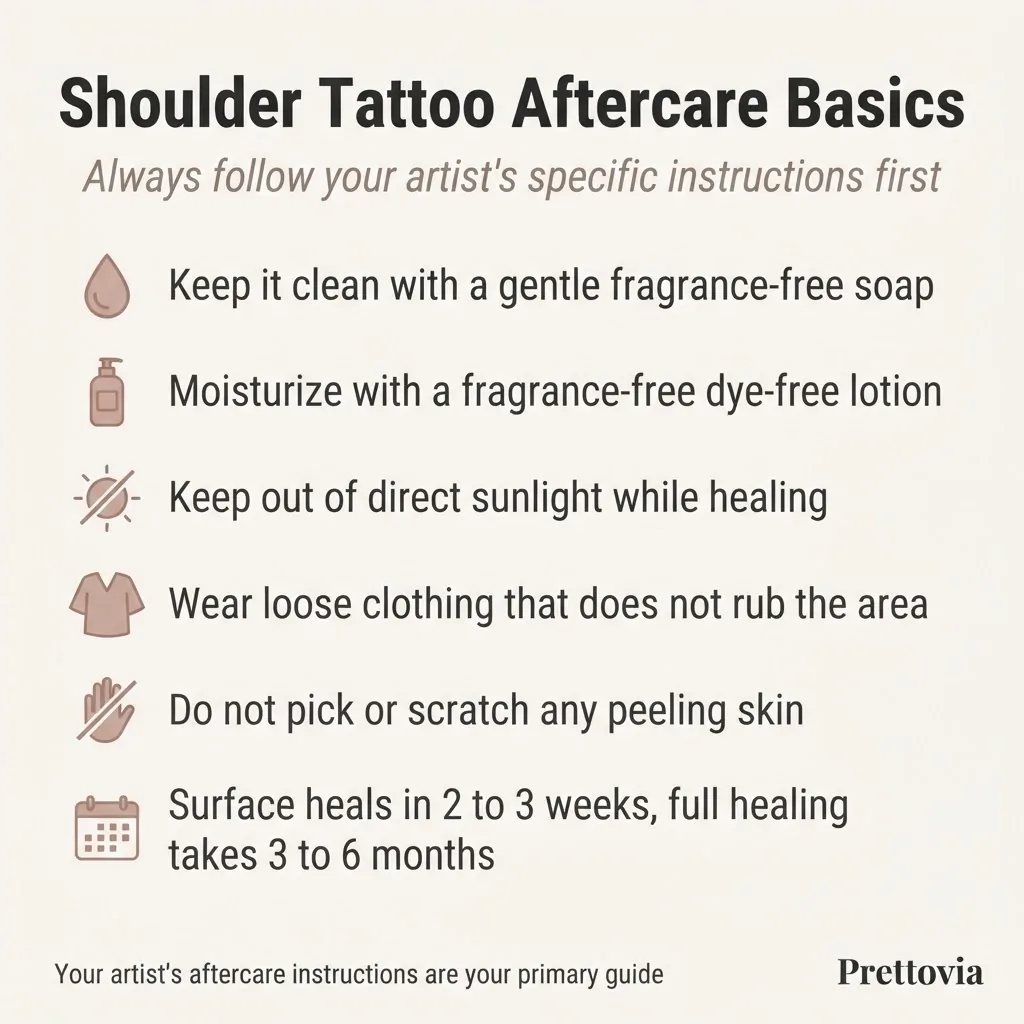
After: Your artist will give you specific aftercare instructions, and those instructions should be your primary guide. What dermatologists and artists generally agree on is that keeping a new tattoo clean, moisturized appropriately, and protected from sun and friction during healing is the foundation of good healing. Avoid submerging the tattoo in water, keep it out of direct sun, and resist the very human urge to pick at any peeling or scabbing. The shoulder in particular may rub against clothing and bra straps during healing, so loose-fitting tops or clothing that does not cross directly over the tattooed area will be your friend for those first two weeks.
Initial surface healing typically takes around two to three weeks. Full healing through all skin layers takes considerably longer, often three to six months. Be patient with it.
On the Permanence (and the Beautiful Weight of That)
Something I have thought a lot about over the years of collecting my own pieces and helping friends through theirs is that the permanence of a tattoo is not a problem to work around. It is actually what makes the decision meaningful.
A tattoo being forever is the reason the planning phase matters. It is the reason you take time to find the right artist. It is the reason you sit with a design for weeks or months before committing. The fact that it stays with you is not a red flag. It is the whole point.
Most regret, in my experience and everything I have observed, does not come from people who thought too carefully. It comes from people who rushed because they did not know what to think about. You are reading this, which means you are already doing it right. Take the time. Find the artist who genuinely excites you. Choose something that carries meaning beyond the trend cycle. And when you do walk into that studio, walk in knowing you are prepared.
The shoulder is a beautiful place to start, or to continue. I hope something on this list sparks exactly the clarity you were looking for.