Your First Ankle Tattoo: Designs, Pain, and What to Expect
I still remember the conversation that almost talked me out of my second tattoo. A well-meaning friend leaned over my shoulder while I was scrolling through ankle tattoo inspiration and said, “Those look so cute, but don’t they hurt like crazy? And don’t fine-line ones just blur into nothing?” I closed my phone, second-guessed myself for a solid week, and then did what I always do: I got informed, got excited, and booked my consultation.
If you are sitting with a Pinterest board full of delicate florals, dainty script, or beautiful wrap-around anklets and you are wondering whether this is actually a good idea, I want to give you the honest, warm rundown I wish someone had handed me. Ankle tattoos are genuinely one of the most versatile, wearable, and meaningful placements you can choose. They are also one that rewards a little extra research before you book. Here is everything you need to know to move from “I love these” to “I am ready.”
Why the Ankle Works So Well
The ankle is one of those placements that appeals to almost every type of person who gets tattooed. If you want something visible, you can show it off with sandals or rolled jeans any time you want. If you want something private, a long sock covers it completely and most professional environments will never see it. It sits on a part of the body that does not change dramatically with weight fluctuations, which makes it a more stable canvas than, say, the stomach or upper arm in terms of how the design holds its shape over time.
It is also a placement with real versatility in scale. A tiny single-line lavender sprig on the inner ankle reads completely differently from a bold botanical wrap that curves from the outer ankle over the Achilles. Both are ankle tattoos. Both can be beautiful. The difference is in how you choose to use the canvas, and that is exactly what we are going to talk through.
15 Ankle Tattoo Design Ideas Worth Considering
I organized these by style family rather than just listing them one by one, because understanding the style helps you have a much more productive conversation with your artist than showing up with a single image and hoping for the best.
Fine-Line and Minimalist Designs
Fine-line is probably the style I get asked about most for ankle placement, and for good reason.
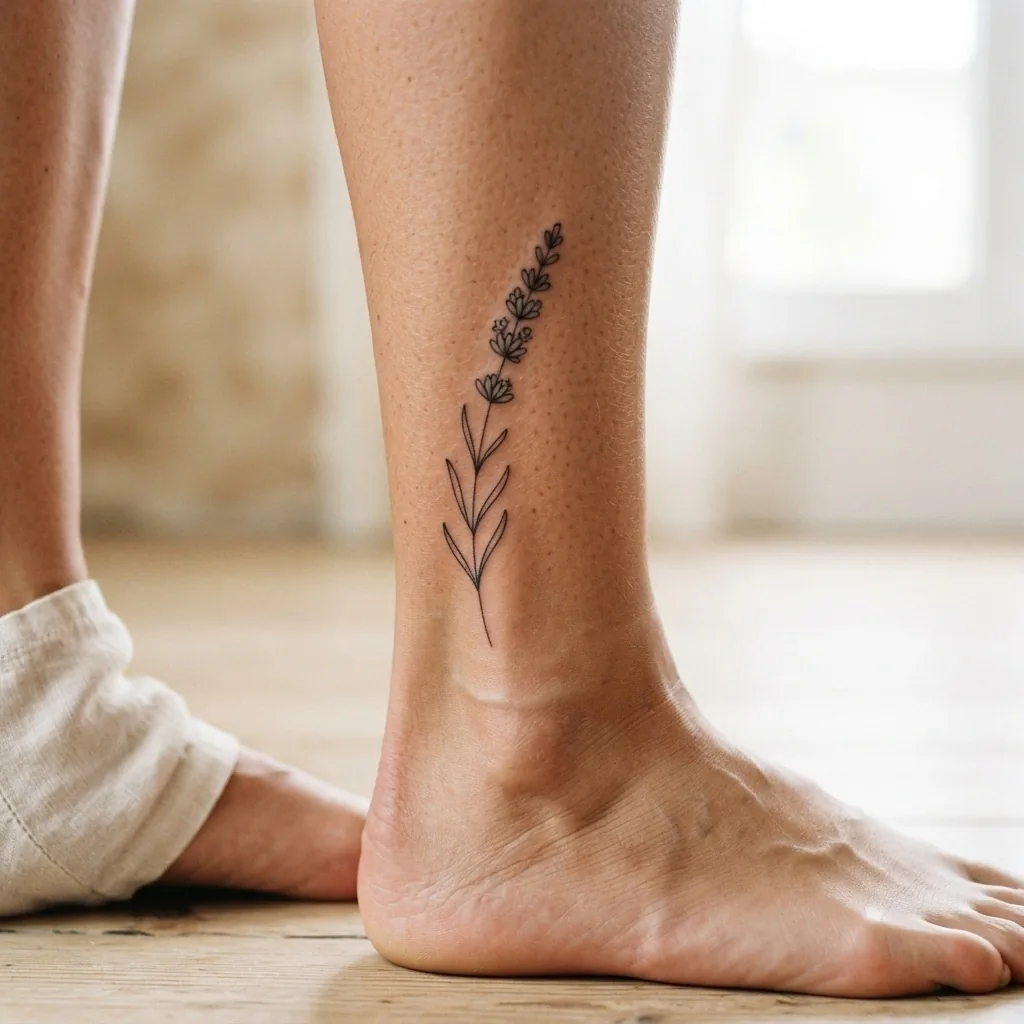
The delicacy of thin-line work looks stunning at the ankle, especially with sandals. Within this family, some of my favorite design directions include:
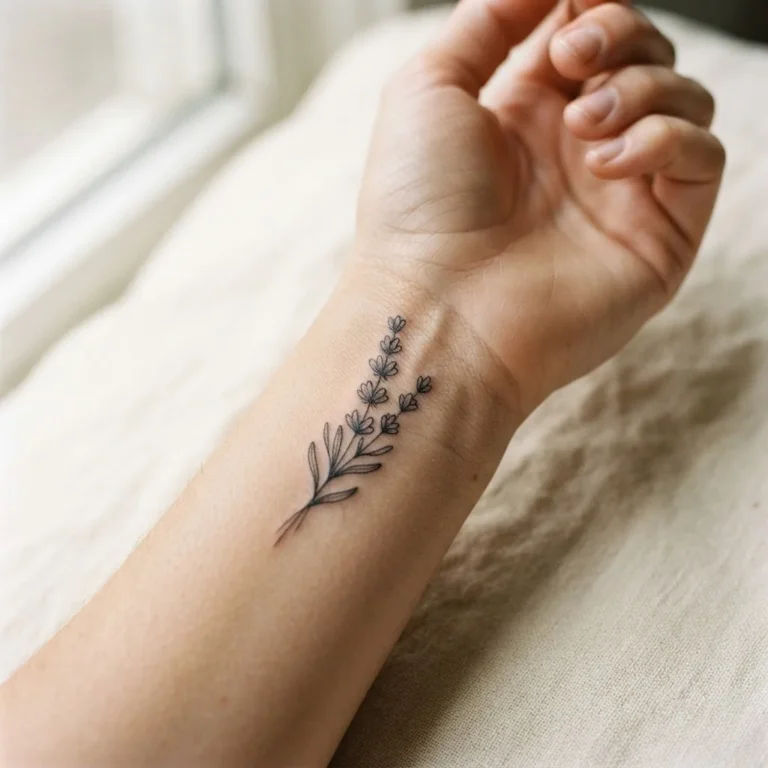
1. Single-stem botanical. One sprig of lavender, a thin-line rosemary branch, or a simple fern frond placed vertically on the inner or outer ankle. The upright shape fits the narrow canvas naturally and photographs beautifully.
2. Micro floral cluster. A small grouping of two or three different blooms, maybe a rose bud, a daisy, and a tiny leaf or two, arranged loosely rather than stiffly. This style gives artists room to create something that looks organic rather than stamped on.
3. Fine-line crescent moon. A simple, clean crescent, sometimes with a single star or tiny celestial detail. Timeless, personal, and a design that communicates meaning without being literal about it.
4. Single-word or short-phrase script. A meaningful word or date in a clean, readable font placed horizontally along the ankle or slightly curved. If you go this route, talk to your artist about font weight. Very fine script can lose legibility over time, and a slightly bolder choice reads more cleanly for years.
5. Geometric linework. A single clean shape, a triangle, a circle, a delicate diamond, or an abstract arrangement of geometric lines. These work well over or just below the ankle bone where you want something graphic and precise.
Botanical and Floral Designs
Florals are the most requested category in ankle tattoos by a wide margin, and with good reason. Flowers carry centuries of symbolic meaning, and the right bloom can communicate something deeply personal without you having to explain it to everyone who notices the tattoo. If you are exploring flower symbolism and want to dig into what different blooms traditionally represent, Inked Magazine’s A-Z flower tattoo symbolism guide is genuinely one of the best reference resources I have found for this.
6. Rose, classic or fine-line. The rose is a design that works in almost every style and never truly goes out of fashion. A traditional bold rose holds up differently over time than a fine-line version, and knowing which you want before your consultation helps your artist plan the right approach.
7. Lotus flower. The lotus carries rich symbolism around rebirth, spiritual growth, and beauty rising from difficult circumstances. It translates beautifully to ankle placement, particularly as a slightly larger piece that sits centered below or just above the ankle bone.
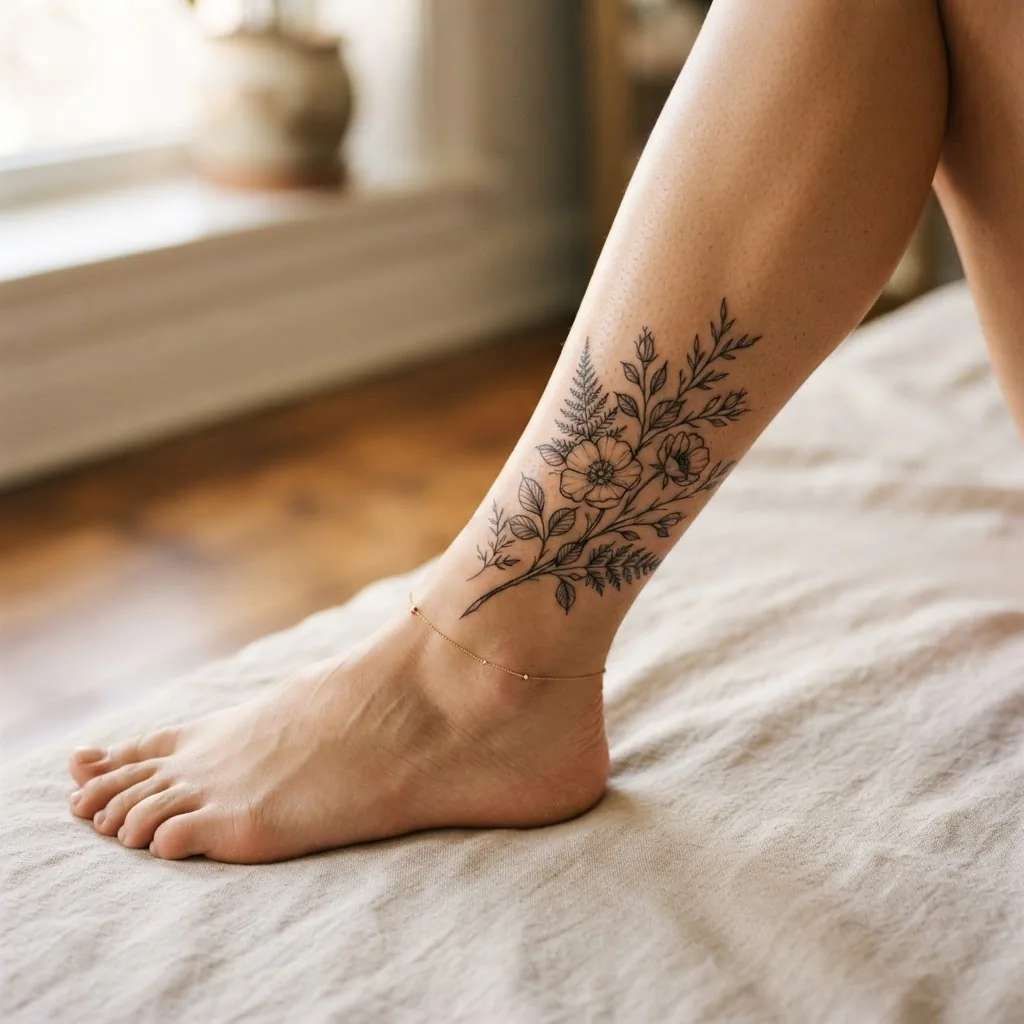
8. Wildflower mix. A casual, organic arrangement of small wildflowers, daisies, poppies, tiny blossoms, arranged in a loose arc or trailing down from the outer ankle. This style tends to look intentionally effortless and suits people who want something that feels like a personal garden.
9. Single-stem tulip or peony. If you want one statement flower rather than a cluster, a tulip or peony in fine-line or light shading can be genuinely stunning. Peonies in particular offer enough internal detail to look rich even at a small size.
Celestial and Symbolic Designs
10. Sun, moon, and stars combination. A small celestial arrangement can range from three or four tiny stars scattered in a loose arc to a more composed mini-scene of a crescent moon and radiating sun. These designs feel personal and timeless and are a strong choice for someone who is drawn to the idea of meaning without wanting something literally illustrative.
11. Constellation. Your own birth constellation or one that holds personal meaning mapped as fine dots and connecting lines. This is a design that photographs extremely well and tends to spark conversation in the best possible way.
12. Snake coil. I know, I know. But a fine-line snake coiled loosely around the ankle or positioned on the inner ankle is a genuinely elegant design choice. In many cultural traditions the snake carries symbolism around transformation, protection, and renewal, which are meanings that resonate deeply for a lot of people.
Wrap-Around and Anklet Designs
13. Anklet-style wrap. A design that circles the ankle like a bracelet, whether that is a chain of small flowers, a continuous geometric pattern, or a flowing vine. This style works beautifully but is important to discuss carefully with your artist in terms of placement and proportions. The design needs to account for how the ankle’s circumference changes as it moves from front to back.
14. Trailing vine or branch. Starting from the outer ankle and curling slightly toward the foot or up toward the calf, a trailing branch or vine gives your artist more room to work and creates a design that looks like it belongs on the body rather than sitting on top of it.
Meaningful Text and Personal Symbols
15. Personal symbol or custom design. This is the one I encourage people to think about most seriously. A symbol that is genuinely yours, perhaps something from your family’s heritage, a meaningful motif from a place you love, or a symbol you have drawn yourself and carried in your notes app for two years, often becomes the tattoo you treasure most. Do not underestimate a design that is simple but entirely personal. Bring it to your consultation and let your artist help you refine it.
The Honest Pain Conversation
The question I get texted most often before someone’s ankle appointment is some version of “How bad is it really going to hurt?” And I always give the same answer: real but manageable, and very dependent on exactly where on the ankle you are placing the tattoo.
The ankle as a whole has less cushioning than places like the outer thigh or upper arm.
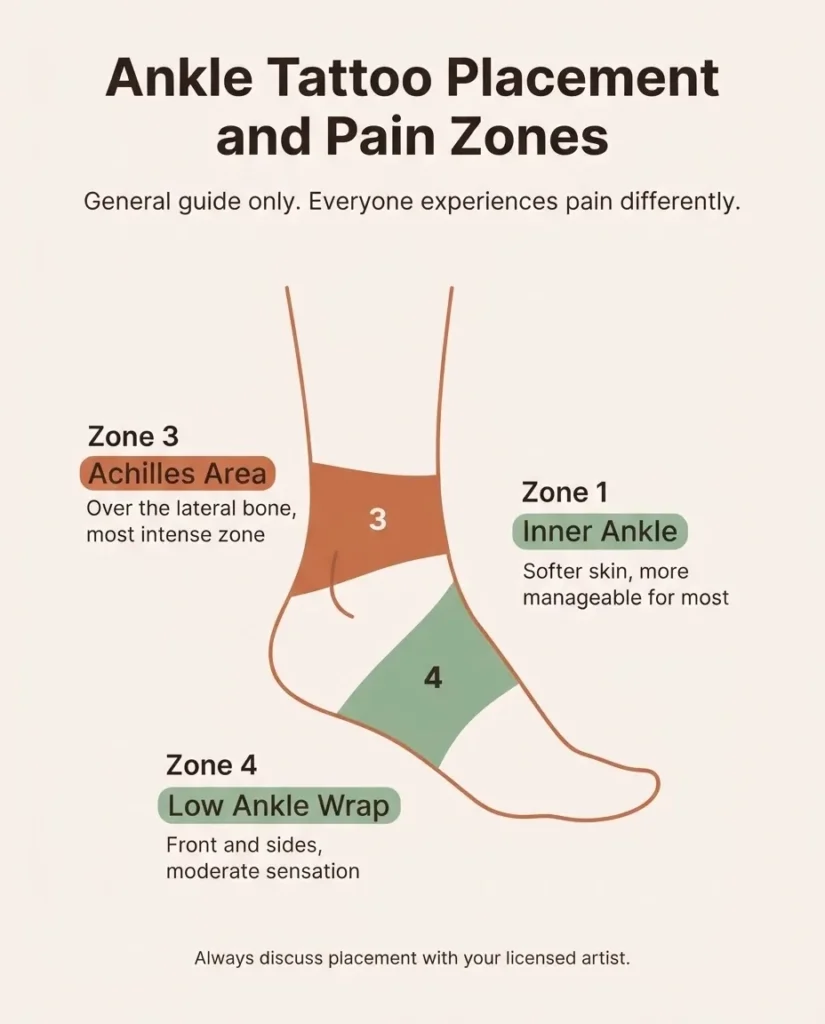
Thin skin over bone means more sensation, and the ankle bone and the Achilles tendon area are the spots people most commonly describe as intense. The inner ankle, where the skin is a little softer and there is slightly more flesh between surface and bone, tends to be more manageable for most people. The outer ankle over the lateral malleolus (the bony knob on the outside of your ankle) is typically the most reported as sharp and uncomfortable.
That said, ankle tattoos are almost always relatively small and short in duration, which matters a great deal for how you experience the session. An ankle piece that takes 30 to 90 minutes feels very different from a multi-hour piece on a bony area. Most people who describe ankle tattoo pain also describe getting through it without too much trouble because the session ends before the discomfort becomes overwhelming.
A few things that genuinely help: eating a full meal beforehand, staying hydrated, wearing clothing that gives your artist easy access without you having to hold an awkward position, and just being honest with your artist if you need a short break. Topical numbing options exist, but their effectiveness varies and some artists have preferences about using them. Bring it up at your consultation rather than deciding on your own.
Sizing Realism: What Actually Fits the Ankle Canvas
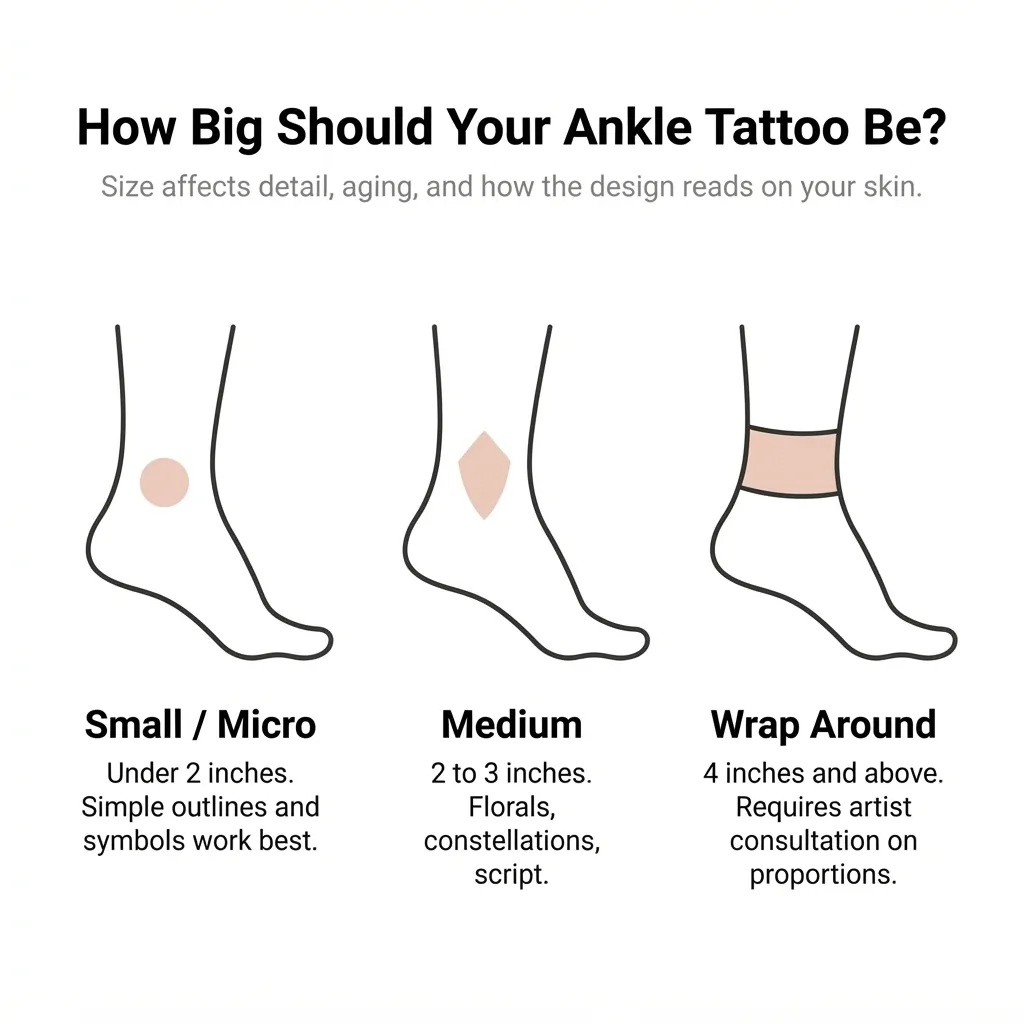
This is the piece of planning information that I think is most commonly skipped, and it is the one that prevents the most regret. The ankle is a narrow, curved, three-dimensional canvas. A design that looks balanced and detailed on a flat screen may not translate directly to a small curved surface.
Very small designs (roughly one inch or smaller) work best when they are kept simple. A single clean outline, a tiny symbol, a word in a readable font. Too much detail crammed into a tiny space will merge together as the tattoo heals and ages over time, because ink spreads slightly in the skin as years pass.
Medium designs (two to three inches) offer more room for detail and work well for single stems, a rose or small floral cluster, a constellation, or a clean symbol with some interior detail.
Larger or wrap-around designs (four inches and above, or anything that wraps the whole ankle) give your artist the most room to do interesting work, but they require the most careful pre-planning and sizing discussion. Your artist will typically create a stencil and place it on your skin before committing to anything, and this is your best opportunity to see how the scale actually looks on your body.
My strong advice: trust your artist’s sizing recommendation.
When I have had artists suggest going slightly larger than I originally planned, they have always been right. Designs that feel bold on paper look appropriately balanced once they are on skin.
How Ankle Tattoos Age: The Realistic Version
I believe every person who sits for a tattoo deserves an honest conversation about aging before they book, not to discourage them but to help them choose well. The ankle has some specific characteristics worth knowing.
Because the ankle is a high-movement joint and is frequently exposed to sun, footwear friction (especially the back of the ankle where shoes rub), and the general wear of daily life, tattoos in this area are subject to more environmental stress than pieces on, say, the upper back. This does not mean your ankle tattoo will look bad quickly. It means the choices you make during design and the care you take during healing and long-term maintenance matter more here than they might on a more protected placement.
Fine-line work specifically deserves a clear-eyed look before you commit. The very delicacy that makes fine-line ankle tattoos so appealing is also what makes them more sensitive to aging. Over time, very thin lines can soften and appear slightly wider than when they were fresh.
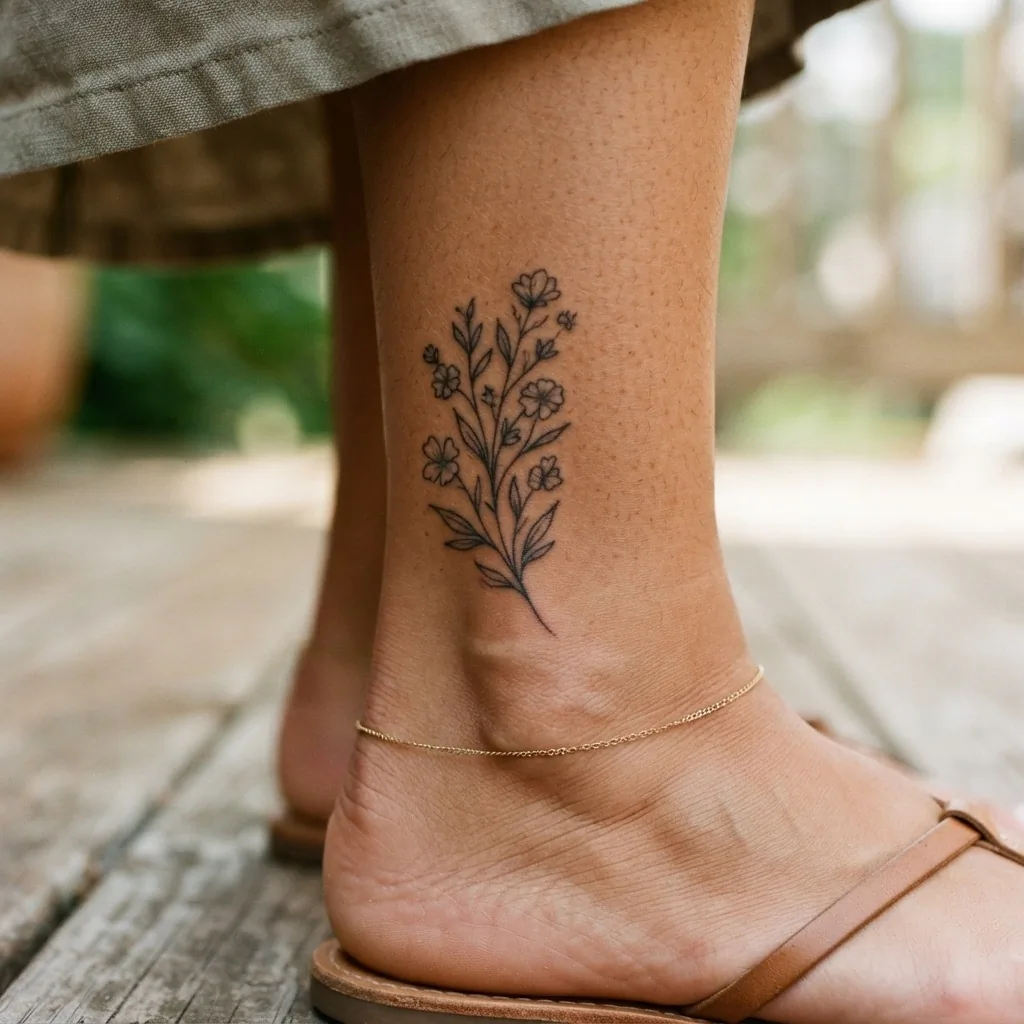
This is a natural process that happens in all tattoos but is more noticeable in extremely fine work. A realistic guide to how fine-line tattoos age over time is worth reading before your consultation, because walking in informed helps you have a much better design conversation with your artist about line weight choices that balance that beautiful delicacy with long-term wearability.
Designs with a slightly heavier line weight, solid botanical fill, or strong contrast tend to hold their visual clarity longer. This does not mean you have to skip fine-line work, many fine-line pieces age gracefully with good aftercare and smart sun protection. It means asking your artist specifically how they approach longevity in fine-line ankle work, and trusting an experienced answer.
Finding the Right Artist: The Part That Matters Most
I genuinely believe that the most important single decision in the entire tattoo process is choosing the right licensed artist for your specific design. Everything else, design, placement, pain, cost, flows from that choice.
Here is what I look for, and what I suggest you look for too.
Start with portfolios. Every artist who works professionally maintains a portfolio of healed work, not just fresh photos taken immediately after the session. Fresh tattoos look saturated and perfect. Healed work shows you the real picture. Look specifically for healed examples of the style you want. If you want fine-line florals, find an artist whose portfolio shows healed fine-line florals. If you want a bold traditional rose, look for someone who has done many of them with clean, saturated results.
Then check licensing. In the US, tattoo licensing requirements vary by state and even by county, but most jurisdictions require artists and studios to be licensed through a local health department. Licensing is not just bureaucratic formality. It is how health departments verify that a studio meets sanitation and bloodborne pathogen standards. You can typically find a studio’s license displayed visibly at the shop or check with your local health department. If an artist cannot tell you where their license is or a studio does not have one posted, that is a meaningful flag. The OSHA bloodborne pathogens standard as it applies to body art studios is the framework that governs how licensed professionals handle exposure control, sterilization, and single-use equipment, and understanding the basics helps you know what to look for when you visit a studio.
When you visit for a consultation, notice the studio environment. Surfaces should be clean. Equipment should be sealed and sterile. Needles are always single-use. Artists should wash their hands and put on fresh gloves before working. These are not extras. They are baseline professional standards, and any artist worth your trust will meet them without comment.
What to Bring to Your Consultation (and What to Say)
This is the part that makes first-timers most nervous, and it does not need to be. A consultation is just a conversation where you tell an artist what you are thinking and they tell you what is possible. Here is how to make it productive.
Bring references, not just one image but a small collection, three to six images that show what you are drawn to.
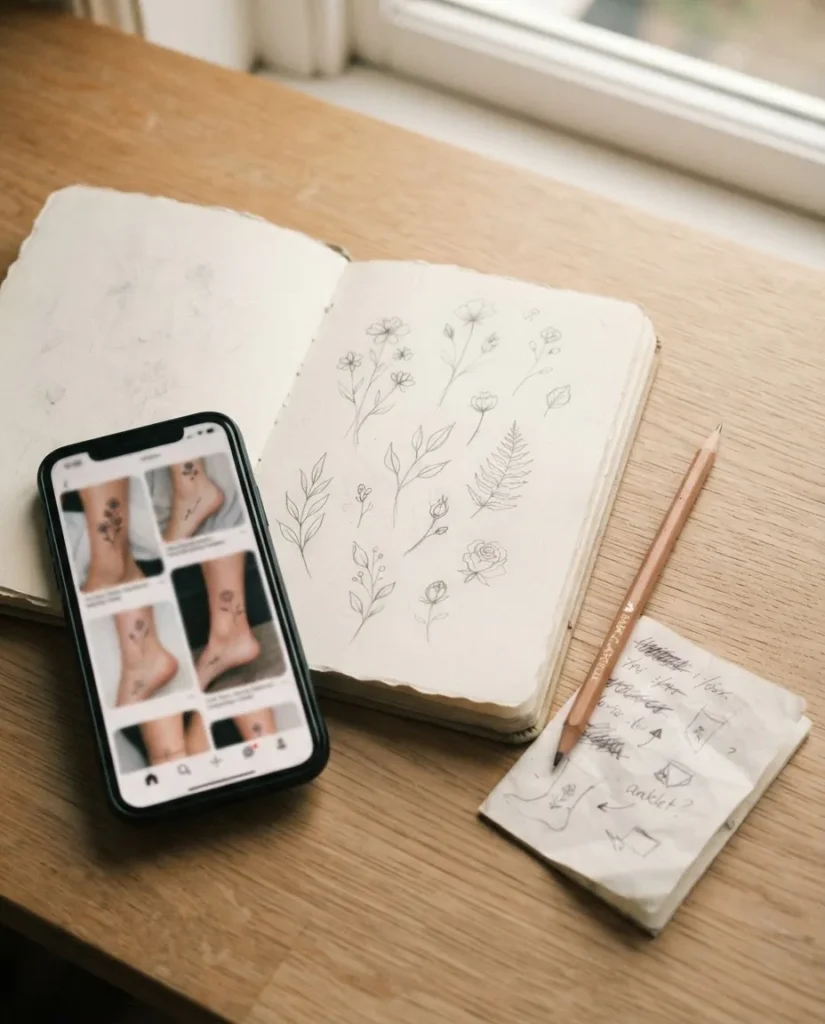
Some might be exact designs you love. Some might show a style you like. Some might show a placement or a size you are considering. The goal is not to hand the artist a blueprint. It is to give them a sense of your aesthetic and what excites you.
Be ready to talk about meaning. You do not owe an artist an explanation of why you want a particular design. But sharing context, “this flower was in my grandmother’s garden,” “I want something that reminds me of a specific year in my life,” helps an experienced artist create something that feels more genuinely yours rather than something generic.
Ask honest questions. Good questions to ask at a consultation include: “Have you done this style at this placement before? Can I see healed examples?” “What size do you think works best for what I’m describing?” “What is your aftercare recommendation?” “What is your touchup policy?” An experienced artist will welcome every one of these questions.
Also ask about cost at this stage. Small ankle tattoos typically start at a studio’s minimum rate, which in many US cities runs from around $80 to $150 or more depending on the market and the artist. Experienced artists with strong followings often charge more, and in most cases that premium reflects genuine skill and demand. A good tattoo is worth its cost. A cheap tattoo on a visible placement that you will wear for life is rarely the bargain it seems.
A Note on Ink Safety and Skin Reactions
I want to include this because it is genuinely important information that does not get covered enough in ankle tattoo roundups. Tattoo ink safety is an area where the regulatory picture is still evolving. The FDA classifies tattoo inks as cosmetics but has not formally approved any pigment for injection into the skin, and adverse reactions including infections and allergic responses are documented. The agency has issued safety alerts about contaminated inks in recent years. A 2024 peer-reviewed study published in PMC highlighted that underreporting of adverse events makes the full scope of ink reactions difficult to quantify, which is a reason to take this seriously rather than dismiss it.
What this means for you practically: work with a licensed professional who uses reputable, commercially sold inks (not mixed or diluted inks). If you have known skin sensitivities, a history of allergic reactions to cosmetics or metals, or any skin condition, speak with a dermatologist before getting tattooed. Reactions can develop immediately or weeks later, and red and bright-colored pigments are most commonly associated with allergic responses, though reactions can occur with any color. The American Academy of Dermatology has a detailed overview of tattoo skin reactions that is worth reading if you have any concerns.
None of this is meant to scare you. Most people who get tattooed by a licensed professional using quality inks have no complications. It is meant to make sure you have the full picture so you can make an informed decision and know what to watch for afterward.
Healing Your Ankle Tattoo: The Basics
Healing is one of the most important parts of the tattoo process, and the ankle has a few specific considerations that are worth knowing.
Your artist will give you their own aftercare instructions, and those instructions are your first and most important guide.

What I will share here are general principles that most professional artists agree on, but nothing here replaces what your specific artist tells you.
The surface skin of a new tattoo typically heals within two to four weeks, though deeper layers continue healing for up to several months. During the initial healing phase, keeping the area clean, avoiding soaking (baths, swimming pools, oceans), and protecting it from prolonged sun exposure matters a great deal for how your tattoo heals and looks long term. For ankle tattoos specifically, footwear is worth thinking about. A shoe or boot strap that rubs directly across a healing tattoo can cause real irritation and affect how the ink sets. Sandals or loose-fitting footwear during the healing window makes the process much easier.
Once your tattoo is fully healed, long-term sun protection is one of the single biggest factors in how well ink holds its color and clarity over time. The American Academy of Dermatology’s guide to caring for tattooed skin covers moisturizing and sun protection basics for healed tattoos in a way that is genuinely useful, and I reference it often when friends ask me about maintenance. For a placement as exposed as the ankle and lower leg, committing to SPF on sunny days is one of the most effective long-term investments you can make in your tattoo.
If anything during the healing process concerns you, whether that is unexpected redness, swelling, warmth, discharge, or a reaction that seems off, contact your artist first and then see a doctor or dermatologist if anything persists or worsens. Do not wait on a concern that seems like it might be an infection.
The Last Thing I Want to Say
Ankle tattoos are personal, wearable, beautiful, and capable of carrying real meaning. I have seen them turn a vague Pinterest-board feeling into something a person genuinely treasures. I have also seen people rush into them without much planning and end up wishing they had paused to think more carefully about style longevity or size or what they actually wanted to say with the design.
You are not going to be one of those people, because you are already doing the most important thing: taking the decision seriously before you sit down. That information, that groundwork, that clarity you are building right now is exactly what sets up a tattoo you will genuinely love.
When you are ready, find an artist whose portfolio makes you excited, book a consultation, bring your references and your questions, and walk in knowing you have done the work. The rest is theirs to bring to life.
That is what a good tattoo looks like from the beginning.