Behind the Ear Tattoos: Pain, Placement, and Perfect Size
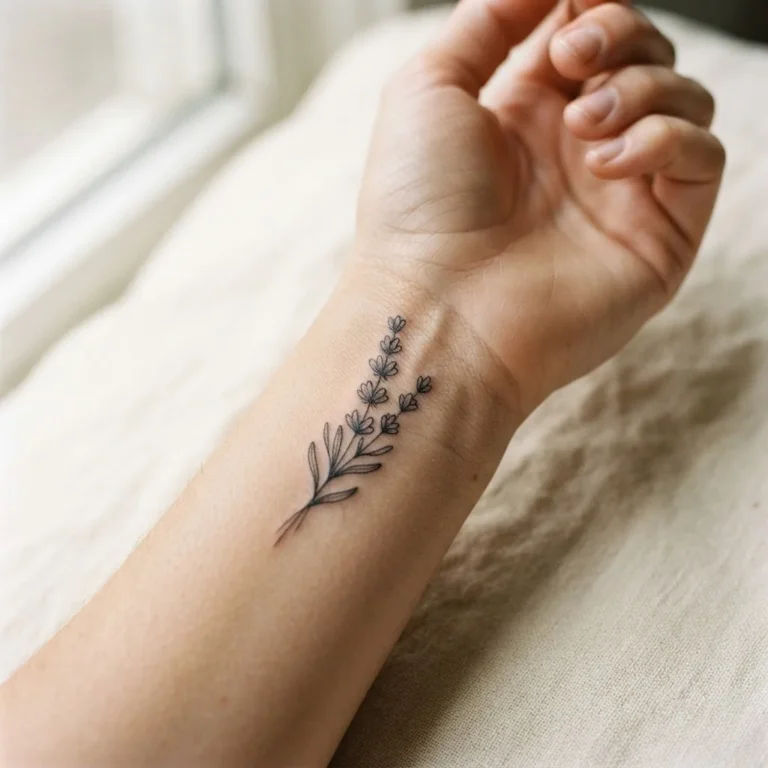
The first time I saw a behind-the-ear tattoo in person, I understood immediately why people become obsessed with this placement. A friend pushed her hair back before tucking it into a ponytail, and there it was, a tiny sprig of lavender, perfectly placed, perfectly sized, completely her. She had not told anyone she was getting it. That intimacy is part of the appeal. A behind-the-ear tattoo is a secret you can choose to share.
If you are here, you probably already feel that pull. You have seen the Pinterest pins, the Instagram posts, the gentle reveals. And now you have questions. Does it hurt? How small does it have to be? What styles hold up over time? What do I even say to an artist? Those are exactly the right questions to be asking, and I am going to walk you through all of them.
My whole thing is that a good tattoo starts with good information. This placement is genuinely beautiful and completely approachable, but it does have some specific characteristics you should know about before you book your appointment. Let’s cover everything so you can walk into a studio feeling calm, confident, and ready.
Why People Love This Placement
Behind-the-ear tattoos sit in a sweet spot between visible and hidden. They are easy to show when you want, easy to cover with your hair when you do not. That combination of intimacy and control is rare in tattooing. Most placements are either fully visible or fully hidden. This one lets you choose, which is exactly why it appeals so strongly to people who are thoughtful about their ink.
The placement also feels deeply personal in a way that is hard to articulate. There is something about putting a meaningful image in a spot so close to how you hear and experience the world, tucked right beside you, that resonates emotionally. A lot of people describe their behind-ear tattoo as feeling “just for them,” even when others can see it.
For first-timers, the small scale and relatively contained area can feel less daunting than a larger placement. That said, small does not mean simple or low-stakes. Size and placement bring their own specific considerations, and those are worth understanding clearly.
The 20 Design Ideas Worth Considering
Before we get into the planning details, let’s talk inspiration. These are the design directions I find myself discussing most often, the ones that consistently photograph beautifully, age relatively well at this scale, and feel genuinely personal rather than generic.
Fine-Line Botanical Designs
A single sprig of lavender, a small eucalyptus branch, a delicate fern, a minimalist rose. Botanical designs have dominated this placement for several years and they remain popular for good reason: they feel organic next to the natural curve of the ear, they scale down beautifully, and they carry an effortless, personal quality.
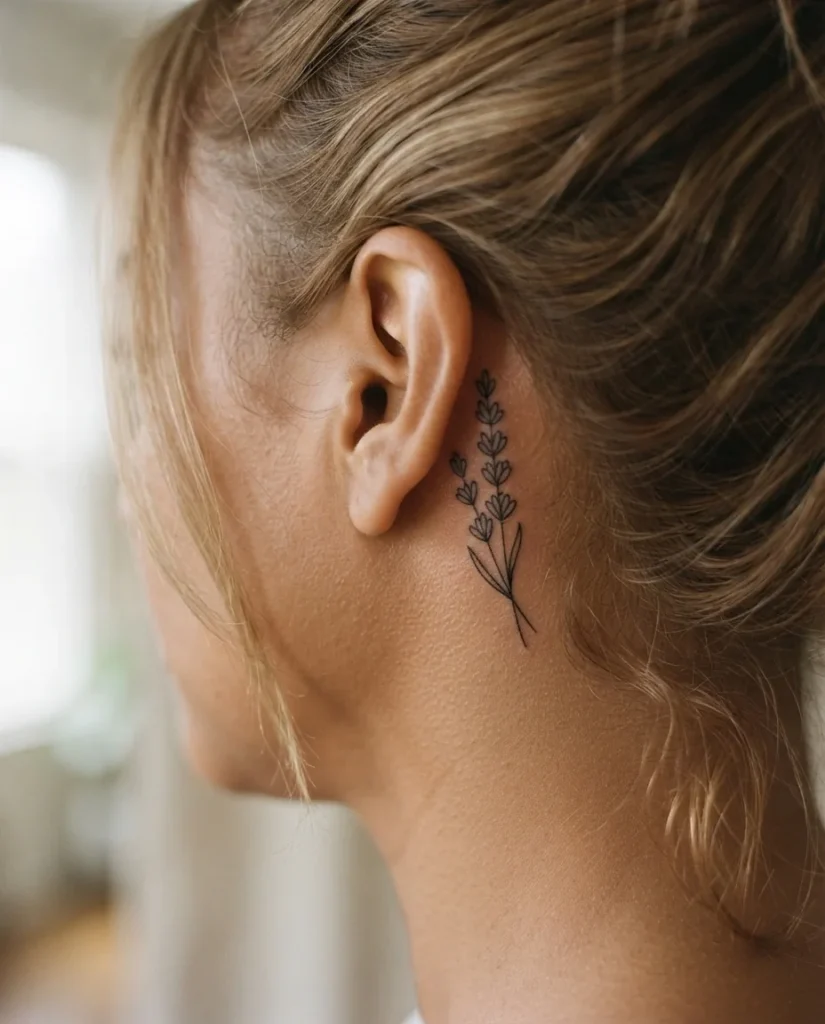
A lavender sprig can represent calm and healing. A cherry blossom branch can honor Japanese aesthetic traditions or simply speak to the fleeting beauty of spring. Fine-line botanical work is among the most technically demanding styles at small scale, so choosing an artist with a strong portfolio specifically in fine-line florals is especially important here.
A Single Flower
Similar to the sprig but even more focused. One peony, one daisy, one sunflower rendered in fine line. When sizing is done right by a skilled artist, a single bloom behind the ear feels complete rather than sparse. The key conversation to have with your artist is whether the design will hold its detail as it settles and ages over time.
Celestial Symbols: Moon, Stars, and Sun
A crescent moon, a small cluster of stars, a tiny sun with simple rays. Celestial imagery works beautifully at this scale because it reads clearly even at very small sizes. Simple shapes hold up well over time in a way that more complex designs at the same size may not. These designs also tend to carry rich personal meaning, from astrology to spirituality to simply loving the night sky.
Script and Words
A single meaningful word, a short date, a name, a phrase in small script. Script behind the ear is deeply personal and consistently popular. The honest thing to say about this style is that lettering is one of the more technically demanding choices at small scale. Letters need to be large enough to stay legible over time as ink naturally settles and softens. Your artist should advise you honestly on minimum letter size. Trust that guidance. A script tattoo that blurs into illegibility over five years is a heartbreaking outcome that a skilled artist will help you avoid.
Musical Notes and Sound Symbols
For anyone who lives and breathes music, placing a small treble clef, a few notes, or even a sound wave just behind the ear feels genuinely right. The proximity to where you hear everything adds a layer of meaning that goes beyond the visual.
A Tiny Animal: Butterfly, Bee, Hummingbird, or Dragonfly
Small animals read beautifully behind the ear, particularly those with a natural delicacy: a butterfly with wings slightly open, a bee in profile, a hummingbird in mid-hover. These work best with an experienced fine-line or micro-realism artist who knows how to render detail at a scale that will actually survive long-term. The more intricate the detail, the more important it is to choose an artist specifically skilled in micro work.
A Snake
Snakes have a long, rich history in tattoo art and symbolism, representing transformation, rebirth, protection, and duality depending on cultural context. A small coiled or curling snake works particularly well behind the ear because the natural shape of the design fills the available space gracefully. This is one case where slightly bolder linework can serve longevity better than ultra-fine lines.
Geometric Shapes
Clean triangles, circles, hexagons, simple sacred geometry. Geometric designs at small scale are clear, graphic, and age relatively gracefully because their basic shapes remain readable even as lines soften slightly over time. These are also highly personalizable, since geometric shapes carry different meanings across different traditions.
Arrow
A single arrow, pointing forward or upward, is a classic of minimalist tattooing. It reads as direction, intention, and moving forward. At this placement it sits beautifully without needing much real estate.
Semicolon
The semicolon has become a widely recognized symbol of mental health awareness and the choice to continue. For people who carry that meaning personally, placing it behind the ear, close and private, is a deeply intentional choice. These are among the simplest designs visually, but they carry some of the most weight.
Heartbeat or EKG Line
A short pulse line, sometimes with a small heart. Simple, clean, and meaningful. Works well at small scale because the graphic quality of the line does not require fine detail to read clearly.
Feather
A single feather, particularly in fine line, has a natural elegant quality that suits this placement well. Feathers carry varied meaning depending on cultural background and personal association, from freedom and lightness to connection to a person or tradition. One important note: if a feather design carries specific Indigenous cultural significance, be thoughtful about that. Research the meaning behind what you are choosing to permanently place on your body.
Infinity Symbol
Clean, simple, and enduringly popular. The infinity symbol reads clearly at small scale and holds up well over time. It works especially well for people who want something meaningful but visually understated.
Wave or Water Element
A single small wave, a water droplet, a simple ocean element. These feel calming and personal, particularly for people with a deep connection to water or coastal places. At this scale, keeping the design clean and relatively simple is important for longevity.
Constellation
Your birth constellation or a meaningful star pattern rendered as small dots connected by fine lines. Constellations feel personal, are visually clean, and scale well to this placement. The challenge is keeping the proportions accurate enough to be recognizable, which is another reason to bring a reference image and discuss the design carefully with your artist before committing.
Small Portrait: A Pet or Beloved Face
Micro-portraits are among the most demanding styles in tattooing at any scale. Behind the ear, the technical challenge is significant. If you want a micro-portrait of your dog, your cat, or a person you love, invest in finding an artist who has an established portfolio specifically of micro-portraits. This is not a style to get from a generalist. Done well, it is extraordinary. Done without the right expertise, it can be disappointing.
Tiny Landscape
Mountains, trees, a simple horizon. Small-scale landscapes work best when the composition is simplified down to its most essential elements. Think two or three mountain peaks rather than a detailed scene. Your artist can guide you on what reads clearly at this size.
Cross or Religious Symbol
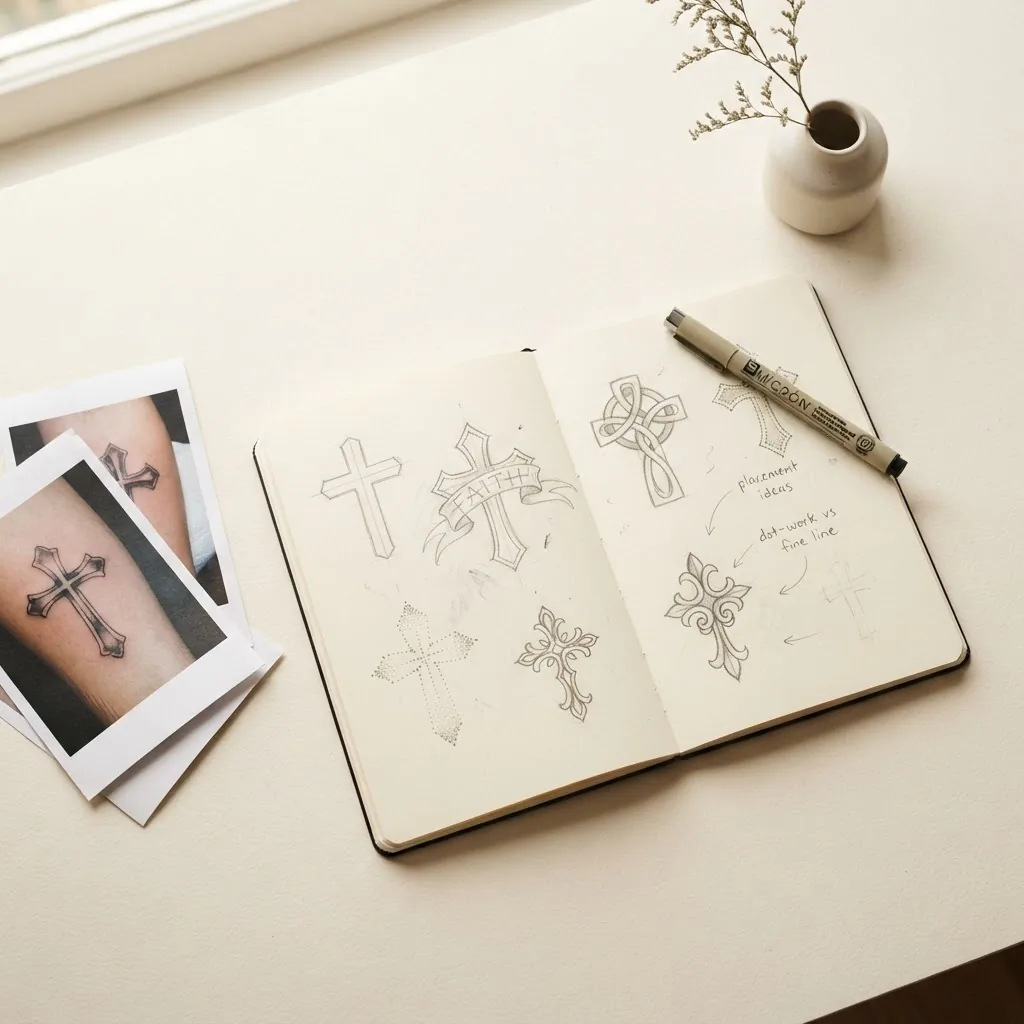
A small cross, a chai, an Om, a hamsa. Religious and spiritual symbols are some of the most personal choices in tattooing. Behind the ear is an intimate, close placement for something that speaks to your faith or spiritual practice. These designs often work beautifully here precisely because they are for you first.
Leaves or A Branch
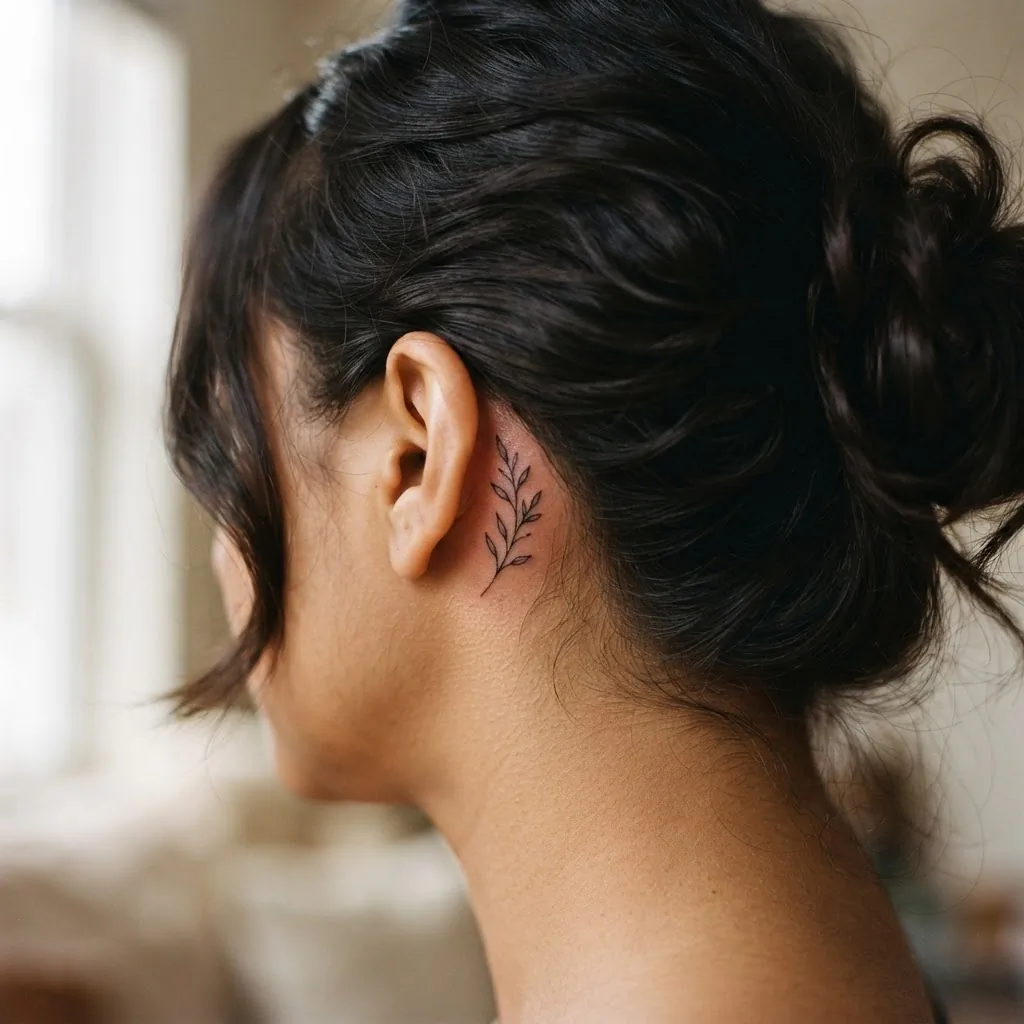
A minimal branch with a few leaves, an olive branch, a small willow. These share the natural quality of botanical designs but feel slightly different in their energy, perhaps more grounded and rooted than a blooming flower.
A Meaningful Date in Roman Numerals
Roman numerals have a timeless graphic quality that reads clearly even at small scale. A birthday, an anniversary, a date that changed everything. This is one of the most personal design choices you can make, and it works well at this placement because the clean, simple lines hold up reliably over time.
The Placement in Detail: What You Are Actually Working With
Understanding the actual anatomy of this area helps you make smarter decisions before your consultation.
The skin behind the ear sits over the mastoid bone, a hard, bony prominence just behind the ear. The skin here is relatively thin and close to the bone. That matters for two things: how the tattooing experience feels, and how the ink behaves over time.
Sub-zones to know:
The area directly behind the earlobe, on the soft tissue just below the ear, is slightly softer and flesher. Designs placed here tend to have a little more cushioning. Moving upward, toward and along the mastoid ridge, the skin sits closer to bone. Further up, along the hairline, the skin picks up more texture from hair follicles. Each zone is slightly different in feel and in how ink settles.
One practical thing to consider: how does your hair interact with this placement? If you have long hair, your hair will frequently contact the healing tattoo, especially in the first few weeks. Hair products can irritate healing skin. You will want to plan for pulling your hair up or back consistently during the healing period. Talk with your artist about this specifically, because their aftercare guidance will account for it.
If you wear glasses daily, the arms of your frames likely rest directly on or near this area. Glasses rubbing against a fresh tattoo can be genuinely problematic for healing. This is something your artist needs to know so they can advise you on timing, placement within the zone, and how to manage the healing period.
The Honest Truth About Pain
People ask me about pain more than almost anything else. The behind-the-ear area is generally considered a moderately to highly sensitive placement, and I want to be straightforward with you about that.
The mastoid bone area has thin skin, significant nerve density, and sits close to hard bone, all of which contribute to a sharper or more intense sensation than fleshier areas. Many people describe the experience as more buzzy and vibrating than other placements because the sound of the machine travels through the bone. Some find that the noise and vibration are stranger than the pain itself. Some genuinely find it more intense than expected.
Healthline’s medically-reviewed tattoo pain chart places the head and neck area among the higher-pain zones, which is consistent with what most people report for this placement. That said, pain is deeply personal. Your individual pain threshold, your mental state on the day, how well you slept, and whether you have eaten beforehand all factor into your experience.
The good news about this placement is that behind-ear tattoos are small. A short session is often all it takes. Even if it is more intense than a forearm or a shoulder, you are not enduring it for hours. Most people find that very manageable.
My best advice: go in well-rested, well-fed, and well-hydrated. Be honest with your artist about any nerves. A good artist will check in with you and pace the session thoughtfully.
Sizing and Detail: The Single Most Important Design Decision
This is where I spend the most time when friends text me before booking, because sizing mistakes behind the ear are probably the most common source of disappointment with this placement.
The space behind the ear is genuinely limited.
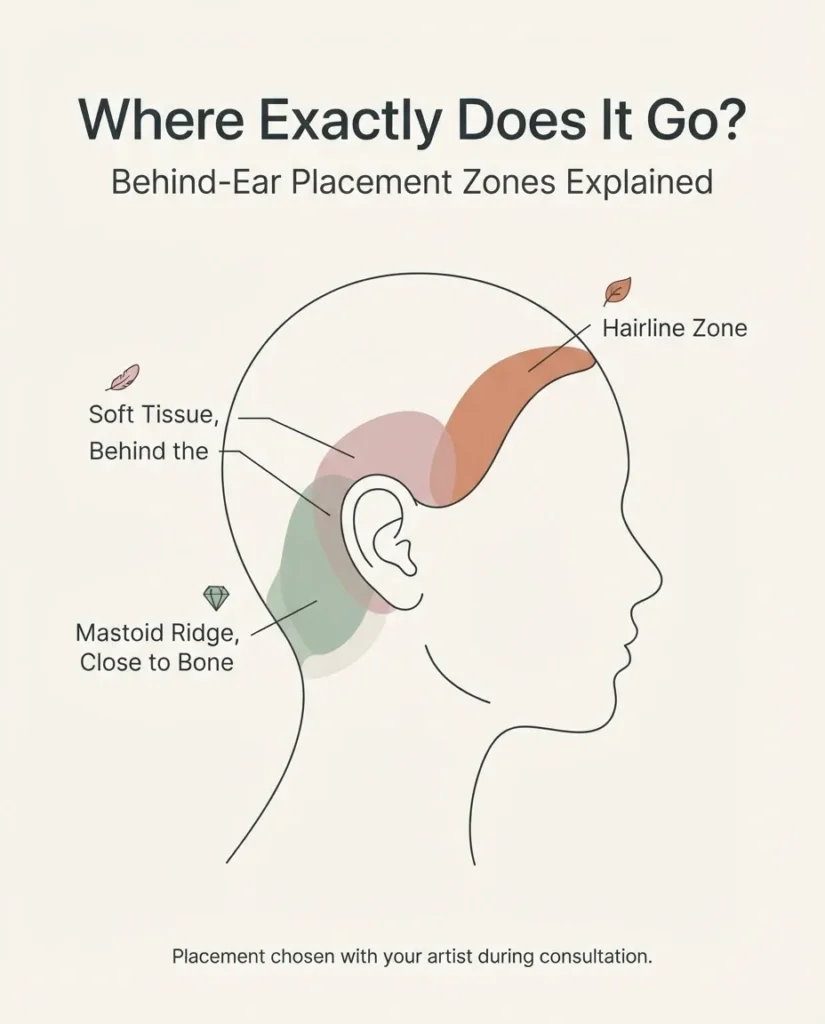
Roughly one to two inches of workable area is typical, though this varies depending on anatomy and which sub-zone you choose. Within that space, your design needs to be simple enough to remain legible over time as the ink naturally settles and softens.
Fine-line tattoos look extraordinarily beautiful fresh. The delicacy and precision are part of their appeal. But ultra-fine lines in a small, tight design on thin skin can blur more over time than in other placements. This is not a reason to avoid fine-line work here; it is a reason to have an honest conversation with your artist about line weight, spacing between elements, and realistic expectations for how the design will look in five or ten years.
The general guidance artists consistently give is: simpler designs age more gracefully at small scales. One clear motif reads better in the long run than several small, complex elements crowded together. Adequate spacing between lines matters more here than in larger placements.
When you sit down for your consultation, bring reference images. Not just the one perfect image you love most, but a small collection showing the scale, the style, and the level of detail you are drawn to. A skilled artist will look at what you have brought and give you an honest assessment of what will hold up beautifully in the space you have available.
Fading and Longevity: What to Expect Over Time
I want to be honest with you about this because competitors rarely are. Behind-the-ear tattoos do tend to fade faster than tattoos in many other locations. The reasons are structural and practical.
Thin skin over a bony area means the ink sits differently than it would in fleshier tissue. The skin behind the ear moves frequently, from talking, chewing, turning your head, and sleeping. Friction from hair, pillowcases, and glasses arms contributes over time. Sun exposure on the neck and behind the ears adds up, particularly for people who spend time outdoors without sunscreen in that area.
None of this means a behind-ear tattoo is a bad decision. It means going in with realistic expectations and a commitment to caring for it well. Many people with behind-ear tattoos get a touch-up at some point, and that is a completely normal and accepted part of owning a tattoo in a high-friction, high-movement area.
The styles that tend to hold up best over time at this placement are those with slightly bolder lines and simpler compositions.
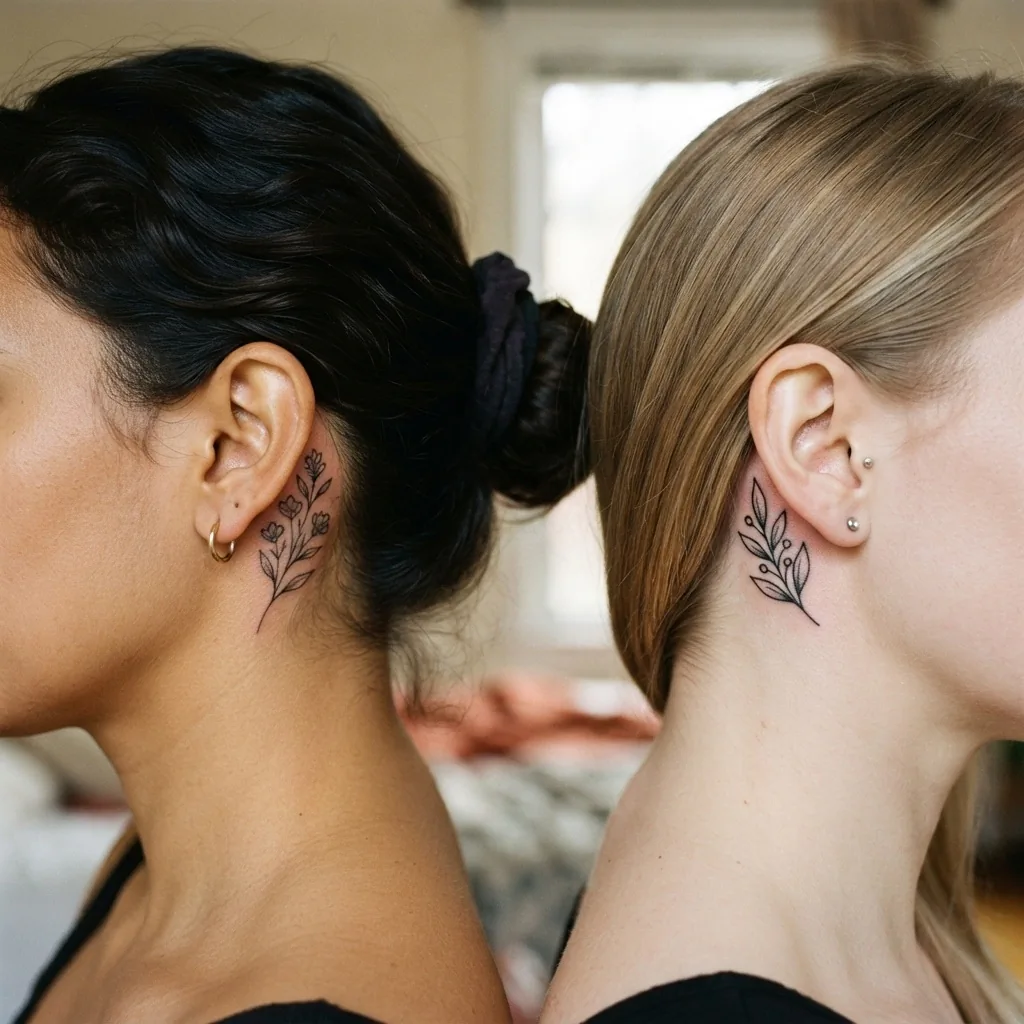
Ultra-fine single-needle work can be stunning but may require earlier touch-ups to maintain its crispness. Your artist will be your best guide on this based on your specific design and their experience with the placement.
Finding the Right Licensed Artist for This Placement
This is where the whole plan comes together, and where I genuinely care most about getting you the right information.
Behind-the-ear tattoos require a skilled, experienced artist. The limited real estate, the curved anatomy, the thin skin, and the precision required for small-scale work all mean that this is not a placement to assign to someone who has never worked it extensively. Portfolio research matters enormously here.
What to look for in portfolios:
Search specifically for an artist’s healed work in small-scale fine-line or minimalist styles. Fresh tattoo photos are beautiful but they do not tell you how the work ages. Healed photos, even if harder to find, show you the actual quality you can expect. Look for crisp lines, accurate scale, clean negative space, and designs that look complete rather than crowded.
How to verify a licensed studio:
Tattooing is regulated at the state level in the US. Licensing requirements vary by state, and most state health departments maintain public license lookup databases. For example, Texas DSHS maintains a public license search for tattoo and body piercing studios, and most other states offer similar tools. When you research studios in your area, check that the studio and artist hold current, valid licenses. Ask when you call to inquire. A reputable studio will answer that question without hesitation.
Hygiene standards are non-negotiable. Licensed studios follow bloodborne pathogen protocols established by OSHA (Standard 29 CFR 1910.1030) to protect clients from infection risk. When you visit a studio for a consultation, observe the space. Is it clean and organized? Does the artist use single-use, sterile equipment? Do they wear gloves? These are not rude questions to think about; they are important ones.
A note on ink safety:
The FDA has documented concerns about contaminated tattoo inks and ink-related adverse reactions, and I encourage you to read their Think Before You Ink consumer update as part of your research. A licensed, professional studio sources its inks responsibly and can answer questions about the products they use.
What to say at your consultation:
Bring your reference images. Describe what draws you to this placement specifically. Talk about your lifestyle: your hair, your glasses if you wear them, your job and whether visibility is a consideration. Ask the artist what line weights they recommend for your design to age well. Ask to see examples of their healed small-scale work. Ask what their aftercare instructions are, because you will follow their specific guidance, not generic internet advice.
Be honest if you are a first-timer. Experienced artists work with nervous first-timers all the time, and the good ones genuinely appreciate knowing so they can pace the session thoughtfully and check in with you.
A Word on Design Meaning
One of the things I love most about the behind-ear placement is how personally meaningful the choices tend to be. Because the spot is intimate and not immediately visible to others, people often choose designs that are truly for themselves, not for an audience.
If you are drawn to a symbol from a cultural or spiritual tradition that is not your own, take the time to understand its meaning and significance before committing to it permanently. That is not a lecture; it is genuinely part of choosing a design you will feel good about for decades. Researching the meaning behind what you are putting on your body forever is just good practice, and it almost always makes the final design more meaningful to you too.
Age, Legality, and a Few Practical Notes
All 50 US states and the District of Columbia have statutory laws requiring a person to be at least 18 years old to receive a tattoo, as documented by Wikipedia’s overview of the legal status of tattooing in the United States. Some states have additional regulations, including historically restricting above-the-neck tattooing. South Carolina, for example, has had ongoing legislative discussion about its above-the-neck restriction, with changes reported as recently as early 2025. If you are in a state with specific placement restrictions, check your state’s current laws and ask your artist directly. This is part of why working with a licensed, informed professional matters: they will know the current regulations in your location.
Tattooing is a 18-or-older decision, full stop. If you are researching this for yourself and you are not yet 18, save this article, keep building your Pinterest board, and let the ideas develop. The right decision made at the right time will feel so much better than rushing.
What to Expect During Your Session
Once you have found your artist, confirmed the design, and booked your appointment, here is what to generally expect.
You will discuss and confirm the design placement at the start of your session, often with a stencil applied to the skin so you can see the size and position before anything permanent happens. Take your time with this step. Look in a mirror. Make sure the placement feels right to you.
The session itself for a small behind-ear tattoo is typically short, often 30 minutes to an hour depending on the complexity. The sound of the machine may feel amplified because of the proximity to your ear and the bony structure, which is perfectly normal. Focus on steady breathing. Most people manage this placement completely fine.
You may notice some redness and swelling immediately after. That is a normal response. Your artist will cover the area and give you their specific aftercare instructions before you leave. Follow those instructions. They know the work they just did, the ink they used, and how they want it to heal.
Aftercare: The Basics and Why This Spot Needs Extra Attention
General tattoo aftercare principles apply here, and the American Academy of Dermatology’s tattoo care guidance is a solid reference for understanding the fundamentals, though your artist’s specific instructions always take priority over general guidelines.
For behind-ear tattoos specifically, a few things require extra thought. Hair products, dry shampoo, hairspray, and styling products should not contact the healing tattoo. If you have long hair, keeping it pulled back during the healing period is important. Be mindful of pillowcase friction at night, as this area contacts your pillow constantly while you sleep. Sleeping on a clean pillowcase on the opposite side for the first week or two is often advised. If you wear glasses, the arm of your frames may need to be wrapped with something soft or temporarily swapped for contact lenses during the most active healing phase.
Do not submerge the tattoo in water during healing. Avoid direct sun exposure on the healing skin. Do not pick at any peeling or flaking skin.
If you notice signs of infection beyond normal healing responses, including excessive redness, warmth, discharge, or anything that concerns you, contact your artist and, if needed, see a doctor or dermatologist. Reactions to tattoo ink pigments, though not common, are documented in dermatological literature, with certain pigment colors carrying a higher reported risk than others. A published review in the Journal of Cutaneous and Aesthetic Surgery (PMC) documents that red pigments are among those most commonly associated with allergic reactions. If you are choosing a multi-color design and have known skin sensitivities, mentioning this to your artist and to a dermatologist beforehand is a thoughtful step.
Surface healing typically takes two to four weeks for most people, though full healing of the deeper skin layers takes longer. Your artist will be the best guide on your personal healing timeline.
Making Your Decision
A behind-the-ear tattoo is one of the most personal placements you can choose. It is intimate, often deeply meaningful, and genuinely beautiful when it is designed thoughtfully and executed by a skilled, licensed professional.
The things I hope you are leaving with: a clearer sense of what styles suit this placement, an honest picture of the pain and the fading realities, a framework for finding an artist whose portfolio you love and whose studio you trust, and the confidence to walk into that consultation knowing exactly what you want to talk about.
Take your time with the design. Save your references. Do your research on artists in your area. Book a consultation before you commit to anything. And then, when you are ready and you feel sure, go get it.
That is the whole philosophy. Good info in, great tattoo out.