Summer Hair Care Tips That Actually Keep Your Hair Healthy
I want to be real with you for a second. Every summer, I see the same thing happen. Someone spends months growing out their hair or finally gets a color they love, and then by August it feels like straw, the ends are snapping, and the color looks like it went through a bleach wash it never asked for. And the frustrating part is that most of the summer hair care advice out there is so generic it doesn’t actually help anyone figure out what to do.
So let’s fix that. This is the real breakdown: what summer is actually doing to your hair, which threats matter most for your specific situation, and the practical things you can do today that will make a visible difference by the end of the season. No filler, no unrealistic promises.
What Summer Is Really Doing to Your Hair (and Why It Matters)
Before we get into the tips, I think it helps to understand what you’re actually protecting against. Because once you know why, the tips stop feeling like a random checklist and start feeling like an obvious, logical plan.
Summer throws four major stressors at your hair at the same time. The sun. The water (pool or ocean). The humidity. And the fact that you’re probably still using heat tools on top of all of it. These four things each damage your hair through a different mechanism, which is why “just deep condition more” fixes some of the problem but not all of it.
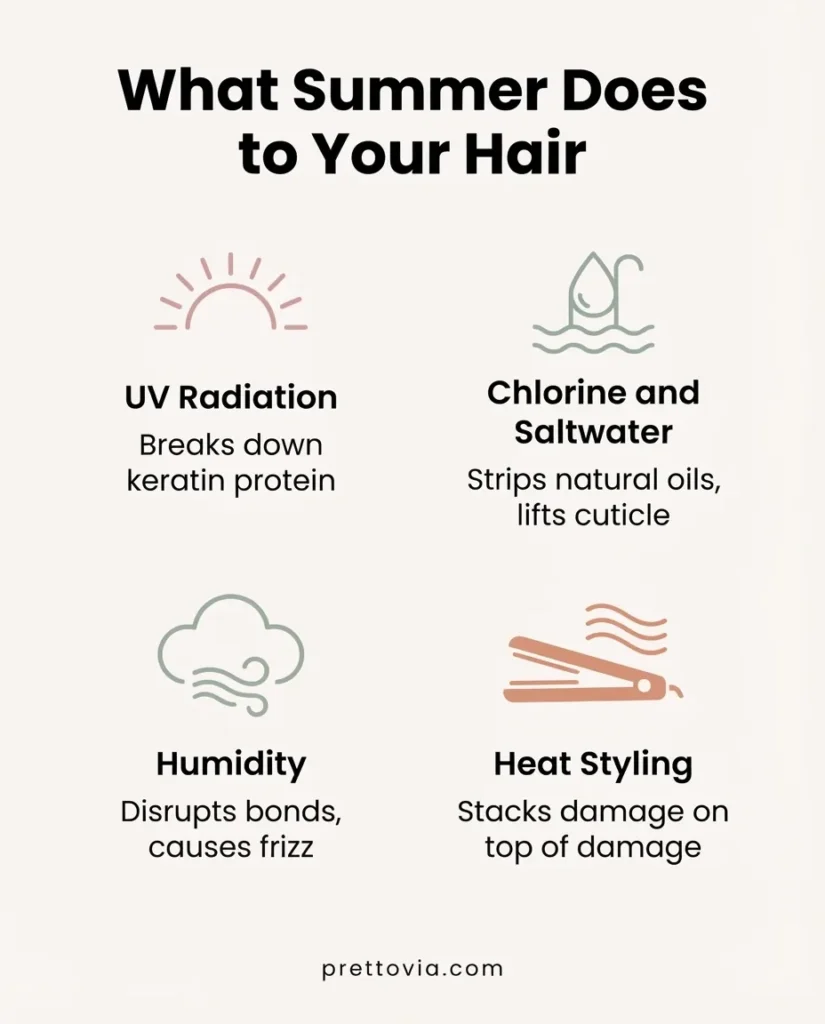
UV radiation is the one most people underestimate. Research published in a peer-reviewed dermatology journal confirms that UV wavelengths between 254 and 400 nm directly degrade hair proteins, specifically the keratin that gives your strands their structure and elasticity. UVB radiation causes protein loss from the hair fiber itself. UVA radiation is what drives color changes, including the fading and brassiness that color-treated hair gets. Your hair’s melanin (the pigment that creates your natural color) provides some built-in UV buffering, which is one reason darker, coarser hair is a bit more resistant. But lighter, finer, or chemically processed hair has less of that natural shield, and it takes the hit faster.
Chlorine and saltwater work differently. They don’t just dry out your hair, they strip away the natural oils that keep your cuticle (the protective outer layer) lying flat and smooth. Once those oils are gone and the cuticle is lifted and rough, your hair loses moisture faster, tangles more, and becomes far more vulnerable to breakage when you brush or style it.
Humidity doesn’t damage your hair the way UV does, but it does change how it behaves, often dramatically. Hair is porous, and it responds to moisture in the air by absorbing it, which disrupts the hydrogen bonds that hold your hair in whatever shape it’s in. If you’ve ever had a blowout that lasted exactly forty-five minutes before puffing out into a frizz cloud, that’s humidity breaking those bonds. Not damage, but genuinely frustrating, and very manageable once you understand what’s happening.
Tip 1: Start Protecting Before You Go Outside
This is the most common mistake I see, treating summer hair care as something you do after the damage has already happened. The prep step matters just as much.
Before you head to the beach, pool, or even a long day outside, apply a leave-in conditioner or a lightweight oil to your hair. Coconut oil, almond oil, and avocado oil are popular choices because they create a light barrier on the hair shaft. I want to be honest here: they’re not sunscreen and they don’t block UV. But they do help slow moisture loss, which is especially valuable if you’re heading into chlorine or saltwater. As the Cleveland Clinic notes, natural hair oils may help add a protective barrier and lock in moisture before exposure. Even just a small amount of leave-in conditioner applied to dry or slightly damp ends before you leave the house is doing real work.
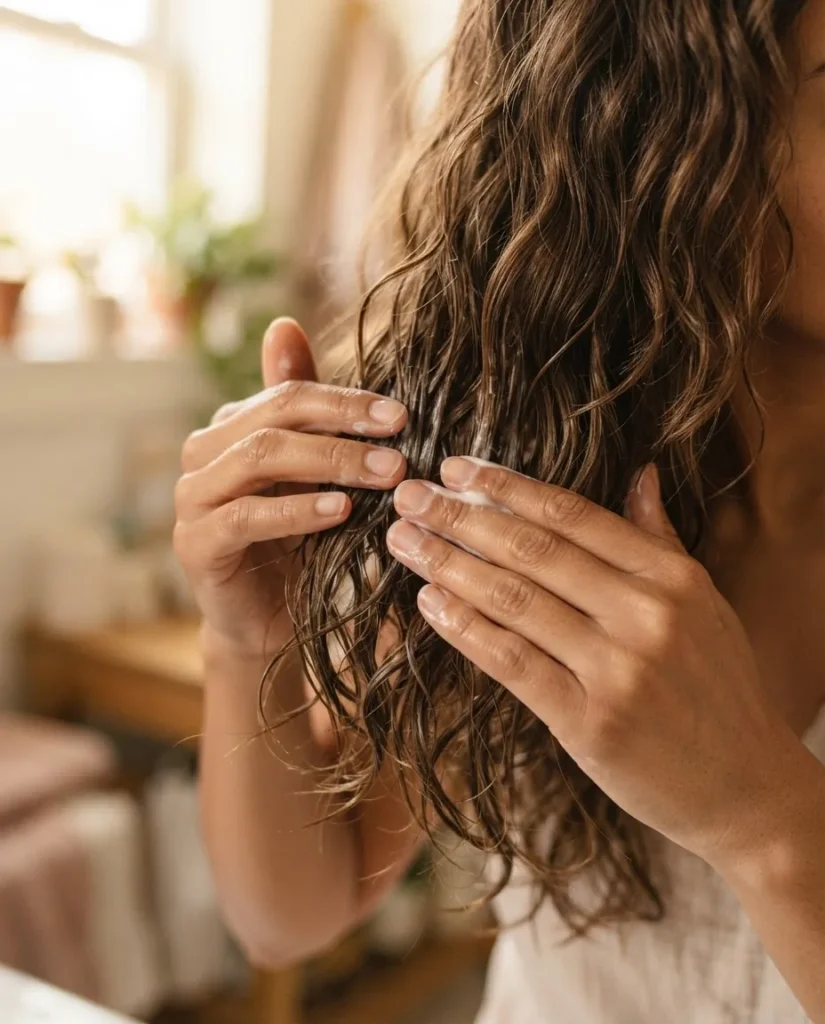
For curly and coily hair, this step is even more important, because those hair types are naturally lower in moisture to begin with, and the combination of sun exposure and water can cause significant setback in terms of shrinkage, tangles, and breakage.
Tip 2: Take UV Protection Seriously, Including for Your Scalp
Most of us don’t think about sunscreen for our hair and scalp. We think about it for our face, our arms, the tops of our feet. But your scalp is skin, and it can burn. It can also develop skin cancer. The Cleveland Clinic explicitly flags scalp skin cancer as a real risk and recommends SPF 30 or higher applied directly to your scalp, especially along your part line if you have one.
For your scalp, the most practical options are SPF sprays that are designed specifically for hair and scalp use. These go on without leaving a greasy film the way regular sunscreen might. Sun Bum’s Scalp and Hair Mist SPF 30 is one I recommend to anyone looking for a budget-friendly starting point, and it runs about $15, which is very reasonable for what it does. Higher-end options like COOLA’s version run closer to $28 and offer similar SPF 30 protection with a slightly more lightweight feel. Spray it on your part and the areas of your scalp that get the most direct sun, and reapply if you’re out for an extended period.
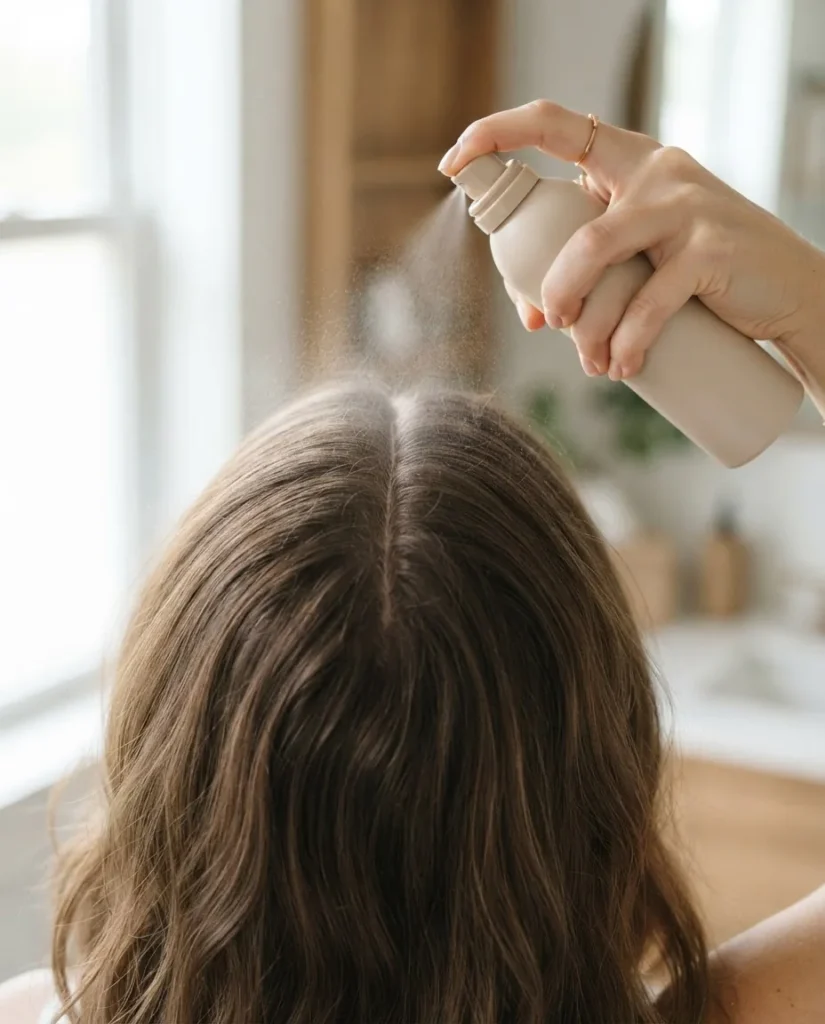
For your strands, look for leave-in products and hair sprays that list UV filters or UV protection on the label. The ingredients you’re looking for include benzophenone-4 and other UV-absorbing agents. You won’t find SPF numbers on hair products the way you do on skincare, because SPF is a regulated skin-specific measurement, but a product that mentions UV protection in its formulation is meaningfully better than one that doesn’t.
Wide-brimmed hats are also genuinely one of the most effective tools you have. They block direct UV from reaching both your hair and your scalp with no product required. If you’re going to be outdoors for hours, especially between 10 a.m. and 4 p.m. when UV intensity peaks, a hat is not optional, it’s the easiest and most complete protection you can give yourself.
Tip 3: The Pool Trick Most People Skip
If you swim in a chlorinated pool regularly in summer, here is the most important thing you can do: rinse your hair with clean water before you get in. This sounds almost too simple, but there’s a good reason it works. Your hair is porous, and if you saturate it with fresh water before you enter the pool, it has much less capacity to absorb chlorinated pool water. Think of your hair shaft like a sponge. A wet sponge picks up far less of a new liquid than a dry one.
After that pre-soak, apply a leave-in conditioner or a small amount of oil to create an extra layer of protection between your hair and the chlorine.
The AAD recommends applying oil or leave-in conditioner before pool entry as a simple but effective preventive measure.
After you’re done swimming, rinse your hair with clean water as soon as you can, ideally immediately. Then shampoo at your normal frequency, and follow with a good conditioner. If you’re swimming multiple days in a row, a clarifying shampoo once a week will help clear out any mineral or chemical buildup that’s been accumulating on your strands.
For serious swimmers, a silicone swim cap is the most effective protection available. It’s not glamorous, but it does work. If that’s not your vibe, applying a generous coat of conditioner to your hair under a soft cap before you swim creates a decent barrier.
For post-pool care, Olaplex’s breakdown of chlorine damage and repair is a genuinely helpful read if you want to understand more about what’s happening structurally and which products help repair it afterward.
Tip 4: Deep Conditioning Is Your Summer Anchor
If you’re only going to add one step to your routine all summer, this is the one to pick. A deep conditioning mask or treatment replenishes moisture and helps smooth the cuticle, which is exactly what sun, salt, and chlorine are working against all season.
In summer, most hair types benefit from deep conditioning at least once a week. If your hair is color-treated, fine, or already feeling dry and brittle, you might consider twice a week, especially during periods of heavy sun or swimming exposure. If your hair is thicker and naturally more resilient, once a week is usually enough.
Here’s how you actually get the most out of a deep conditioning treatment. Apply it to clean, damp hair after shampooing. Use enough to coat every strand from mid-length to ends. Apply the heat. No, not a styling tool, but a simple plastic conditioning cap or a warm towel wrapped around your head for 20 to 30 minutes. Gentle heat helps the product penetrate the hair shaft more effectively. If you want to keep it budget-friendly, literally any deep conditioner will work better with this step than the most expensive one in your bathroom applied without it.
Fine hair tip: if heavy masks make your hair limp and lifeless, look for treatments labeled “lightweight” or use a regular conditioner and let it sit for 10 extra minutes instead of rinsing immediately. You’ll get most of the same benefit without weighing your hair down.
Curly and coily hair tip: this hair type generally needs more moisture than straight hair and can handle richer, thicker masks. If your curls are feeling crunchy or your coils are losing definition, bump your deep conditioning to twice a week and pay attention to whether your curl pattern bounces back with better hydration.
Tip 5: Turn the Heat Styling Way Down
This one is harder for people to hear because we all love a good blowout. But here’s the honest truth: if your hair is already being hit by sun, saltwater, chlorine, and humidity, adding 400-degree heat tools to the mix is stacking damage on damage. Every time you use high heat without a protectant, you’re contributing to cuticle breakdown, the same breakdown the sun is already working on.
Summer is genuinely the best season to lean into heatless styling, not because heat is always evil but because your hair needs the cumulative recovery time. Back when I was assisting in the salon in Austin, I watched how stylists actually treated their own hair at home versus what clients requested. Almost every one of them was air-drying and heatlessly setting curls more in summer than at any other time of year. It’s not about being precious. It’s about managing the total damage load.
If you can’t or won’t give up heat tools entirely (I get it), here’s what actually makes a difference: always use a heat protectant spray before any heated styling, reduce your tool temperature to the lowest setting that still works for your hair type, and wait until your hair is at least 80% air-dried before reaching for the blow dryer. Applying heat to wet hair takes far more time and far higher temperatures to achieve results, which translates directly to more damage. Let it air dry first and you’ll be using significantly less heat to finish.
For heatless curl options in summer specifically, braids and buns set overnight are among the most low-effort and low-damage routes to texture and wave. Looser braid sets give soft waves. Tighter braids give more defined texture. A set of foam rollers on damp hair overnight gives a soft, voluminous curl that holds surprisingly well with the humidity working in your favor for once.

Tip 6: Wash Smarter, Not More
Summer makes most people feel like they need to wash their hair every single day. You’re sweating more, you might be swimming, and everything just feels less clean. I get why the instinct is to reach for shampoo constantly. But washing too frequently strips your scalp of its natural oils, which then prompts your scalp to produce even more oil as compensation, which makes you feel like you need to wash again. It’s a cycle.
The smarter move is to rinse with water more freely while shampooing less often. After a sweaty workout or an afternoon outside, a rinse with cool water removes a lot of the surface buildup without stripping your scalp the way shampoo does. When you do shampoo, focus on your scalp and roots and let the product rinse through your lengths rather than scrubbing the full strand.
If your scalp tends to get oily quickly in summer heat, a dry shampoo at the roots on day two or three buys you time between washes without the stripping cycle. Look for formulas that are transparent or tinted to match your hair color so you don’t end up with a dusty cast at your roots.
Tip 7: Color-Treated Hair Needs Extra Protection
If your hair is color-treated, whether that’s highlights, balayage, a vivid tone, or a single-process color, summer is genuinely harder on you than anyone else. The UV-driven color fading that research has documented is more intense on chemically processed hair because the processing already altered the cuticle structure, making it more porous and more vulnerable. You’ll notice your color going brassy, dull, or faded faster in summer, and this is exactly why.
A few specific things make a real difference here. Swap to a sulfate-free shampoo for the summer months. Sulfates are effective at cleansing but they’re also quite stripping, and color-treated hair that is already losing moisture to sun and heat doesn’t need that extra depletion. Sulfate-free formulas clean well enough without accelerating fade. Rinse with cool or cold water whenever you can. Hot water opens the cuticle and causes color to bleed out faster with every wash. Cool water keeps the cuticle closed and your color where it belongs. And use a UV-protective leave-in on your strands before any sun exposure. This is non-negotiable for color-treated hair in summer.
If you’re planning any touch-ups, highlights, or new color during summer, have a conversation with your colorist about timing.
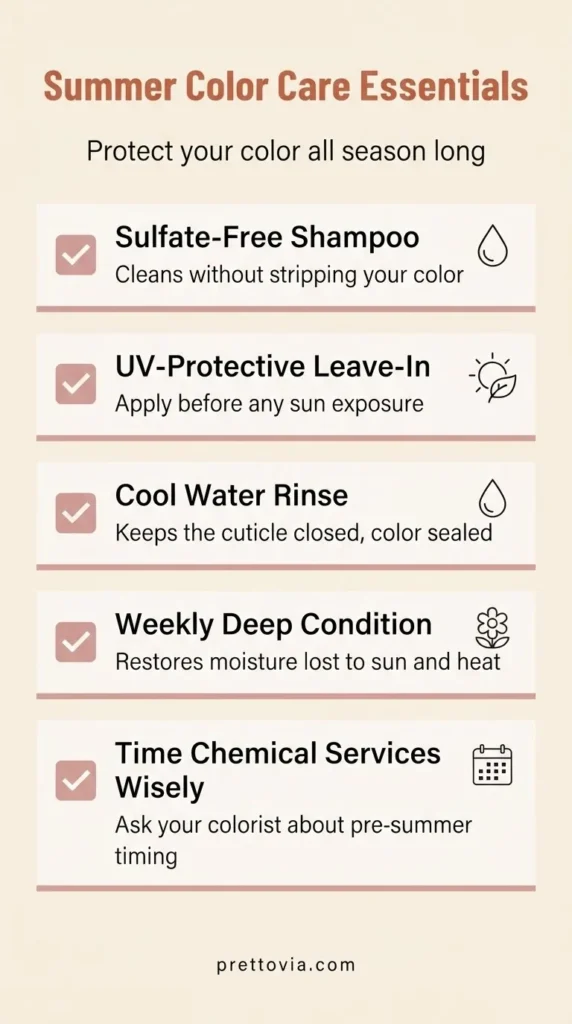
Many stylists recommend doing chemical services before the heaviest summer months begin, or scheduling them for when you can give your hair a period of lower UV exposure right afterward.
Tip 8: Don’t Ignore the Signs of Sun Damage
One thing I appreciate about the Cleveland Clinic’s guidance on this is that it gives you something concrete to look for. Sun-damaged hair typically feels dry and rough to the touch, dries unusually fast when wet (because the cuticle is too open), refuses to hold a style or curl, and looks dull even when it’s clean. Split ends and increased breakage are also common.
If you’re already seeing these signs, the protective tips above still matter to stop further damage, but your routine will need to lean harder on repair. Weekly deep conditioning, reduced heat styling, gentle detangling only when hair is wet and conditioned, protein treatments for severely damaged hair (look for formulas with hydrolyzed keratin or silk proteins on the label), and trimming off the most damaged ends are all part of a real recovery plan. Healthy ends that are slightly shorter are going to look better and behave better than long ends that are actively breaking.
If you’re ever dealing with significant scalp irritation, unusual hair loss, or anything that seems beyond the normal seasonal dryness, that’s a conversation worth having with a dermatologist. The scalp is skin, and a board-certified dermatologist can assess what’s actually happening.
Putting It All Together
You don’t have to do all eight of these perfectly to see a difference. Start with the ones that match your biggest summer challenge. If you swim a lot, the pre-soak and post-swim rinse steps are your priority. If you’re mostly fighting frizz and dryness from the sun, deep conditioning and a UV-protective product will do the most work. If you have color-treated hair, the sulfate-free swap and UV protection are where your energy should go.
Summer hair care isn’t complicated. It’s mostly just understanding what your hair is up against and being a little more intentional than usual. Your hair will thank you by Labor Day, and honestly so will your future self when she doesn’t have to deal with six months of recovery damage.