Rice Water for Hair: Benefits, How-To, and Honest Results
If you have been anywhere near Pinterest or TikTok lately, you have seen rice water. You have probably seen the clips of women with waist-length, mirror-shiny hair crediting a simple bowl of starchy water from their kitchen. And you have probably thought one of two things: “This is incredible, I need to try this immediately,” or “There is absolutely no way.”
I was both of those people at the same time, which is pretty on-brand for me.
Here is what I will tell you upfront: rice water is real, it is not magic, and whether it works beautifully or becomes a sticky disaster depends almost entirely on how you use it. I am going to walk you through everything, starting with what is actually in it, what it genuinely does for your hair, how to make it without overthinking it, and, crucially, the things that go wrong so you can skip that part entirely. No overselling, no mystery.
Let’s get into it.
What Is Rice Water, Actually?
Rice water is exactly what it sounds like: the starchy, milky water left over after you rinse or soak uncooked rice. It has been used in Asia for centuries, most famously by the Red Yao women of Longji village in China’s Guangxi region, who are known for their extraordinarily long, thick, and healthy hair. Many of them grow their hair well past their waists and attribute this largely to a fermented rice water ritual they have practiced for generations. Their story went genuinely viral a few years ago and is a big part of why the trend exploded in Western beauty spaces.
What makes rice water interesting from a hair science perspective is its composition. It contains amino acids (the building blocks of the proteins that make up your hair strand), B vitamins, vitamin E, minerals, ferulic acid, and, most notably, a compound called inositol.
According to a peer-reviewed review published in PMC (NIH) on the conventional and scientific uses of rice-washed water, these components have documented uses in cosmetic and hair care applications with a long history of traditional support. The research is growing, even if it is not yet definitive.
Inositol deserves its own sentence because it is the ingredient that hair scientists talk about most. It is a carbohydrate that can actually penetrate the hair shaft, not just sit on top of it, which makes it different from many topical treatments that only coat the surface.
What Rice Water Actually Does For Your Hair (The Real Benefits)
Let me go through the benefits that have the most support, both from research and from the very vocal community of people who have been using this rinse for years. I am also going to be clear about which ones are well-documented and which ones are more in the “promising but not proven” category, because you deserve that honesty.
Benefit 1: It can improve hair elasticity.
Hair with good elasticity stretches a little when wet and springs back without snapping. Hair with poor elasticity (often a sign of damage or dryness) snaps and breaks easily. The amino acids in rice water can temporarily strengthen the hair’s protein structure, and the inositol component may help improve this stretch and resilience. This is probably the most well-supported benefit.
Benefit 2: It can reduce breakage.
This is connected to elasticity. Stronger strands with better protein integrity break less. For people trying to retain length (meaning their hair is growing but snapping off before it gets long), reducing breakage can make a real difference over time. This is likely why so many people feel like their hair has “grown” after using rice water regularly: it has not grown faster, but more of the growth is staying on their head.
Benefit 3: It can make hair feel smoother and look shinier.
The starchy coating that rice water leaves on the hair shaft temporarily smooths the cuticle, which reduces frizz and increases light reflection. This effect is visible and immediate for many people, which is part of why the before-and-after videos are so satisfying to watch.
Benefit 4: It may help repair some surface damage.
The Cleveland Clinic notes that inositol can penetrate damaged hair and repair it from the inside out, and that it continues to protect hair even after rinsing, which makes it genuinely unusual among DIY treatments. This is not a claim you can make about most kitchen remedies.
Benefit 5: It can support a healthier scalp environment.
Rice water is mildly acidic, which means it can help nudge your scalp’s pH back toward its natural balance (roughly 4.5 to 5.5). Shampoos, especially sulfate-heavy ones, tend to be alkaline and can temporarily disrupt this. A slightly acidic rinse helps flatten the hair cuticle and may calm minor scalp irritation or flakiness over time.
Benefit 6: It detangles.
The slip from rice water makes it genuinely easier to comb through hair, especially for naturals and curlies. Many people in the curly hair community use it as a pre-shampoo detangle step or as a post-wash treatment specifically because it reduces knots.
Benefit 7: It adds body and thickness to fine hair.
The starch in rice water can give fine hair a temporary thickening effect, almost like a light volumizing treatment. This does not last forever, but for hair that tends to go flat by noon, it is a nice bonus.
Benefit 8: It protects against heat and environmental stress.
Ferulic acid is an antioxidant that shows up in rice water and may help buffer hair from environmental damage, including UV and pollution. This is a subtler, cumulative benefit rather than a dramatic overnight one.
Benefit 9: It reduces surface friction (frizz management).
Related to the smoothing effect above, lower surface friction means less frizz, less tangibility, and hair that behaves better during styling. This is especially noticeable on wavy and curly hair types.
Benefit 10: It is genuinely affordable and accessible.
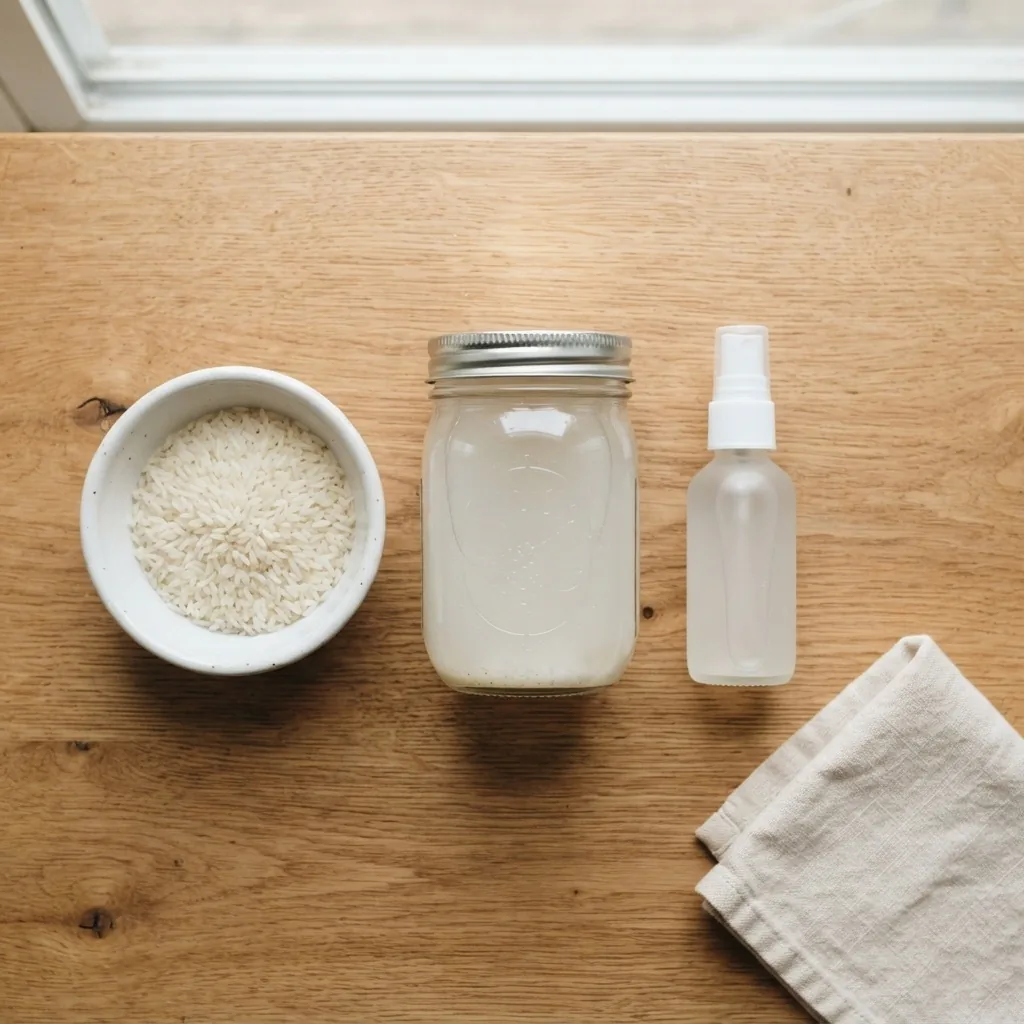
Half a cup of white rice, two cups of water, and a spray bottle. That is the entire supply list. I cannot think of a single other hair treatment that costs less than a dollar per use and is already in most people’s kitchens. For anyone on a tight budget, this is a legitimate reason to give it a try.
A Few More Benefits Worth Mentioning:
Beyond the ten listed above, rice water may also soften coarse strands over time, reduce static in dry seasons, and serve as a gentle alternative to store-bought protein treatments for people who react to synthetic conditioning agents. Some people with mild dandruff report that the scalp-balancing and anti-inflammatory properties of rice water help reduce flaking, though persistent dandruff should always be evaluated by a dermatologist.
But Does It Actually Grow Hair?
I want to give this question its own section because it is the biggest one, and I think it deserves a straight answer.
The honest answer is: not directly. Rice water does not appear to speed up the rate at which hair grows from the follicle. Hair grows roughly half an inch per month on average, and there is no topical rinse that meaningfully changes that rate. According to Medical News Today’s review of the available evidence on rice water and hair, the research points to benefits for hair strength, texture, and shine, but the evidence on actual growth rate is limited.
What does happen is that rice water can reduce the breakage that prevents many people from retaining length. If your hair is growing half an inch a month but breaking off half an inch a month, you are not seeing growth, even though it is happening. Reduce the breakage, and suddenly the growth starts showing up. That is the real mechanism behind the “growth” stories, and it is worth understanding before you start.
There is also some genuinely promising research on rice-derived ingredients at a deeper level. A 2022 systematic review on rice products and hair growth published in the Journal of Drugs in Dermatology (via PubMed) found that rice bran extract may support the anagen (active growth) phase of the hair cycle and inhibit 5-alpha-reductase, an enzyme linked to hair thinning. This is encouraging, but it is about rice bran extract, not a basic DIY soak, so the gap between that research and your kitchen bowl is worth acknowledging.
How to Make Rice Water at Home (Three Methods)
There are three main ways to make rice water, and which one you choose matters, especially if you are a beginner.
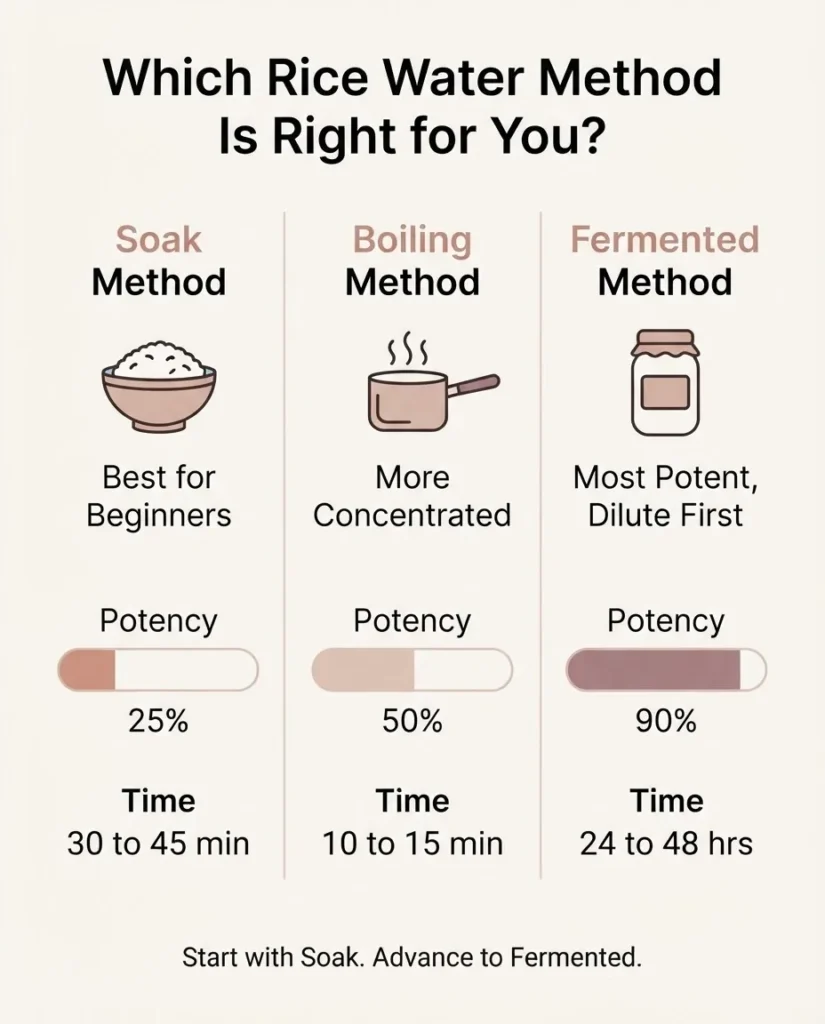
Method 1: The Soak Method (Best for Beginners)
This is where I recommend everyone start. It is the gentlest, the quickest, and the most forgiving.
Measure out about half a cup of plain white rice (jasmine or regular long-grain both work well). Rinse it quickly under the tap to remove surface dust. Add it to a bowl with one and a half to two cups of filtered water. Let it soak for 30 minutes to an hour. Some people go up to 24 hours for a more potent result, but for your first few uses, 30 to 45 minutes is plenty. Swirl the water gently until it turns milky, then strain the rice out. Transfer the water to a spray bottle or a small bowl. Use it fresh, or store it in the fridge for up to three to four days.
The soak method produces a mild, gentle rice water. It is the least likely to cause protein overload and the best starting point for beginners, fine hair, and low-porosity hair types.
Method 2: The Boiling Method
Instead of soaking, you cook the rice in more water than usual, then drain and collect the water. This produces a more concentrated starchy liquid. Some people dilute it with plain water before using it. The boiling method creates a denser treatment, but it also changes the composition slightly (heat affects some of the more delicate compounds). This method is often used for people who want the starch thickening and detangling effects specifically.
Method 3: Fermented Rice Water
This is the method most closely associated with the Red Yao tradition, and it is also the most potent. After making your soak-method rice water, you simply leave it at room temperature (covered) for one to two days. You will notice it starts to smell slightly sour. That sourness means fermentation is happening, and during that process, the amino acids in the water become more bioavailable and the pH drops, making it even more effective at smoothing the hair cuticle.
Fermented rice water has real advantages: it is more potent, more acidic (which helps more), and has a longer track record in traditional use. The downside is that beginners should always dilute it before use (roughly one part fermented rice water to two or three parts plain water), use it no more than once a week, and pay close attention to how their hair responds. The higher potency means the protein overload risk goes up. If your hair feels unusually stiff, dry, or brittle after using it, that is a signal to scale back.
Which Rice Works Best?
White rice (jasmine, long-grain, or basmati) is the most commonly recommended because it is less processed but still produces a good yield of starch and nutrients. Brown rice contains more nutrients in theory, but the bran layer also contains more phytic acid, and some sources note that brown rice may have slightly higher arsenic levels than white rice, which is worth knowing even though topical use is very different from eating it. Organic where possible is a nice bonus but not essential.
Step-by-Step: How to Use Rice Water on Your Hair
Here is the full process from wash day start to finish.
Step 1: Shampoo first. Wash your hair as normal. This is important because rice water works best on clean hair. Applying it over product buildup or oil means a lot of those beneficial compounds get blocked before they can do anything.
Step 2: Rinse out your shampoo completely. Squeeze out excess water with your hands so your hair is wet but not dripping. You want damp, not soaked, so the rice water is not immediately diluted down.
Step 3: Apply the rice water. Pour or spray it over your hair, making sure to saturate the lengths and ends.
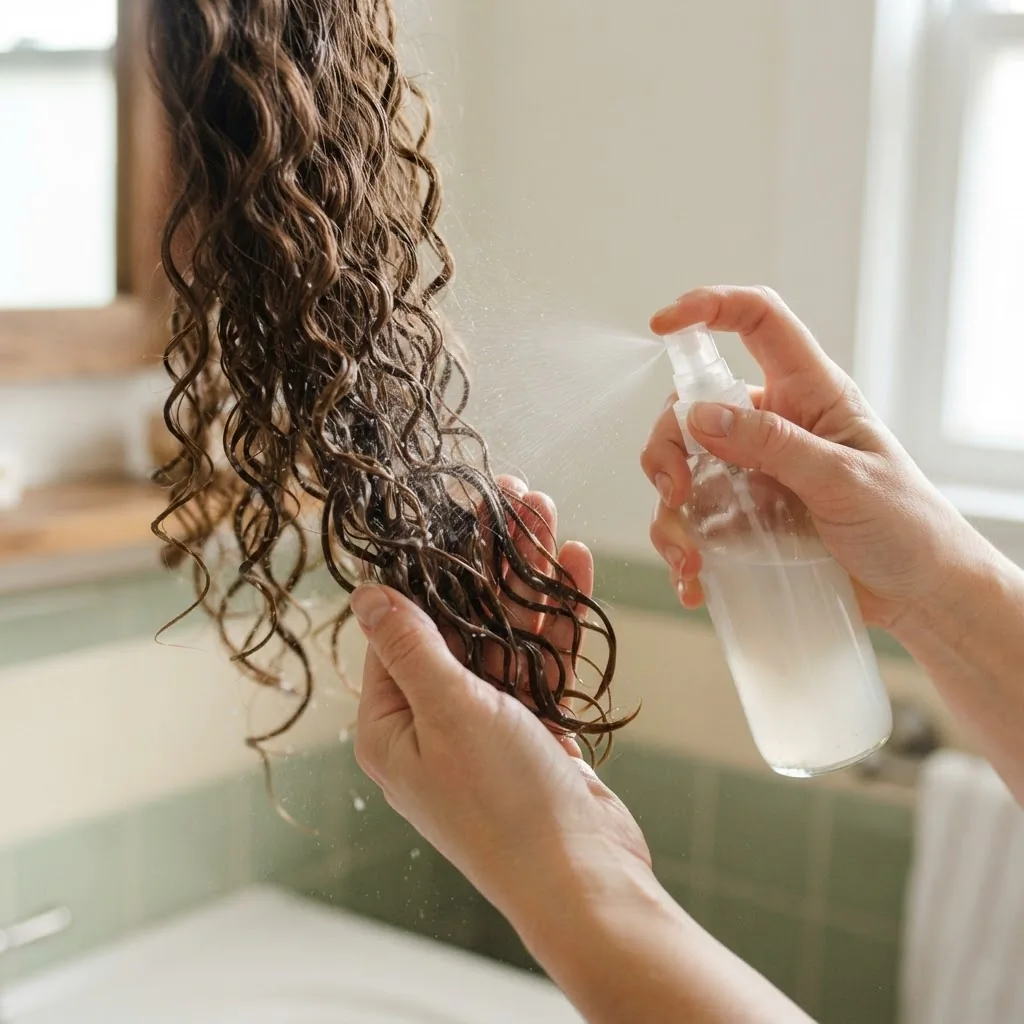
If you are also targeting your scalp (for shine, pH balance, or minor flakiness), you can massage a little into your scalp too. This is where I would use your spray bottle for even distribution.
Step 4: Let it sit. Leave it in for 20 to 30 minutes. You can sit under a shower cap, throw your hair in a bun, and do your skincare. If you have fine or low-porosity hair, 15 to 20 minutes is enough. There is no benefit to leaving it on for hours, and longer is not better here.
Step 5: Rinse thoroughly. Use cool to lukewarm water and rinse well. If you leave starchy residue in your hair, it can attract buildup and feel crunchy as it dries.
Step 6: Follow with conditioner. This step is non-negotiable. Rice water is a protein treatment, and protein without moisture is a fast track to brittle hair. Apply a moisturizing conditioner, let it sit for a few minutes, and rinse. The combination of protein from the rice water and moisture from your conditioner is where the real magic happens.
Hair Type Guide: How to Adjust for Your Hair
This is where most tutorials fall short, so I want to be specific.
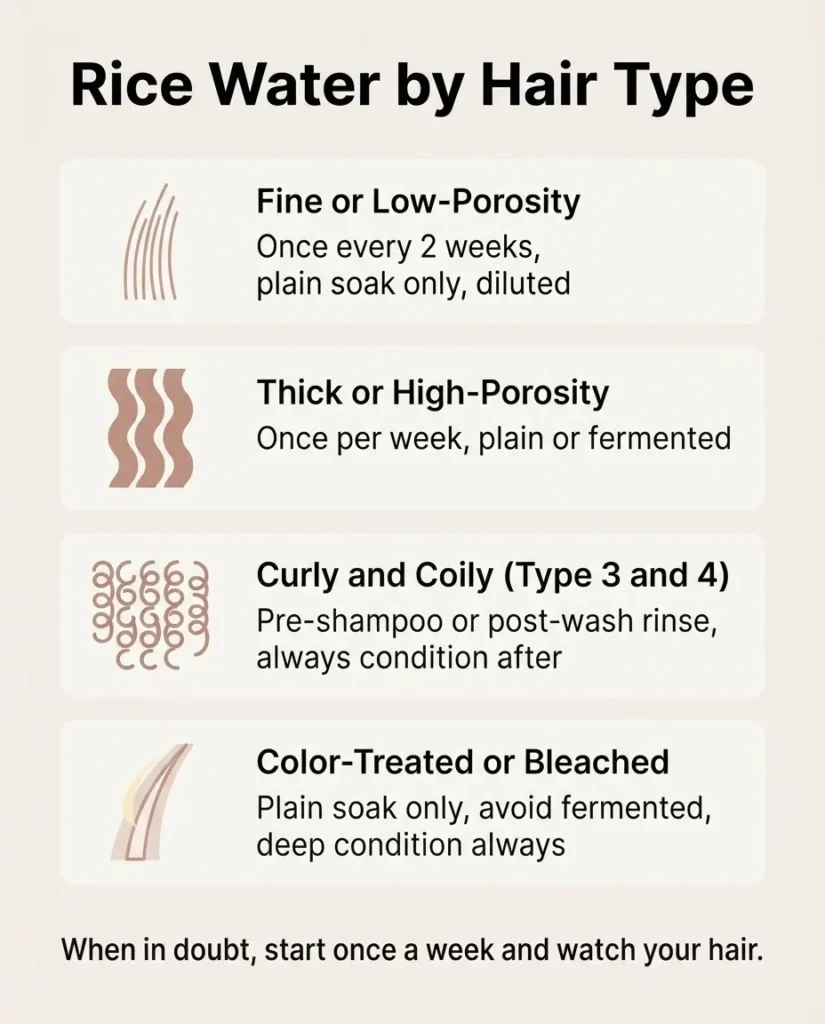
Fine or low-porosity hair: You are the most prone to protein overload. Start with the plain soak method, diluted slightly, and use it no more than once every two weeks to start. Watch how your hair feels. If it becomes stiff, dry, or harder to detangle, stop and do a deep moisture treatment.
Thick, coarse, or high-porosity hair: Your hair can generally handle rice water better and may need it more. High-porosity hair (often bleached, heat-damaged, or chemically processed) has gaps in the cuticle that the amino acids and inositol can actually fill in and strengthen. You can use it once a week with good results.
Curly and coily hair (type 3 and 4): Rice water can be transformative for reducing frizz and improving definition, but again, watch for protein overload, especially if you are already using other protein treatments in your routine. Use it as a pre-shampoo soak or a post-shampoo rinse, and always follow with a rich moisturizing conditioner.
Color-treated or bleached hair: Your hair is porous and may respond really well to the strengthening benefits. But be extra careful with fermented versions and always do the conditioner step. If your hair is very recently bleached or processed, it is worth waiting a week or two before introducing a new treatment.
Scalp sensitivity or ongoing hair loss: This is a spot where I want to be direct. Rice water is a cosmetic treatment, not a medical one. If you are experiencing significant hair loss, scalp irritation, or shedding that concerns you, WebMD recommends talking to your doctor before relying on rice water as a treatment, since hair loss has many root causes and most of them need more targeted intervention than a kitchen rinse can provide.
How Often Should You Use It?
Once or twice a week is the standard recommendation, and I would add that beginners should start at once a week and see how their hair responds for two to three weeks before increasing. More is not better with protein treatments. Protein overload is real, it is common, and it is the number one complaint in every rice water comment section I have ever read.
What Is Protein Overload and How Do You Know If You Have It?
This is the section I wish existed in every rice water article I came across early on, because it is the part nobody talks about clearly.
Protein overload happens when your hair has absorbed more protein than it can balance with moisture. The signs are: hair that suddenly feels stiff, dry, and almost like straw.
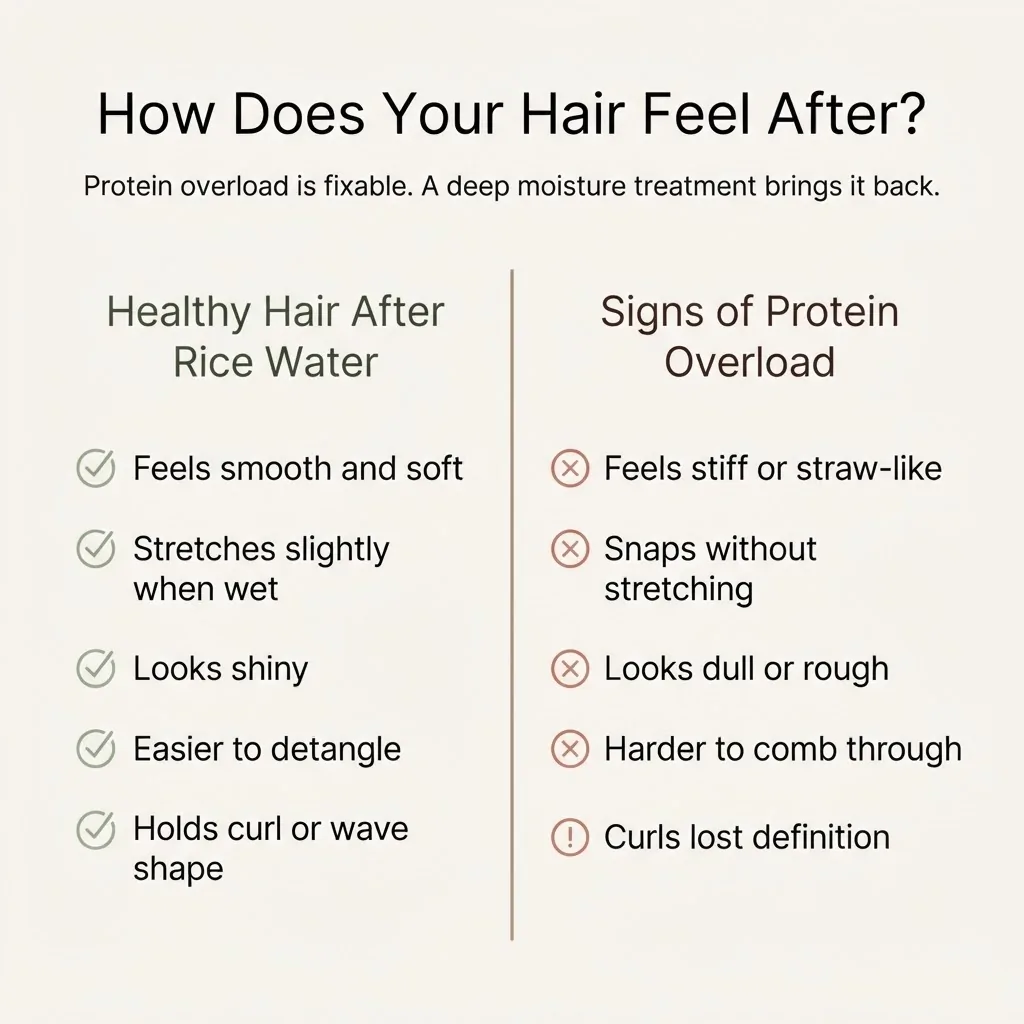
Hair that used to be stretchy when wet but now snaps without any give. Hair that is harder to detangle than normal. Hair that looks dull instead of shiny. In curls, it often shows as a loss of definition and more frizz, not less.
The fix is simple: stop rice water immediately, do one or two deep moisture treatments (a hydrating mask or a heavy conditioner left on for 20 to 30 minutes), and give your hair a break from protein for a few weeks. You did not ruin your hair. You just temporarily oversaturated it with protein, and moisture will bring it back.
The Arsenic Question (Calm, Clear Answer)
You have probably seen this floating around and it sounds alarming, so I want to address it plainly. Rice does contain trace amounts of arsenic, and this is a legitimate concern for dietary consumption of rice over time. However, applying rice water topically to your hair is not the same as eating rice every day. You are not ingesting it, and the amounts involved in a rinse-out topical treatment are very different in terms of exposure.
That said, using filtered water to make your rice water is a sensible choice, rinsing it out thoroughly is important, and there is no reason to use it daily. At the once-or-twice-a-week frequency that experts recommend, topical use is considered to be very low risk. If you are concerned or have specific sensitivities, basmati rice (which tends to have lower arsenic levels than other varieties) is a practical choice.
Fermented Rice Water: Is It Worth the Extra Step?
For most beginners, I would say: master the plain soak method first. Once you have used it a few times and know how your hair responds, then try fermenting. The fermented version really does seem to work better for a lot of people because the fermentation process makes the amino acids more potent and the lower pH gives it more smoothing power. But it is also more likely to cause protein overload if you are not careful, and it smells noticeably sour, which some people love and others do not.
If you go the fermented route, dilute it before use, apply it the same way as the plain method, and rinse it out thoroughly.
A Note on Store-Bought Rice Water Products
If making your own feels like a hurdle, there are now a number of rice water-based products on the market, from rinses to shampoos to leave-in treatments. The advantage is consistency and convenience. The downside is that some products are mostly marketing with very little actual rice water in the formula, and they can be significantly more expensive than making it yourself. If you go this route, look for rice water or oryza sativa (the scientific name for rice) listed in the first half of the ingredients list. If it is buried near the bottom, it is mostly a branding play.
Frequently Asked Questions
Can I leave rice water in my hair overnight?
Most stylists and hair experts do not recommend leaving rice water in overnight. The protein concentration can cause stiffness and buildup if it sits too long without being rinsed. Twenty to thirty minutes is the sweet spot, and the research on inositol actually suggests it continues working even after you rinse it out, so longer does not mean better.
Do I need to shampoo after using rice water?
No. The standard method is to shampoo first, apply rice water after, and follow with conditioner before your final rinse. You do not need to shampoo again after the rice water step.
Can I use it on dry hair?
Some people spray diluted rice water on dry hair as a curl refresher or frizz smoother between wash days. This can work, but use a very diluted version and do not use it every day. Daily protein application adds up quickly.
Which is better, plain or fermented?
Fermented has more potency and a lower pH, which many people find gives better results for shine and smoothness. But it is also more likely to cause protein overload. Start plain, then experiment with fermented once you know your hair tolerates it.
Realistic Expectations: What to Expect in the First Month
Week one: your hair may feel a little different after the first use, sometimes very smooth, sometimes slightly stiff if you left it on too long or did not condition after. Give it a few uses before you decide.
Week two through four: if your hair responds well, you will likely notice less breakage when detangling, smoother texture, and slightly more shine. These are real, cumulative improvements. They are not dramatic overnight transformations, but they are consistent.
One month in: for many people, this is where the length retention benefit starts to become visible.
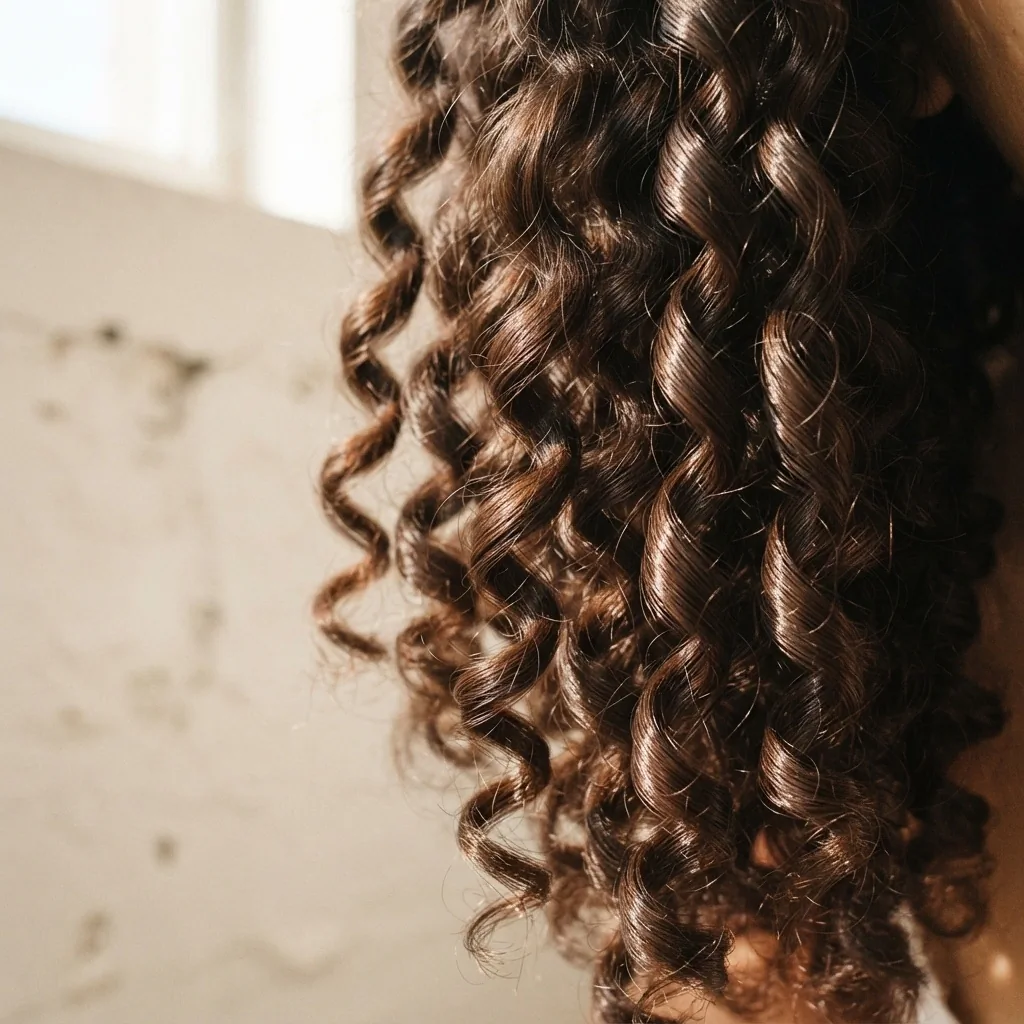
Less breakage over four weeks adds up. This is also when you will know definitively whether you are prone to protein overload and whether you need to adjust your frequency.
The bottom line is that rice water works for a lot of people, it is safe and affordable to try, and the worst realistic outcome is temporary protein overload that a good deep conditioner fixes within a week. That is a pretty low-risk experiment for something that might genuinely improve your hair health over time.