Sibling Tattoos: How to Choose a Design You’ll Both Love
There is a text I get more than almost any other from my friends. It reads something like: “We decided we want to get sibling tattoos. We have no idea where to start. Help.”
I love getting that text. Not because I have all the answers ready for them, but because that moment, the one where two or three people decide they want to carry a piece of their bond on their skin forever, is one of the most meaningful things you can do with a tattoo. It is not just a design decision. It is a relationship decision. It deserves to be treated as one.
The problem is that most of what is out there for sibling tattoo inspiration is pure visuals: gorgeous galleries of photos with almost no guidance on how to actually choose something, coordinate it, and walk into a studio feeling sure. This article is the guide I wish I could send every one of those friends when they text me. Whether there are two of you or five, whether you have been planning this for years or you are in the very early daydream stage, let’s work through it together.
Why Sibling Tattoos Deserve More Planning Than Most
Getting a tattoo with someone you love is one of the most joyful, bonding experiences in the world. I say that as someone who has sat for more sessions than I can count. But the same closeness that makes it special is exactly what raises the stakes.
When it is just your own tattoo, you answer only to yourself. When it is a sibling piece, you are making a creative and permanent decision alongside someone else. That means two sets of opinions, two bodies with different proportions and skin tones, possibly two cities, and definitely two different pain tolerances. None of that is a problem. It just means the planning phase matters more, not less.
Regret with sibling tattoos, when it does happen, almost always comes from rushing. From choosing a design because it looked good on someone else’s Pinterest board without asking whether it will work on both of you. From not talking to each other honestly about size, placement, and style before sitting down with an artist. Good planning is not a buzzkill. It is how you protect something you are going to care about for the rest of your life.
Matching vs. Complementary: The First Decision to Make Together
Before you look at a single design, the two of you need to agree on one fundamental question: do you want matching tattoos or complementary ones?
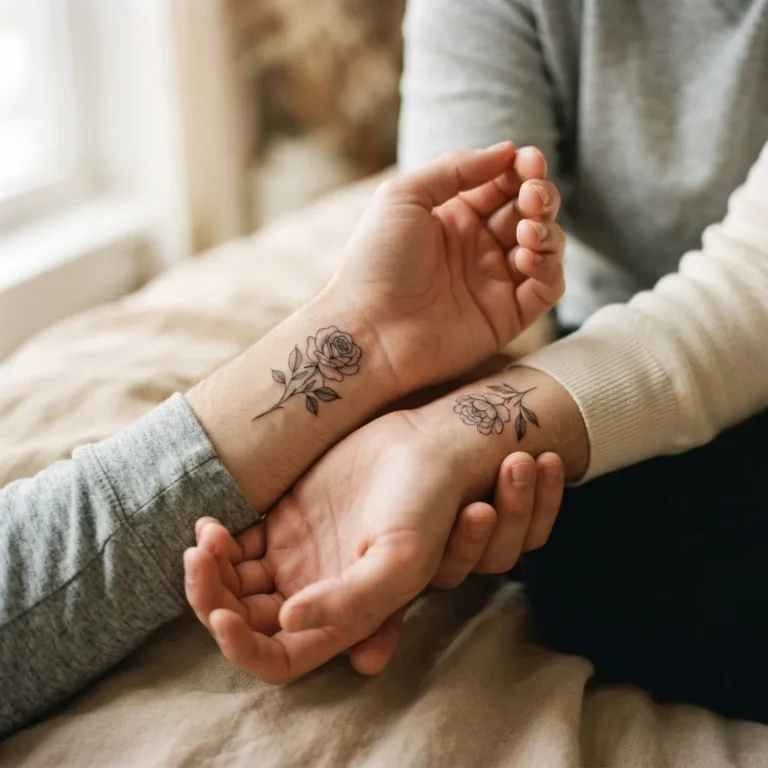
Matching tattoos are identical designs placed on each person. Same image, same size, same style. When you hold your wrists side by side, they are mirrors of each other. This is the classic vision people have in mind. It works beautifully for simple, timeless designs like a shared symbol, a date in Roman numerals, or a single word that means something to both of you. Matching tattoos are also the most recognizable way to telegraph the connection to the world, which some siblings love and others feel is a little too literal.
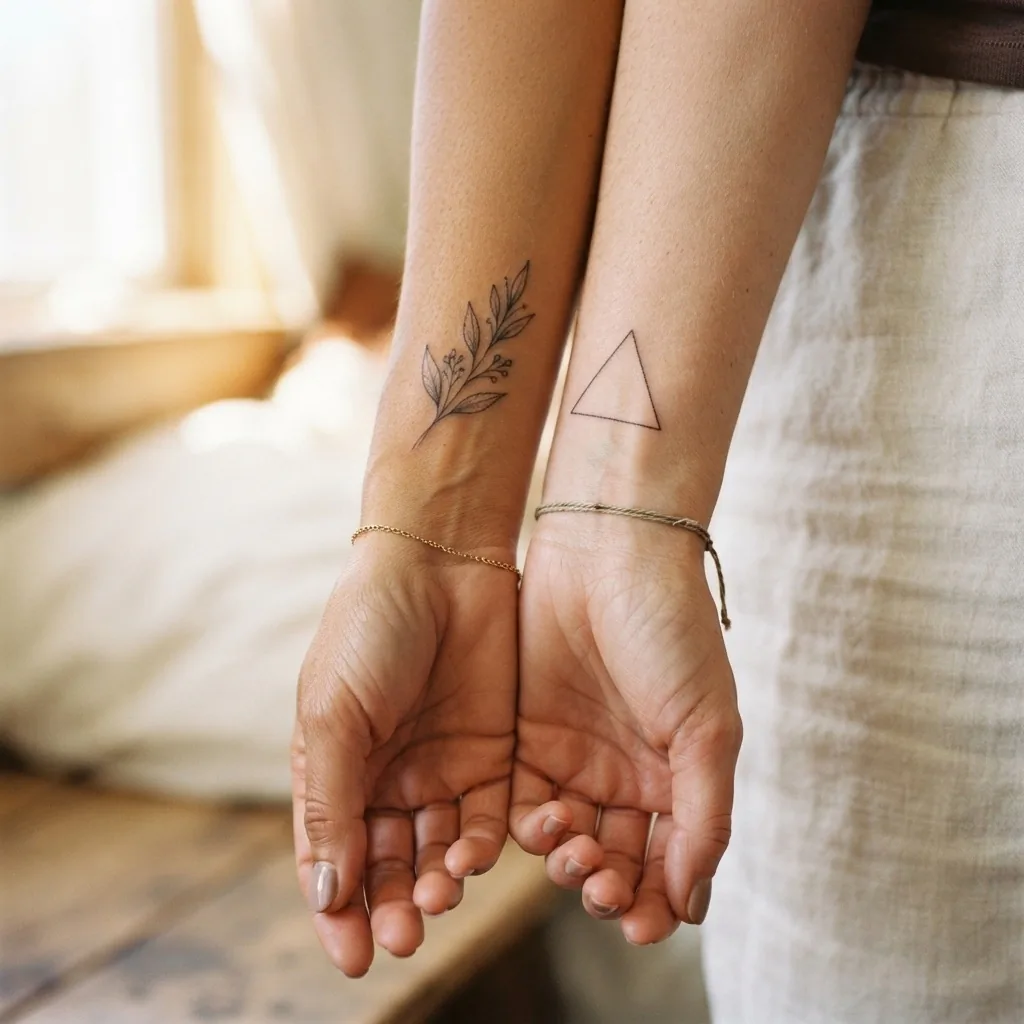
Complementary tattoos are designed to go together without being identical. Think sun and moon, two halves of a broken heart, a question mark on one person and an exclamation point on the other, or two flowers from the same botanical family. Complementary designs allow for more personality and individuality. If you and your sibling have very different aesthetics, this approach lets both of you have a piece that feels authentically yours while still clearly belonging to a set.
There is no right answer. The question to ask yourselves is: do we want the world to immediately know these go together, or do we want something that is more of a secret between us?
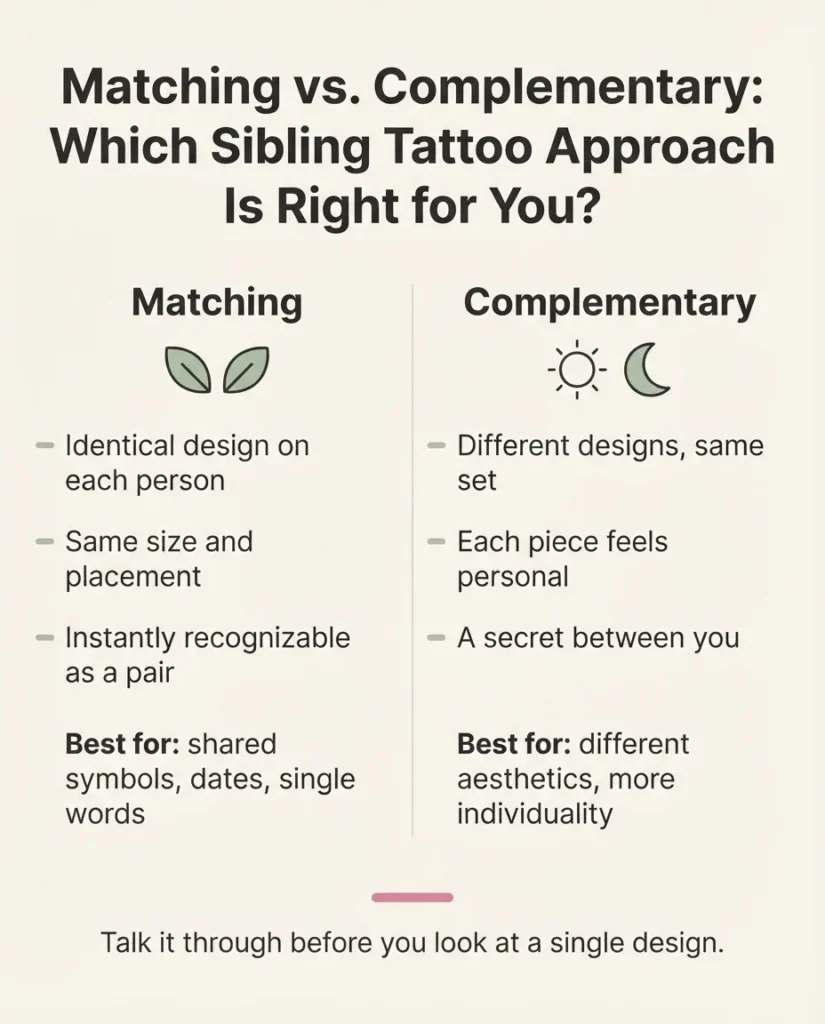
Both are beautiful. Both are valid. But settling this question early saves a lot of time and prevents design-planning arguments later.
8 Sibling Tattoo Ideas Worth Considering
These are the design directions I most often suggest when friends ask me for ideas. They span a range of aesthetics, from very personal and text-based to purely visual, so at least one of them should resonate with where you and your sibling are starting.
1. Birth Flowers, One for Each of You
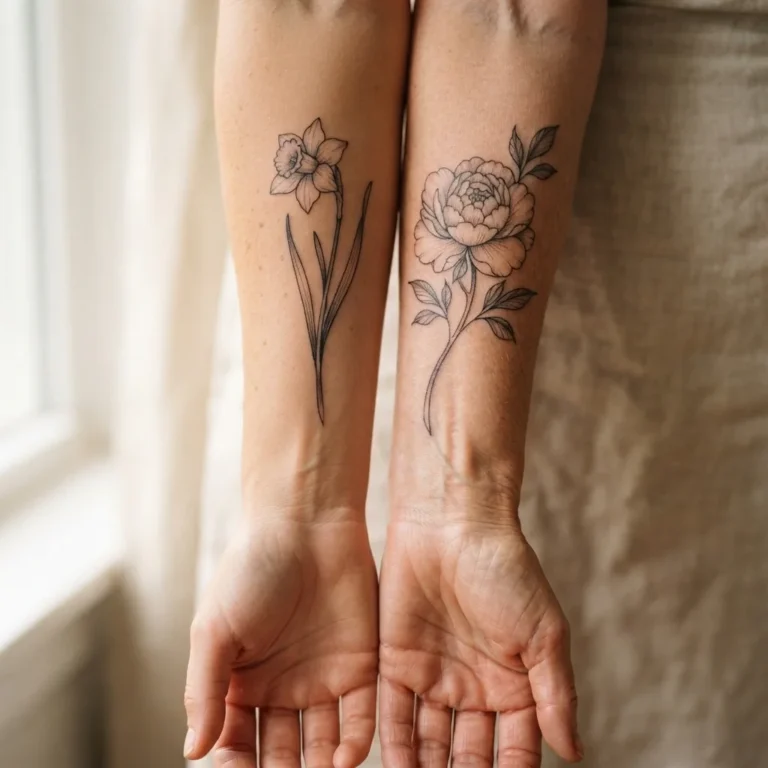
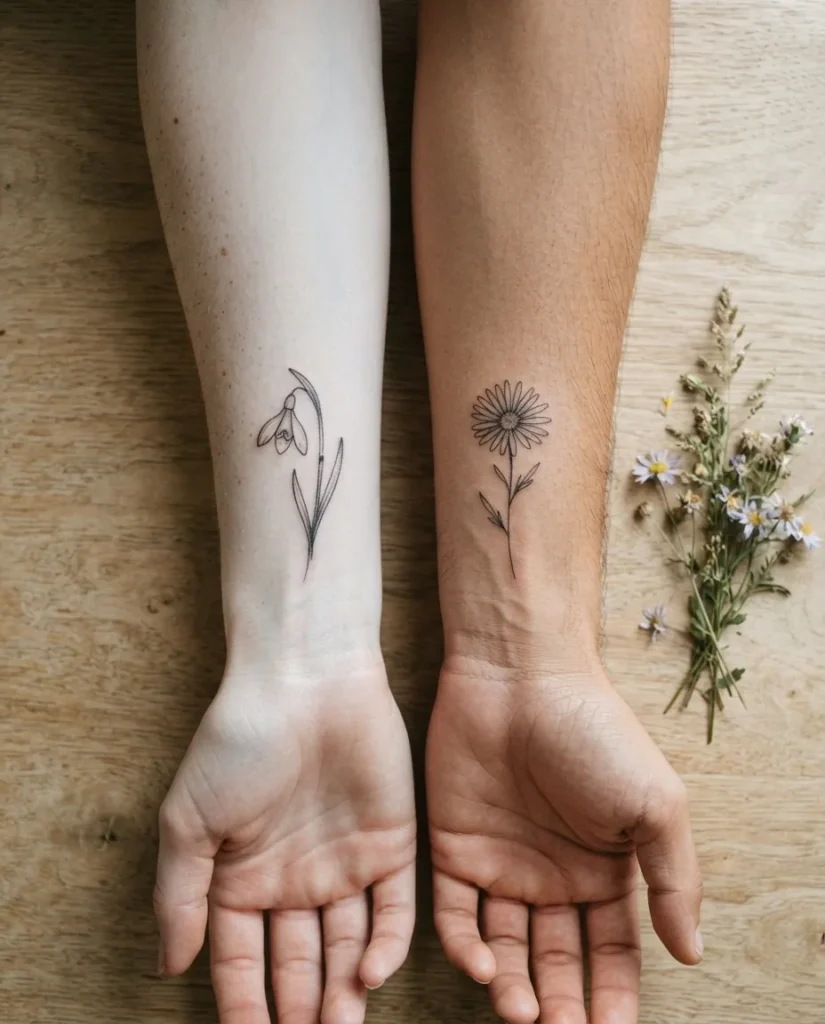
Every month of the year has a designated birth flower, and a set of sibling tattoos that features each person’s bloom is one of the most personal and beautiful approaches you can take. What makes this work is that the flowers are different by design, so each person ends up with something that is uniquely theirs, but the set clearly belongs together. A January snowdrop for one sibling and a September aster for another, rendered in the same fine-line style by the same artist, read as a set while also honoring each person individually. For larger sibling groups, this scales beautifully because every person gets their own flower and no two are the same.
2. A Shared Coordinate or Location
A set of coordinates representing the place where your family grew up, the hospital where you were both born, or a location with deep significance, like a grandparent’s home or a lake you returned to every summer, is one of the most quietly meaningful tattoo ideas I know. Coordinates are typically small and clean, work in almost any placement, and age extremely well because they are essentially a series of numbers and letters with no fine detail to blur over time. They can be identical on both people or staggered slightly, one set per person representing a different meaningful location that still tells a shared story.
3. Sun and Moon (Done Thoughtfully)
Sun and moon tattoos are popular for good reason. The imagery has been used across cultures and centuries to represent duality, balance, and complementary forces that are stronger together than apart. For siblings, it can capture a dynamic beautifully, the one who lights up every room and the one who is the steady, calming presence. The key to making this feel fresh in 2025 is the execution. Work with an artist on a rendering that feels specific to you both rather than pulling directly from a template. Fine-line celestial work, a delicate crescent with botanicals, or a minimalist sun with rays that incorporate a personal element can take a familiar motif somewhere genuinely original.
4. A Celtic or Infinity Knot
Celtic knot designs carry centuries of symbolism around continuity, interconnection, and the bonds that cannot be broken. The triquetra, sometimes called the Trinity Knot, is especially popular for three siblings, as its three interlocking points can represent each person in the set. You can read more about the origins and meaning of Celtic knot designs at sources like Byrdie’s deep-dive on Celtic knot symbolism, which gives helpful context if you want to make sure the design you choose carries the meaning you intend. For sibling tattoos, a knot design communicates the unbreakable-bond idea without having to spell it out literally, which many people prefer.
5. A Line from a Shared Poem, Book, or Song
Text tattoos are deeply personal and endlessly flexible. For siblings, a line from a book your mother read to you both, lyrics from a song that was on at every family gathering, or even a phrase one of you always says to the other can become a tattoo that only the two of you fully understand. The most important thing here is font choice and sizing. Script tattoos can become difficult to read over time if they are too small or too thin. Your artist will be able to advise you on the minimum legible size for the style you want, and that conversation is worth having before you fall in love with a four-word phrase that turns out to be too long to work at the size you envisioned.
6. Minimalist Animal Pairs
If you and your sibling connect with the natural world, a pair of small, minimalist animals can make a beautiful sibling set. Think two birds on a branch, a fox and a rabbit, a pair of whales, or two fish swimming in opposite directions. This works especially well for siblings who have very different styles, because minimalist wildlife can be rendered in ways that range from playful and cartoonish to clean and almost abstract. The key is finding an artist who has genuine experience with this aesthetic, because minimalism is deceptively technical: every line has to carry weight, and there is nothing to hide behind if the proportions are off.
7. Roman Numerals: A Date That Belongs to Both of You
Roman numerals are a classic for good reason. A shared birthday, the year a parent passed away, the year a major family event happened, or even the year you each got your first home can all become a clean, minimal tattoo that wears beautifully on almost any placement. For sibling sets, the numerals can be identical on each person, or you can each take one piece of a date, one person wearing the month and day and the other wearing the year, so that the full meaning only reveals itself when you are together.
8. Something You Designed Together, from Scratch
This is my personal favorite approach and the one I always suggest to siblings who have been close-knit their whole lives. Sit down together, with a sketchbook or even a phone notes app, and start writing down every symbol, image, phrase, and feeling that comes to mind when you think about your relationship. What is the inside joke that has followed you for twenty years? What did you both love as kids? What does this person mean to you in a single image? Take that raw material to your artist as a conversation starter, not as a finished brief. The best sibling tattoos I have ever seen came from people who walked into a consultation with a feeling and let a skilled artist help them turn it into something visual.
How to Think About Placement and Sizing
Placement is where a lot of sibling tattoo plans run into trouble, and it is one of the things almost no inspiration gallery ever addresses properly.
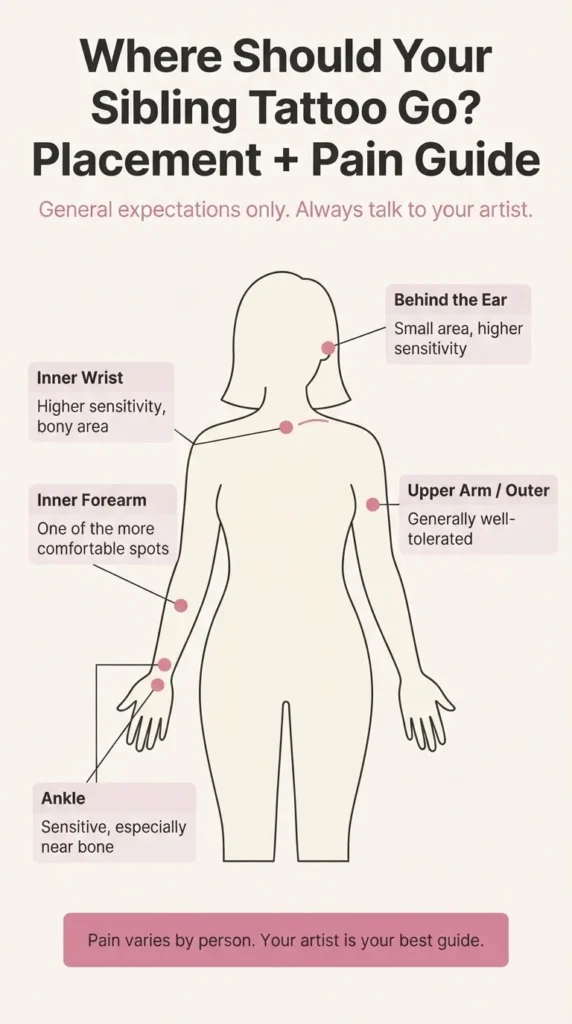
The most popular placements for sibling tattoos are the wrist, the inner forearm, the ankle, behind the ear, and the collarbone. All of these are visible without effort, which is often the point: you want to be able to glance down and see it. But visibility comes with a trade-off. As Healthline’s medically reviewed pain chart by body location explains, areas with less fat, thinner skin, or proximity to bone tend to involve more discomfort during the session. The wrist, ankle, and collarbone are all areas where most people report a noticeable sting, more so than the outer forearm or upper arm, for example. This is not a reason to avoid those spots. It is information to have going in so that neither of you is surprised in the chair.
Sizing matters just as much as placement, and the two are connected. A design that works perfectly at three inches on a taller person with a longer forearm may look cramped or stretched on a shorter person with a smaller wrist. If you and your sibling have different body types, bring that up at your consultation. A good artist will adjust scale and proportion to make the design land correctly on each body, which is one of the biggest arguments for having both of you present at the consultation, or at minimum having detailed measurements and reference photos of both of you on hand.
Another consideration: if one of you is placing the tattoo somewhere that will be regularly exposed to sun and one of you is not, your long-term maintenance needs will be different. Sun is one of the biggest enemies of tattoo vibrancy over time. Once any tattoo is fully healed, consistent SPF protection for exposed pieces is genuinely important for keeping the ink looking sharp for years to come.
Coordinating When You Live in Different Cities
This is one of the most practical questions siblings ask and one that almost no existing resource answers. Here is what actually works.
The cleanest solution is to choose one artist for both of you and make a trip of it. Book a single consultation with one licensed artist you both trust, explain that you are creating a coordinated set, and let that artist design and execute the work on both of you, ideally in the same session or on consecutive days. This guarantees visual consistency in line weight, ink density, and style. It is the single most important thing you can do for the long-term look of a sibling set.
If geography truly makes that impossible, the next best option is to find two artists in different cities who work in the same aesthetic, share reference images between them, and be explicit with both artists that you are creating a matched or complementary set. This requires more coordination but it is workable, especially for simpler designs where the risk of inconsistency is lower.
What does not work as well is choosing different artists independently, comparing designs over text, and hoping for the best. Fine-line work especially has very different “handwriting” from artist to artist, and what looks similar in a reference photo can end up feeling quite different when executed by two different people.
How to Find and Vet a Licensed Artist for a Coordinated Set
Finding a good artist for a solo tattoo is already important. Finding one for a coordinated sibling set requires a little more intentionality.
Start with portfolios. The platforms to search are Instagram and the artist’s own website, if they have one. You are looking specifically for healed work, not just fresh tattoos straight off the table. Fresh ink looks beautiful on everyone. What you want to see is how the artist’s work holds up six months or a year later, because that is what you will be living with. Look for consistency in line quality, clean edges, and ink that has settled evenly rather than blurring or fading unevenly. If an artist’s portfolio does not include healed photos, ask for them at the consultation.
Licensing is non-negotiable. Every legitimate tattoo studio operates under state or local body art licensing regulations, and every professional artist should be able to show you their credentials. You want to see a clean, inspected facility, single-use needles, properly sterilized equipment, gloves worn throughout the process, and ink that is opened fresh for your session. OSHA’s Bloodborne Pathogens Standard requires tattoo establishments to implement specific hygiene and safety controls, and understanding that a licensed studio is operating within these standards is part of what should give you confidence when you walk in. If a studio feels off, if the space is not clean, if the artist cannot answer basic questions about their sterilization process, walk away.
At the consultation itself, come prepared. Bring visual references, the more specific the better. Bring photos of placements you like on real bodies, not just design close-ups. If both siblings can attend together, bring you both. Tell the artist directly: this is a coordinated set, we want the designs to feel like they belong together, how do you typically handle that? A skilled, experienced artist will have a clear process for coordinated work and will be excited about the design challenge.

Questions worth asking at the consultation include: Have you done sibling or matching sets before? Can we see examples? How do you adjust sizing when clients have different body proportions? What is your healing and aftercare recommendation? Do you offer touch-ups if something heals unevenly?
What to Expect on the Day
Walking into your appointment knowing what to expect is one of the best gifts you can give yourself. Here is the general shape of a professional tattoo session.
You will fill out consent paperwork and a health intake form. This is where you will note any known allergies, skin conditions, or medications you are taking. If you have a history of skin sensitivity or allergic reactions, it is worth mentioning to your artist and discussing with your dermatologist before your appointment. The FDA’s tattoo safety information notes that reactions to tattoo inks, including infections from contaminated inks and allergic responses, do occur, and that certain ink colors are more commonly associated with reactions than others. Your artist should be using high-quality, professionally sourced inks, but asking is always appropriate.
Your artist will apply a stencil of the design to your skin before anything permanent happens. This is the moment to speak up if the placement feels wrong, the size looks off, or you want to adjust anything. A good artist will expect this and welcome the feedback. Take your time here. Look at it in a mirror. Look at it on your sibling’s body too. Do not let anyone rush you past this step.
During the session itself, what you feel will vary depending on placement. Most people describe it as a scratching or burning sensation rather than sharp pain. It is manageable. It is finite. Taking slow, steady breaths helps more than most people expect. Eat a good meal beforehand, stay hydrated, and wear clothing that gives easy access to the placement area.
Aftercare: The Part That Determines How It Actually Looks
The tattoo is done at the studio. The healing happens at home. And how your sibling tattoos look in two years depends almost entirely on how you both care for them in the first few weeks.
Your artist will give you specific aftercare instructions, and those instructions are the ones you follow. Full stop. They know their specific inks, their technique, and what their clients’ healed work looks like. The information below is general context only, not a substitute for what your own artist tells you.
Generally speaking, the surface of a new tattoo heals within two to four weeks. The skin underneath takes considerably longer to fully settle, sometimes up to three or four months. During the initial healing phase, keeping the area clean and moisturized with a gentle, fragrance-free product is the standard approach most artists recommend. The American Academy of Dermatology’s guide to caring for tattooed skin is a helpful general reference for understanding what the skin is going through and what to avoid, such as petroleum-based products, excessive sun exposure, and picking at peeling skin.
One thing worth knowing, and worth sharing with your sibling so you are both on the same page: skin reactions to tattoo ink can happen. The AAD notes that reactions can occur immediately after getting a tattoo or even years later. If you notice anything unusual, including prolonged redness, swelling, warmth, discharge, or an itchy rash that develops in the weeks after healing, see a dermatologist or your primary care provider rather than trying to treat it on your own.

The AAD’s resource on tattoo skin reactions covers the range of what these reactions can look like and is worth bookmarking before your appointment.
For the long term, once your tattoos are fully healed, sun protection is the single most important thing you can do to keep them looking the way they looked when they were fresh. Apply a broad-spectrum SPF to any exposed ink before time outdoors, and make it a year-round habit.
A Final Note Before You Book
Here is what I always tell the friends who text me for advice before they sit down together with an artist: the fact that you are thinking this hard about it already means you are going to make a good choice.
Sibling tattoos are not about finding the trendiest design or the most Pinterest-worthy composition. They are about finding something that is true to your relationship, something that will still feel right in ten years, in twenty, when you are both sitting at a kitchen table somewhere and you glance down and remember exactly why you did this together.
Take your time with the design. Choose a licensed artist who understands what you are trying to create. Show up to your appointment informed, fed, and ready. Follow your aftercare instructions. And enjoy every single minute of the planning, because that part, the dreaming and deciding together, is honestly some of the best of it.
You have got this.