Mother Daughter Tattoos: 12 Ideas Worth Pinning Forever
The question I get most often from friends before they book a tattoo is some version of “is this a good idea?” But when the question involves a mother-daughter tattoo, it gets a little more tender. There’s something different about a piece of ink that represents a relationship. It’s not just “do I love this design?” It becomes “does this feel like us?” And that question, honestly, is one of my favorites to help someone answer.
I’ve watched friends plan these tattoos beautifully and walk away with pieces they adore. I’ve also watched the process get rushed, resulting in a design that was chosen quickly without thinking through how it would feel for both people involved. The difference, almost every time, comes down to information and intention. So that’s what this is: a real, thorough guide to mother-daughter tattoo ideas, what they mean, how they age, where to put them, and how to plan the whole thing with a licensed artist who can bring your shared vision to life.
This is a big decision. Let’s treat it like one.
Matching vs. Complementary: The First Choice to Make
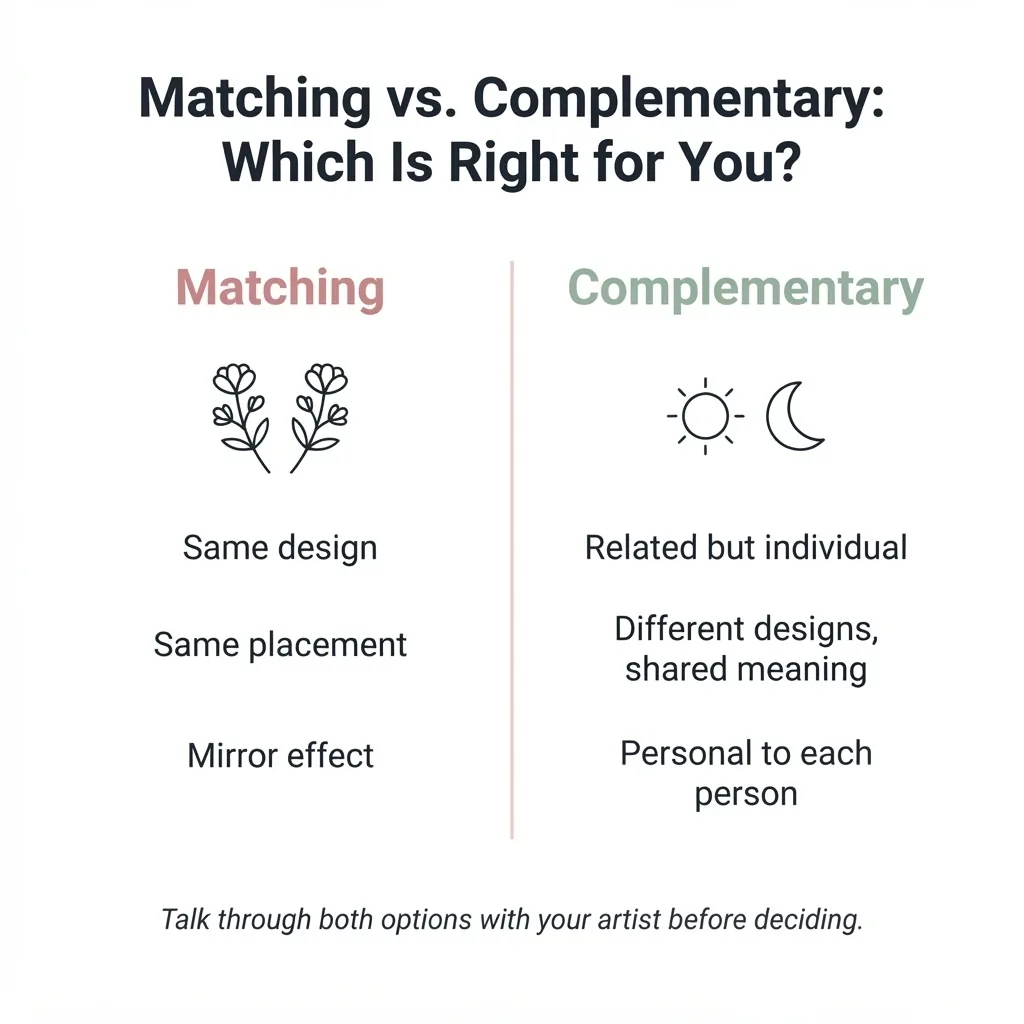
Before you land on a design, there’s a concept worth understanding because it changes everything about the planning process. There are two fundamentally different approaches to mother-daughter tattoos, and most inspiration galleries online mix them together without explaining the distinction.
A matching tattoo is identical on both people. The same design, the same size, the same placement, the same everything. There’s something undeniably powerful about that kind of symmetry. When you two stand next to each other and show them, they’re mirrors.
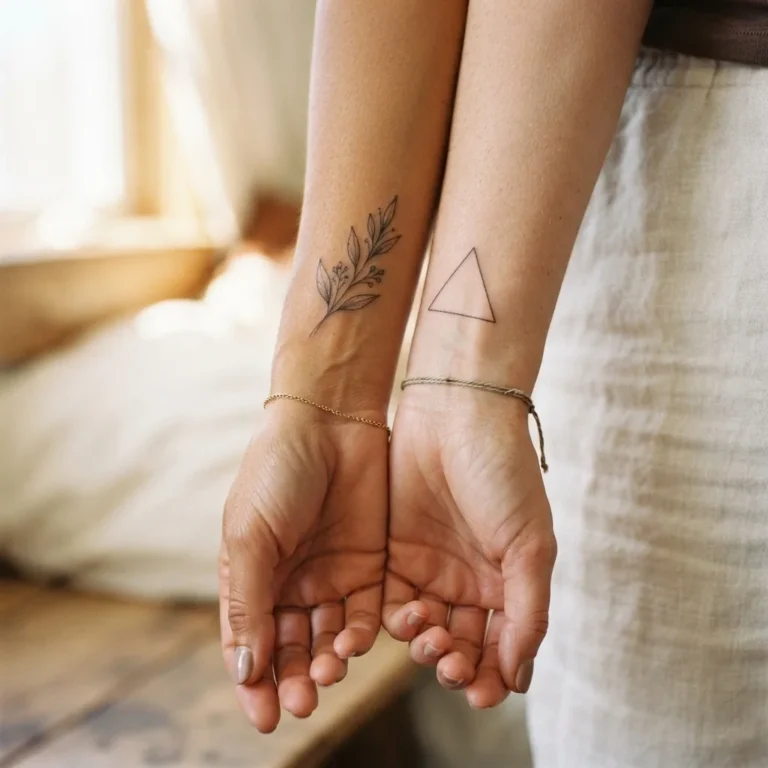
A complementary tattoo is related but not identical. Think of a sun on one and a moon on the other. Or a stem on one person and the bloom on the other. Or two birds from the same flock, facing different directions. The designs connect meaningfully without being copies. This approach allows for more individuality. It lets each person have something that suits her own body, her own style, and her own sense of what looks right on her skin, while still sharing a visual and emotional language with the other person.
Neither approach is more meaningful than the other. The right choice depends entirely on what feels true to your relationship. Some mothers and daughters are proud of being almost identical. Others celebrate the ways they’re different while staying deeply connected. Both are beautiful. Deciding which direction you’re going before you start searching for designs will make the whole process easier and more focused.
12 Mother Daughter Tattoo Ideas Worth Loving for Years
1. Birth Flower Pair
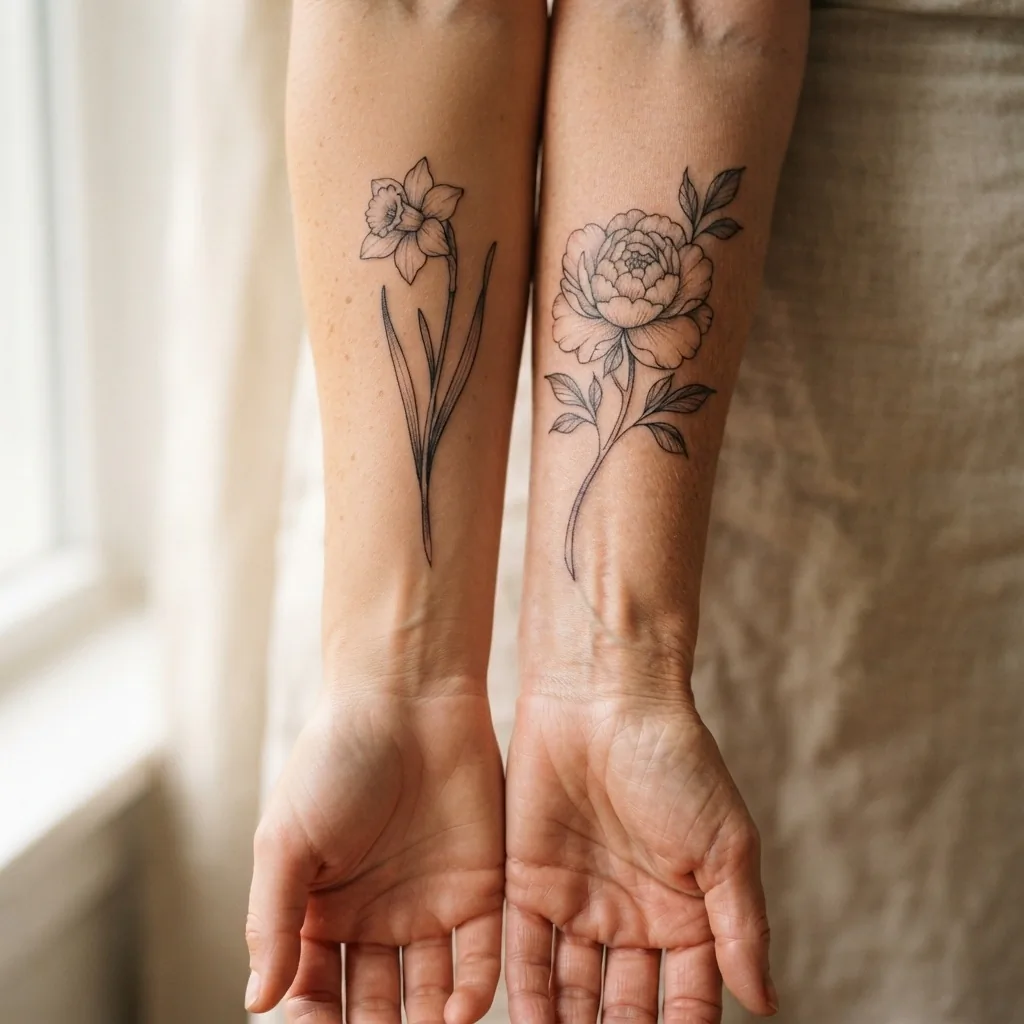
This is one of the most personal and visually versatile options available, and it’s having a major moment right now. Each of you gets your own birth month flower, either matching in style or slightly different in detail to reflect your individual personalities. The result is two tattoos that are obviously a set but don’t have to be identical, which makes them especially beautiful when you have different aesthetic preferences.
January is the carnation, February is the violet, March is the daffodil, and so on through the year. If you want to go deeper into the meaning of each flower before choosing, Tattoo Wizard’s birth flower guide by month is a lovely, thorough reference. Artists who specialize in fine-line botanical work can make these look extraordinary, especially on the inner forearm or wrist.
2. Fine-Line Floral Matching
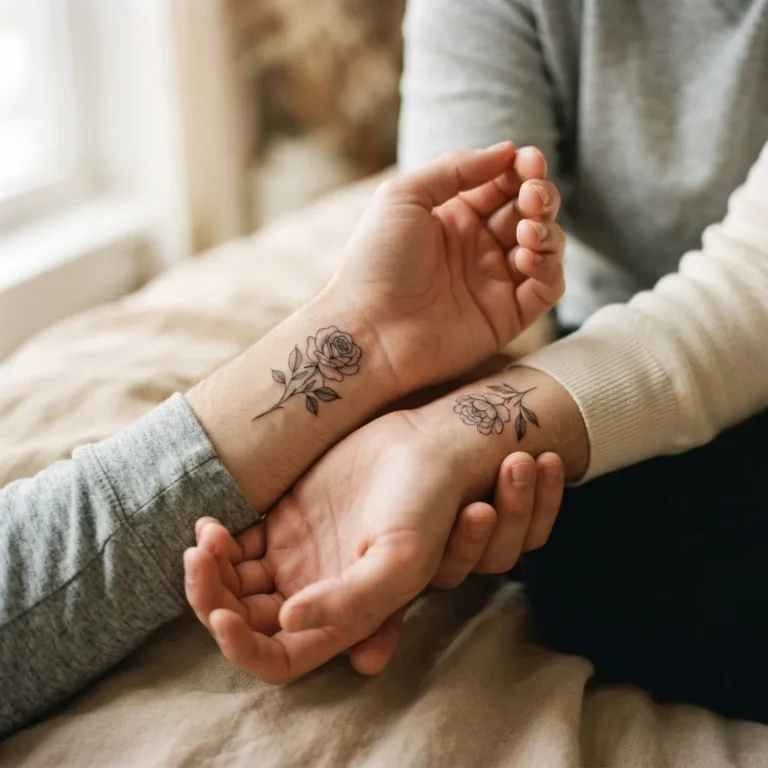
Fine-line work has become the dominant trend for intimate, delicate tattoos, and it suits the mother-daughter aesthetic beautifully. A small bouquet, a single peony, a sprig of lavender, a wild rose. The style is subtle enough to feel personal rather than loud, and skilled fine-line artists can pack incredible detail into a small space.
One thing to know about fine-line tattoos: they are gorgeous, and they do change slightly over time. The ultra-thin lines that look razor sharp on day one will soften a little as years pass. This is completely normal and doesn’t ruin the piece; it just shifts it. Artists consistently recommend choosing placements with minimal skin stretching and movement, like the upper arm or outer forearm, to help fine-line work hold its precision longer.
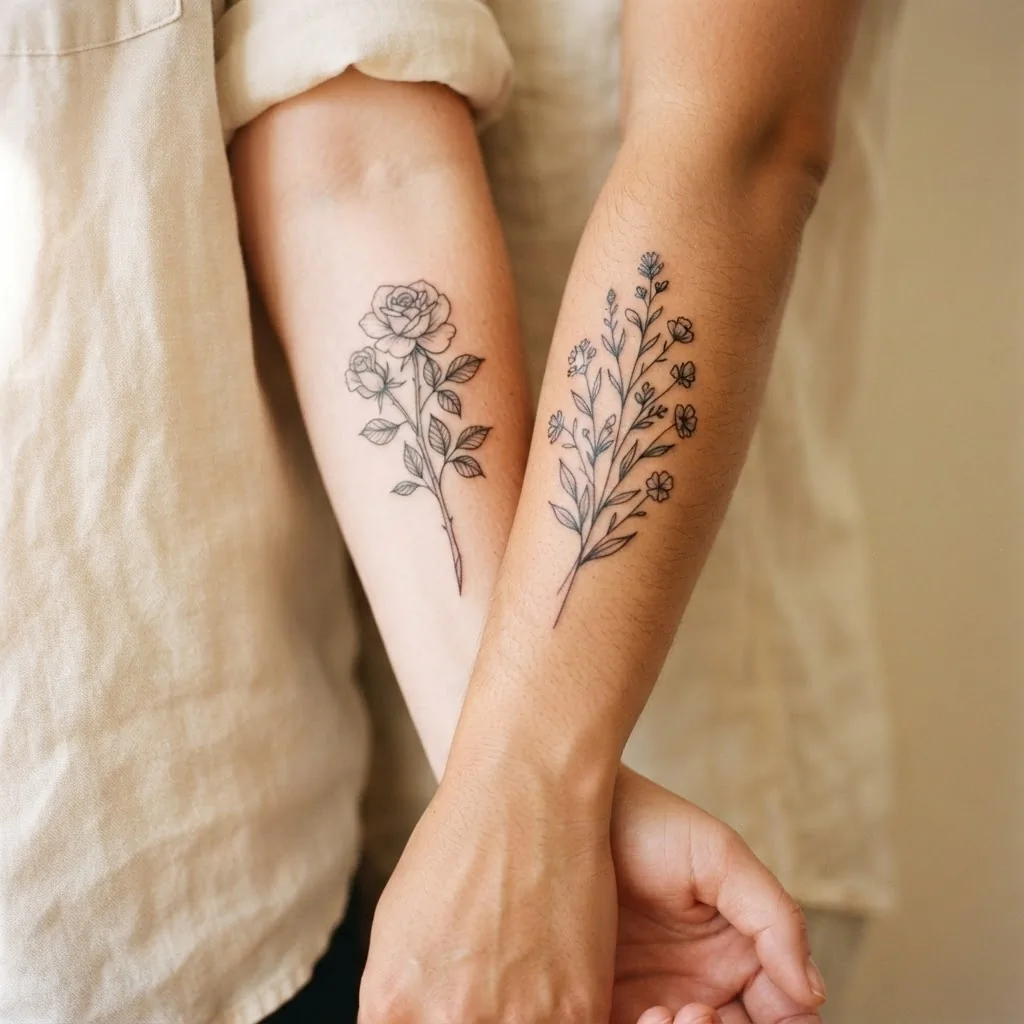
Inner wrists and areas near joints tend to experience more movement, which can affect how crisp the lines stay over years.
3. Sun and Moon
This is a classic pairing for good reason. The sun and moon represent two different energies that are both essential and perfectly opposite. They’re never in the same sky at the same time, but neither could exist without the other. For a mother and daughter who are very different people but completely devoted to each other, this pairing often resonates in a way that’s hard to put into words.
The design range here is wide. It can be fine-line and minimal, just the outline of each shape. It can be more detailed and ornamental, with rays, stars, and texture. It can be watercolor, geometric, or blackwork. That flexibility makes it accessible to people with very different style preferences.
4. Infinity Symbol with Meaning
The infinity symbol on its own has been done so many times that it can feel a little generic. But artists can do remarkable things with it when it’s given context. Woven with flowers, with initials worked into the loops, with a word or short phrase integrated into the lines, the infinity symbol becomes something specific rather than something borrowed. If this motif appeals to you, the key is working with an artist to make it yours, not just printing out a generic reference image and asking for a copy.
5. Coordinates
A set of geographic coordinates representing a place that matters to both of you is one of those design concepts that sounds simple and turns out to be quietly profound. The house you grew up in. The hospital where you were born. A beach you return to every summer. A city you visited together and never forgot. Written in a clean, small serif font, coordinates make for an elegant and understated tattoo that only the two of you fully understand. They’re also easy to place almost anywhere and scale to almost any size.
6. Small Script Quote or Single Word
A word or phrase that belongs to your relationship specifically can make for an incredibly personal tattoo. The same word in matching placement, or the same quote split across two people so neither has the complete sentence without the other. This approach works best when the quote or word is genuinely specific to you, not a phrase you found on Pinterest that also means nothing in particular to your relationship. Take your time with this one. The design that lasts a lifetime is the one where you already know the meaning by heart.
7. Birds on a Branch, Together and Apart
Two birds sitting on the same branch, or one branch with birds facing opposite directions, or one bird in flight and one still resting. This imagery has deep roots in the symbolism of love, freedom, and returning home. It works beautifully as a complementary pair where the birds are from the same flock but positioned differently on each person. Artists who work in fine-line or traditional black-and-grey styles do particularly stunning work with bird imagery.
8. Minimalist Wave or Mountain Line
For the pair who loves nature and clean, geometric aesthetics, a simple continuous line forming a wave or a mountain silhouette is quietly striking. These pieces look almost architectural on the skin. They tend to age very gracefully because the lines are intentionally simple and bold enough to hold. They’re also an easy conversation to have with an artist because the concept is clean and straightforward.
9. Compass or North Star
“You are my north.” That idea, the idea of someone being your constant and your direction, is what makes compass and north star tattoos so frequently chosen for mother-daughter pairs. A small compass rose or a five-pointed star can be done in an enormous range of styles and sizes. This is also a good option for a pair where one person prefers something slightly more geometric while the other leans more delicate, because both a compass and a star read well in multiple style languages.
10. Watercolor Florals
Watercolor tattoos look like they’ve been painted directly onto the skin, with soft edges, color bleeds, and the feel of something from a sketchbook. They’re visually stunning and uniquely personal. The honest note here is that watercolor tattoos require careful maintenance. Because the style relies on soft edges and pigment spread rather than bold outlines, they can fade more noticeably than other styles over time, and sun exposure accelerates that fading. This doesn’t mean they’re a bad choice; it means they need a committed aftercare routine (more on that below) and regular touch-ups over the years. If you love the look and are prepared for the long-game care, they’re extraordinary.
11. Meaningful Symbol Personal to Your Family
Maybe there’s a symbol that belongs specifically to your family. A hummingbird because your grandmother loved them. A specific flower that grows in your grandmother’s garden. A shape or icon from a shared religious or cultural tradition. A symbol from a story or a song that has been yours since childhood. These are the tattoos that can’t be explained to a stranger in ten seconds, and they’re often the ones that matter most. This kind of design absolutely requires a custom consultation with an artist. There’s no reference image for something you invented together. There doesn’t need to be.
12. Matching Micro-Tattoos in Hidden Placement
Not every mother-daughter tattoo needs to be visible to the world. Some of the most meaningful ones are tucked behind an ear, placed on the inner wrist where a watch usually sits, or inked on the upper arm where a sleeve covers it. Micro-tattoos (very small, often under an inch) are bold enough to be intentional but subtle enough to feel like a private language. If either of you works in an environment where visible tattoos create professional complications, or if either of you simply isn’t ready to announce the tattoo to everyone, a small and hidden placement is a thoughtful solution.
The Sizing Conversation Nobody Has (But Should)
Size matters more than most inspiration galleries let on, and it’s one of the most important conversations to have before you book. Here’s the reality: a design that looks beautiful at four inches will not simply scale down to one inch and stay beautiful. Fine details collapse. Text becomes illegible. Intricate patterns turn muddy. A skilled artist will tell you this honestly during a consultation, but it helps to walk in with some awareness.
Small to micro tattoos work best with designs that are simple by nature, single line drawings, bold shapes, single words in a clean font, minimal geometric patterns. If you’ve fallen in love with a complex floral design but you both want something tiny, your artist may suggest simplifying it, and that advice is worth taking seriously.
The other sizing consideration is body. Two people with different body proportions may find that the same design sits and scales differently on each of them. An artist experienced in custom work can adjust the design subtly for each person so that it looks right on both bodies without being a different piece entirely.
Placement and Pain: A Realistic Conversation
This is where I find a lot of people freeze up a little, especially if one of the pair is getting her first tattoo. Pain is real. It varies a lot by placement, and it varies by person. Going in with realistic expectations is far more helpful than either catastrophizing or dismissing it.
Generally speaking, areas with more fat and muscle and fewer nerve endings close to the surface tend to be more comfortable. The outer upper arm and outer forearm are among the most commonly recommended placements for first-timers because they tend to be more tolerable. The shoulder blade, outer thigh, and calf also tend to fall in the manageable range for most people.
Areas that tend to be more intense include the inner wrist (more nerve endings and thinner skin), the ankle and foot area (bone proximity), the ribcage (limited padding, proximity to bone), and the inner arm near the elbow. This doesn’t mean you shouldn’t choose those spots. It means you should choose them knowing what to expect, and communicate with your artist about pacing the session if needed.
If either of you has concerns about pain, bring it up with the artist before the appointment. Many studios are open to pacing, taking breaks, and working with first-timers in whatever way makes the experience manageable.
Thinking About How This Tattoo Will Age
A tattoo you love at 25 should still be a tattoo you’re at peace with at 55. That’s not a reason to overthink it, but it is a reason to think about it once with some intention.
Bold and solid designs tend to age the most predictably. What you see is largely what you’ll have, with some natural softening and slight color shift over the years. Fine-line and micro designs are more susceptible to spreading slightly as the ink settles into deeper layers of the skin. Colorful pieces (especially those using red or brightly pigmented inks) can fade more visibly than black and grey work over time, and some pigments have been associated with a higher rate of skin reactions than others. A 2016 peer-reviewed study published in the National Institutes of Health library, which reviewed patterns of reactions to red tattoo pigment, found that red pigments have the highest incidence of chronic allergic-type reactions among tattoo colors. This isn’t a reason to avoid color entirely, but it is worth asking your artist about the specific pigments they use.
Sun protection is also a long-game conversation for tattoos, not just for the healing period. UV exposure is one of the primary drivers of ink fading. The American Academy of Dermatology specifically recommends applying broad-spectrum SPF to protect tattoos from UV damage even after they are fully healed, because ultraviolet light can break down pigment over time. You can read their full guidance on caring for tattooed skin here.
If One of You Has Never Had a Tattoo Before
This situation is more common than you might think. A daughter brings the idea and mom, who has never been tattooed, agrees out of love and a sense of adventure. That’s wonderful. It’s also a reason to plan with a little extra care.
First-timer nerves are completely normal. The unknown is almost always scarier than the actual experience. Being well-fed and hydrated on the day of the appointment helps enormously. Wearing comfortable clothing that gives the artist easy access to the placement area makes the session smoother. Most artists are experienced with first-timers and will walk through what to expect before beginning.
If there are any health considerations, including medications that affect bleeding, skin conditions at or near the planned placement, or a history of allergic skin reactions, the first conversation should be with a doctor before the tattoo appointment. This isn’t overly cautious; it’s just the right order of operations. The FDA’s consumer guidance on tattoo safety covers some of the key things worth knowing before anyone gets tattooed, including the fact that no tattoo pigment has been formally approved by the FDA for injection into skin. That’s not a reason to panic; it’s a reason to use a licensed professional who knows the materials they’re working with.
Finding the Right Artist for a Two-Person Concept
This step matters more than any design decision, and it’s where I want to spend a minute because it often gets skipped. For a mother-daughter tattoo, you’re not just looking for an artist who does good work generally. You’re looking for an artist who does good work in the specific style you’ve chosen, who is licensed and working in a properly inspected and regulated studio, and who is comfortable working with two people on a connected concept in the same appointment or consecutive appointments.
Start with portfolio research. Most artists post their current work on Instagram. Look not just for pretty tattoos but for healed photos when you can find them, and for work that shows consistency and clean technique in the style you want. An artist who does breathtaking watercolor work may not be the right choice for the minimalist fine-line piece you have in mind, and vice versa.
Licensing and hygiene standards matter. Every state has its own regulatory framework for tattoo studios, but all licensed studios should comply with bloodborne pathogen safety standards. The CDC’s NIOSH has published guidelines specific to tattooists and piercers that clarify the applicable safety requirements. When you visit a studio, the space should feel clean, equipment should be visibly sterile and single-use where appropriate, and the artist should be willing to answer questions about their hygiene practices without hesitation. If anything feels off, trust that instinct and look elsewhere.
Book a consultation before committing. A good consultation is a conversation, not a sales pitch. You should be able to share your reference images, explain the relationship context, ask questions about how the design will age, and discuss placement and sizing without feeling rushed. If an artist dismisses your questions or seems impatient with the planning conversation, they are not the right fit for a piece this meaningful.
What to Bring to Your Consultation
Bring any and all visual references, even if they feel incomplete or contradictory. Images from Pinterest, photos of styles you like, examples of what you don’t want. The more context an artist has, the more accurately they can interpret your vision. If the design has a personal meaning, write it out briefly in a sentence or two so the artist understands why it matters. That context often influences the creative decisions they make.
Talk through the two-person dynamic explicitly. Tell the artist that this is a shared concept. They may have ideas about how to make the designs read as a pair without being identical, or suggestions about placement that would make both pieces look cohesive. That creative input is part of what you’re paying for.

The Basics of Healing, and Why You Should Follow Your Artist’s Instructions
A tattoo is a wound healing. That’s the honest, unglamorous truth of it, and it’s the reason aftercare matters. The surface skin typically takes two to three weeks to close and peel. The deeper skin layers can take several months to fully settle, and how the final tattoo looks is in part a product of how well it healed.
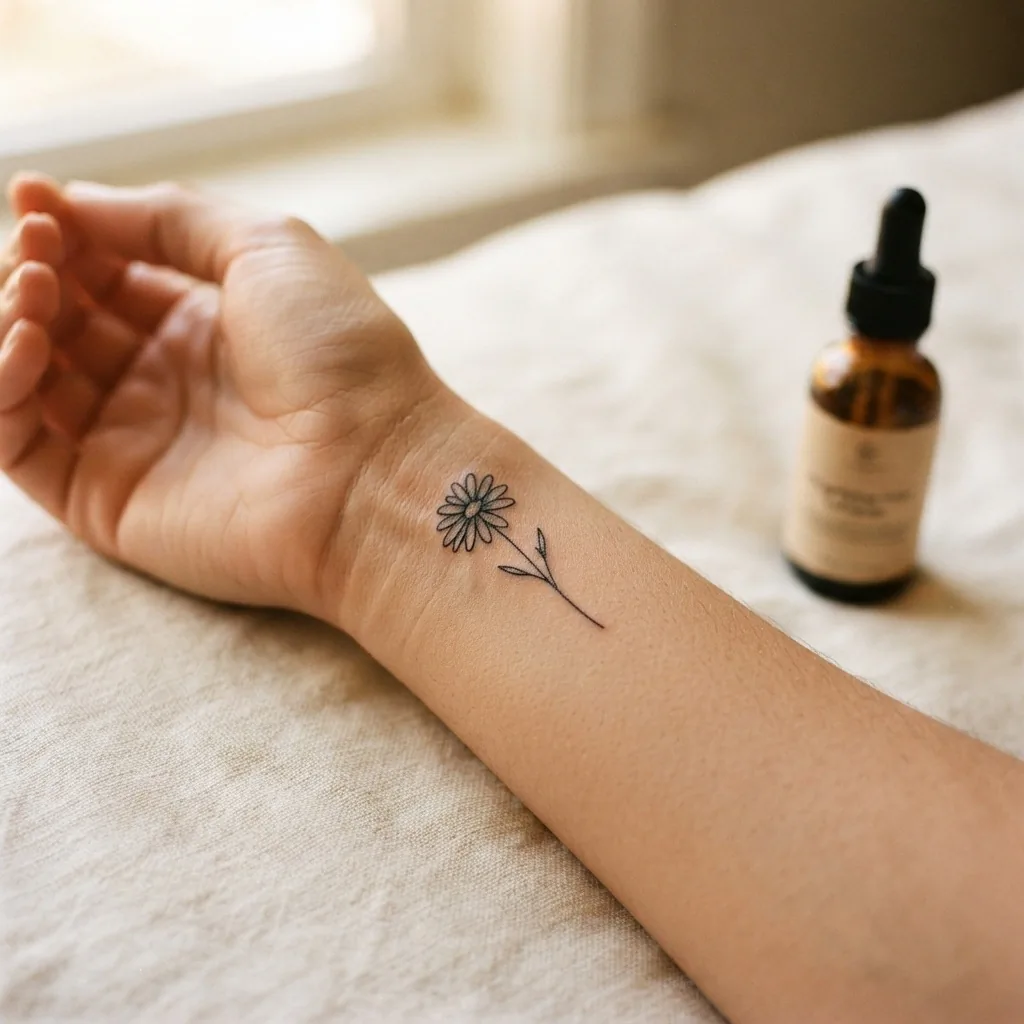
Your artist will give you specific aftercare instructions, and those instructions are the ones to follow. They know the materials they used, the depth of the work, and what that particular piece needs. General guidance from dermatologists and healing research includes keeping the area gently clean, avoiding submerging it in pools, oceans, or baths during the healing period, not picking at peeling skin, and keeping it moisturized with a fragrance-free product. The American Academy of Dermatology also notes that tattoos should be protected from sun exposure during healing and with SPF afterward.
If you notice anything that concerns you during healing, including unusual swelling, redness spreading beyond the tattoo area, discharge, or a rash, contact your artist and consider seeing a dermatologist or doctor. Reactions do happen, and they’re better addressed early. The AAD’s guide to tattoo skin reactions is a helpful reference for understanding what’s normal and what warrants professional attention.
A Note on Cost and Planning Realistically
Two people getting tattooed means two budgets, or a shared budget that’s twice what a single tattoo would cost. Small to medium pieces from a skilled, experienced artist in a US city typically start somewhere in the range of $150 to $300 per piece for a simple design, though pricing varies widely based on the artist’s experience level, your city, and the complexity and size of the design. Custom work takes more time than flash, and more time means more cost. Most studios also charge a shop minimum regardless of size.
Plan for the cost you want, not the lowest number you can find. A tattoo is permanent. The price of fixing a tattoo done poorly, or the cost and pain of laser removal, will almost always exceed what a quality artist would have charged from the start. Think of it as one of the more meaningful investments you’ll make together.
Before You Book: A Simple Planning Checklist
You don’t need to have every detail decided before your consultation, but walking in with the following settled will make the whole process easier and more enjoyable.
Know whether you want matching or complementary. Know the general style direction, whether fine-line, bold minimalist, watercolor, or something else. Have a rough sense of placement, even if it’s just a body region rather than an exact spot. Bring reference images. Know your budget. If anyone has health considerations relevant to tattooing, talk to a doctor first. And give yourselves permission to not rush. The right artist and the right appointment date are worth waiting for.
Final Thought
Of all the reasons people get tattoos, wanting to mark a relationship with someone they love is one of the most honest and enduring ones. A mother-daughter tattoo, planned thoughtfully and executed by a licensed artist you trust, is a beautiful thing. It doesn’t have to be elaborate to be meaningful. It doesn’t have to be visible to the world to matter. It just has to feel true to the two of you.
Take your time. Do your research. Work with a professional you believe in. And go get something you’ll both be proud of every single time you see it.