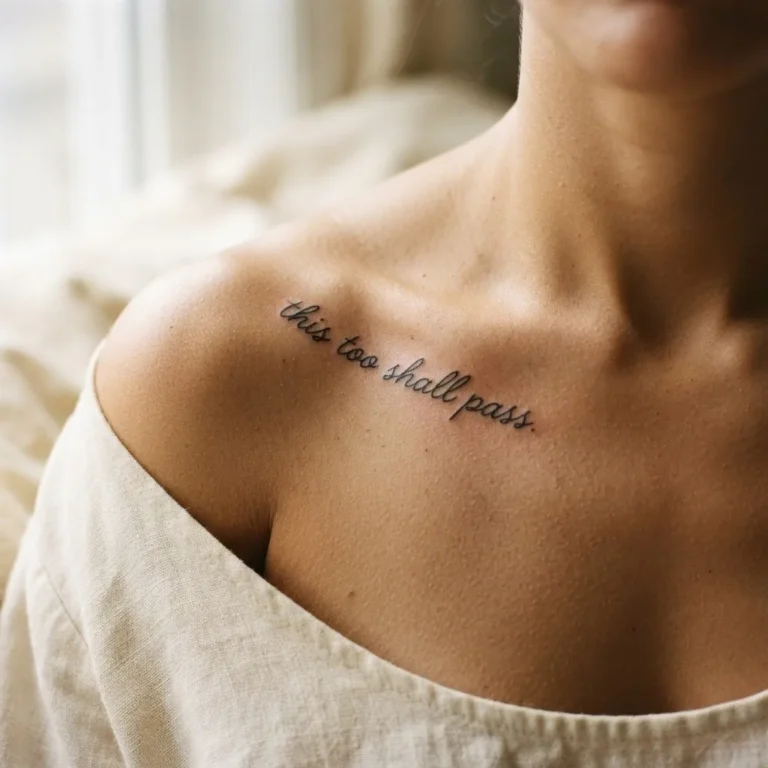
10 One Word Tattoo Ideas and How to Make Each One Truly Yours
There is something quietly brave about a one-word tattoo. No image to hide behind, no long phrase to soften the message. Just one word, chosen by you, living on your skin for the rest of your life. The friends who text me before booking appointments ask about one-word tattoos more than almost anything else, and I always tell them the same thing: this style sounds simple, and it is simple in the best way, but “simple” does not mean “easy to choose.” It means there is no room for a word that is anything less than exactly right.
The good news is that getting it right is very doable. You just need a little more preparation than the average inspiration gallery gives you. So instead of handing you a list of 50 words and wishing you luck, I want to walk you through ten genuinely beautiful one-word tattoo ideas, explain why each one works, and give you the planning framework to figure out which one, or which word entirely of your own, is the right one for your skin.
If you are 18 or older and ready to start dreaming with intention, let’s go.
Why One Word Tattoos Are Having Such a Strong Moment
Word tattoos have always been popular, but the current wave of one-word pieces feels different. The fine-line renaissance that swept Pinterest and TikTok over the last several years made delicate, precise lettering the aesthetic of the moment, and a single word in a flowing script or a clean serif sits right at the center of that trend. It is small enough to feel accessible for a first tattoo, personal enough to carry real meaning, and visually clean enough to work on almost any placement.
What makes this particular style genuinely enduring is that it does not rely on an image that might fall in and out of fashion. The right word is timeless because it is yours. Nobody else chose it for the same reason, and that personal gravity is what separates a word tattoo that ages gracefully from one that starts to feel hollow after a few years.
Before the Ideas: The Question That Matters Most
Before I show you the ideas, I want to ask you something the inspiration boards never do: how does this word feel when you say it on a bad day?
Pinterest boards and Instagram saves are almost always captured during a high moment, a beautiful afternoon when everything feels possible. But a tattoo lives through every kind of day. The words that hold up across both the beautiful afternoons and the hard ones are the words that become something people rarely regret. Words connected to a core value, a person you love, a quality you are committed to growing into, a language that is part of your heritage, or a moment that genuinely changed you tend to pass this test. Words chosen because they are trending, because you saw them on someone else, or because they sounded nice in a screenshot are the ones people sometimes wish they had sat with a little longer.
This is not meant to scare you. It is meant to free you to choose well. Give yourself a week or two with whatever word you are considering.
Write it down every morning. Say it out loud. If it still feels true, it probably is.
10 One Word Tattoo Ideas Worth Considering
1. Breathe
This single word has been tattooed on more people than almost any other, and with good reason. It is a directive, an anchor, and a reminder all at once. For people who live with anxiety, chronic stress, or grief, “breathe” functions as a tactile cue, a glance at the inner wrist or forearm in a hard moment that actually does something. It works in fine-line lowercase script, in a quiet serif, or even in a single brushstroke style.
Because it is a common word, the magic is in your font and placement, and in what it means specifically to you.
Placement idea: Inner wrist (readable to you), inner forearm, or collarbone.
2. Strength
A classic, but classics become classics for a reason. “Strength” tends to work for people coming through something, whether that is a health journey, a loss, or a chapter of life that required more of them than they thought they had. It is a word that can honor where you have been and remind you of what you are made of. It lands beautifully in a bold serif or an elegant blackletter, both of which age particularly well because the letters are full enough to stay crisp.
Placement idea: Forearm, ribcage, or upper back.
3. Wildflower
A newer entry in the one-word tattoo space, “wildflower” is lovely because it carries so many simultaneous meanings: growing without instruction, beauty in unexpected places, resilience, independence, a connection to nature. It is long enough to work as a single flowing script line across a collarbone or a forearm, and it pairs naturally with a delicate botanical element if your artist and your vision align on that direction.
Placement idea: Collarbone (horizontal), inner forearm (vertical or diagonal), or ribcage.
4. Brave
Short, punchy, and personal, “brave” is the word a lot of people choose to mark a turning point. It is a word you can grow into rather than a word that only describes where you have already been. That forward-facing quality makes it stay meaningful. It works in almost any font but looks particularly striking in a clean, minimalist sans-serif or a confident italic script.
Placement idea: Inner wrist, behind the ear (if the studio confirms enough space for legibility), or ankle.
5. Saudade
If you want a one-word tattoo with genuine depth, consider a word from another language. “Saudade” is a Portuguese word with no clean English equivalent. It describes a longing or nostalgia for something beloved that may never return, carrying both sorrow and warmth at once. It is often chosen by people with Portuguese or Brazilian heritage, or by anyone who has experienced a particular kind of bittersweet love. Its uniqueness means most people who see it will ask, and telling the story becomes part of the piece.
Placement idea: Inner forearm, ribcage, or spine.
6. Still
This one is my personal favorite in the minimalist category because of how much it carries. “Still” can mean: I am still here. I am still standing. Be still. Still growing. It changes depending on who reads it and what you need it to say. Its short length means it is often tattooed slightly larger than you might expect, to give the artist enough room to make the letterforms look intentional and clean, and a talented artist will help you nail that sizing conversation.
Placement idea: Inner wrist, collarbone, or behind the ear with appropriate sizing.
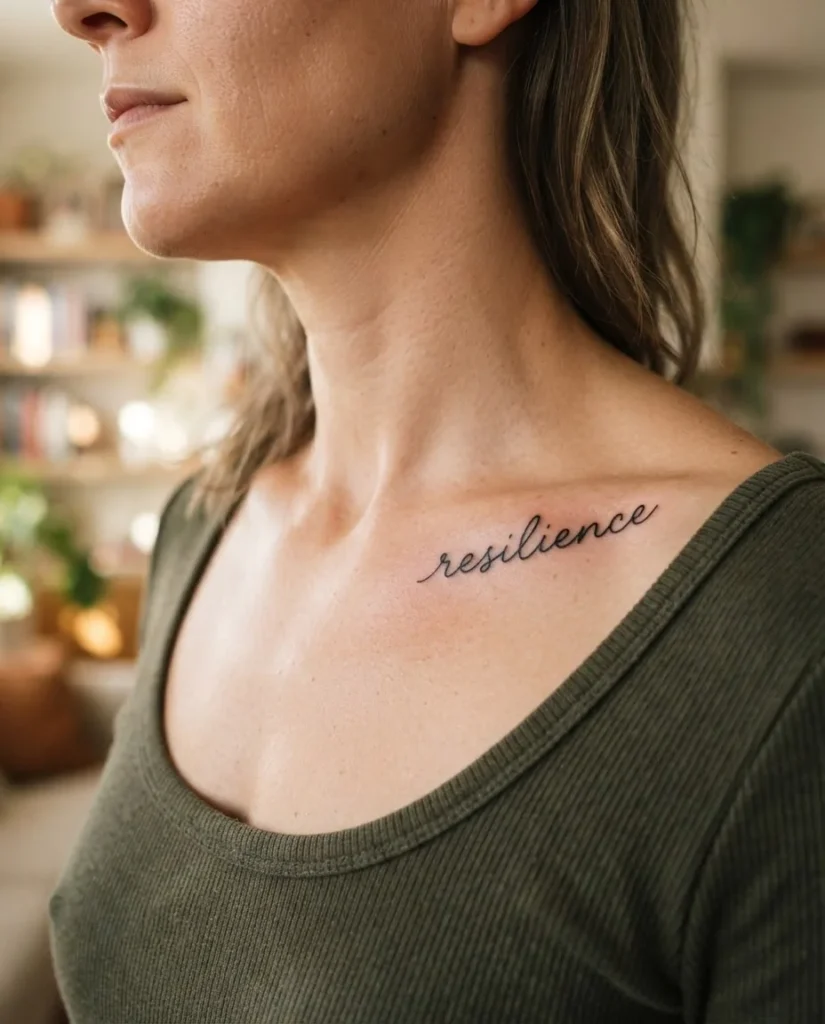
7. Resilience
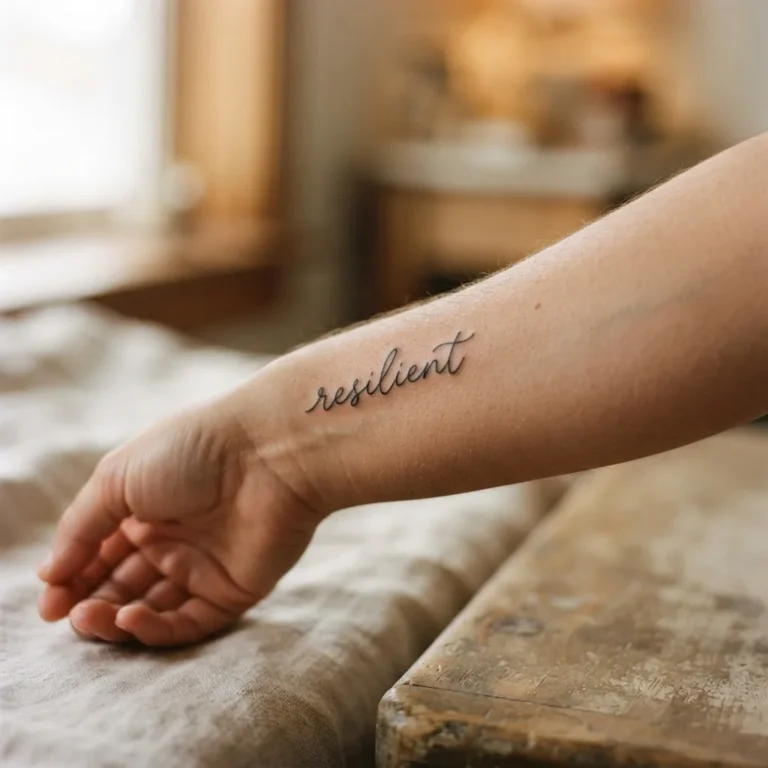
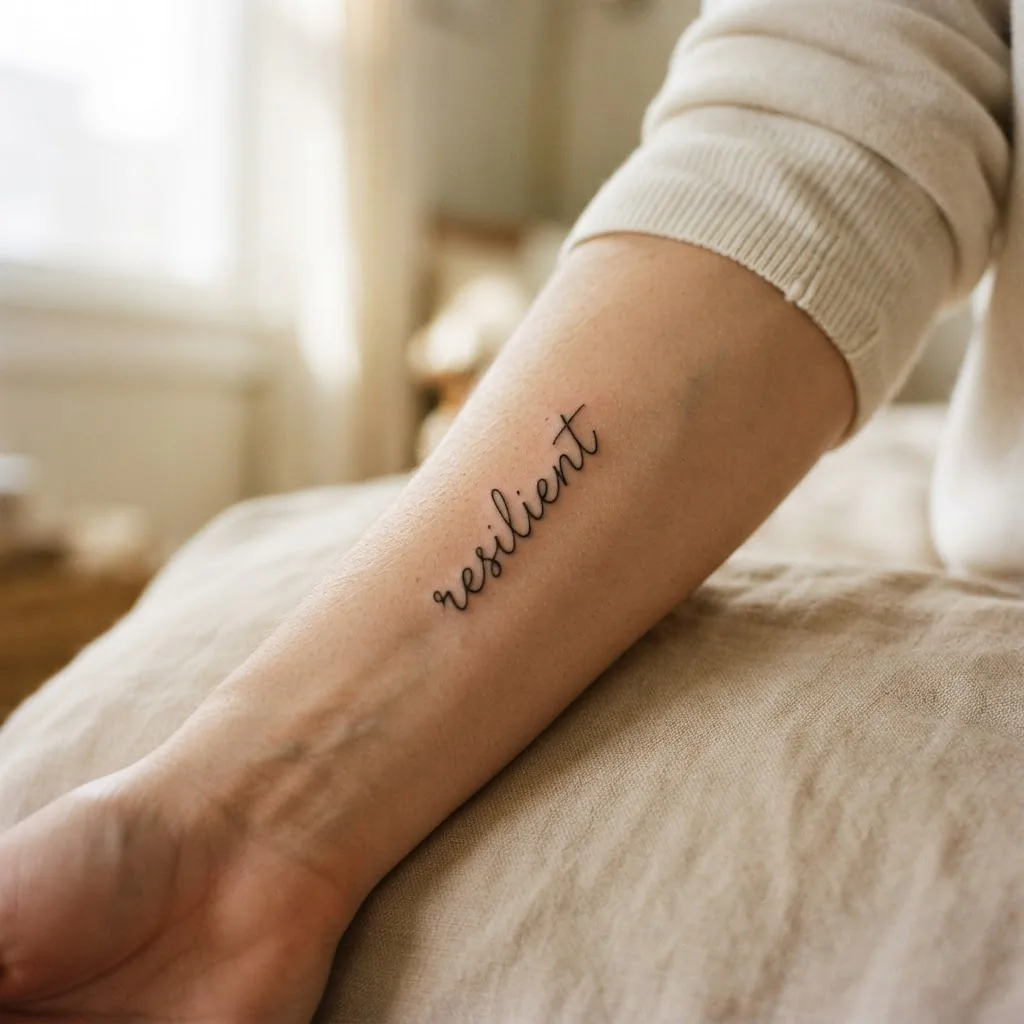
A longer word for a one-word tattoo, but that length gives it presence. “Resilience” works for people who have been through something significant and want a word that encompasses the whole arc of it, not just the surviving but the rebuilding. It flows beautifully in a single-line cursive across a forearm or a collarbone, and its length naturally creates a sense of movement.
Placement idea: Collarbone, inner forearm, or upper arm.
8. Gratitude
A word in the same family as resilience but softer in energy. People choose “gratitude” as an anchor for a daily practice, a reminder to come back to thankfulness even when life makes it hard. It photographs beautifully in an open, airy script and tends to draw immediate warm responses when people see it.
Placement idea: Inner forearm, sternum (vertical), or upper back.
9. Free
Three letters, enormous weight. “Free” is chosen for all kinds of reasons: freedom from something specific, a core value, a hard-won chapter finally closed. Its brevity means the font and sizing choices define the entire piece, so the artist conversation is especially important here. A very thin, micro-sized “free” risks becoming unreadable within a decade. A well-sized version in a thoughtful font becomes something you carry with pride.
Placement idea: Wrist, ankle, finger (with honest conversation about fading in that location), or behind the ear.
10. Wanderer
For people who feel most themselves when moving, exploring, and discovering, “wanderer” has a romantic, literary quality. It is less about restlessness and more about orientation: this is how I meet the world. It works in both a flowing script and a typewriter-style serif, and the slight vintage feel of those fonts suits the word’s character.
Placement idea: Inner forearm, ribcage, or collarbone.
Fonts, Sizing, and the Aging Question Nobody Talks About Enough
This is the section I wish every one-word tattoo article included, because it is where the most preventable regret lives.
Every tattoo changes over time. The ink spreads slightly as skin ages and stretches, ultraviolet light breaks down pigment, and the body’s natural processes affect how the final result looks years down the road. This is not a reason to avoid getting a word tattoo. It is a reason to plan it well from the start, specifically around font choice and sizing.
On fonts: Very fine, hairline cursive scripts are beautiful and very much a part of the current fine-line moment, but they carry more long-term risk of blurring than bolder letterforms. This is especially true in areas with softer or more mobile skin, like fingers, inner wrists, and the sides of hands. A licensed artist who specializes in fine-line lettering, and whose portfolio shows healed pieces, not just fresh ones, is your most important resource for this conversation. Healed examples are the single best predictor of how your tattoo will look in a few years. Bolder script, clean block letters, and full-weight serifs tend to hold their shape better over time, while still being beautiful. A piece that is slightly bolder than you originally imagined often ages into something you love more than the ultra-delicate version that starts to look soft and diffuse after ten years.
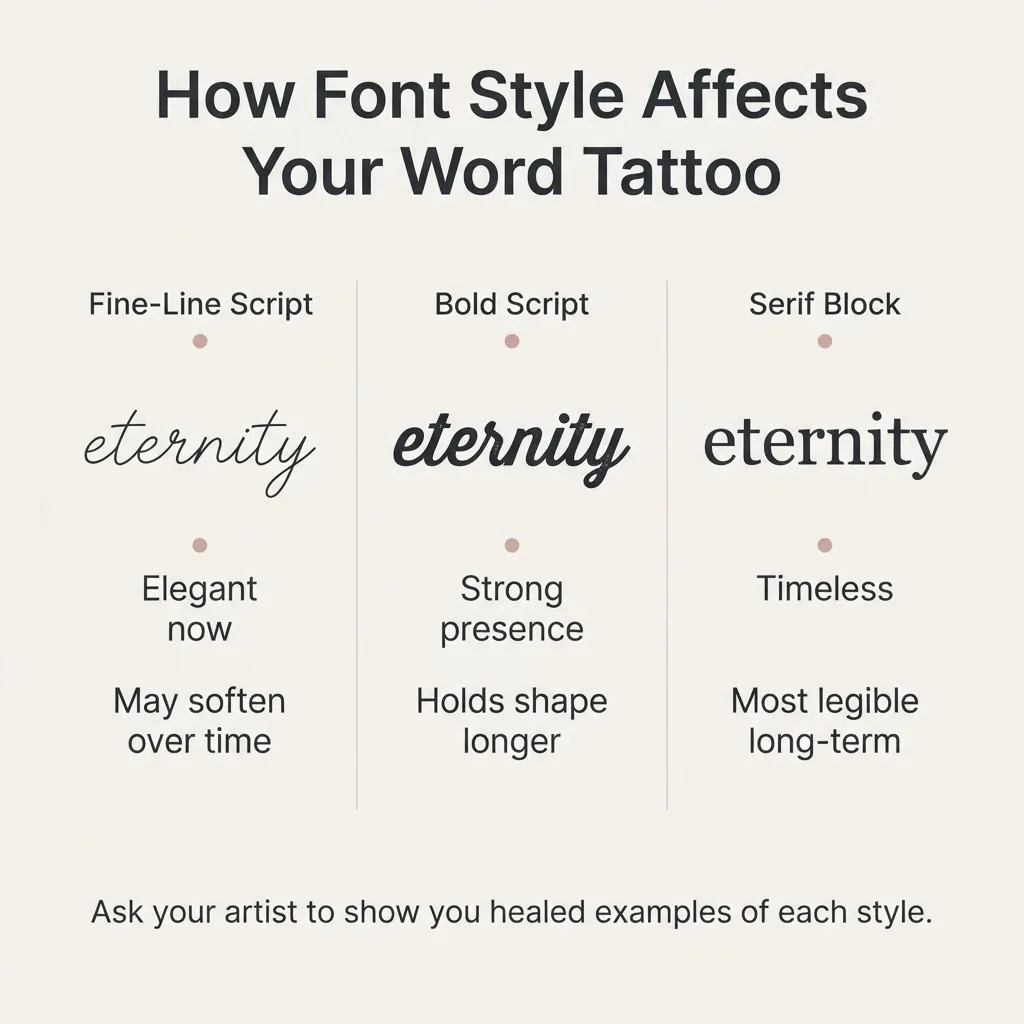
According to one specialist studio’s 2025 analysis of how fine-line tattoos age, it is realistic to expect some softening and slight blurring in fine-line work over a decade, particularly in higher-movement areas. This does not mean fine-line is wrong for you. It means the artist conversation about placement, sizing, and line weight is genuinely important.
On sizing: Most tattoo artists and industry guides suggest that for script tattoos to stay legible, letter height should generally be at least half an inch, depending on the font and placement. Very small lettering on high-movement or soft-skin areas is where word tattoos most commonly become unreadable over time. For a single word, “going a touch bigger than you think” is advice I hear from almost every experienced artist. Your artist will have a view on the minimum size for your chosen word and font, and trusting that guidance is one of the smartest things you can do.
On placement and movement: Areas where skin stretches, folds, or sees a lot of sun exposure tend to affect ink longevity most. The forearm and upper arm are among the most stable placements for lettering. The ribcage, inner wrist, collarbone, and spine are popular and can look stunning, but they each come with their own sizing and aging conversation. Fingers and the sides of hands are notoriously high-touch-up areas for lettering. None of these are “wrong,” but all of them deserve an honest discussion with your artist before you commit.
Placement and Pain: An Honest Overview
Pain is real, and I would rather give you an honest framework than pretend it is nothing or terrify you unnecessarily. The general principle, covered well in Healthline’s medically reviewed tattoo pain chart, is that areas with more fat and muscle padding, fewer nerve endings, and skin that is not directly over bone tend to be less painful. Areas that are bony, have thin skin, or have a high concentration of nerve endings tend to be more intense.
For one-word tattoos specifically:
Lower pain areas (generally): Outer forearm, outer upper arm, calf, shoulder. These are often recommended for first-timers specifically because the sensation is more manageable and the skin holds ink well.
Moderate pain areas: Inner wrist, inner forearm, collarbone, ankle. These are very popular placements for word tattoos and absolutely doable for most people, especially for the short session time a small word requires. The wrist and inner forearm tend toward sharp or scratchy sensations rather than deep pain, and the brevity of a word tattoo means the session time is short.
Higher pain areas: Spine, ribcage, sternum, behind the ear, fingers, foot. These are beloved placements for a reason, and people get them every day. But they deserve honest acknowledgment. The ribcage and spine in particular involve thinner skin over bone, and sessions in those areas are usually described as more intense.
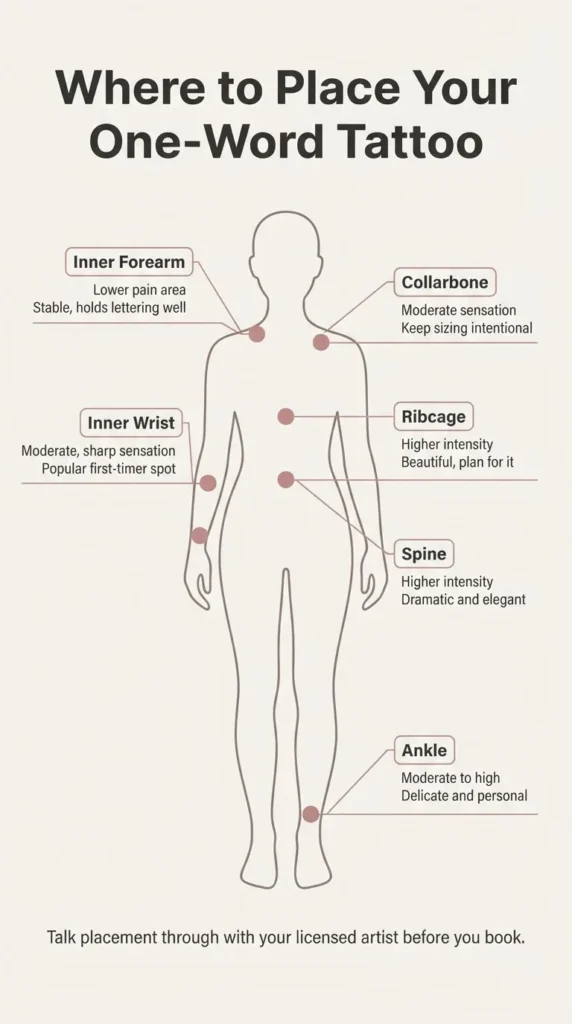
For a first tattoo, I would think carefully before choosing these locations, not because they are impossible, but because it helps to know what you are signing up for.
Your artist is always the best person to talk to about pain for your specific placement, body, and word length. A session for a single word typically runs short, which makes intensity more manageable no matter where you go.
Finding the Right Artist for a Word Tattoo
This step matters as much as the word itself. Word and lettering tattoos are genuinely specialized. An artist who is extraordinary at illustrative or geometric work may not be the right choice for fine-line script. Look specifically for an artist whose portfolio shows word and lettering work, and look for healed examples of that work wherever possible, not just fresh photos shot right after completion.
Here is what I would check before booking:
The studio should be licensed by your local or state health authority. Licensing requirements exist to ensure basic hygiene, sanitation, and bloodborne pathogen protocols are being followed. You can often verify licensing directly through a state health department website. Do not hesitate to ask a studio about their sterilization practices, whether they use single-use needles, and how they handle hygiene between clients. A professional studio will answer these questions without any pushback.
The studio environment itself tells a story. It should be clean, organized, and feel clinical rather than casual. Needles should be opened in front of you.
Ask to see healed portfolio examples specifically for lettering, not just fresh work. The real test of a skilled lettering artist is whether their work is still clean, crisp, and legible after healing.
Book a consultation before your appointment. Most studios offer this, and for a word tattoo, it is genuinely useful. Bring font references you like, photos of placements you are considering, and a sense of the size range you are thinking about. Your artist will have opinions on what will work well for your vision long-term, and those opinions are worth hearing.
For context on why choosing a reputable, licensed professional matters so much from a safety standpoint, the FDA’s consumer guide on tattoo safety is a straightforward and honest read, covering everything from ink contamination risks to what to watch for in a studio. It is worth a few minutes of your time before you book.
What to Expect in the Session
For a one-word tattoo, your session will almost certainly be on the shorter side. Depending on the word, the font, and the size, many single-word pieces take between 30 minutes and an hour and a half. That is one of the genuinely reassuring things about this style for first-timers: you are not signing up for a three-hour ordeal.
Your artist will transfer a stencil of the design onto your skin before the machine touches you, so you will see exactly what it will look like in terms of placement, size, and orientation. This is your moment to speak up about anything that feels off. Move it half an inch. Make it slightly larger. Shift the angle. Once you see it on your skin and feel good about it, the work begins.
Bring water, wear comfortable clothing that gives easy access to the placement you chose, eat a real meal beforehand, and skip alcohol the night before and day of (it can affect bleeding). Your artist will give you specific preparation guidance. Follow it.
After Your Tattoo: Healing and Keeping It Beautiful
Your artist’s aftercare instructions are the instructions you follow, full stop. Different artists have different approaches, and their guidance is specific to their technique, the inks they use, and their clinical experience. What I can share are the general principles the American Academy of Dermatology outlines for caring for tattooed skin, which include keeping the area clean, using a gentle fragrance-free moisturizer as the skin heals, and avoiding sun exposure on healing skin.
Surface healing typically takes roughly 2 to 4 weeks for most people, though the deeper layers of skin continue repairing for several months afterward. During healing, some redness, peeling, and itching is normal. What is not normal is significant swelling, oozing beyond the first day or two, spreading redness, heat, or any sign of infection, and if you see those signs, contact your artist and see a doctor promptly.
Sun protection matters enormously for the long-term vibrancy of word tattoos specifically. Fine lettering and light-colored ink are the most vulnerable to UV fading. Once your tattoo is fully healed, keeping it covered or protected with a high-SPF sunscreen when it is exposed to the sun is one of the most effective things you can do to preserve the crispness of the lettering.
Be aware that some people experience reactions to tattoo ink. The American Academy of Dermatology notes that ink allergies can appear immediately after getting a tattoo or even years later, and that red pigments are the most commonly reported culprit, though any color can cause a reaction. DermNet’s clinical overview of tattoo-associated skin reactions provides a thorough reference on the range of reactions that can occur, from contact dermatitis to photoallergic responses. If you notice anything unexpected with your healed tattoo, a dermatologist is the right person to consult, not a forum, not a follow-up tattoo session.
Turning Your Pinterest Board Into a Real Conversation
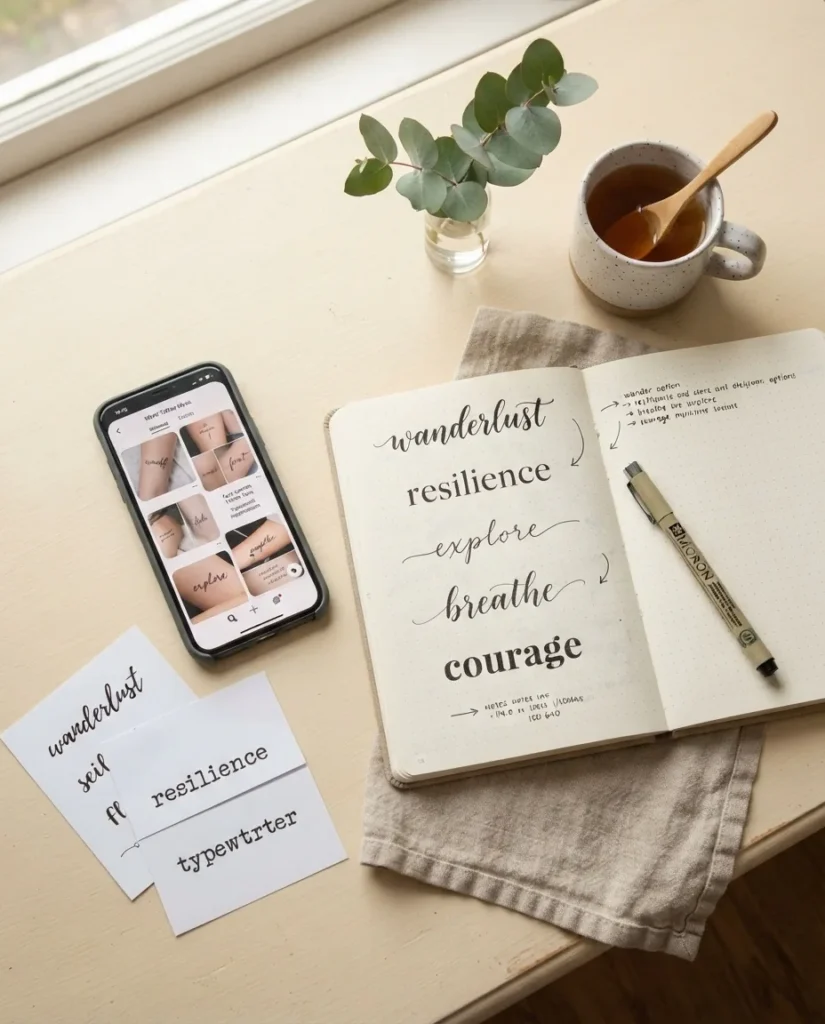
One of the most practical things you can do before a consultation is build a focused reference folder. Not 200 pins saved over two years, but a curated set of 5 to 10 images that show your licensed artist exactly what you love. Look specifically for: the font style or styles you are drawn to (loose cursive, clean serif, bold script, fine-line), the placement that resonates most, the sizing that feels right relative to the body part shown, and healed examples over fresh ones whenever you can find them.
Bring those images to your consultation with clear notes on what specifically you love about each one. “I love the spacing of the letters in this one” or “I want something more delicate than this but in this style” is genuinely useful artist communication. Your artist will tell you what is achievable for your placement and skin, which fonts hold up well in that area, and what size will keep the word legible for years. That conversation is where your Pinterest dream becomes a real plan.
And then you walk into your appointment knowing exactly what you want and why. That is the best possible starting point.
One Last Thing Before You Book
A one-word tattoo is one of the most personal things you can put on your body. It is also, I would argue, one of the most beautiful precisely because of that restraint. One word. Chosen carefully. Placed thoughtfully. Executed by a skilled, licensed professional. That combination is not complicated, but it does ask you to slow down slightly and prepare with intention.
You have time. The word will still be the right word after a few more weeks of sitting with it. The artist whose portfolio makes you say “yes, that” will still be there after you research them properly. Good decisions in the tattoo world are almost never the rushed ones.
When you are ready, you will know. And when you walk in with your reference images, your questions, and your chosen word, you will feel it: that particular calm that comes from knowing exactly what you want and trusting the process to deliver it.
That is the whole goal.