10 Moon and Star Tattoo Ideas Worth Pinning and Planning
There’s a reason moon tattoos never really go out of style. I’ve watched trends come and go since I got my first piece at eighteen, and celestial designs, specifically moons and stars, have stayed consistently beloved not because they’re trendy, but because they’re genuinely meaningful. A moon tattoo can represent something deeply personal: a transition you survived, a side of yourself you’re finally embracing, a quiet reminder of your own rhythms. Or it can simply be beautiful, and that’s a completely valid reason too.
What I notice in the questions my friends send me before booking is that most people have the feeling locked down (“I definitely want something celestial and delicate”) but they’re still working out the specifics. Which moon? What style? Where? How big? This article is designed to help you move from that vague, excited feeling to a clear, confident vision you can walk into a studio with.
Let’s go through ten design directions, why each one works, what it means, how it ages, and where it tends to sit beautifully on the body.
A Word on What the Moon Actually Means
Before we get into designs, it’s worth understanding why moon symbolism resonates so widely, because knowing the meaning can genuinely help you choose the right version for your story.
The moon has carried deep cultural weight across virtually every human civilization.
As the Museum of the Moon’s cultural research notes, the moon has been interpreted across centuries as a deity, a timekeeper, a symbol of femininity and mystery, and a marker of cycles, harvest, peace, and transformation. In Chinese tradition, the full moon represents peace, prosperity, and family reunion. In Greek mythology, the moon was Selene, a goddess associated with the soul and the passage of time. Celtic traditions tied the moon to nature’s rhythms and the sacred feminine. Islamic art and architecture have honored the crescent moon for centuries as a symbol of faith and protection.
None of this means your moon tattoo needs to carry a specific cultural assignment. But understanding that these symbols carry centuries of weight can help you feel more intentional about which phase or shape you choose. The crescent means something different from the full moon. A waxing moon tells a different story than a waning one. More on that as we go.
The 10 Designs
1. The Classic Crescent Moon
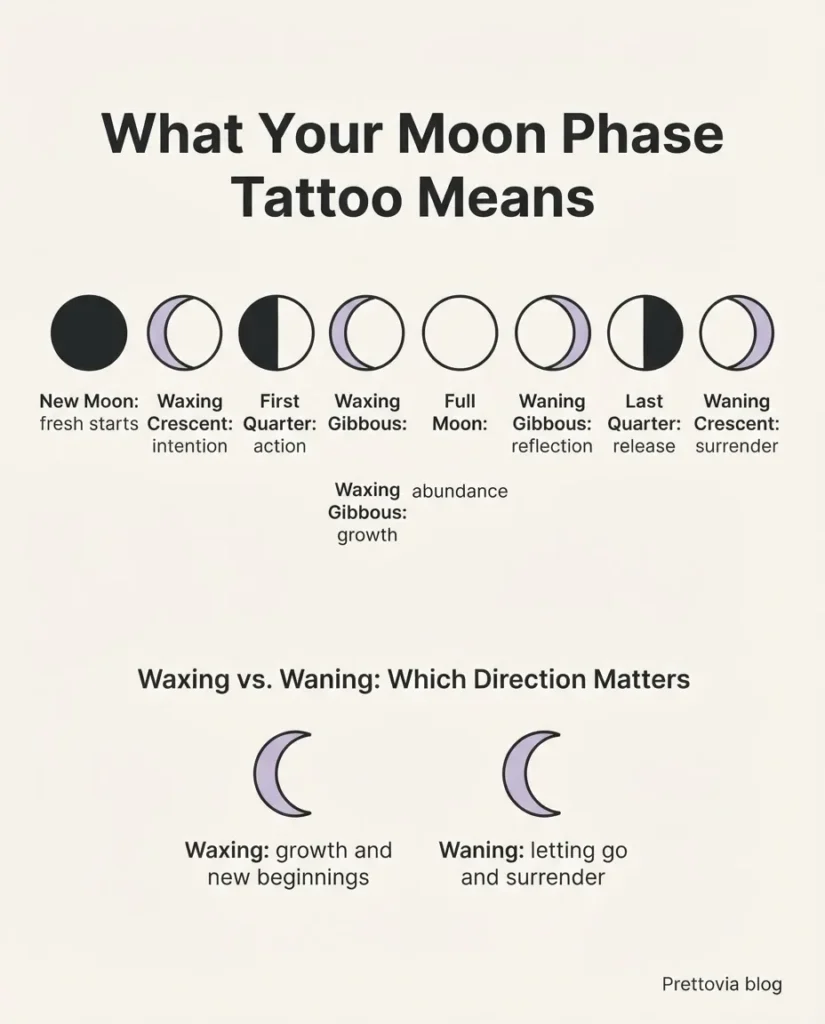
The crescent is probably the most recognized moon tattoo shape, and it earns that status. A waxing crescent (curving to the right in the Northern Hemisphere) is widely associated with new beginnings, intention-setting, and growth. A waning crescent (curving to the left) represents release, surrender, and the quiet wisdom that comes from letting go.
Most people don’t think about this distinction before booking, and their artist won’t necessarily ask. So decide which direction your crescent faces before your consultation, because it changes the symbolic story you’re telling.
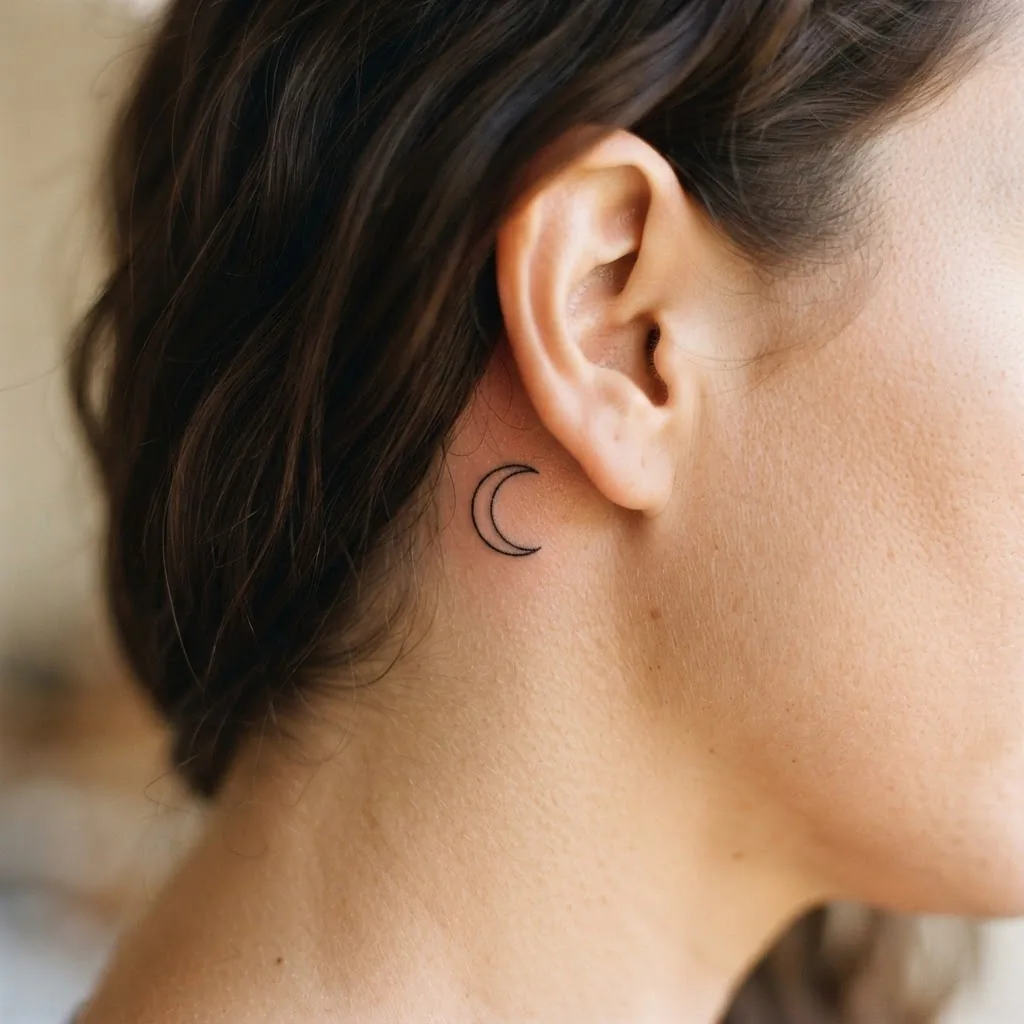
In terms of style, the crescent works beautifully in fine-line, in bold blackwork, and in geometric forms. Fine-line crescent tattoos are among the most requested designs in studios right now, especially in small to medium sizing. They are elegant and versatile in placement, fitting naturally behind the ear, on the inner wrist, along the collarbone, or at the ankle.
One honest note on fine-line tattoos: they are stunning fresh, but they do soften over time. Most fine-line designs hold their crisp detail for roughly five to ten years with good sun protection and care, after which some blurring or softening at the edges is normal. This isn’t a dealbreaker, but it’s worth discussing with your artist, particularly if you want a very delicate, hair-thin line version.
2. The Full Moon
The full moon is the bold choice, visually and symbolically. It represents abundance, illumination, the peak of a cycle, and the moment when things come to fruition. Many people choose a full moon to mark a life milestone, an achievement, or a period of clarity after a long, uncertain stretch.
Design-wise, a full moon tattoo offers more creative surface area. Artists can render it as a simple stark circle (incredibly elegant in blackwork), as a detailed realistic moon with cratering, as a glowing orb with soft shading, or incorporated into a larger scene with clouds, botanicals, or figures. The circle format means sizing matters more here than with the crescent: a tiny full moon can look like a simple dot without enough detail, so most artists recommend at least one to two inches for a full moon to read properly.
Placement-wise, the upper arm, thigh, and forearm give an artist the room they need to do a full moon justice, though a minimalist circle can work beautifully small on the wrist or inner arm.
3. Moon Phases in a Row
The moon phase sequence, typically showing all eight phases from new moon through to waning crescent in a horizontal or vertical line, is one of the most searched celestial designs for good reason. It reads as a complete story: beginning, growth, fullness, and release. Many people wear it as a metaphor for their own cycles, capacity for change, or personal transformation.
Practical sizing note: this design needs horizontal or vertical space to breathe. A moon phases tattoo across the collarbone, along the spine, or across the forearm typically runs four to ten inches depending on how many phases are shown and how much detail each phase carries. Spine placements for this design are visually stunning but come with a higher pain level because the spine runs along the vertebrae, where there is less cushioning and more nerve sensitivity. A collarbone or forearm placement is significantly more comfortable for most people.
If you’re drawn to the moon phases design and want a deeply personal version, consider asking your artist to incorporate a specific moon phase, like your birth moon or the moon phase from a meaningful date, as the focal point of the sequence. That small detail transforms a trending design into something that is entirely yours.
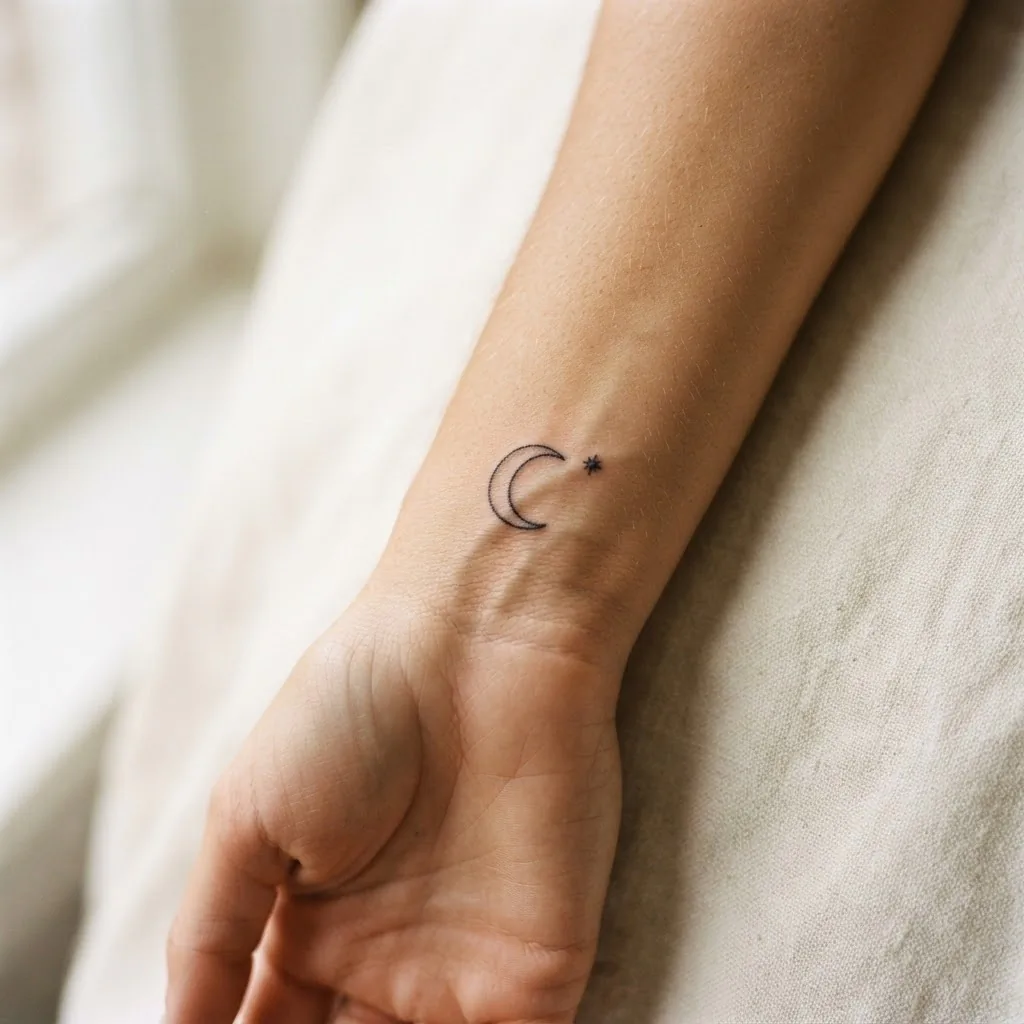
4. Crescent Moon with a Single Star
This pairing is as old as recorded human history, and it holds up. The crescent-and-star combination appears across Islamic art, Ottoman symbolism, ancient Mesopotamian iconography, and countless folk traditions around the world. As a tattoo, it reads as a symbol of guidance, of light appearing in the darkness alongside a quieter, gentler glow.
The single star creates a balancing point of light next to the curved moon, and the two elements together feel complete and compositionally satisfying. Style flexibility is wide here. Fine-line versions feel delicate and modern. Blackwork versions feel graphic and confident. Dotwork versions feel dreamy and soft.
Placement: this design is well-suited to spots where a small-to-medium composition can be appreciated close up, such as the inner wrist, behind the ear, or at the collarbone. It also scales well into a larger forearm or upper arm piece if you want more visual presence.
5. Sun and Moon Together
The sun and moon pairing is a classic symbol of duality: light and dark, masculine and feminine, action and rest, logic and intuition. Many people choose this design to represent balance within themselves, a relationship of complementary opposites, or simply the idea that two different energies can coexist beautifully.
Stylistically, this design has a lot of room to play. An illustrated, slightly retro look with a face on each (often called the celestial faces style) is having a real moment right now and feels warm and artistic. Geometric interpretations with interlocking circles feel modern and clean. Fine-line botanical versions with the sun and moon surrounded by florals feel romantic and detailed.
One consideration: this is typically a medium-to-large design because fitting two distinct celestial bodies with enough detail to read clearly requires real estate. An artist who specializes in illustrative or fine-line celestial work will be your best resource for scaling this one appropriately.
6. Stars as a Constellation
Stars are one of the oldest navigational tools humans have relied on, and their meaning in body art runs similarly deep. As HowStuffWorks notes in their comprehensive guide to star tattoo meanings, stars in tattooing have long represented guidance, hope, ambition, and the pursuit of something larger than the everyday. Different star shapes carry their own weight too: a five-pointed star suggests aspiration; a nautical star is a longstanding symbol of finding your way home; a shooting star carries the energy of wishes, fleeting beauty, and luck.
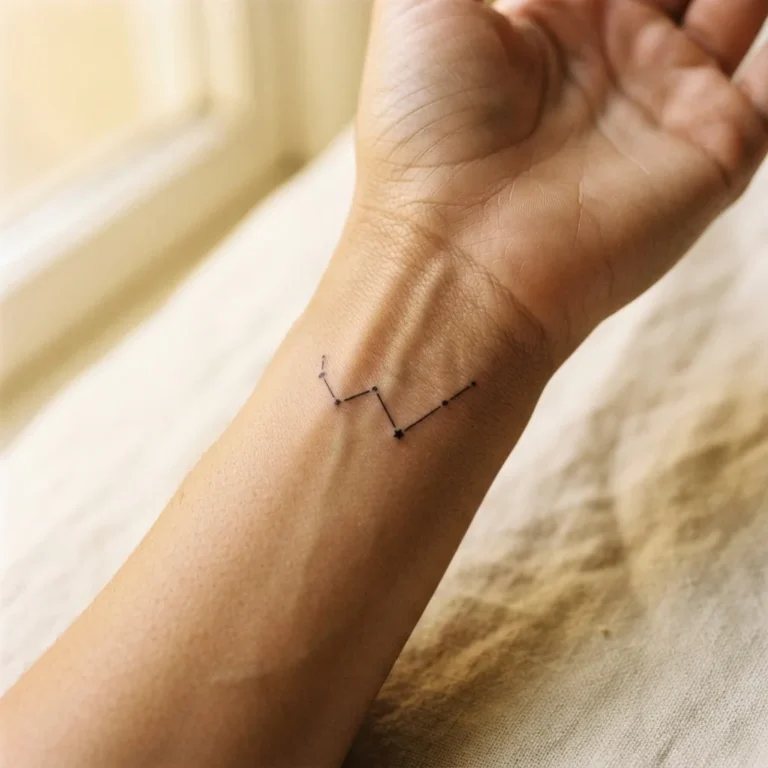
Constellation tattoos (your birth constellation, Orion’s Belt, the Pleiades, Cassiopeia) are a beautiful way to make a star tattoo immediately and permanently personal. Your artist will need a clear reference for the specific constellation you want, including accurate star positioning, so bring a map or a printed image to your consultation.
Constellation tattoos pair naturally with moon imagery, and many people build a small celestial scene that combines a crescent or full moon with a meaningful constellation around it.
7. The Geometric Moon
If you’re drawn to clean, architectural aesthetics, the geometric moon is the direction to explore. These designs use precise linework, triangles, hexagons, or mandala-style patterns either to fill the moon’s form or to frame it within a geometric structure. The result feels modern, intentional, and slightly otherworldly.
Blackwork and dotwork are the natural style homes for geometric moon tattoos. They age well because the bold, high-contrast lines hold up better over time than very fine single-stroke linework. If longevity and long-term crispness are priorities for you, a geometric or blackwork approach is worth discussing with your artist.
Placement: geometric designs tend to shine on flat, less-curved surfaces where the precise lines can be fully appreciated. The forearm, upper arm, and thigh work especially well.
8. The Watercolor Moon
Watercolor moon tattoos are genuinely gorgeous: soft, painterly washes of color (often purples, blues, indigos, and silvers) that give the impression of ink bleeding and bleeding into skin the way pigment bleeds into wet paper. They feel artistic and romantic in a way that is hard to achieve with any other style.
The honest conversation to have here is about longevity. Watercolor-style tattoos, especially those with very light, diffuse color and no bold black outlines to anchor the color, tend to fade and soften more noticeably over time than outlined designs.
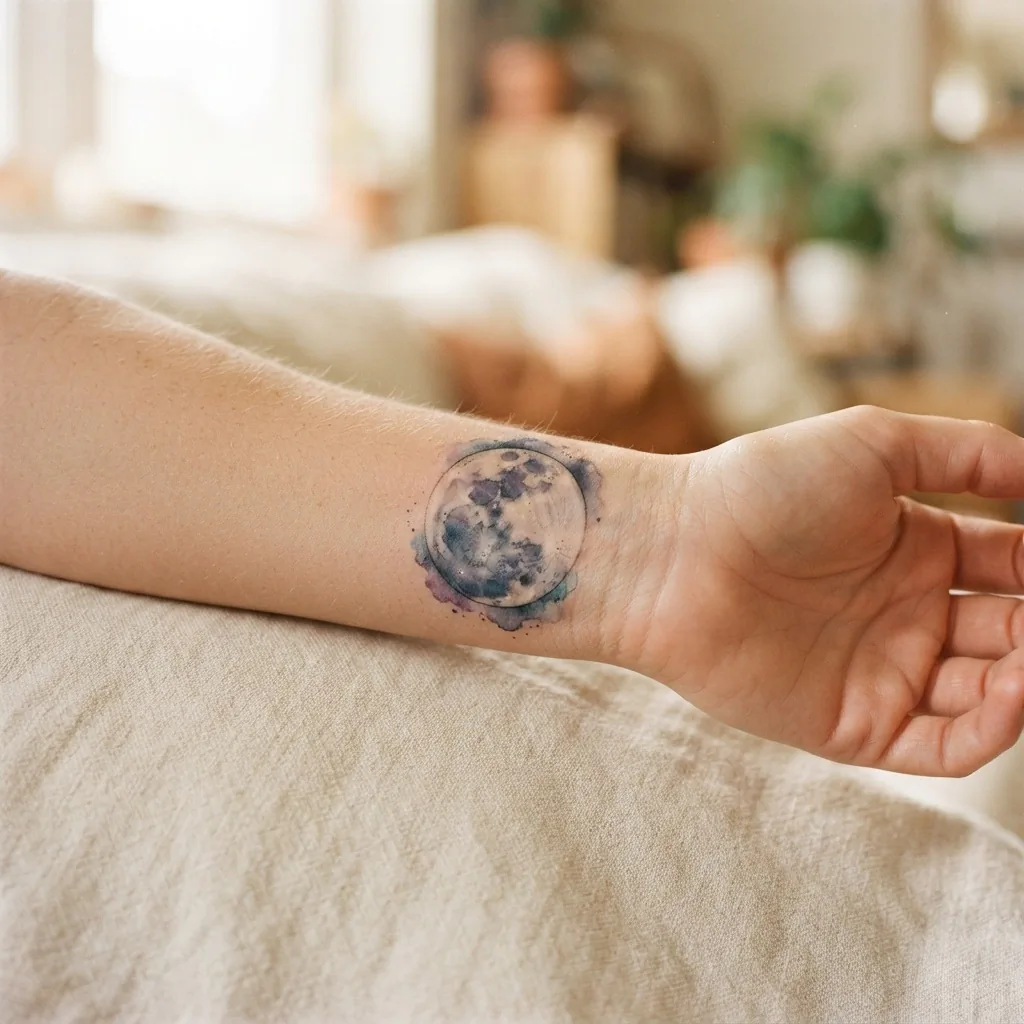
An artist who specializes in watercolor work will typically build in some structure to help the design hold, but you should ask directly: “How do you build this to age well?” That is a completely appropriate consultation question, and a skilled artist will be glad you asked.
Also worth knowing: colored inks, particularly certain pigments used for vibrant purples, blues, and pinks, carry a somewhat higher potential for allergic skin reactions than black ink. The University of Utah Health’s current reporting on tattoo skin reactions notes that studies show as many as 10 percent of tattooed people experience some form of skin reaction, and colored pigments are often involved. This doesn’t mean you should avoid color, but it’s worth discussing your skin history with your artist and, if you have known sensitivities, with a dermatologist before booking.
9. Moon with Botanicals
Moons paired with florals, leaves, herbs, and branches have become one of the most beloved combinations in contemporary tattoo art, and I completely understand why. The pairing works because the moon’s circular or crescent form gives the botanicals something to orbit around, creating a natural, flowing composition that feels balanced without being rigid.
Popular botanical pairings include: roses or peonies for romance and softness, lavender or wildflowers for a more whimsical or witchy feel, jasmine or cherry blossoms for delicacy, and dried or pressed botanical elements (a pressed fern, a dried lunaria branch) for a more earthy, naturalistic look.
This type of piece typically requires an artist who has a strong portfolio in botanical illustration or fine-line illustrative work. When you’re searching for your artist, look specifically for healed photos of their botanical designs, not just fresh-tattoo photos, because the healing process reveals how much detail actually holds.
10. Micro Moon (Tiny and Minimalist)
Sometimes the most powerful statement is the quietest one. A micro moon tattoo, a crescent or full moon at roughly half an inch to one inch, can be a deeply personal piece precisely because it isn’t designed to be noticed by everyone. It’s for you.
Micro tattoos do require a very skilled artist who specifically works in fine-detail miniature tattooing. The margins for error are extremely small at that scale. Tiny, densely detailed designs can blur over time if the linework is too close together or placed on high-movement skin. Placement matters enormously for a micro moon: behind the ear, inner wrist, collarbone, inner ankle, or finger are common spots, though finger tattoos are known to fade faster than almost any other placement due to constant friction and skin regeneration on the hands.
Always ask your artist directly: “Is this design achievable at this size, and will it hold?”
If they pause and say the design needs to be slightly larger to age well, trust that instinct. Their job is to give you something you’ll love in ten years, not just on the day you walk out.
Placement and Pain: An Honest Breakdown
I get asked about pain more than almost anything else, so let’s talk about it honestly. Pain varies enormously between people and depends on factors including your individual nervous system, your mental state on the day, how well you ate and slept, and the placement itself. That said, some areas are consistently more intense than others, and this matters when you’re choosing where to put a moon or star design.
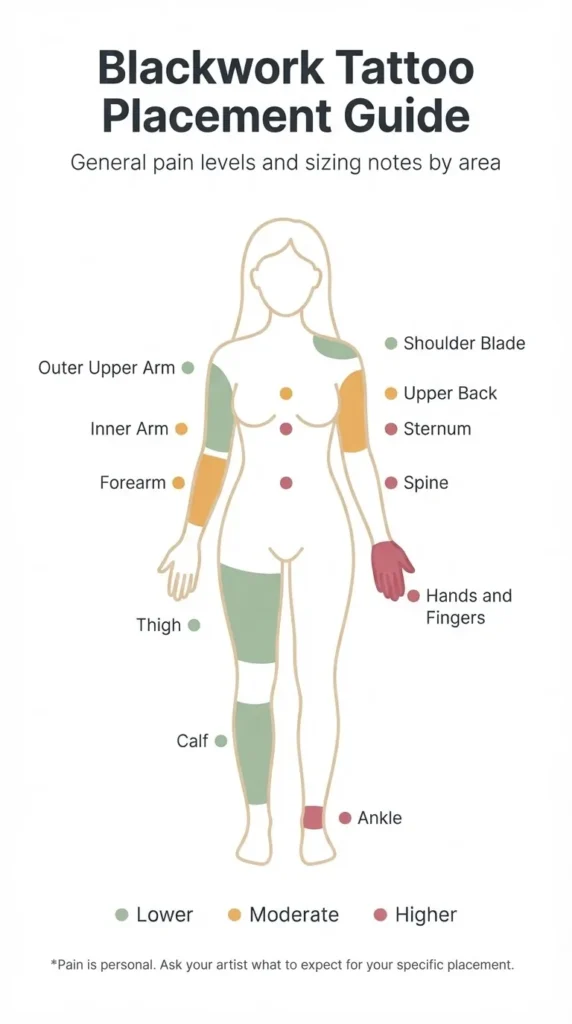
As Healthline’s tattoo pain chart explains, the most painful placements tend to be those with the least fat padding, thinnest skin, and the most nerve endings. For moon tattoos specifically, here’s a general guide:
Areas that most people find relatively comfortable include the outer upper arm, the outer thigh, the forearm (especially the outer forearm), and the calf. These are great starting-point placements for first-timers.
Areas that tend to be more intense include the ribcage (very thin skin stretched over bone, and breathing during the session adds to the sensation), the spine (directly over vertebrae with very little padding), the collarbone and sternum (bony with thin skin), behind the knee, and the inner wrist (more nerve-dense than the outer wrist, though still manageable for a small piece for most people). Behind the ear is surprisingly tolerable for many people despite feeling like it would hurt, though the sound and vibration of the machine nearby can feel disorienting.
The good news: most moon tattoos, unless you’re going for a large back or ribcage piece, are relatively small to medium in scale, which means sessions are short. A small crescent or micro moon might take fifteen to thirty minutes. A moon phases spine piece could take two to four hours. Session length matters as much as placement when it comes to managing discomfort.
Understanding Style and Longevity
One of the questions I think most planners are quietly carrying is: “Will I still love this in twenty years?” The honest answer is: probably yes, if you choose thoughtfully now.
Here are the factors that most affect how a moon tattoo holds up over time. Placement on high-sun-exposure areas (forearms, collarbone, chest) without consistent SPF protection is one of the leading causes of premature fading. Placement on high-friction areas (fingers, inner wrists, inside of the elbow) causes faster wear. Very fine linework at very small scales is more vulnerable to blurring over years than bolder, higher-contrast designs. Colored inks may shift or fade differently than black ink over time.
The single most consistent advice across licensed artists and dermatology professionals: protect your healed tattoo from the sun. Consistent SPF application on healed, tattooed skin is one of the most practical things you can do for long-term vibrancy.
How to Find and Vet a Tattoo Artist for a Celestial Piece
Finding the right artist is genuinely the most important planning step you’ll take, and it deserves real attention. Here’s how I approach it, both from my own experience and from what consistently comes up in the questions friends ask me before booking.
Start with style-specific searching. Instagram and TikTok are excellent research tools for this. Search hashtags like #finelinesunmoon, #crescenttattoo, #moonphasetattoo, or #celestialtattoo, but filter your attention toward healed photos, not just fresh ones. Fresh tattoos almost always look stunning. Healed photos, typically taken several weeks to months after the session, reveal how the artist’s linework actually holds and how colors settle.
Once you identify artists whose healed work resonates with you, move to the practical vetting stage. Verify that your artist holds a current license in your state or jurisdiction. Licensing requirements vary by location, but most states require tattoo artists to be licensed through the state health department or a professional licensing board, and many require proof of bloodborne pathogen training. You can typically check an artist’s license status through your state health department’s online licensing lookup. If a studio or artist cannot show you their current license or bloodborne pathogen certification on request, that is a serious red flag.
Look at the studio.
A clean, professional studio will have an autoclave (a sterilization device for reusable tools), will use single-use needles opened in front of you, will have clean surfaces and organized workspaces, and will feel generally hygienic. The FDA’s tattoo safety guidance is worth a read before your first appointment; it covers what contamination risks exist even in sealed ink bottles and what studio hygiene standards matter.
Questions worth asking your artist in a consultation or via DM before booking include: “Do you have healed photos of this style?” “What size do you recommend for this design to age well?” “Have you done moon phases on a spine before?” (or whichever specific placement you have in mind) “What is your aftercare recommendation?”
A good artist welcomes these questions. They want you informed. The consultation is a conversation, not an audition you can fail.
Ink Safety and What to Know Before You Book
This is worth a moment of your planning time, especially if you’re considering a colorful watercolor or vividly pigmented design. Tattoo inks are not regulated in the same way that food or pharmaceuticals are, and even inks that are commercially sold and sealed can occasionally harbor contaminants. The FDA has published safety guidance specifically on this, and it’s directly relevant to any consumer making a booking decision.
Skin reactions to tattoo ink range from mild and temporary (some redness and swelling in the first few days, which is normal) to more persistent responses. The American Academy of Dermatology’s guide to unexpected tattoo skin reactions outlines what is normal in healing versus what warrants a medical conversation: things like raised bumps that appear months after the tattoo, persistent itching, or spreading rash are worth bringing to a dermatologist rather than waiting out. The AAD is clear that these reactions, while not common, do occur, and that early attention is always better than delay.
If you have a history of skin sensitivities, eczema, psoriasis, or known allergies, it is genuinely worth a conversation with a dermatologist before booking, not to be scared out of a tattoo, but to go in informed.
Getting Ready for Your Appointment
Once you’ve chosen your design, your placement, your artist, and you’re booked, the preparation phase is where a lot of the first-tattoo nerves live. Here’s what most people find helps.
Stay well-hydrated in the days before your appointment. Eat a proper meal a few hours before your session so your blood sugar is stable. Wear comfortable clothing that gives your artist easy access to the placement area without requiring you to fully undress. Bring a reference image (or several) that capture the style, scale, and feeling you’re after, even if your artist is working from their own design. Having visual references in your hands helps the conversation land exactly right.
On the day, it’s okay to feel nervous. Most people do, including me, and I’ve done this many times. The nervousness is part of the excitement. If you’ve done the planning work, if you’ve found a licensed artist whose healed work you trust, and if you know what you want and why, then you’ve already done the hardest part.
Aftercare Basics (Always Follow Your Artist’s Specific Instructions)
I want to touch on aftercare briefly, with an important caveat: your artist’s aftercare instructions are the authority here, not me, not any blog post, and not whatever your friend tells you worked for them. Every artist has a method they trust, and that method is tailored to their technique and the products available in your area.
That said, some general principles are widely shared across the licensed tattoo and dermatology community. Keep the new tattoo clean and gently moisturized. Avoid soaking it in water (pools, baths, and open water) during healing. Keep it out of direct sun while it heals, and once fully healed, use SPF consistently. The American Academy of Dermatology’s guide to caring for tattooed skin is a useful reference alongside your artist’s specific instructions.
Healing timelines vary. Surface healing, where the skin feels normal to the touch, typically takes two to four weeks. Deeper skin layer healing can take two to four months. During that full healing window, sun protection and gentle care matter.
If anything looks or feels wrong during healing, such as spreading redness, fever, increasing rather than decreasing pain, or pus, contact your artist and seek medical attention promptly. These are not things to wait out or self-treat.
A Final Thought
Moon tattoos endure because they hold space for so many different stories. A crescent can mark a new beginning. A full moon can celebrate a moment of fullness and arrival. A moon phases sequence can honor the truth that you change, and that is a good thing, not something to be ashamed of.
Whatever direction pulls you, the most important thing is that you take your time with it. Save the images. Sit with the meaning. Find the artist whose hands you trust. Walk in knowing exactly what you want and why you want it.
That’s where a truly great tattoo starts.