Sun Tattoo Ideas: Styles, Placements, and How to Choose Yours
The sun tattoo has been saved to more Pinterest boards than almost any other design, and honestly, I get it completely. There is something about a sun that feels both deeply personal and universally understood.
It crosses cultures, centuries, and tattoo styles with an ease that very few motifs can match.
Whether you are drawn to a delicate fine-line sunburst or a bold blackwork mandala sun, the core of the design carries the same warmth, literally and symbolically.
But “sun tattoo” covers a lot of ground, and that is exactly why people end up feeling stuck. You know you want one. You have a folder full of saved images that all feel slightly different from each other. And somewhere in the back of your mind is the very reasonable question: “Which one is actually mine?”
That is what this guide is for. I want to help you move from a vague sun-shaped feeling to a clear, confident plan, the kind you can walk into a studio with and feel genuinely excited about. Let’s start at the beginning.
Why Sun Tattoos Have Resonated Across Every Culture and Century
Before you choose a design, it helps to understand what you are working with symbolically. And the sun has one of the richest symbol histories of any image you could put on your skin.
Ancient Egyptians worshipped Ra, the sun god, as the source of all creation and divine order. The sun disk, often depicted with radiating lines or carried across the sky in a solar barque, was among the most sacred images in all of Egyptian art. The Greeks honored Helios as the god who drove the golden chariot of the sun across the sky each day, and later Apollo became associated with solar radiance, reason, and creative power. In the Roman world, Sol Invictus, the “Unconquered Sun,” was a symbol of imperial power and eternal light.
In Mesoamerica, the sun held even deeper layers of meaning. The Aztec sun stone, often called the Aztec calendar, is one of the most recognizable ancient artifacts in the world. For the Aztecs, the sun was not a passive symbol of warmth but an active, demanding force that required ritual care to continue its journey across the sky. According to History on the Net’s breakdown of Aztec designs and their cultural meanings, the sun represented cyclical time, sacrifice, and the ongoing struggle between light and darkness. This layered meaning is one reason Aztec-inspired sun designs remain so visually and spiritually compelling today.
Celtic and Norse traditions had their own solar imagery, often expressed through interlocking circular patterns, solar crosses, and knotwork that represented the eternal cycle of seasons. In Polynesian tattooing traditions, the sun appears within larger compositional designs as a symbol of life force and guidance for navigators. The Zia symbol, sacred to the Zia Pueblo people of New Mexico, is a sun design representing the four cardinal directions, the four seasons, and the four stages of life, though it is important to note that this is a protected cultural symbol, not a generic motif available for anyone’s tattoo.
Why does any of this matter before you book? Because knowing what a design carries means you can choose with intention. A person who picks a fine-line sunburst simply because it looks pretty is making a totally valid choice. But a person who understands that their geometric sun connects to themes of renewal and light tends to love their tattoo longer, and they can tell the story behind it, which makes it feel even more theirs.
Today, most people who get sun tattoos are drawn to the universal meanings the symbol holds across cultures: vitality, warmth, a new beginning, the idea of being your own source of light. Those are wonderful reasons. You do not need a mythology degree to get a sun tattoo. You just need to know what it means to you.
The Most Popular Sun Tattoo Styles Right Now (and How to Know Which One Suits You)
This is where a lot of people get overwhelmed, and I want to make it simpler. There is no universally “best” style. There is only the style that fits your aesthetic, your skin, your placement, and how you want the tattoo to look in ten years, not just on day one.
Fine-Line Sun Tattoos
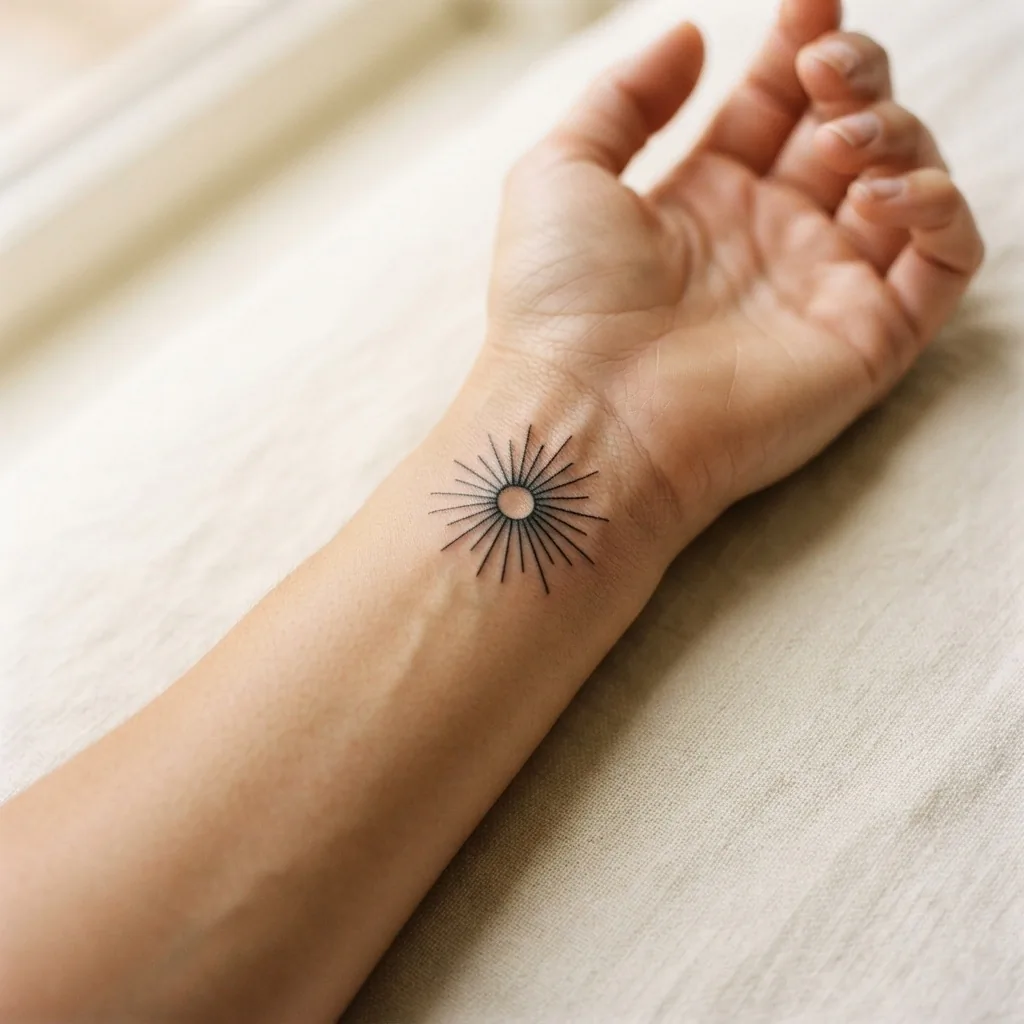
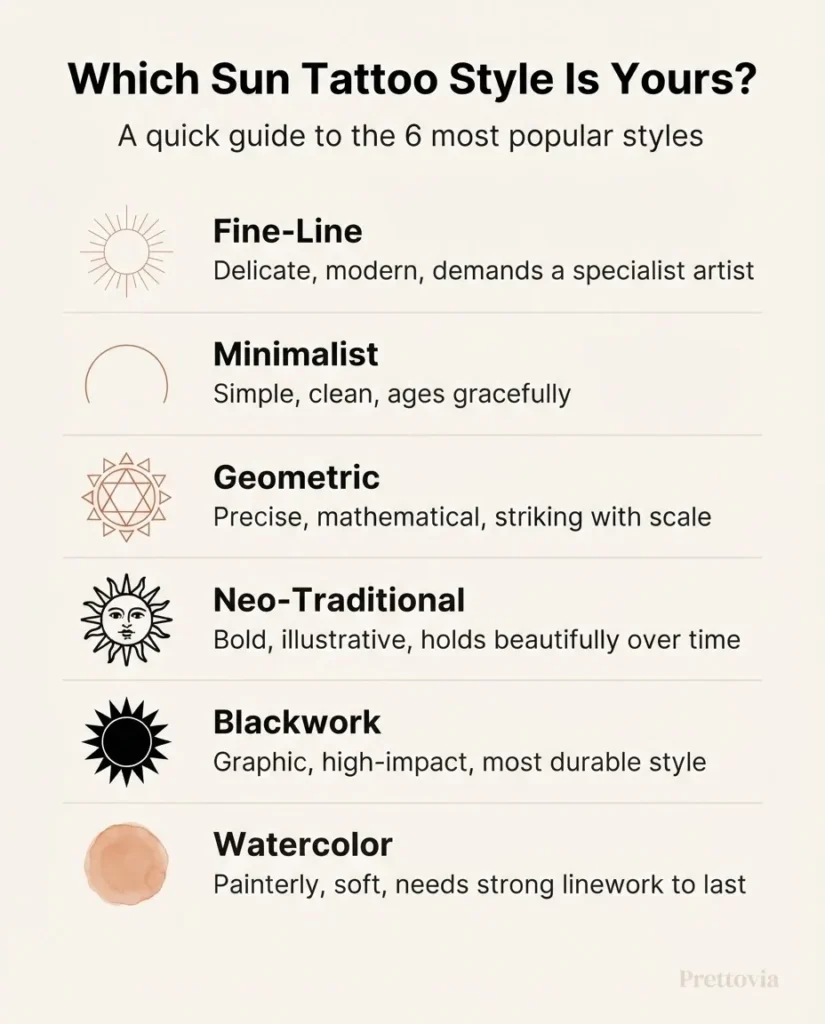
Fine-line is having a major moment, and sun tattoos in this style are everywhere. Think delicate, precise linework, often just a single-weight thin line, creating a sun with long radiating rays, a clean circle, or subtle detail like dots and dashes. The effect is airy and modern, almost like a pen sketch on skin.
What makes fine-line so appealing is also what makes it the most demanding to execute well. The thinner the lines, the more skill the artist needs to keep them crisp and even. Fine-line work also tends to soften over time, especially on sun-exposed placements like the wrist, forearm, or collarbone. This is not a reason to avoid it, but it is a reason to choose an experienced fine-line artist specifically, and to commit to excellent sun protection after healing. A fine-line sun can stay beautiful for many years with the right care. It will naturally settle and soften slightly, which many people actually love, as long as you go in with realistic expectations.
Minimalist Sun Tattoos
Related to fine-line but not identical, minimalist sun tattoos prioritize simplicity and negative space. This might be a clean circle with a few short rays, a half-sun on the horizon, or just a small solid circle that reads as the sun without any additional detail. Minimalist designs work beautifully small, making them perfect for wrists, ankles, behind the ear, or the inner arm.
Because of their simplicity, minimalist sun tattoos tend to age gracefully. There is less detail to blur or lose over time. If you are getting your first tattoo and feeling nervous about commitment, a clean minimalist sun is a genuinely excellent starting point.
Geometric and Mandala Sun Tattoos
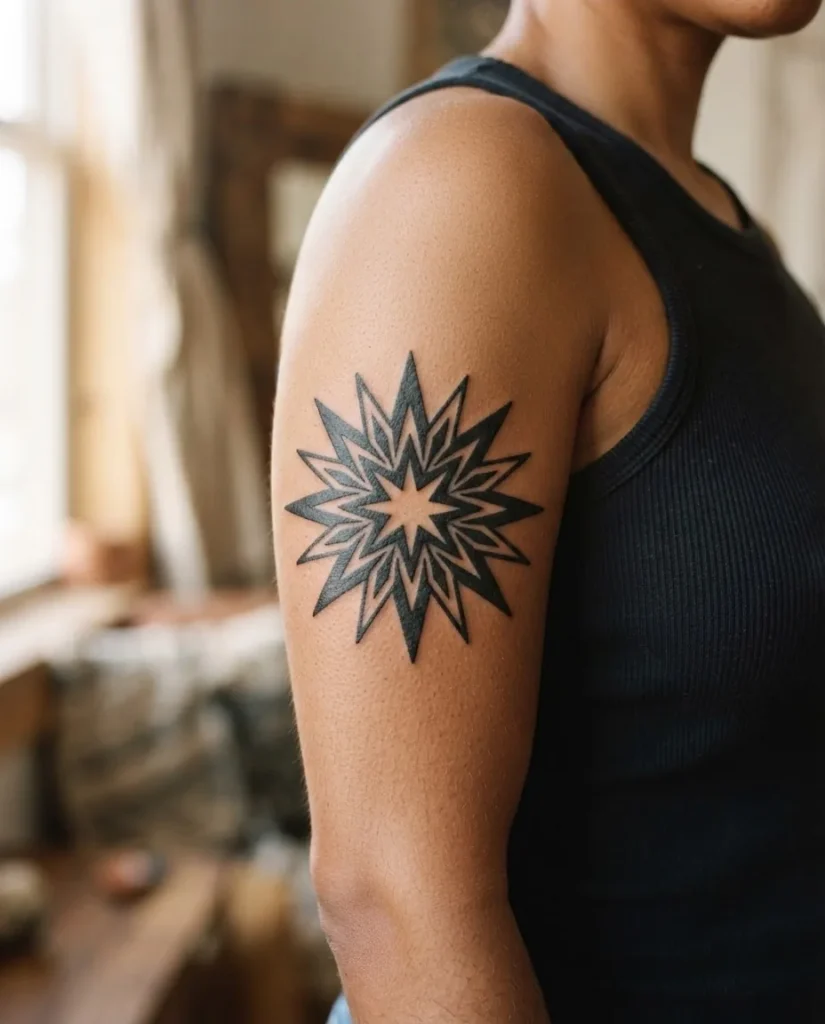
Geometric sun tattoos use precise shapes, angles, and symmetry to construct a sunburst or solar design. Mandala-influenced suns add layered circular patterning, sacred geometry, and intricate dotwork. These designs tend to be medium to large and look most impressive with scale behind them. A geometric sun on the upper arm, back, or sternum can be genuinely stunning.
The precision required for geometric work is significant. Lines need to be ruler-straight, symmetry needs to be mathematically accurate, and dotwork needs to be evenly distributed. This is another case where going to an artist who specifically excels in geometric or mandala work is essential, not a nice-to-have.
Neo-Traditional Sun Tattoos
Neo-traditional brings bolder lines, richer color, and illustrative detail to the sun motif. Think of a sun with a face, classic rays, and deep saturated golds or warm oranges, rendered with thick, confident linework. Neo-traditional tattoos tend to age very well because of their bold outlines, which hold shape longer than fine-line work.
If you love vintage Americana aesthetics, illustrated art, or anything with an “old school cool” feeling, neo-traditional might be your style.
Blackwork and Bold-Line Sun Tattoos
Blackwork sun tattoos use solid black ink, sometimes with contrast between filled shapes and negative space, to create striking graphic designs. These can range from a stark black circle with bold rays to complex tribal-adjacent patterns or entirely filled sunburst shapes. Blackwork is one of the most durable tattoo styles because solid black ink holds extremely well over time and reads clearly even as skin changes.
If you want a high-impact, low-maintenance tattoo that will look bold and clear for decades, blackwork is worth serious consideration.
Watercolor Sun Tattoos
Watercolor sun tattoos mimic the look of watercolor painting, with soft color washes, blended edges, and minimal black linework. They are beautiful, genuinely painterly, and very popular on Pinterest. The honest thing to say about watercolor tattoos is that they are among the most challenging to maintain over time. Without strong black linework to anchor the design, the color washes can migrate and blur more quickly. Some artists address this by incorporating subtle linework, which helps significantly.
If you love this style, the key is to find an artist with a strong portfolio of healed watercolor work, not just fresh photos. A fresh tattoo looks beautiful in almost any style. A healed tattoo tells you the truth.
Tribal and Cultural Sun Tattoos
Polynesian, Aztec, Native American, and other cultural sun designs carry deep meaning and specific artistic traditions behind them. They can be extraordinary tattoos. They also come with a genuine responsibility. Before getting a design rooted in a specific living culture’s sacred iconography, it is worth doing honest research and, ideally, working with an artist from that cultural background who can speak to the meaning and execution with real authority. This is not gatekeeping. It is respect, and it tends to make the tattoo more meaningful, not less.
Sun Tattoo Placement: Where to Put It and What to Expect
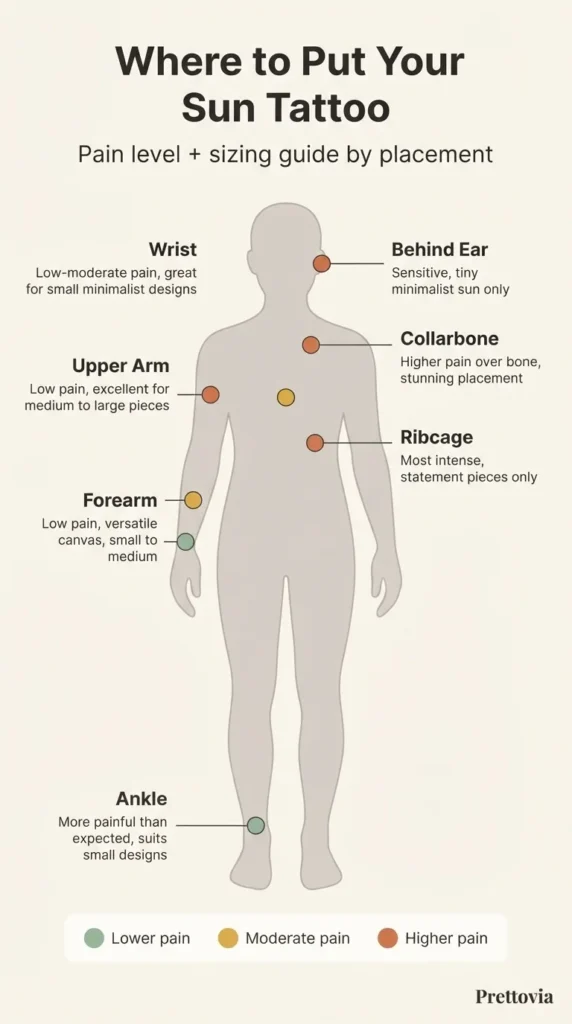
Placement is one of the decisions people most often wish they had thought through more carefully. Here are the most popular spots for sun tattoos, along with honest notes on sizing, visibility, and what to expect in the chair.
Wrist and Inner Wrist
A small sun on the wrist is one of the most popular choices, and for good reason. It is visible, personal, and works beautifully at a small minimalist scale. The wrist is a moderate-pain area, generally manageable for most people, though the inner wrist over the bone and vein can be more sensitive. Because the wrist is constantly exposed to the sun and the elements, keeping a healed wrist tattoo protected with SPF is especially important for longevity.
Forearm and Inner Arm
The outer forearm is widely considered one of the most comfortable placements, with moderate pain and a good flat canvas for designs that range from small to medium. The inner forearm is slightly more sensitive. Both are high-visibility, which some people love and others find feels like a lot. A sun tattoo on the forearm can be sized from a tiny minimalist piece to a more detailed medium design without losing readability.
Upper Arm and Shoulder
The outer upper arm and shoulder are excellent canvases for medium to large sun tattoos, particularly geometric or blackwork designs that benefit from more space. Pain in this area is generally on the lower end of the scale. The shoulder also offers the option of a design that wraps over the shoulder or connects to a sleeve. It is a placement with a lot of creative flexibility.
Collarbone and Sternum
These placements are beautiful and striking, but they come with more honest pain expectations. The collarbone area sits directly over bone with thin skin, and the sternum is similarly bony and sensitive. That said, many people find the result worth it entirely. A sun centered on the sternum, especially in a mandala or geometric style, can be a genuinely breathtaking piece. For realistic pain expectations by placement, Healthline’s medically reviewed tattoo pain chart breaks down sensitivity by body area in clear, accessible terms and is a good reference to look at before you decide.
Ankle and Foot
Ankles and feet are popular for small sun tattoos and can look lovely. They are also genuinely more painful than people expect, as the skin is thin, the bone is close, and the nerve endings are concentrated. Healing in this area requires a bit more attention because shoes and socks can rub the area. Artists generally recommend loose, open footwear during healing.
Behind the Ear
A tiny sun behind the ear is a quiet, personal placement. It is easily hidden or revealed depending on your hair. Pain in this area is higher than most people anticipate, with thin skin and sensitivity around the cartilage. Size is necessarily small here, which suits minimalist sun designs perfectly.
Back and Shoulder Blades
The upper back between the shoulder blades or across one shoulder blade is one of the most comfortable large canvases on the body. For someone wanting a truly statement sun tattoo, a large geometric or mandala design centered on the upper back can be spectacular. Lower back placements are also an option, though they carry more sensitivity.
Ribcage
The ribcage is one of the most beautiful and one of the most painful placements. It is genuinely not for the faint-hearted, and artists will often be upfront about that. The skin is thin, every breath moves the area, and the bone is close throughout. If you want a rib sun tattoo, go in fully informed and make sure the artist is someone you trust completely.
What Your Sun Tattoo Might Cost
Pricing for tattoos is one area where I always want to set honest expectations. A tiny, simple sun design at a reputable studio will typically start at the shop minimum, which is often somewhere between $50 and $100, and small sun tattoos in the 1 to 2 inch range generally run $80 to $200 depending on complexity, the artist’s rate, and the city. Medium designs with more detail can run $200 to $500 or more. Large, intricate, or custom geometric pieces can cost significantly more, particularly with a sought-after artist.
The thing I always tell friends before they book: do not shop for the cheapest tattoo. This is permanent art on your body. A few extra months of saving for an artist whose work you genuinely love is always worth it. The regret that comes from going cheap is far more expensive than the original price difference.
How to Find and Vet a Licensed Artist for Your Sun Tattoo
This is the part I care about most, because it is where good information makes the biggest difference. Finding the right artist is not just about aesthetics. It is about safety, too.
Start by researching artists who specifically specialize in the style you want. A fine-line artist and a blackwork artist have genuinely different skill sets, and someone who excels at one may not be the right choice for the other.
Instagram is currently the most useful portfolio platform for tattoo artists. Spend time scrolling through actual portfolio posts, not just saved designs, and look specifically for healed photos. Fresh tattoos look good in almost any style. Healed photos reveal the truth about how an artist’s lines hold, how their color saturates, and how their fine detail settles over time.
Once you have narrowed to a few candidates, visit their studios before booking. A reputable, licensed studio will be clean, organized, and operating with visible hygiene practices.

Your artist should be working with sterile, single-use needles and autoclave-sterilized equipment. OSHA’s Bloodborne Pathogens Standard applies to tattoo studios and establishes expectations for how practitioners manage exposure to blood and other materials. You can read the OSHA standard interpretation specific to tattooing and body piercing for a clear understanding of what professional compliance looks like. A studio that meets these standards is not a bonus. It is the baseline. Never book somewhere that makes you feel uncertain about cleanliness or professionalism.
Licensing requirements for tattoo artists vary by state and by country, so it is worth checking the specific requirements for your area. Most states require artists to hold a license issued by the state health department and to carry proof of bloodborne pathogen training. Do not hesitate to ask a studio about their licensing before you book. A good studio will answer that question without hesitation.
Book a consultation before your actual appointment if possible. Many artists offer them. This is your chance to share your vision, ask questions, and see whether the artist understands what you want. Bring reference images, but also be prepared to talk about what elements you love in each one and what you might want to do differently. The best consultations feel like a conversation, not an order form.
Questions worth asking at your consultation include: Have you done similar designs before, and can I see healed examples? How would you approach scaling this design for my chosen placement? What should I expect during healing for this particular spot? And what are your aftercare instructions?
Sun Tattoo Aftercare: Protecting What You Just Got
There is a beautiful irony in getting a sun tattoo and then needing to keep it completely away from the sun. But that is exactly what your artist will tell you, and they are right.
During the healing period, which typically covers the first 2 to 4 weeks for the surface skin and can involve deeper tissue healing for up to 2 to 3 months, your tattoo needs protection, moisture, and rest. Follow your artist’s aftercare instructions exactly. They know your specific tattoo, the depth, the ink, and the placement, and their guidance takes priority over any general advice you read online, including here.
General consensus in the tattoo and dermatology communities includes keeping the tattoo clean, applying the moisturizer your artist recommends (usually a fragrance-free, gentle option), avoiding submerging it in pools, lakes, or baths, and staying out of direct sunlight until fully healed. A peer-reviewed study on aftercare instructions in the tattoo community confirms that sun protection during and after healing is one of the most consistent recommendations across the field, and for good reason: UV exposure is one of the primary causes of tattoo fading.
Once your tattoo is fully healed, sun protection becomes a permanent part of the routine for that skin.
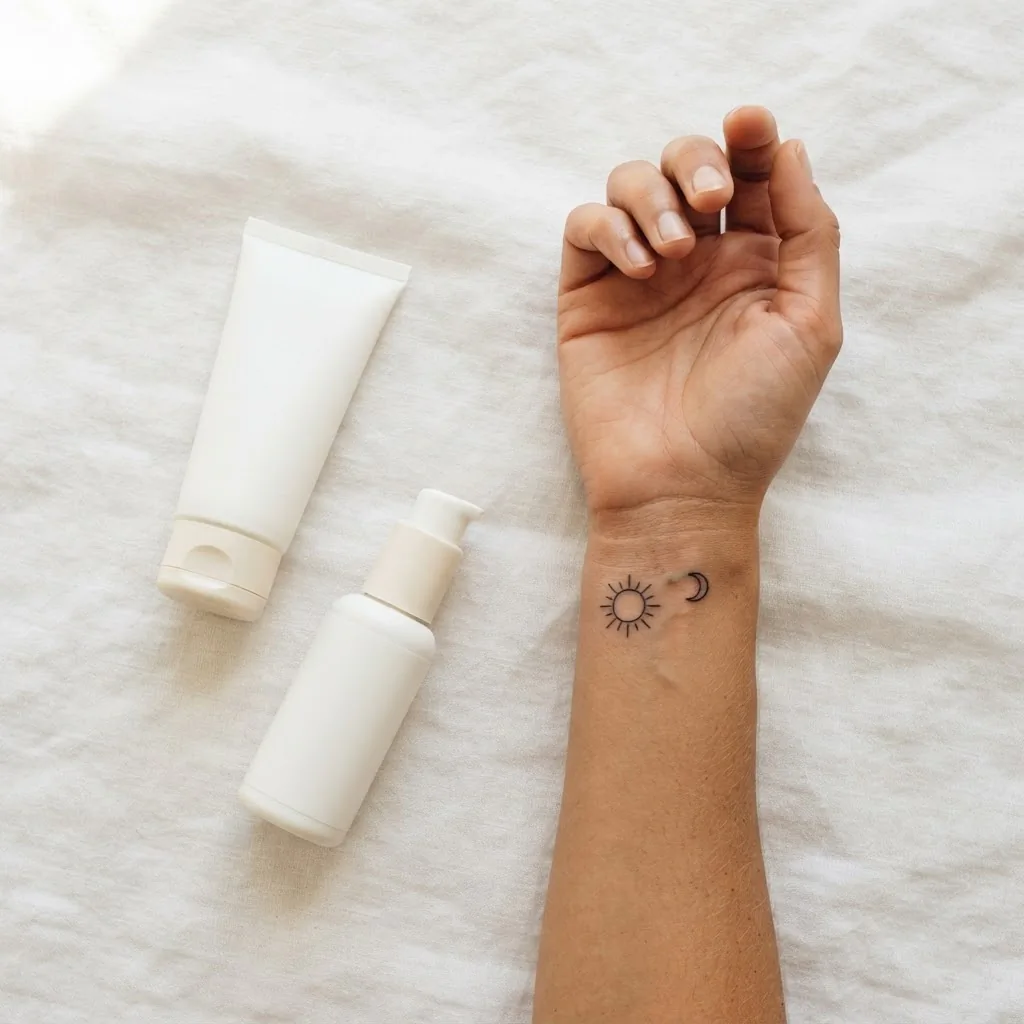
The American Academy of Dermatology recommends applying a broad-spectrum, water-resistant sunscreen with an SPF of 30 or higher to tattooed skin whenever it will be in the sun. For a sun tattoo on a placement like the wrist, forearm, or collarbone, this means SPF is basically part of your daily routine. The good news is that this is the same SPF habit that protects your overall skin health, so it is genuinely a win all around.
It is also worth knowing that tattoo ink can occasionally cause skin reactions, including allergic responses to certain pigments. Red ink is historically the most common allergen, but reactions can occur with other colors too. The FDA’s consumer resource on tattoo safety notes that reactions can appear immediately after tattooing or even years later, which is one more reason that working with a licensed professional using quality inks matters. If you notice anything unusual after getting tattooed, whether redness that spreads, unusual bumps, itching, or swelling that does not improve, contact a doctor or dermatologist rather than waiting. The AAD’s guide to unexpected tattoo skin reactions is a helpful reference for understanding what is normal and what warrants medical attention.
15 Sun Tattoo Ideas to Inspire Your Design
These are not meant to be copied exactly.
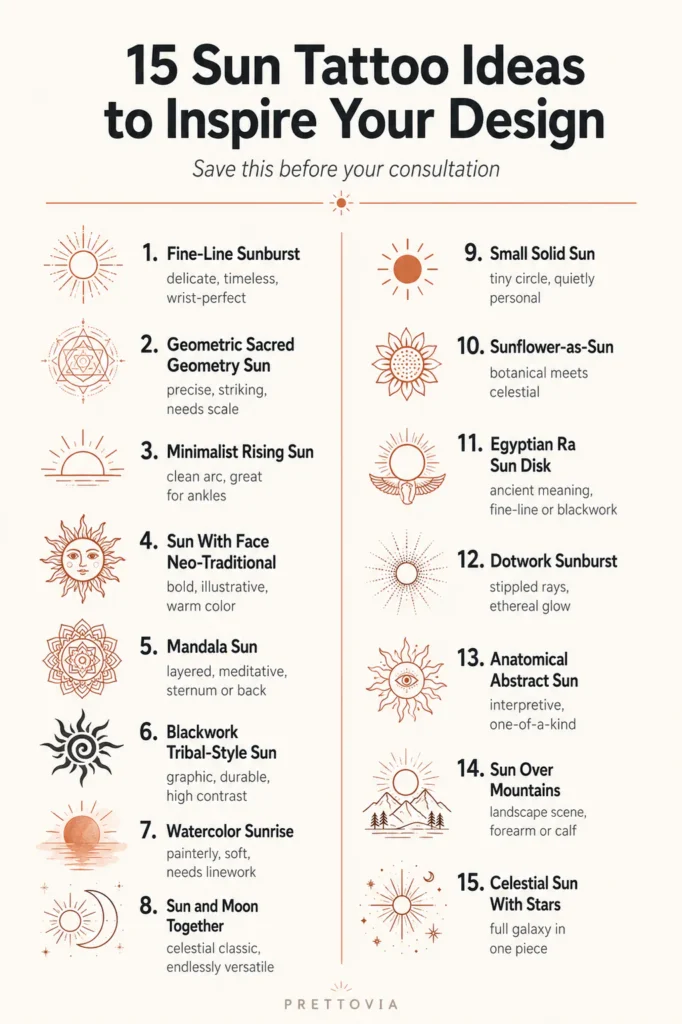
They are meant to spark your thinking. The best sun tattoo you will ever get is the one you and your artist create together.
1. Fine-Line Sunburst – A single-weight thin circle with long, evenly spaced rays. Timeless, minimal, works beautifully small on a wrist or ankle.
2. Geometric Sun with Sacred Geometry Interior – Hexagons, triangles, or Fibonacci-inspired patterns inside the circle. Stunning at 3 inches or larger on an upper arm or back.
3. Minimalist Rising Sun – Just the arc of the sun cresting a horizon line, perhaps over simple waves. Clean, symbolic, perfect on an inner forearm or ankle.
4. Sun with Face (Neo-Traditional) – A smiling or serene sun face with bold outlines and warm color. Nods to historical folk art and illustrated design traditions.
5. Mandala Sun – Concentric layered rings of pattern radiating outward from a central circle. Meditative, intricate, best with space to breathe on a sternum, back, or thigh.
6. Blackwork Tribal-Style Sun – Bold, graphic, high-contrast. Inspired by Polynesian or geometric traditions, executed in solid black ink. Powerful and durable.
7. Watercolor Sunrise – Loose washes of gold, orange, and pale pink with soft edges. Best with an artist who incorporates anchoring linework for longevity.
8. Sun and Moon Together – A split or adjacent composition pairing the sun and crescent moon. One of the most enduring combinations in celestial tattooing.
9. Small Solid Sun – A tiny filled circle, no rays, no detail. As minimal as a tattoo can be. Understated, quiet, and deeply personal for those who want something that is just for them.
10. Sunflower-as-Sun – The sunflower face abstracted into a sun design, blending botanical and celestial imagery in a warm, organic way.
11. Egyptian Ra-Inspired Sun Disk – A sun disk with descending lines or wings, referencing Egyptian solar iconography. Rich in meaning and beautiful in fine-line or blackwork.
12. Dotwork Sunburst – Rays made entirely of dotwork stippling that gradually fade from dense to sparse. Creates an ethereal, glowing effect that photographs beautifully.
13. Anatomical or Abstract Sun – A sun that dissolves into geometric shapes, ink drips, or abstract forms at its edges. For those who want something more interpretive and original.
14. Sun Over Mountains – A landscape composition with a sun rising or setting behind a mountain range. Works beautifully as a horizontal band on the forearm or calf.
15. Celestial Sun with Stars – A sun surrounded by scattered stars, crescent moons, or constellation dots. A full small universe on one piece of skin.
Before You Book: The Confidence Checklist
The friends who text me before booking their tattoos always have the same underlying question, even when they phrase it differently. They are asking: “Am I ready? Am I doing this right?”
Here is how I think about it. You are ready when you have a design direction you have sat with for a while, not just something you loved for a week. You are ready when you have an artist whose portfolio genuinely excites you and whose healed work holds up. You are ready when you know roughly where you want it and you have thought about visibility, pain, and sizing with honest expectations. And you are ready when you have done this for yourself, not for anyone else.
Getting a tattoo is a big decision and a permanent one, and both of those things are true at the same time. A good tattoo starts with good information, and you are already doing that part.
When you find your artist and you sit down for that consultation, you do not have to know everything. You just have to know what you love and why. Bring your references, ask your questions, and trust the process. The best tattoo artists do not just execute designs. They help you find the version of your idea that will truly work on your body for the long run.
That is the whole point of all of this. Not the perfect Pinterest image, but the tattoo that actually feels like you, years from now, catching a glimpse of it in a mirror and still smiling.
Take your time. You will know when it is right.