Constellation Tattoos: 10 Designs Worth Pinning (and Why)
My Pinterest board has had a constellation tattoo pinned to it since before I even knew which constellation I wanted. That is how this kind of ink works on most of us. You see one, something clicks, and suddenly you are three hours deep into star map images at midnight, comparing the Big Dipper to Orion and wondering if the dots on your wrist will still look like stars in ten years.
I get that feeling completely. And because I also get the questions that come right after it, “Will this actually hold up? How small is too small? Where do I even start looking for an artist?”, I want to give you the planning guidance that most of those pretty Pinterest galleries skip entirely. Because a constellation tattoo done right is genuinely stunning, personal in a way few other designs can match, and built to last. Done without enough information, it is the kind of piece people wish they had thought through more carefully.
So let’s think through it together. Here are ten constellation tattoo directions worth considering, and the real planning detail that will help you go from pinboard to studio with confidence.
Why Constellation Tattoos Connect So Deeply
Before we get into specific designs, it helps to understand what makes this style feel so different from other tattoos. Constellations are not just pretty dot patterns. They are one of the oldest organizational systems humans ever created for the night sky. As NASA’s science education resource notes, constellations have been used by civilizations for thousands of years to navigate, track seasons, and tell stories, and astronomers today still use the same 88 officially recognized patterns to map the sky. When you carry one on your skin, you are borrowing from something ancient and universal and making it entirely your own.

That combination of cosmic scale and personal meaning is exactly why constellation tattoos have stayed in demand even as other trends cycle in and out.
A Note on Style: What “Constellation Tattoo” Actually Means
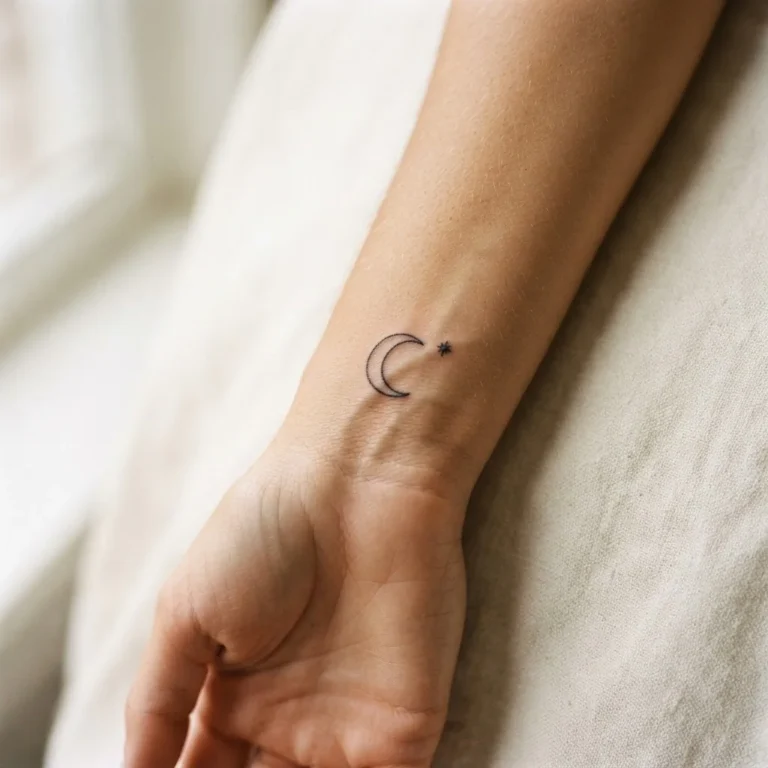
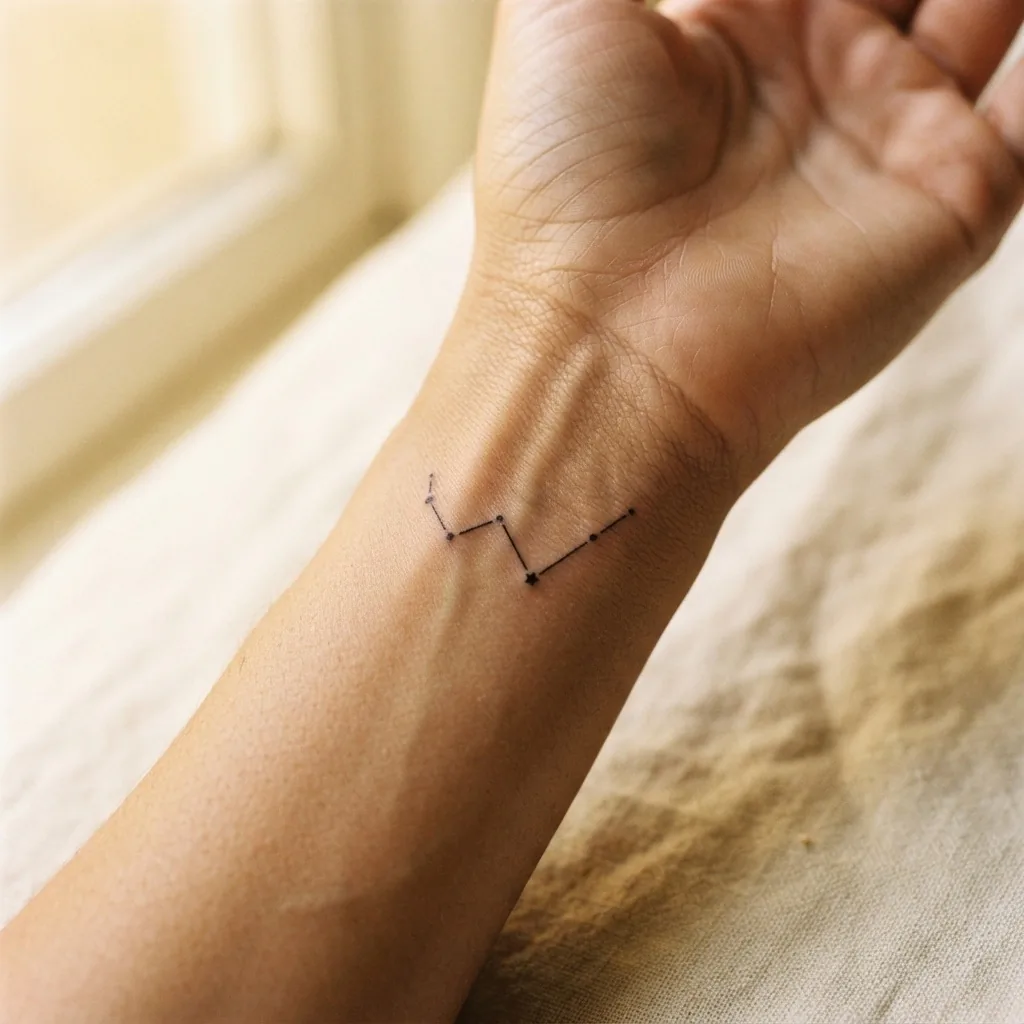
When most people say “constellation tattoo,” they picture a series of small dots connected by thin lines, rendered in fine-line or dot-work style, usually in black ink. That is the classic version, and it is beautiful. But the style category is actually broader than that, and knowing your options before your consultation will help you communicate more clearly with your artist.
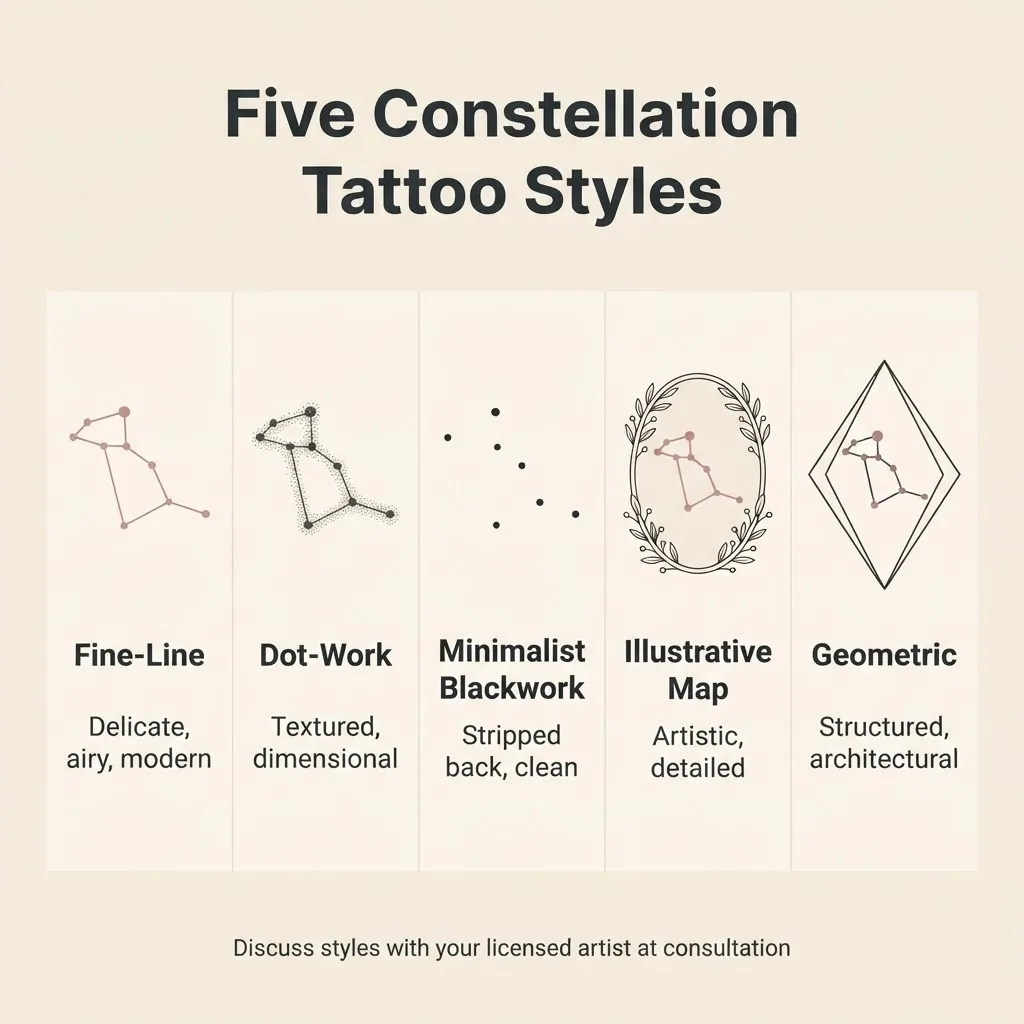
Fine-line constellation is the most popular approach right now, and for good reason. Thin, precise lines connect the stars with a delicate, airy quality that photographs beautifully and suits minimalist aesthetics. The tradeoff is that fine-line work ages differently than bold traditional tattooing. Lines soften and lighten slightly over time as the ink settles into deeper skin layers, rather than spreading aggressively the way a heavy black line might. A skilled artist who specializes in fine-line work will account for this in how they build the piece. The aging is not something to be afraid of. It is something to plan for with the right professional.
Dot-work constellation uses stippling, clusters of tiny dots to build depth and texture around the stars themselves. This approach can make a simple star map feel more dimensional, almost like a print from an old astronomical atlas.
Minimalist blackwork strips the design to its most essential form, sometimes just the dots with no connecting lines at all, letting the viewer’s eye complete the picture. This version reads as especially clean and modern.
Illustrative constellation maps incorporate more artistic detail, decorative borders, shading, or illustrated elements like moon phases or botanical frames around the constellation itself. These tend to be larger pieces and require an artist comfortable in that crossover style.
Geometric constellation uses precise line work and sometimes sacred geometry framing to give the design a structured, almost architectural feel.
Each of these reads completely differently on the skin, and the one that is right for you depends on your personal aesthetic, your placement choice, and your sizing goals.
This is a conversation to have during your consultation, not a decision to make alone based on a Pinterest save.
The 10 Constellation Tattoo Directions Worth Exploring
1. Your Birth Constellation (The Classic)
Your zodiac constellation is the most personal starting point, and it remains one of the most requested designs for good reason. It is yours by birthright, it carries built-in meaning, and it is instantly recognizable to anyone else who shares your sign. Scorpius, Gemini, Leo, Taurus, the shapes vary enormously in complexity and visual character, so it is worth looking at your specific sign’s star pattern rather than assuming it will look the way you imagine. Some constellations, like Gemini with its twin pillars, are beautifully geometric. Others, like Scorpius, have a dramatic sweeping curve that lends itself to placement along the spine or collarbone.
2. Your Birth Chart Constellation (The Layered Version)
A step beyond your sun sign is choosing the constellation associated with your rising sign, your moon sign, or another placement in your birth chart that feels personally significant. This is a wonderful option for people who feel their sun sign does not quite capture them. Astrology enthusiasts often find the moon sign, which relates to emotional nature and inner life, more meaningful for a permanent piece precisely because it is something only people close to them would know to ask about.
3. A Custom Star Map (The Most Personal Tattoo in This Category)
This is the constellation tattoo variation that tends to make people cry a little when they explain it, which tells you everything about its emotional weight. A custom star map shows the actual configuration of the sky at a specific date, time, and location. The night you were born. The night you met your partner. The night someone you loved passed away. The morning of your child’s birth. You choose the moment; a star chart app or website generates the accurate sky map; your artist renders it in the style you have discussed.
The result is a tattoo that is cosmically yours in a way no zodiac design can fully replicate. No one else has that exact sky. If you want to explore what the sky looked like on a specific date, Sky & Telescope magazine’s interactive sky chart is a free tool that lets you map any night at any location, which is a great starting point for reference material to bring to your consultation.
4. Orion (The Universal Constellation)
Orion is not a zodiac sign, which makes it a slightly unexpected choice that tends to intrigue people. It is arguably the most universally recognized constellation across cultures, visible from almost every location on Earth, and it carries rich associations with hunting, strength, mythology, and the wilderness. The three-star belt is one of the most iconic configurations in the night sky and translates beautifully as a minimalist tattoo on its own, or as part of a larger Orion rendering that includes the surrounding stars. For someone who wants a constellation tattoo with deep meaning but no zodiac association, Orion is often the answer.
5. Ursa Major and the Big Dipper
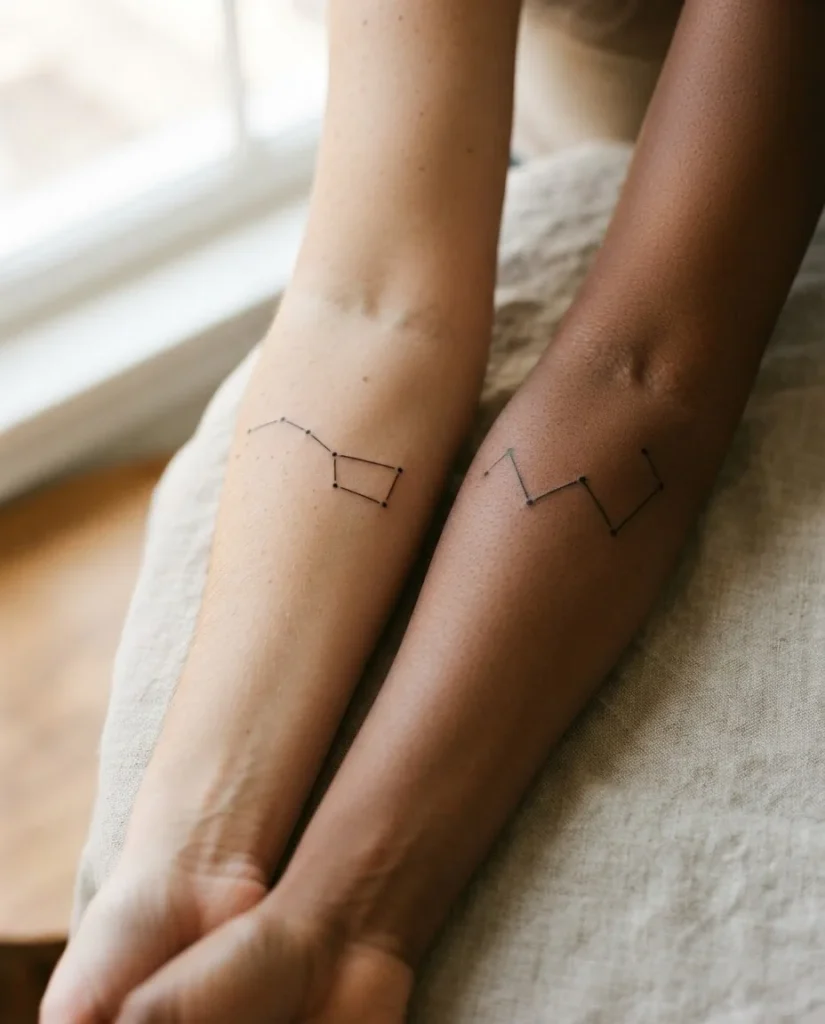
The Big Dipper is technically an asterism, a recognizable star pattern within the larger Ursa Major constellation, but it is so culturally embedded that most people simply call it the Big Dipper and move on. Its shape, a long-handled ladle or drinking dipper, is immediately readable in tattoo form even at fairly small sizes, because the pattern is so familiar. It also carries powerful associations with navigation, freedom, and finding your way home, symbolism that many people find deeply personal. Ursa Minor (which contains the North Star, Polaris) is often paired with it for that reason.
6. Cassiopeia (The W in the Sky)
Cassiopeia’s distinctive W shape is one of the most graphic constellation patterns, clean, angular, and immediately legible. It is also a circumpolar constellation for most of the Northern Hemisphere, meaning it is visible year-round rather than seasonally, which some people find meaningful as a symbol of constancy. Cassiopeia in Greek mythology was a vain queen, but the constellation itself tends to inspire associations with elegance, visibility, and bold presence. Its simple W shape makes it a genuinely excellent candidate for small placements.
7. The Southern Cross (Crux)
For readers with Southern Hemisphere roots or connections, Crux, the Southern Cross, is profoundly meaningful. It appears on the flags of Australia, New Zealand, Brazil, Papua New Guinea, and Samoa, and it is one of the most navigated constellations in the Southern Hemisphere. For someone from or connected to those places, a Southern Cross tattoo carries cultural, geographic, and personal identity all at once. It is also a strikingly simple four-star design that tattooes cleanly in almost any size.
8. A Family Constellation (Multiple Signs Together)
One of the most emotionally resonant constellation tattoo ideas is grouping two or more signs together in a single composition. A parent wearing their children’s birth constellations. A person carrying both their own sign and a late parent’s. A pair of partners each getting the other’s sign. When done thoughtfully, with a skilled artist who can balance the visual weight of multiple constellation shapes, these pieces become something genuinely irreplaceable. The planning challenge is figuring out how to arrange multiple constellation shapes into a cohesive composition, which is where a thorough consultation really earns its value.
9. The Pleiades (Seven Sisters)
The Pleiades star cluster has one of the richest mythological histories of any night-sky formation. Across Greek mythology, Native American traditions, Japanese culture (where it is called Subaru), and dozens of other civilizations, the Seven Sisters have represented everything from feminine power to agricultural timing to the passage of souls. As a tattoo, the cluster of seven (or sometimes six visible) stars has a beautiful organic quality that sits differently than a geometric zodiac constellation. It feels almost like a scattering of sparks. For someone who resonates with themes of sisterhood, cycles, or cultural ancestry, the Pleiades is a deeply considered choice.
10. A Minimalist Single-Star Anchor with Constellation Lines
This is the design for someone who wants to carry the visual language of constellations without committing to a specific, named pattern. An original arrangement of dots and lines, designed by the artist, that feels like it belongs to the sky without being cartographically accurate. This can be purely aesthetic, a beautiful abstract star map, or it can carry personal meaning that only you know. Think of it as commissioning a piece of celestial art that tells your story in a visual shorthand no one else has the key to. Many fine-line artists genuinely love this kind of creative latitude.
Placement and Sizing: The Two Decisions That Matter Most
I want to spend real time here because this is where the most regret happens, not in choosing the wrong constellation, but in choosing a placement or size that does not suit the design.
On sizing: Constellation tattoos are almost always small, which feels right for the delicate, starry quality they have. But there is a meaningful difference between “small and legible” and “too small to hold up.” Most experienced fine-line artists will tell you that a constellation design with connecting lines needs a minimum of roughly 5 to 8 centimeters in its longest dimension to remain readable as the ink settles over the years. Designs smaller than that risk the dots and lines softening into each other and losing their distinct pattern. Your artist will advise you on the right minimum for your specific design, and that conversation is one you should have explicitly before finalizing anything.
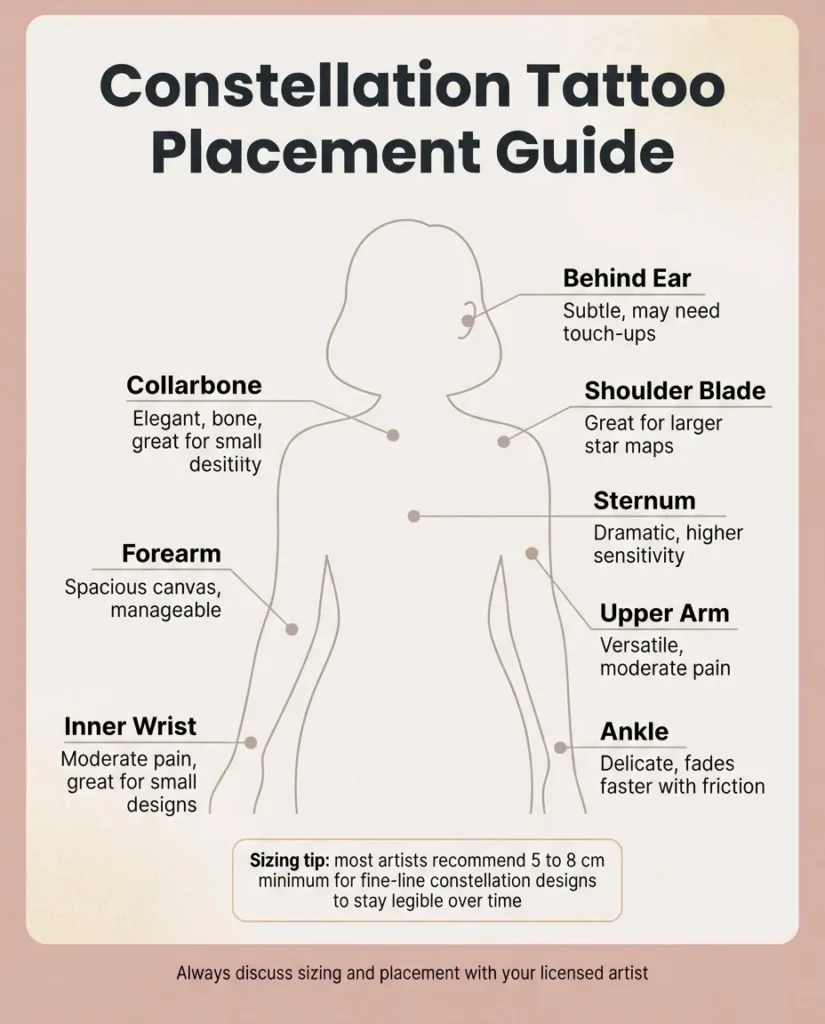
On placement: The right spot depends on three things: how you want the tattoo to move with your body, how much visibility you want day-to-day, and your honest assessment of pain tolerance by area.
Placement ideas that work especially well for constellations include the inner wrist (visible and personal, moderate pain, works beautifully for smaller designs), the forearm (great canvas for slightly larger pieces with room to spread), the collarbone (elegant and frames the neckline, but the bone proximity makes this a more sensitive spot), the upper back or shoulder blade (spacious, works for larger star maps, relatively manageable pain), behind the ear (intimate and subtle, though this area fades faster and requires more touch-up over time), the sternum (dramatic and hidden, one of the more painful placements given the bone and sensitivity of the area), and the ankle or inner ankle (delicate and sweet, though feet and ankles tend to fade faster with daily friction from footwear).
If pain is a concern for you, Healthline’s tattoo pain chart by body location is a solid general reference for understanding which areas tend to be more sensitive and why, though individual experience varies considerably and your artist will always be your best source of honest guidance.
Finding the Right Artist for Fine-Line Work
This is the most important decision you will make in this entire process. A constellation tattoo done by an artist who is not skilled in fine-line or dot-work is a very different outcome from one done by someone who specializes in exactly this.
Here is how I approach this when helping friends think through it:
Start with Instagram. Search the style terms (fine-line tattoo, constellation tattoo, dot-work, celestial tattoo) along with your city or region. When you find an artist whose work consistently stops you mid-scroll, look at their entire portfolio, not just the highlights. Look specifically for healed photos, not just fresh tattoo shots. Fresh fine-line work looks perfect in almost anyone’s hands. What you want to see is how it looks six months or a year later, because that is what you are actually getting.
Look at consistency. Does every piece in their portfolio show the same level of precision? Is the linework clean across multiple pieces and multiple clients, or are there obvious variations in quality?
Check the studio. A licensed tattoo studio in the US is regulated at the state level, and requirements vary, but a legitimate shop will have posted licensing information, use single-use needles, follow sterilization protocols, and be willing to answer questions about their hygiene practices. The CDC/NIOSH bulletin on safety and health for tattooists and piercers outlines the bloodborne pathogen standards that professional studios follow, which is useful background for understanding what you should expect from any shop you walk into.
Book a consultation before you commit to booking the appointment itself. Most reputable artists offer consultations, sometimes free and sometimes with a deposit toward your piece. Use that meeting to bring your reference material, ask questions, and gauge how well the artist communicates and listens.
What to Bring to Your Consultation
A constellation tattoo might be small, but the consultation deserves real preparation. Here is what I always suggest people bring:
Printed or saved reference images of constellation tattoos you love, specific to the style (fine-line, dot-work, geometric, etc.), not just any constellation image. Save a range so you can articulate what you like and what you do not.
The actual star chart or constellation map of the pattern you want. If it is a zodiac sign, a clean astronomical rendering is better than an astrological illustration. If it is a custom star map, bring the generated chart from your chosen date and location.
A clear sense of your placement preference and an openness to the artist’s feedback on sizing. They see how skin moves and ages every day. Their input on minimum size is not them upselling you; it is them protecting the integrity of your piece.
Questions. Real ones. Ask how they approach fine-line constellation work. Ask to see healed examples specifically. Ask about their touch-up policy. Ask how long they estimate the session will take. A confident artist welcomes every single one of these.

Ink Color, Skin Tone, and a Few Things Worth Knowing
The vast majority of constellation tattoos are done in black or very dark grey ink, and for good reason. Black ink holds best over time, reads most clearly against all skin tones, and suits the spare, celestial quality of the designs. White ink constellation tattoos exist and can look stunning in photographs, but they fade significantly faster, often becoming nearly invisible on lighter skin tones and muddying on darker ones. If you love the idea of a more subtle, skin-tone-close design, a grey wash approach gives you something quieter than solid black while holding up considerably better than white.
On the topic of ink itself, the FDA monitors tattoo pigments as cosmetics and has received reports of adverse reactions, including reactions that appear not immediately after tattooing but months or years later. Their consumer guide on tattoo ink safety is worth a quick read before any appointment, not to alarm you, but because being an informed consumer is always the right call. If you have a history of skin sensitivities or allergies, mention this explicitly during your consultation and consider speaking with a dermatologist beforehand.
Speaking of reactions, the American Academy of Dermatology notes that unexpected skin reactions to tattoos can range from temporary redness and swelling to more persistent itching, raised skin, or pigment-specific responses. Red and certain bright pigments are the most commonly associated with allergic reactions, which is one more reason black ink is generally the lower-risk choice for constellation tattoos. If you notice anything unusual during healing, contact your tattoo artist and, if needed, a dermatologist or your doctor. Do not wait and hope it resolves.
What to Expect During Healing
Constellation tattoos are generally on the smaller side, which means sessions tend to be shorter and the healing experience is relatively manageable for most people. That said, healing is always individual and always matters.
In the first few days, your tattoo will be red, slightly raised, and tender to the touch. Your artist will cover it and give you specific aftercare instructions, and those instructions are your primary guide, not general internet advice and not anything I write here. Follow what your artist tells you.
Over the first two to four weeks, you will likely see some peeling and flaking as the outer skin heals. The tattoo may look cloudy or uneven during this stage. This is normal and temporary. The American Academy of Dermatology’s guide on caring for tattooed skin has solid, dermatologist-backed general guidance on what to expect and how to protect healing skin, and it is a good complement to whatever your artist provides.
The surface heals in roughly two to four weeks.
The deeper skin layers continue settling for up to four to six months. The tattoo you see at week three is not the final tattoo. Be patient with it.
Sun protection on a healed tattoo matters more than most people expect. UV exposure breaks down ink over time, which is a particular concern for fine-line constellation work where every line and dot counts. Once your tattoo is fully healed, keeping it covered or applying SPF is one of the simplest things you can do to preserve its clarity for the long term.
A Few Questions to Ask Before You Book
Before you commit your deposit, I want you to feel completely ready. Here are the questions I hear most often from friends before their appointments, and the ones I always make sure they actually ask their artist:
Can I see healed examples of your fine-line or constellation work specifically? Not just fresh photos.
What is your recommended minimum size for the design I have in mind, and why?
How do you recommend I prepare for the session, and what should I avoid beforehand (alcohol, aspirin, sun exposure)?
What aftercare instructions will you give me, and do you provide them in writing?
What is your touch-up policy if the ink does not settle evenly?
Is there anything about my placement choice that you would suggest reconsidering, and if so, what would you recommend instead?
There are no wrong questions in a consultation. If an artist makes you feel embarrassed or rushed for asking them, that is a signal about how they will communicate throughout the entire experience.
The Part I Actually Want You to Remember
Constellation tattoos work so beautifully as permanent art because they are already personal before you even pick up a pen. The night sky has always been a place humans project meaning, memory, and identity. Carrying a piece of it on your skin is not a small thing, and it does not have to be a scary one either.
The readers I most love helping are the ones who have been quietly sitting with an idea for months, not quite sure if it is “good enough” or if they are “ready.” Let me tell you: a well-planned constellation tattoo, chosen thoughtfully and executed by a skilled licensed artist, is one of those pieces people consistently love for decades. Not because it is trendy. Because it is theirs.
Do the research. Find the artist whose work makes your heart do something. Book the consultation. Ask every question. And then walk into that studio knowing exactly what you want and why.
That is where the confidence comes from. Not from rushing, but from knowing.