Curtain Bangs for Every Face Shape: What Actually Works
I want to start by being real with you: “curtain bangs work on everyone” is one of those things people say that is technically true but not very useful. Yes, curtain bangs are one of the most adaptable bang styles out there. But a curtain bang cut that looks stunning on an oval face with wavy hair looks very different on a round face with fine, straight hair and needs to be approached differently. The length changes. The styling technique changes. Even how much hair your stylist pulls into the bang section changes.
So if you have been saving curtain bang photos for three months and still feel like you can’t quite commit because you’re not sure they’ll work for YOUR face, this guide is for you. We are going to go through every common face shape, every major hair type, and all the styling methods from beginner-friendly to zero-heat, so you leave here with an actual plan instead of just more saved pins.
First, Let’s Figure Out Your Face Shape
Before anything else, you need to know what shape you’re working with. Stand in front of a mirror with your hair pulled fully back off your face, and look honestly at the widest point of your head, where your forehead, cheekbones, and jaw measure up against each other.
Oval faces are longer than they are wide, with a jaw that is slightly narrower than the forehead, and soft, gently rounded edges. Most face-shape guides use oval as the “ideal” because it is proportionally balanced.
Round faces are roughly as wide as they are long, with soft curves at the jaw and forehead and the widest point landing at the cheeks.
Square faces share similar width across the forehead, cheeks, and jaw, but with a strong, defined, more angular jawline rather than a rounded one.
Heart faces are wider at the forehead and taper down to a narrower, pointed chin. You may also have high, prominent cheekbones.
Diamond faces are widest at the cheekbones, with a narrower forehead and a narrow, pointed chin. This shape is less common and often confused with heart or oval.
Oblong or long faces are noticeably longer than they are wide, with a forehead, cheekbones, and jaw that are all close to the same width but stretched vertically.
If you are still not sure, the trick one stylist I used to watch back in my salon days suggested was drawing the outline of your face on a bathroom mirror with an erasable marker and then comparing the shape to a reference image.
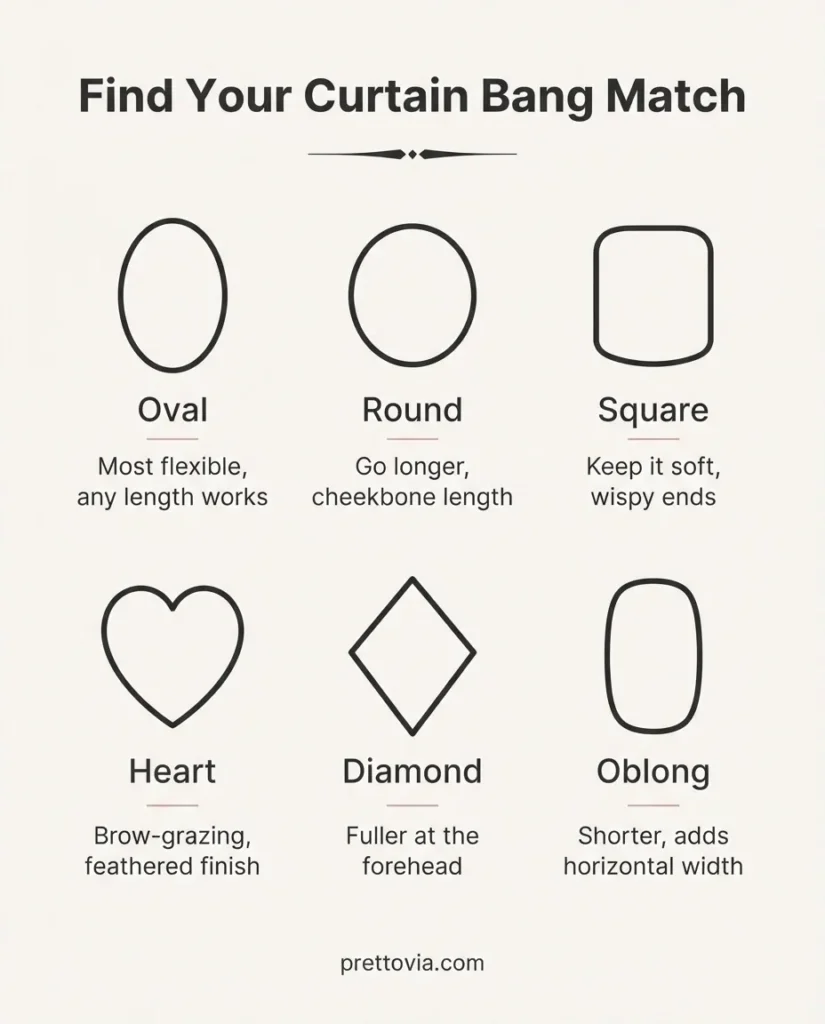
Sounds silly, it works.
Curtain Bangs by Face Shape: The Honest Breakdown
Oval Face
Good news: you have the most flexibility of any face shape. According to Vogue’s comprehensive curtain bangs guide, oval faces can pull off almost any variation, from a shorter brow-grazing curtain bang to a longer, more dramatic cheekbone-length sweep. You are not fighting any proportional challenge here, so you can choose purely based on what you love aesthetically. My suggestion is to let the Pinterest photo you keep coming back to be your guide, because with an oval face, that image is probably achievable.
Round Face
This is where curtain bangs genuinely shine, and I want you to hear that clearly: if you have a round face, curtain bangs are one of the most strategically flattering things you can do. Here’s why. The center part creates a vertical line right down the middle of your face, which draws the eye up and down rather than side to side. That visual line makes the face appear longer and more oval. The pieces that sweep out toward the cheeks add width at cheekbone level, which creates a slimming contrast with the jaw.
The key for round faces is length. You want your curtain bangs to be longer, hitting at the cheekbones or just below them. Short curtain bangs that barely clear the brows can emphasize fullness at the forehead instead of balancing it. Keep the part clean and centered, and resist the urge to go wispy and thin, you want enough weight to create that face-framing effect.

Square Face
Curtain bangs work beautifully on square faces, with one important note: keep them soft. The goal is to counterbalance a strong, defined jawline and a somewhat structured forehead, so you want your curtain bangs to be light and feathery rather than thick and blunt. A heavier, choppier curtain bang adds more structure to an already structured face, and that can read as harsh.
Ask your stylist to point-cut the ends heavily for a wispy, textured finish. A length that grazes the cheekbones is most flattering here, long enough to draw the eye down and soften the face, but not so long they just blend away. Styling with a slight bend or wave at the ends, rather than perfectly straight, helps keep the overall effect soft and balanced.
Heart Face
Heart-shaped faces tend to be wider at the forehead and narrow toward the chin, so the strategy with curtain bangs is to soften the forehead without adding visual weight at the top of the head. A curtain bang that sits closer to brow length, with ends that sweep gently outward, does exactly this. It breaks up the width of the forehead and draws attention to the eyes and cheekbones instead.
One thing to avoid on a heart face is curtain bangs that are too thick or heavy right at the hairline. That can amplify the width you are trying to soften. Ask for a feathered finish with some texture through the ends, and you’ll get that delicate, face-framing effect that makes curtain bangs so magical on this face shape.
Diamond Face
Diamond faces have that striking combination of a narrow forehead, wide cheekbones, and a narrow chin. The goal with curtain bangs is to add a little visual width to the forehead to balance those dramatic cheekbones. For this face shape, fuller, slightly heavier curtain bangs that start close to the hairline work better than super-wispy ones. You actually want that soft fringe weight across the forehead. A length that sits right at brow level or just below tends to be most flattering, rather than a long curtain bang that falls to cheekbone level and just emphasizes the widest part of the face.
Oblong or Long Face
This is the one face shape where I’m going to pump the brakes slightly on the “curtain bangs work on everyone” claim, because the wrong version of curtain bangs on a long face can make it look even longer. If curtain bangs are cut very long and swept far to the sides with a deep center part, they essentially frame the length of the face without adding any width. That deepens the oblong effect rather than balancing it.
What actually works on a long face is a shorter curtain bang, one that sits at the brow or slightly above, and is styled with slightly more volume across the forehead rather than swept completely flat. This adds horizontal visual interest across the upper face and creates the illusion of width. You can still do the center part, but consider pulling it back just slightly or leaving it a touch off-center so it doesn’t emphasize the vertical line of the face.
How Hair Type Changes Everything
Your face shape tells you the ideal length and weight of your curtain bangs. Your hair type determines how you cut them, how you style them, and how often you will need to maintain them.

Straight Hair
Straight hair is the classic curtain bang canvas because the hair falls predictably and the blow-dry technique is easy to learn. The main risk is flatness, so ask your stylist to point-cut the ends rather than blunt-cutting them straight across. Point cutting (where the scissors are held vertically and the tips snip into the ends at an angle) creates texture and prevents the bangs from lying completely flat. The detailed step-by-step guide from Ogle School’s cosmetology team is worth bookmarking if you want to understand the actual cutting technique, because knowing what “point cut at an angle” means helps you communicate with your stylist and understand what they’re doing.
Wavy Hair
Wavy hair is probably the most naturally compatible hair type for curtain bangs, because the wave creates that sweeping, face-framing shape mostly on its own. The important thing here is that you should ask your stylist to cut your curtain bangs slightly longer than you think you want them. Wavy hair has shrinkage: when the wave sets, the bangs will appear shorter than they look immediately after cutting. Starting a bit longer gives the wave room to work without ending up with accidental eyebrow-skimming bangs when you didn’t plan for them.
Curly Hair
Curtain bangs on curly hair look incredible when they’re done right, but they require a stylist who understands curl shrinkage. This is non-negotiable: curtain bangs on curly hair should always be cut on dry, fully styled hair. When curly hair is wet, it appears much longer than it actually is once dry, and if a stylist cuts your bangs wet, they can end up dramatically shorter than intended once your curls spring back. A length that looks eyebrow-grazing when your curls are stretched can bounce up to mid-forehead or higher when fully dry. Always cut dry, always.
For styling, many people with curly hair find their curtain bangs work beautifully with a diffuse-and-air-dry approach, letting the curl pattern create the shape naturally. You can also apply a small amount of curl cream to damp bangs and pin them gently to each side with clips while they dry, which trains the sweep without any heat.
Fine Hair
Fine hair can absolutely have curtain bangs, but the approach is different. Ask your stylist to pull a smaller section of hair into the bang than they might instinctively reach for. Taking too much hair for the bang on fine hair strips volume from the rest of the style, and you end up with bangs that look sparse and hair that looks even thinner in the front. A lighter, wispier curtain bang actually reads as more intentional and polished on fine hair. Volumizing mousse at the roots and a small round brush for the blow-dry will become your best friends.
Thick Hair
Thick hair handles curtain bangs with almost no drama. There is plenty of density to create a full, face-framing effect. The thing to ask for here is thinning or texturizing through the ends of the bang, because without it, thick curtain bangs can look blunt or heavy rather than soft and feathered. Texturizing shears make a real difference.
How to Style Curtain Bangs at Home
The Classic Round Brush Blow-Dry
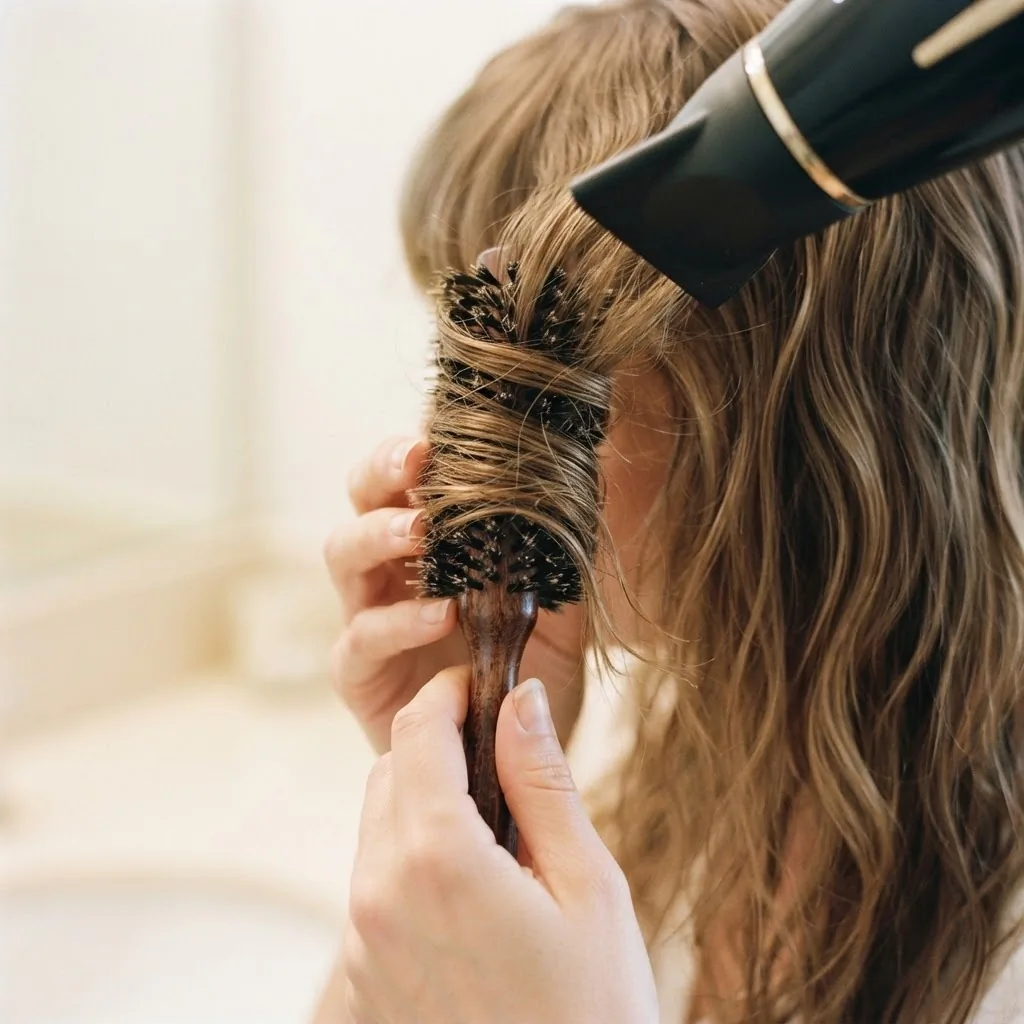
This is the technique that gives curtain bangs that signature wispy sweep, and it’s more beginner-friendly than it looks. Start with your bangs slightly damp, either fresh from washing or misted with water from a spray bottle. Apply a small amount of volumizing mousse or a light styling foam to the roots of your bangs only. Then, using a small to medium round brush held vertically, blow dry each side of your bangs away from the center part, rolling the brush slightly under the ends as you go. The “roll under and out” motion is what creates the curl and sweep. Alternate sides so you’re lifting and curving both directions. Once dry, let the bangs cool for 30 seconds before touching them.
The Flat Iron Method
For a sleeker, smoother curtain bang look, a flat iron on dry hair works well and takes about two minutes once you get the hang of it. Clamp near the root, rotate the iron slightly away from your face as you draw it toward the ends, and you get that outward-facing sweep. Heat protectant is genuinely important here, not just a product recommendation for the sake of it. The American Academy of Dermatology specifically notes in their healthy hair tips that using a heat protectant product before blow-drying or flat-ironing is one of the key ways to reduce heat damage, alongside keeping your heat setting at low or medium. Bangs are shorter and get heat applied repeatedly, so please do not skip the protectant.
The Velcro Roller Method
This is one of my favorite lower-heat options for curtain bangs, especially on days when I want volume without the arm workout of a round brush session. Roll damp bangs around a large Velcro roller and let them set while you do your makeup or get dressed, roughly 10 to 15 minutes. When you remove the roller, the bangs have built-in volume and a soft bend without direct heat on the hair shaft. It is the lazy girl method that genuinely delivers.
Heatless Styling for the Heat-Damage-Conscious
If you are actively trying to cut back on heat styling, or if your hair is already a bit fragile, you can style curtain bangs with zero tools. Her Campus has a solid breakdown of four heatless methods for curtain bangs that includes the roller method, a T-shirt wrap technique, and using foam rollers overnight. The key with any heatless approach is to work with damp (not soaking wet) bangs and pin or roll them in the direction you want them to fall, then leave them completely alone until fully dry. Touching them mid-dry breaks up the shape.
Beginner Mistakes to Avoid (And How to Fix Them)
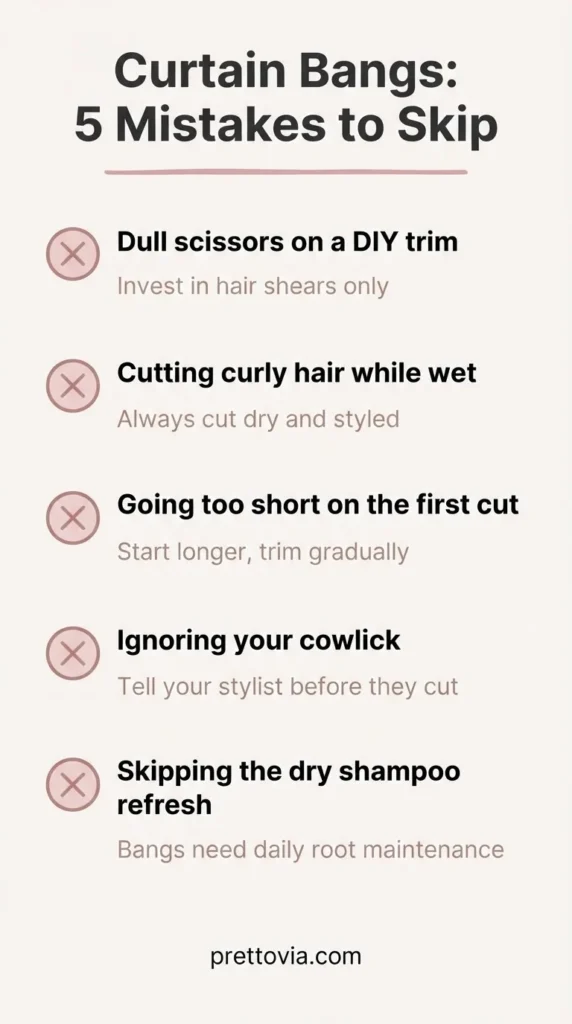
Cutting them yourself without sharp scissors. This is the number one cause of those choppy, uneven home-cut bangs you see on Reddit. If you are going to trim your curtain bangs at home between appointments, you need actual hair shears, not kitchen scissors or craft scissors. If you’re unsure whether you’re ready for a DIY trim, the WikiHow guide to cutting curtain bangs at home walks through the section, the angle, and the point-cut method in a very clear way. Honestly though, a professional trim every 3 to 6 weeks is the much safer path. Even a quick bang trim appointment at your salon, which is usually a short service, keeps the shape looking intentional.
Cutting on wet hair if you have curls. Already covered above, but it bears repeating because this is such a common issue. Dry, styled, always.
Going too short on the first cut. This is the beginner mistake I personally cringe about the most, because there is no fixing too-short bangs except growing them back. If you are brand new to curtain bangs, ask for them longer than you think you want them. You can always trim again in a few weeks. You cannot add length back.
Skipping the cowlick conversation. If you have a cowlick in your hairline or at your part, tell your stylist before they cut. Cowlicks don’t disqualify you from curtain bangs, but they do affect where the bang will naturally want to sit. A good stylist will account for this in the cut. A flat-creaseless clip at the part while bangs are drying can also help train the direction over time.
Letting the bangs get oily without refreshing. Bangs sit directly on your forehead, which means they absorb oil, sweat, and skincare product faster than the rest of your hair. A good dry shampoo applied at the roots between washes keeps them looking fresh. This isn’t optional maintenance, it’s just part of the curtain bang lifestyle.
What to Actually Tell Your Stylist
Walk in with a photo, yes, but also be ready to answer these questions, because a great stylist will ask them: How do you usually part your hair? How much time do you want to spend styling in the morning? Do you air dry or use heat tools? Have you had bangs before?
The more specific you are, the better the cut. A few things worth saying out loud: “I prefer a longer curtain bang because I’m not sure how short feels on me yet.” Or “I have fine hair and I’m worried about losing volume, can you keep the section light?” Or “I have a cowlick right here, what do we do about that?”
The professional guide at Numi Hair has a clear breakdown of what to communicate around your parting preference and styling commitment, and it’s a good read before your appointment if you want to feel prepared.
Growing Them Out: What to Expect
One of the best things about curtain bangs compared to blunt, straight-across bangs is that they grow out gracefully. Because they’re already longer at the sides and blended into your layers, the grow-out phase is mostly invisible. The center section gets longer, the curtain effect gradually softens, and eventually they just become face-framing layers. Most people find this takes about 2 to 3 months to fully blend in.
If you change your mind and want to grow them out, tell your stylist. They can take a slightly different approach at each trim, allowing the center to grow while keeping the sides from looking scraggly, so the whole thing transitions cleanly rather than awkwardly.
Products Worth Knowing About
For styling, you mostly need three things: a heat protectant (do not skip it, see above), a light volumizing mousse or foam for the roots, and a finishing spray with flexible hold. You do not need anything fancy. Drugstore heat protectants from brands like TRESemmé and Garnier work perfectly well for curtain bang styling. For the round brush, a small to medium boar-bristle round brush gives you the most control, but a standard barrel brush works fine for beginners.
For in-between refreshes, dry shampoo at the roots extends the life of your curtain bang style by a day easily. And a light texturizing spray misted over dry bangs adds that lived-in, wispy finish without any additional heat.
One last thing: curtain bangs are not a scary commitment.
They are already designed to grow out gracefully, they’re one of the most versatile bang cuts a stylist can give you, and the learning curve on styling them is genuinely short. A couple of weeks and you will do it on autopilot. If you’ve been saving curtain bang photos and talking yourself out of it because you’re not sure your face qualifies, I hope this helped you figure out not just whether they’ll work, but exactly how to make them work for you.
Book the appointment. Ask the questions. You’ve got this.