12 Best Heat Protectant Sprays, From Drugstore to Splurge
Let me be honest with you about something I see constantly: people skipping heat protectant because they either do not think it matters, or they bought one years ago that left their hair sticky and limp and they never looked back. I get it. Back in my salon assistant days in Austin, I watched clients come in with hair that looked like straw, and nine times out of ten, it was a combo of high heat and zero protection. A good heat protectant is not a luxury step. It is genuinely the difference between hair that holds up over time and hair that gets progressively more porous, dull, and snappy.
But here is the thing nobody in a lot of these roundups actually tells you: heat protectants do not make heat styling completely safe. According to cosmetic chemistry research, even a well-formulated protectant offers around 10 to 20% reduction in measurable heat damage, with the best-case scenario being roughly 50% protection. That is still really significant, and it absolutely matters for long-term hair health. It just means a protectant is one layer of defense, not an invisible shield. You still need to use the right temperature for your hair type, keep your tool moving, and not blast the same section six times.
So what should a good one actually do? It should slow down how quickly heat transfers through your hair shaft, help lock in some moisture so the interior of the strand does not dry out from the inside, and reduce frizz and surface damage. The best ones do all three without leaving your hair flat, crunchy, or coated in so much product buildup that your blowout looks greasy by hour two.
Here are my 12 picks, organized from wallet-friendly to worth-the-splurge, with honest notes on who each one actually works for.
Why the Ingredients Matter More Than the Marketing:
Before we get into the list, I want to spend a quick moment on what you are actually looking for on an ingredient label, because this is where a lot of people get lost.
The ingredient classes that have actual research behind them for heat protection are silicones (look for dimethicone, cyclopentasiloxane, and amodimethicone), hydrolyzed proteins (hydrolyzed wheat protein, hydrolyzed keratin, hydrolyzed silk), and certain film-forming polymers like PVP or related copolymers. These work by forming a thin film over the hair cuticle that slows heat conduction and distributes the temperature more evenly across the strand, reducing the hot spots that cause cuticle cracking and protein breakdown.
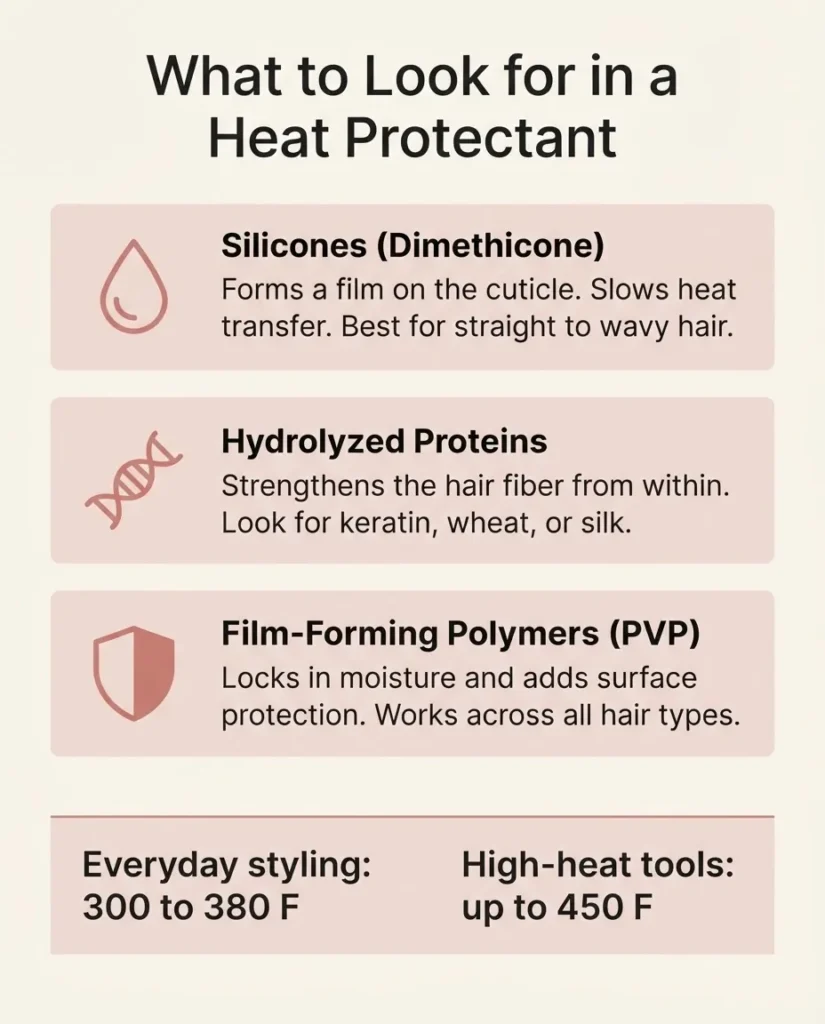
I know “silicones” has become a somewhat loaded word in the curly hair world, and I understand why. Silicones do require a proper clarifying shampoo routine to prevent buildup. But for people who heat style regularly, silicones are genuinely one of the better-studied protective ingredients, particularly for straight and wavy hair types. If you are curly or co-washing only, I have got some notes on that later.
You also want to pay attention to temperature ratings. Most quality heat protectants are rated for 400°F to 450°F. If you are using a flat iron on fine hair and you have it cranked to 450°F, no protectant is going to save you from cumulative damage. The protectant buys you a margin, not a free pass. The American Academy of Dermatology recommends using the lowest effective heat setting for your hair type and limiting how often you apply direct heat, and that advice stands regardless of which protectant you use.
The Ranking: 12 Best Heat Protectant Sprays
1. TRESemme Thermal Keratin Smooth Heat Protection Spray (The Best Drugstore Starting Point)
Price range: around $6 to $9 for 8 oz. This is the one I point beginners to first, every time, without hesitation. It is genuinely lightweight, it does not leave that sticky film that puts so many people off drugstore options, and it contains hydrolyzed keratin alongside a silicone base, which means you are getting both a surface film and some protein support. It covers up to 450°F, and it is widely available at every drugstore, Target, and Walmart in existence. If you are brand new to heat protectants and want to try one before committing to something pricier, the TRESemme Thermal Keratin Smooth formula is a legitimate place to start. It works best on straight to wavy hair that is normal to fine in texture.
2. Not Your Mother’s Beat the Heat Thermal Styling Spray (Budget Pick for Normal to Thick Hair)
Price range: around $7 to $8 for 6 oz. This one gets underestimated because of the price point, but reviewers consistently mention that it does not weigh hair down and smells significantly better than most in this range. It is rated for heat up to 400°F rather than 450°F, so if you are using ultra-high-heat tools, keep that in mind. For everyday blowouts and curling iron use in the 300 to 380°F range, it does the job well and feels like nothing in the hair. It also tends to be a nice option for people with normal to slightly thick hair who want a spray without a lot of silicone heaviness.
3. CHI 44 Iron Guard Thermal Protection Spray (The Cult Classic)
Price range: around $20 for 8 oz. This one has been around for years, and there is a reason it keeps showing up in conversations. The formula is weightless, protects up to 450°F, and contains vitamins and proteins that add a little bit of conditioning along with the thermal barrier. The CHI 44 Iron Guard can be used on both damp and dry hair, which gives it more flexibility than a lot of sprays that work best on one or the other. Stylists I have watched work recommend it particularly for fine to medium hair because it gives a slight frizz-smoothing effect without flattening the hair. It is a step up from drugstore pricing but not a big leap, and you can often find it discounted.
4. Pantene Miracle Rescue 10-in-1 Multitasking Spray (The Overachiever)
Price range: around $8 to $10 for 6.8 oz. If you are someone who does not want to layer multiple products, this one is worth knowing about. It markets itself as ten benefits in one, and while marketing claims always deserve a healthy side-eye, users consistently report that it detangles, adds shine, reduces breakage, and provides heat protection in a single step. The formula is lightweight enough for daily use on fine to medium hair. It is not the deepest heat protection on the market, but for someone whose routine is already complicated, doing one less step with one solid product is a real benefit.
5. Garnier Fructis Sleek & Shine Flat Iron Perfector (For Frizz-Prone Hair)
Price range: around $5 to $7 for 5 oz. This one is positioned for people specifically trying to fight humidity-induced frizz alongside heat styling. It contains a blend of argan oil and smoothing polymers, and while argan oil alone is not a particularly strong heat protectant, the polymer base does contribute to the thermal barrier. It works best for people with frizz-prone hair in the straight to wavy range, and it is genuinely one of the better drugstore options for that specific concern. It is not ideal for fine hair that needs volume, because the smoothing agents can flatten things a bit.
6. Dove Style + Care Smooth & Shine Heat Protection Spray (The Forgotten Gem)
Price range: around $5 to $7 for 6.7 oz. Dove does a lot of things quietly right in the hair care space, and this spray is one of them. It is fragrance-light compared to some of the other drugstore options, which matters for people who are sensitive to strong scents in product. It leaves hair soft, provides a reasonable thermal barrier, and is one of the lightest-feeling sprays in this price range. Good for fine hair that needs protection without adding weight.
7. John Frieda Frizz Ease Heat Defeat Protective Styling Spray (Mid-Range, Frizz-Fighter)
Price range: around $10 to $13 for 6 oz. John Frieda has been formulating for frizz-prone hair for a long time, and this spray reflects that focus. It protects up to 450°F and contains ingredients aimed at smoothing the cuticle rather than just coating it. If you have naturally frizzy or slightly coarse hair and you use a flat iron regularly to achieve a sleeker look, this one performs consistently well. It is on the lighter end for mid-range sprays, which means it is not going to give you much extra nourishment, but as a protective spray specifically, it is solid.
8. Moroccanoil Perfect Defense Heat Protectant (Mid-Range with an Argan Boost)
Price range: around $26 for 5.4 oz. If you are already a Moroccanoil person, or if your hair is on the drier or more porous side and genuinely benefits from argan oil in products, this is a nice step up. It protects up to 450°F and has a lightweight enough formula that it works on fine to medium hair without feeling heavy. The argan oil gives a slight shine bonus that you do not always get from basic spray formulas. The price is higher than drugstore options, and honestly for people with non-porous or already-healthy hair, the TRESemme or CHI will do the same protective job. But for dry, color-treated, or slightly damaged hair, the extra conditioning here is real.
9. Kenra Platinum Silkening Mist (The Blowout Artist’s Pick)
Price range: around $28 to $30 for 8 oz. This one is popular in professional circles and tends to show up in recommendations from people who do blowouts regularly. It gives a beautiful smoothing effect alongside heat protection, and it is especially good for people trying to achieve that salon-quality, glass-smooth blowout at home. It is heavier in feel than most sprays on this list, so I do not recommend it for very fine hair. For medium to thick hair that tends to be frizzy or fluffy after blowdrying, it is a standout in this price range.
10. Redken One United All-In-One Multi-Benefit Treatment (For the Multi-Tasker)
Price range: around $30 for 5 oz. This is a 25-benefit spray (yes, 25), which sounds ridiculous but several of those benefits are genuinely legitimate including thermal protection, detangling, shine, and frizz control. It protects up to 450°F. Reviewers with color-treated and chemically processed hair tend to love it because of how much conditioning it delivers alongside the protection. It is not a budget pick, but if you are already spending on multiple hair products and want to streamline, this can legitimately replace several of them.
11. Olaplex No. 9 Bond Protector Nourishing Hair Serum (The Splurge with Science Behind It)
Price range: around $32 for 3 oz. The most expensive pick on this list in terms of cost per ounce, and also genuinely different in terms of what it is doing. Most heat protectants are creating a surface barrier. Olaplex No. 9 is also delivering antioxidants (vitamin E, niacinamide) and aims to reduce oxidative stress on the hair fiber alongside the thermal protection. A published study on heat damage mechanisms noted that heat disrupts the hair’s hydrophobic lipid layer (specifically a fatty acid called 18-MEA), which shifts the hair surface from hydrophobic to hydrophilic over time, making it increasingly porous, and that this kind of structural damage compounds with repeated heat exposure. Whether No. 9’s formula counteracts that specific mechanism at the levels used in a spray is still a discussion in the cosmetic science world, but the ingredient profile is notably more nuanced than a basic silicone spray. For people actively trying to recover from heat damage or who bleach and color their hair regularly, it is the pick I would point you toward if budget allows. If budget does not allow it, the mid-range Moroccanoil or Kenra options are closer in intent than the basic drugstore picks.
12. Bumble and Bumble Bb. Hairdresser’s Invisible Oil Heat/UV Protective Primer (The Luxury All-Rounder)
Price range: around $38 for 8.5 oz. If you have dry, thick, or naturally coarser hair and you want a heat protectant that also doubles as a pre-styling primer that gives your hair incredible slip and shine, this is the one. The blend of oils (maracuja, argan, coconut, avocado, plus others) makes it nourishing in a way that most sprays are not. It protects up to 450°F. It is heavy enough that people with fine hair should be careful with the amount, but for anyone with thicker, drier, or medium to coarse hair, it is a genuinely luxurious product that makes your hair feel as good as it looks.
How to Apply Your Heat Protectant (This Is Where Most People Go Wrong)
I want to take a moment here because the application step is where beginners consistently lose results, even when they have a great product. The most common mistake I see is spraying heat protectant like hairspray. Holding the bottle a few inches from your hair and misting a couple of times does not do much. You need actual coverage.
Start on damp hair (after towel-drying, before blowdrying) and divide your hair into sections.
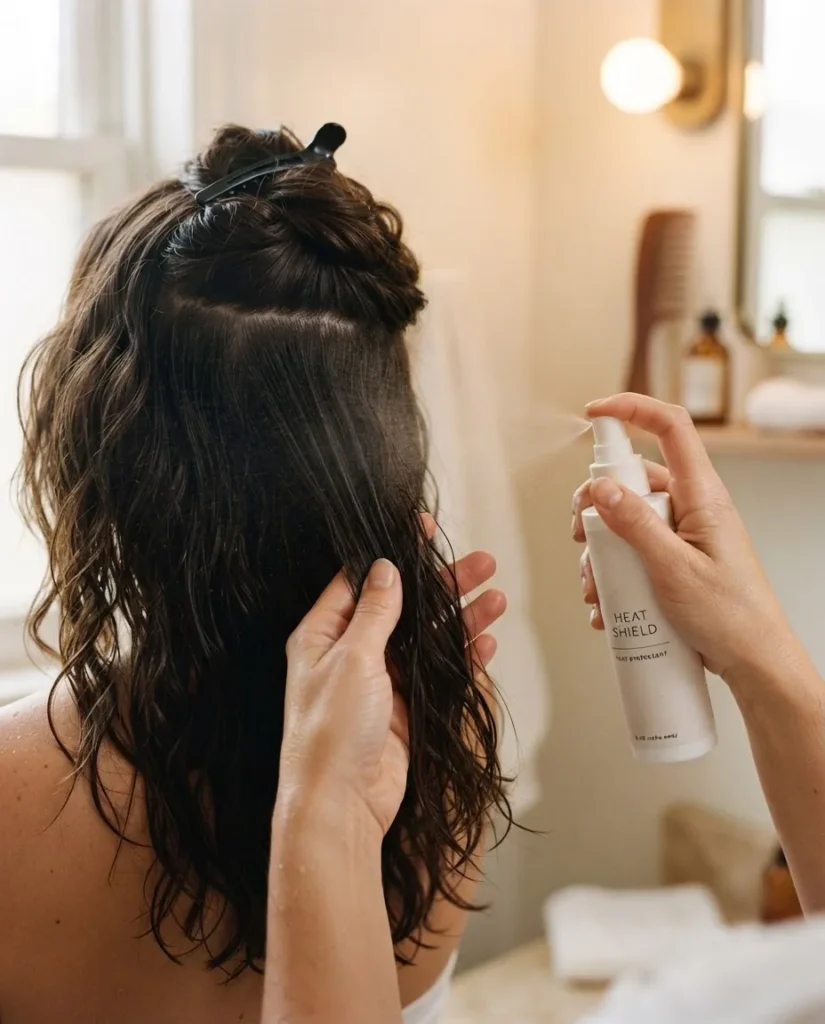
Hold the bottle about 8 to 10 inches from your head and spray each section lightly but evenly, then run your fingers or a wide-tooth comb through to distribute. For fine hair, less is more: too much product weighs the hair down and can actually make it more prone to heat damage because you are trapping moisture in the strand (which becomes steam under high heat). For thick or curly hair, you may need to work in smaller sections and use slightly more product to ensure coverage throughout.
If you are applying to dry hair before using a curling iron or wand, use even less product than you would on damp hair, and make sure any damp-application product from earlier has fully dried before you introduce heat. Putting a hot iron on still-damp hair, even hair that feels mostly dry, is one of the fastest routes to real structural damage. Research on hair dryer heat damage found that moisture trapped inside the hair shaft under high temperatures causes cuticle lifting and can disrupt the inner cell structure of the strand in ways that are not immediately obvious but compound over time.
Adjusting by Hair Type: What Nobody Tells You
Fine hair is actually more vulnerable to heat damage than thicker hair types. Studies have noted that fine strands have less density and a smaller or absent medulla (the innermost layer of the hair shaft), which means less structural buffer between the heat source and the cortex. For fine hair, the priority is finding a spray that covers without adding weight. Sprays are almost always better than serums or creams for this reason, and you want one that dries down clean. The TRESemme Thermal Keratin, CHI 44 Iron Guard, and Dove options are all solid here.
Thick, coarse, or naturally curly hair often needs more product and a richer formula to get the same level of coverage.
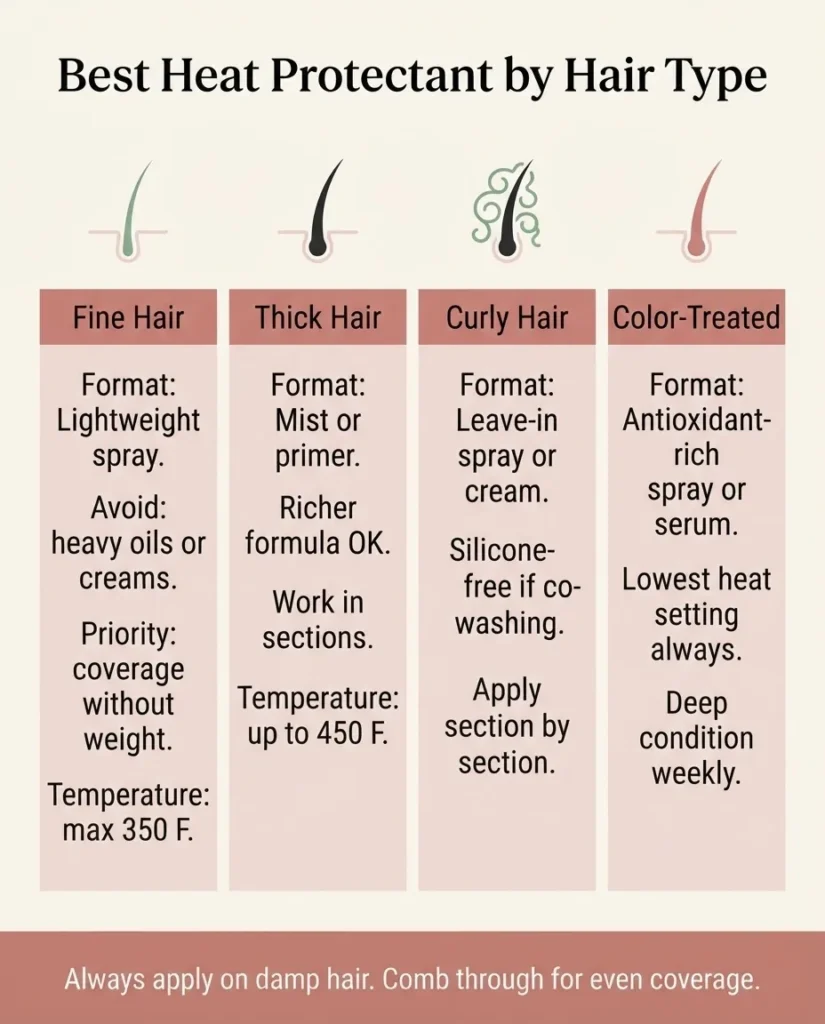
The Bumble and Bumble primer or the Kenra Silkening Mist will serve you better than a very lightweight spray. If you are curly and only occasionally straighten or diffuse with a dryer, you can absolutely use a heat protectant without silicones if your routine does not include clarifying shampoos regularly. Hydrolyzed protein-based sprays and some of the lighter oil-based options work well here. If you have 4b or 4c natural hair, sprays alone may not give you sufficient coverage and a leave-in with heat protection or a cream-based protectant applied to sections will do more for you.
Color-treated or chemically processed hair sits in a more vulnerable category because the chemical process already disrupts the outer cuticle layer to some degree. The AAD notes that chemical services combined with frequent heat styling are among the most damaging combinations for hair health, and that using the lowest effective heat setting matters even more in this context.
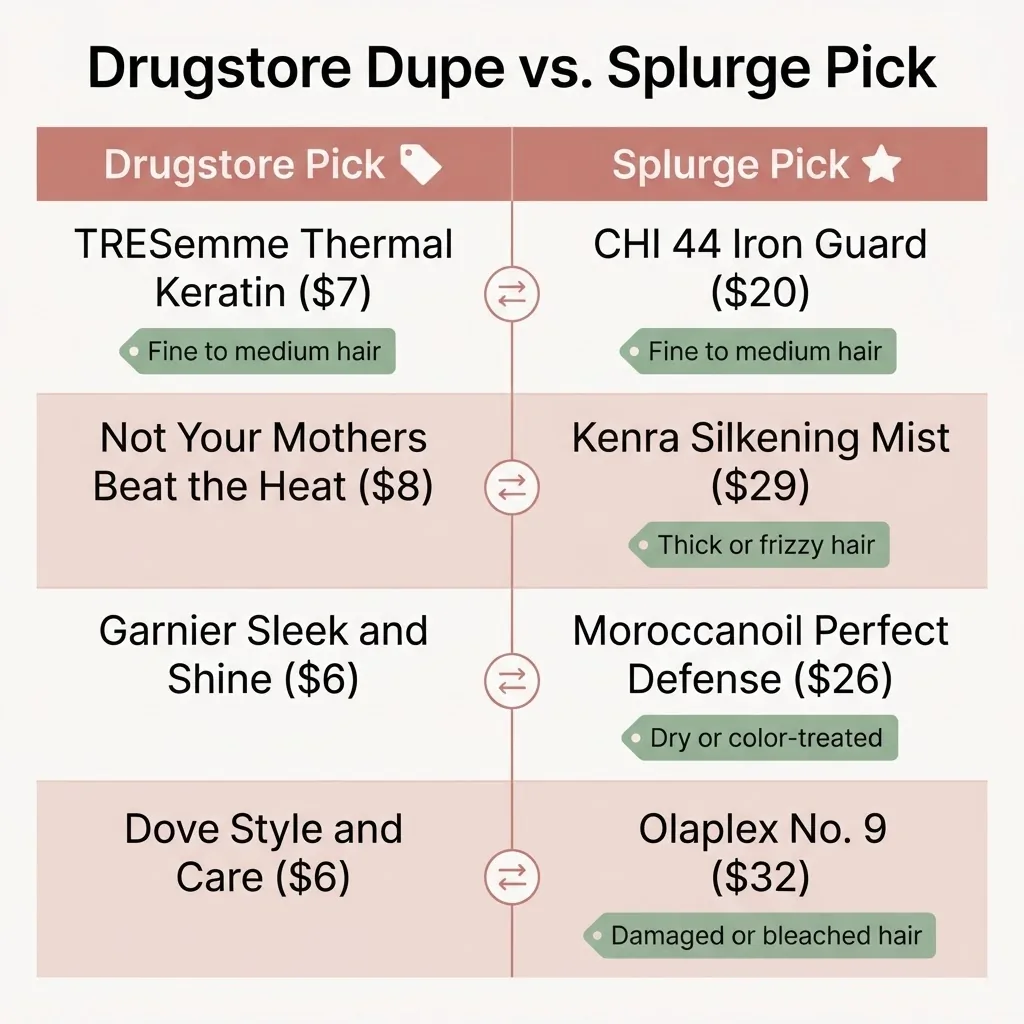
For this hair type, I would lean toward Olaplex No. 9, Moroccanoil Perfect Defense, or the Redken One United, all of which deliver conditioning alongside protection.
Do Heat Protectants Actually Work? The Honest Answer
Yes, and no, and it depends on what you expect them to do. Here is the thing I keep coming back to: if you are using a flat iron at 450°F on fine hair six days a week, no spray in the world is going to keep your hair from experiencing cumulative damage. Heat protectants reduce the intensity of each individual heating event, they help your hair heat up more gradually and evenly rather than sustaining intense localized hot spots, and they help seal in some moisture to reduce the brittleness that comes from repeated drying. That is genuinely meaningful over time. But the protection is a reduction, not elimination.
The hair science research is actually pretty clear on this: the cuticle cracks, the pigment destabilizes, the keratin proteins begin to break down, and moisture evaporates at temperatures above roughly 266°F (130°C), and heat protectant ingredients slow how fast that process happens by acting as a thermal buffer. But they work best alongside lower heat settings, less frequent heat styling, and a healthy hair care routine overall. A heat protectant paired with a lower temperature is going to protect your hair dramatically better than the best protectant on the market used with the iron cranked to maximum.
Signs Your Hair is Already Heat Damaged
If you are reading this because something already feels off, here is what heat damage actually looks and feels like: your hair feels rough or coarse even when freshly washed and conditioned, it does not hold a curl anymore or loses shape very quickly, you see splits and breakage mid-shaft rather than just at the ends, and it has lost a lot of its natural shine and elasticity (when you stretch a wet strand gently, damaged hair is more likely to snap than bounce back).
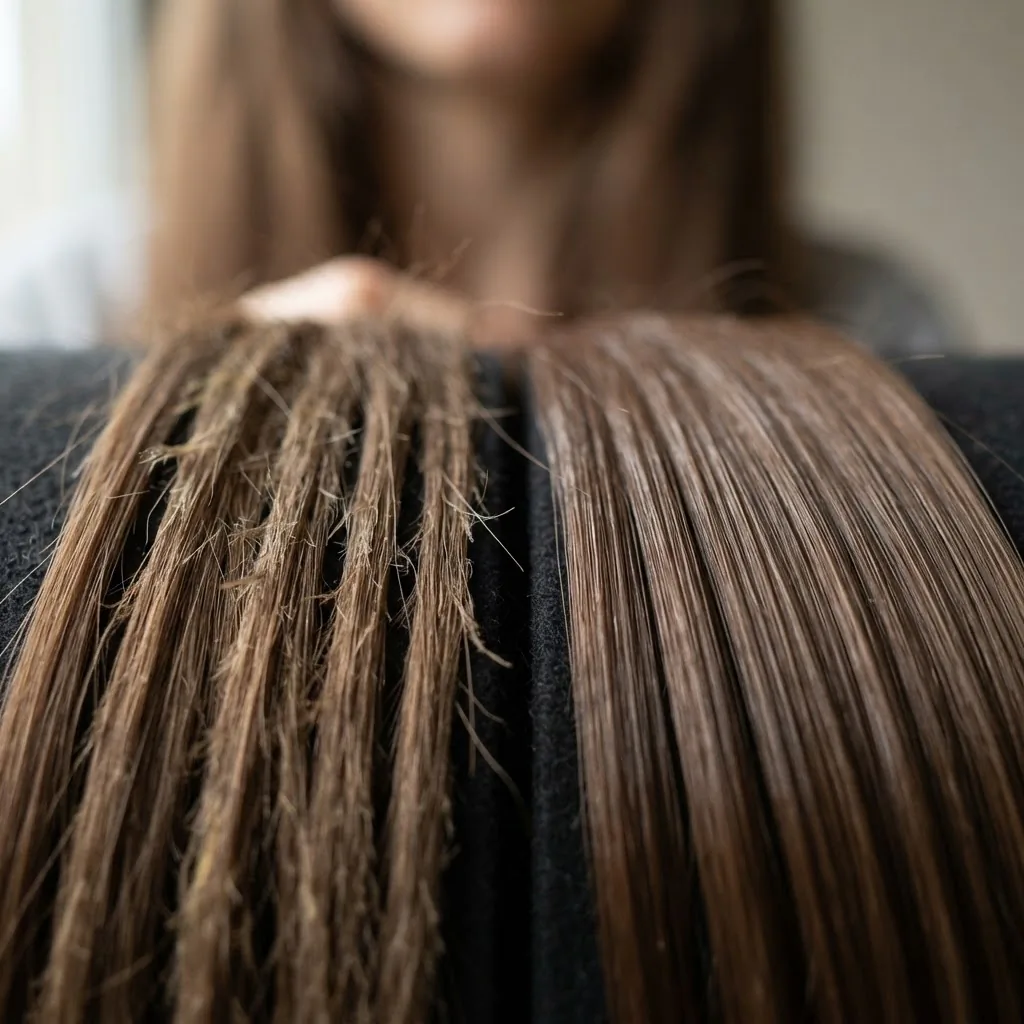
The porosity shift caused by repeated heat damage means your hair absorbs product faster but also loses moisture faster, leaving it feeling dry almost immediately after you style it.
If this sounds familiar, slowing down on heat styling, adding a weekly protein treatment or deep conditioning mask, and starting with a heat protectant consistently going forward are the practical starting points. Serious structural damage is worth a conversation with a dermatologist or a professional trichologist, because hair loss and scalp changes that come from aggressive heat use are worth a professional eye.
Quick Cheat Sheet: Which Pick Is for You
For the beginner on a tight budget, start with TRESemme Thermal Keratin or Not Your Mother’s Beat the Heat.
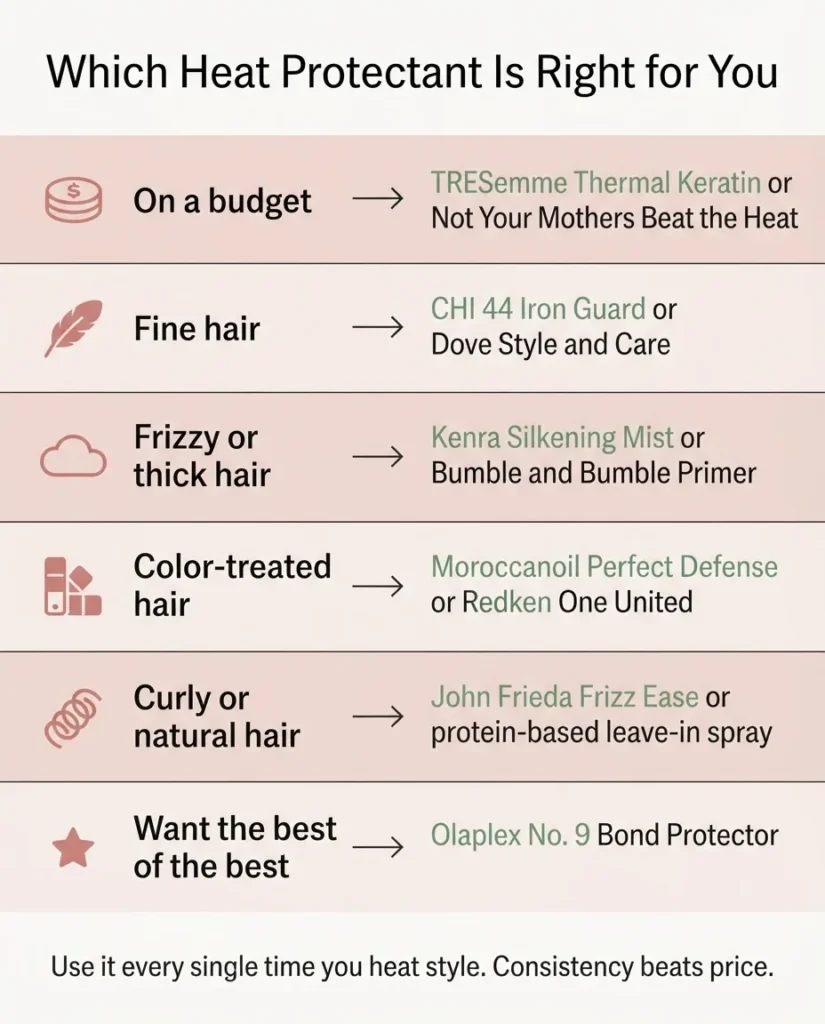
For fine hair that goes flat easily, CHI 44 Iron Guard or Dove Style + Care. For frizzy or thick hair in the mid-range, Kenra Silkening Mist. For color-treated or damaged hair, Moroccanoil Perfect Defense or Olaplex No. 9. For curly and natural hair that occasionally uses heat, John Frieda Frizz Ease or a protein-forward leave-in spray. For the luxury all-rounder with dry or thick hair, Bumble and Bumble Hairdresser’s Invisible Oil Primer.
Whatever you choose, use it every single time you touch a heat tool to your hair. That consistency matters more than picking the most expensive formula on the shelf.