The Real Meaning Behind Mountain Tattoos (and 8 Designs Worth Exploring)
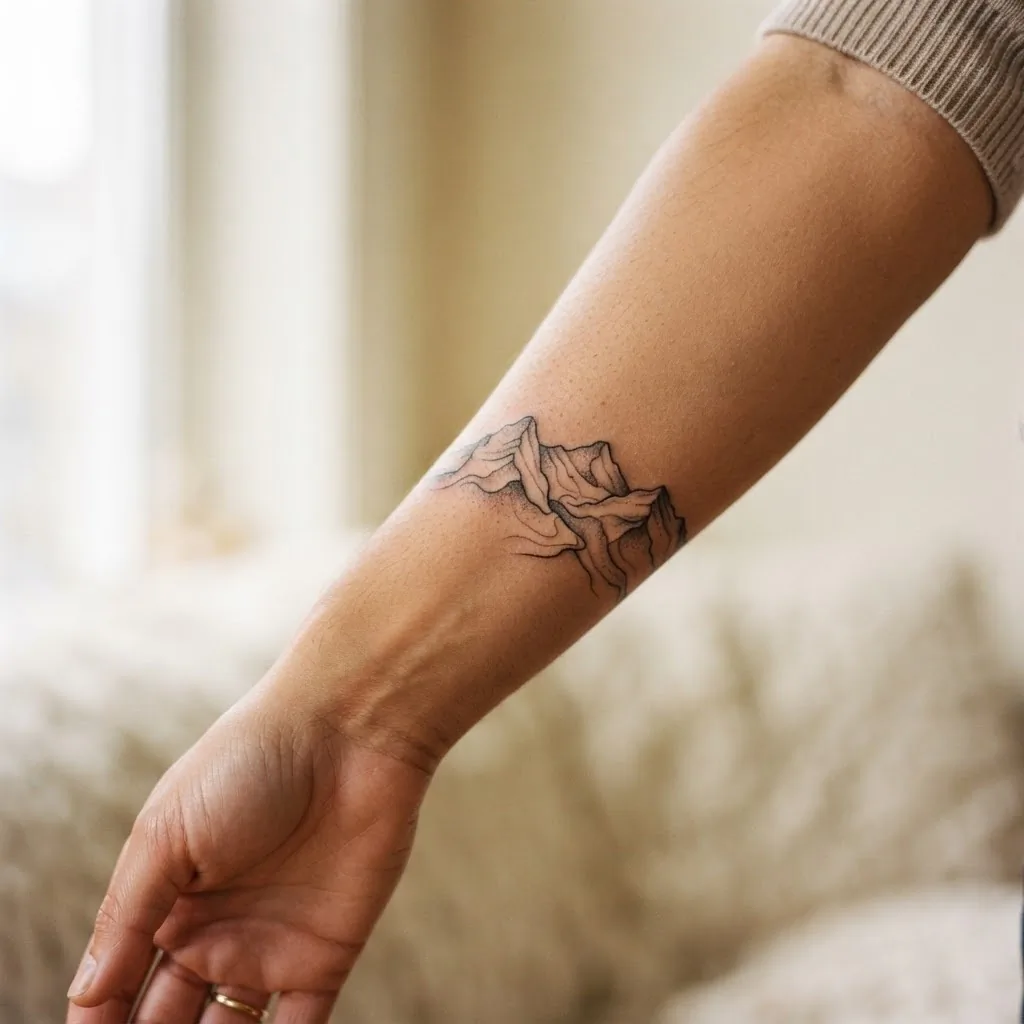
I remember the first time I really understood why someone would permanently put a mountain on their body. A friend of mine had just come back from a solo trip through Oregon’s Three Sisters Wilderness. She didn’t say much about it when she got home, but three weeks later she sat down with a licensed artist in Portland and walked out with a quiet ridgeline on her forearm. It wasn’t dramatic. It wasn’t even that big. But every time I saw it, it looked exactly like something she had earned.
That’s what mountain tattoos do when they’re done right. They hold a specific kind of weight that is hard to put into words but immediately recognizable on skin. If you’ve been sitting with the idea of a mountain tattoo for a while now, this is everything I wish I’d had to read before my own first consultation.
What Mountains Actually Mean (And Why It Goes Deeper Than You Think):
The easy answer is “strength and resilience.” You’ll see that phrase on approximately every mountain tattoo Pinterest board ever created. It’s not wrong, but it barely scratches the surface.
Mountains have carried spiritual and symbolic weight across nearly every human culture that has ever lived near one.
According to Wikipedia’s documentation on sacred mountains, peaks hold documented sacred significance in Hinduism, Buddhism, Greek mythology, Navajo tradition, Shinto, Jainism, and Zoroastrianism, among others. Mount Olympus was the home of the Greek gods. Mount Kailash in Tibet is considered sacred by four separate religions simultaneously. Mount Sinai is where, in the Abrahamic traditions, the divine spoke directly to Moses. For the Navajo people, four specific mountain peaks define the sacred boundary of their homeland, each associated with a direction, a color, and a cosmic force.
What all of this history is pointing at is something consistent: mountains are where humans go when they are trying to reach something beyond themselves. The peak is the liminal place, the threshold between the ordinary and the transcendent. For most people getting a mountain tattoo in 2025, that ancient resonance is still very much alive, even if they’re framing it in secular terms.
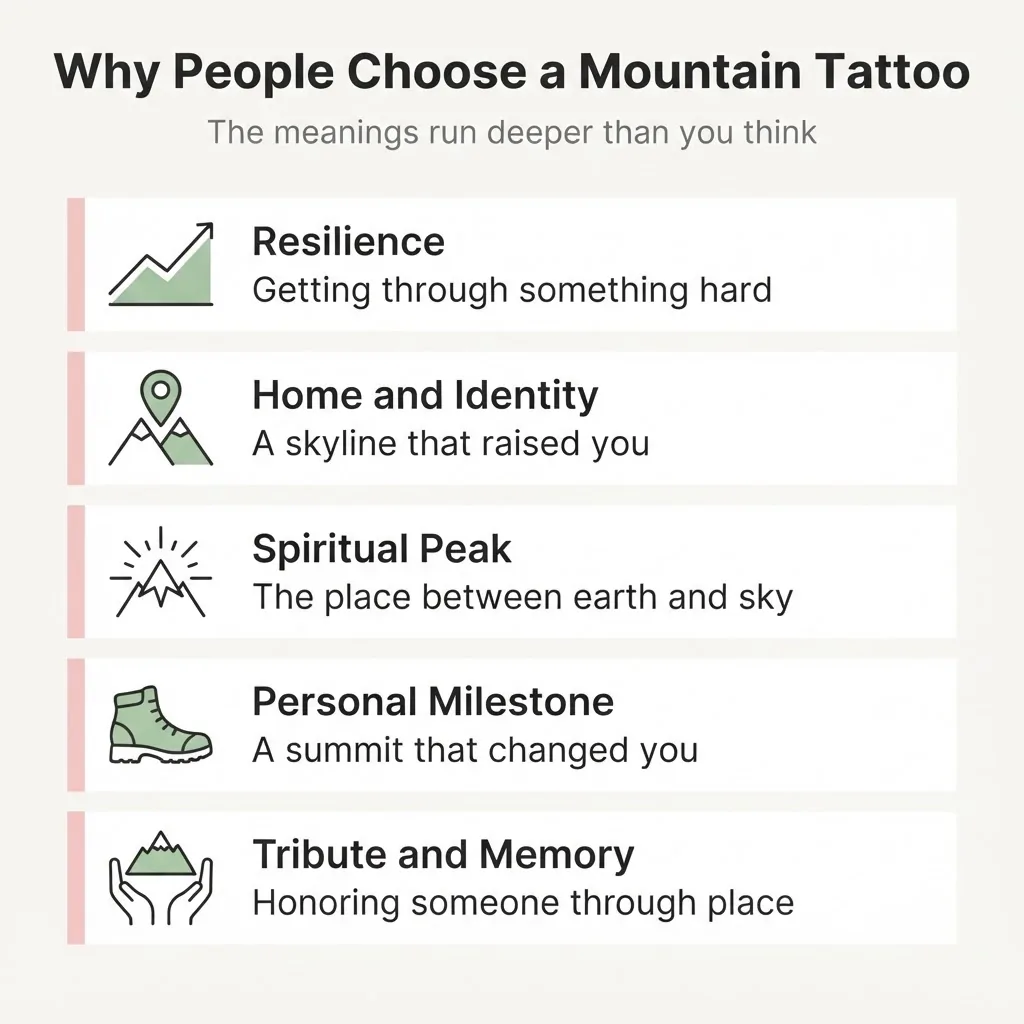
So when someone tells me their mountain tattoo means “I got through something hard,” or “this is where I feel most like myself,” or “this is home,” they are not being cliche. They are participating in a tradition that is genuinely thousands of years old.
Some of the most common personal meanings I hear:
- Overcoming a specific period of difficulty or grief
- A literal mountain that changed them (a summit, a trail, a view)
- A hometown skyline or regional identity (the Cascades, the Rockies, the Alps)
- A spiritual or philosophical relationship with stillness and perspective
- A tribute to someone lost, anchored in a place that mattered
Knowing your specific “why” before your consultation is one of the most valuable things you can bring to the table. It shapes every design decision that follows.
8 Mountain Tattoo Styles Worth Knowing:
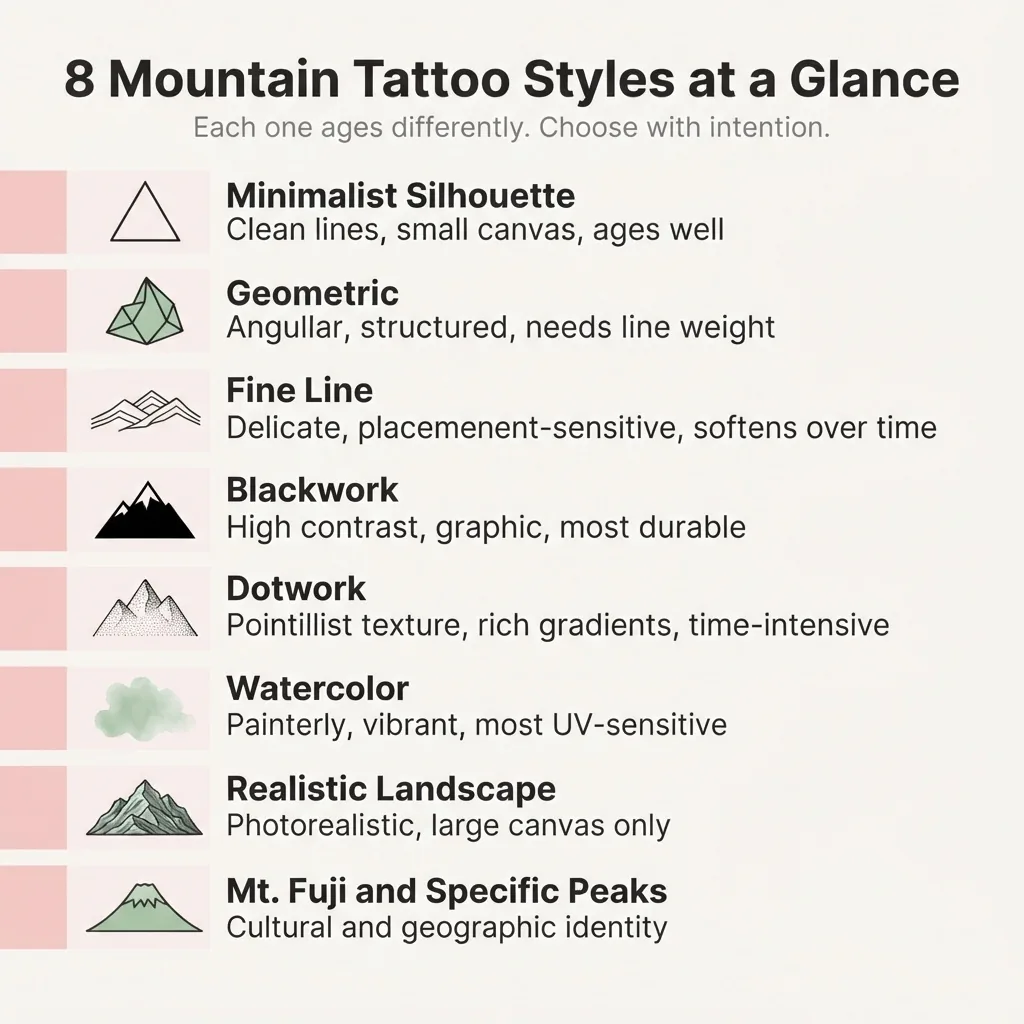
1. Minimalist Silhouette
This is the entry point for a lot of first-timers, and for good reason. A minimalist mountain silhouette is exactly what it sounds like: clean lines, simple peaks, minimal shading. Think of a single dark triangle or a two or three-peak ridgeline with no fill, no texture, no detail work beyond the outline.
What makes this style work is its restraint. It reads immediately from a distance and it ages gracefully because there are no ultra-fine details to blur or spread. It works well at smaller sizes, making it a good candidate for wrists, ankles, behind the ear, and the inner forearm. The limitation is that it can feel generic if the artist doesn’t bring any compositional intention to it.
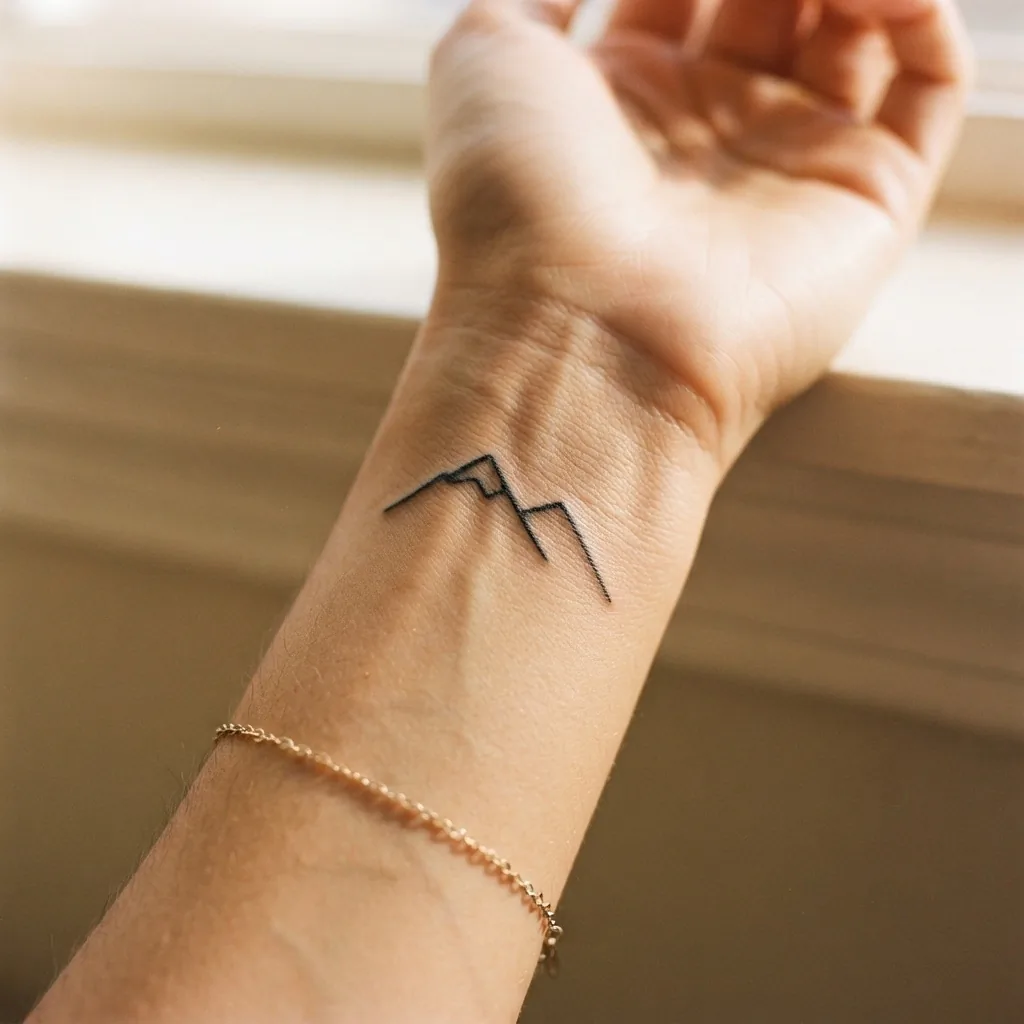
The magic is in the proportions and negative space, not in complexity.
2. Geometric Mountain
Geometric mountain tattoos translate the natural form into shapes — triangles, polygons, nested lines, and structured angles. Some versions look almost architectural. Others incorporate a single realistic peak inside a geometric frame or circle.
These age reasonably well when the artist builds in adequate spacing between lines. According to a style guide from Canggu Ink Club, geometric designs with strong contrast and sufficient negative space hold their clarity far better over time than ultra-fine geometric work, which can blur as the skin changes. This is a direct conversation to have with your artist during the consultation: ask them how the lines are weighted and whether they have healed examples of this specific style in their portfolio.
3. Fine Line Mountain
Fine line mountain tattoos are among the most popular right now and honestly they are breathtaking when they’re fresh. A skilled fine-line artist can create entire landscapes on a forearm — cloud shadows, distant ridges, texture, even a sense of atmosphere — using lines barely thicker than a hair.
The honest reality is that fine line work requires more maintenance and is more placement-sensitive than other styles. A fine line tattoo in a high-friction area (inner wrist, fingers, feet) will fade and spread faster than the same design on an outer forearm or upper arm. I always point people toward an honest resource on this: this guide from IGLA Tattoo is one of the better plain-language breakdowns of what to realistically expect from fine line work over time, including how placement, ink depth, and your skin type all interact.
4. Blackwork Mountain
Blackwork uses solid black ink — bold fills, heavy linework, and high-contrast areas of negative space — to create mountain imagery that reads like a woodcut print or linocut illustration. It’s dramatic, graphic, and ages exceptionally well because solid black holds better in skin than fine details.
Blackwork mountain tattoos range from stark minimalism (a solid black peak against bare skin) to densely detailed compositions with treelines, texture, and sky. They tend to read beautifully in larger formats on the upper arm, chest, thigh, or back. If you’re someone who wants a tattoo that will still be crisp and readable at sixty, blackwork is one of the most honest long-term investments.
5. Dotwork Mountain
Dotwork builds shading and texture entirely from tiny individual dots rather than lines or fills. Up close it looks almost pointillist. From a few feet away it reads as rich, velvety gradients of gray and black.
Mountain imagery lends itself naturally to dotwork because of the way light falls across rocky surfaces and snowfields. A talented dotwork artist can create a sense of texture and three-dimensionality that feels almost photographic. Dotwork does require a skilled hand and tends to be time-intensive, which affects the session length and cost. Give this style the research time it deserves — look specifically for artists with healed dotwork examples in their portfolio, not just fresh work.
6. Watercolor Mountain
Watercolor tattoos use loose, painterly color washes with soft edges and deliberate “bleed” effects to mimic the look of — yes — watercolor painting. Mountain tattoos in this style often pair a soft blue or violet wash for the sky with faded purples and greens in the peaks.
These are genuinely beautiful and they’re also the style that requires the most honest conversation about longevity. The soft edges that make watercolor tattoos so striking are also what makes them more sensitive to fading. Sun exposure, skin type, and placement all have a significant effect. If you love this style, talk seriously with your artist about whether certain areas of the design need a stronger underlying structure — a bit of linework or shading to anchor the color — so the design maintains its legibility as it ages.
7. Realistic / Photorealistic Landscape
Photorealistic mountain tattoos aim to reproduce the actual visual experience of a specific landscape: the texture of granite, snow shadows, cloud cover, the way light hits a ridgeline at golden hour. These are technically demanding and require an artist who specifically specializes in realism or landscape realism — not every tattoo artist does this style well, and for realism, the portfolio research stage really matters.
These pieces tend to work best at larger scales and on flatter, less-mobile areas of the body: the upper back, the thigh, the outer upper arm. At small sizes, fine detail in realism compresses and loses legibility quickly. Budget-wise, realistic landscape work is among the more premium styles.
8. Mt. Fuji and Specific Peak Tattoos
Rather than a generic mountain silhouette, some people go straight for a specific, recognizable peak: Mt. Fuji (often rendered in traditional Japanese ukiyo-e style, influenced by Hokusai’s famous wave series), Mount Rainier, Everest, Denali, or a personal local peak. These carry the specific cultural or personal geography of the place itself.
Mt. Fuji tattoos in particular have a rich design tradition rooted in Japanese tattooing history, and they read differently from a “general mountain” tattoo. If you’re drawn to a specific peak for cultural reasons, it’s worth researching artists who have genuine fluency in the relevant tradition, whether that’s traditional Japanese tattooing or another cultural reference, so the work honors rather than appropriates the source material.
Placement and Sizing: Where Mountains Actually Work Best:
Size and placement are not separate decisions — they completely determine each other, and they are the part of the planning process most people underestimate.
A mountain with real visual presence needs room to breathe.
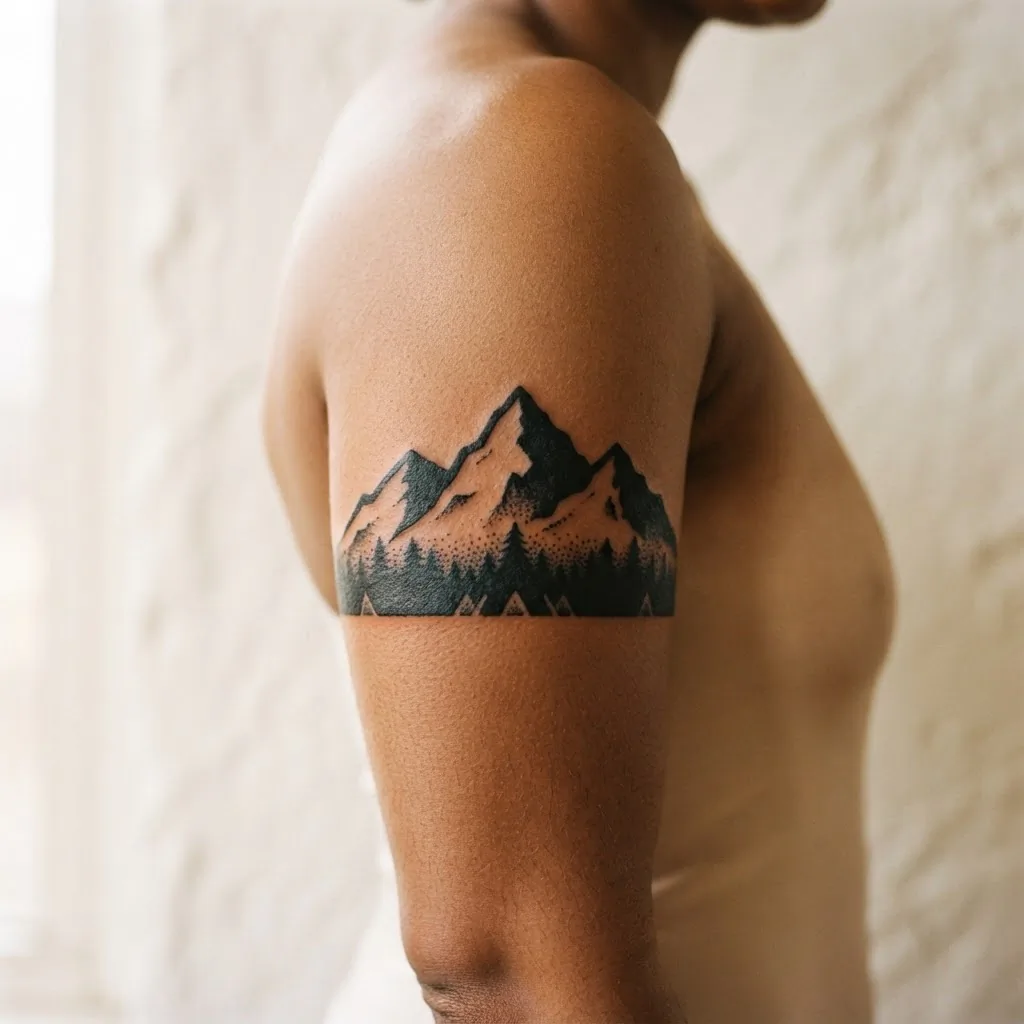
A three-peak ridgeline with atmosphere and any kind of texture needs at least three to four inches of horizontal space to read properly. If you compress that onto a wrist or ankle, the detail work will merge and blur faster than you’d want. This doesn’t mean small mountain tattoos can’t be done beautifully — they absolutely can — but they have to be simplified to match the canvas. A minimalist silhouette or a clean single-peak design works at small scale. A detailed landscape does not.
Forearm and outer forearm are the most popular placement for mountain tattoos right now, and for good reason: the horizontal or vertical canvas is a natural fit for a ridgeline, the area has moderate pain levels, it heals well, and the tattoo is easy to see and show. The outer forearm also holds ink reliably.
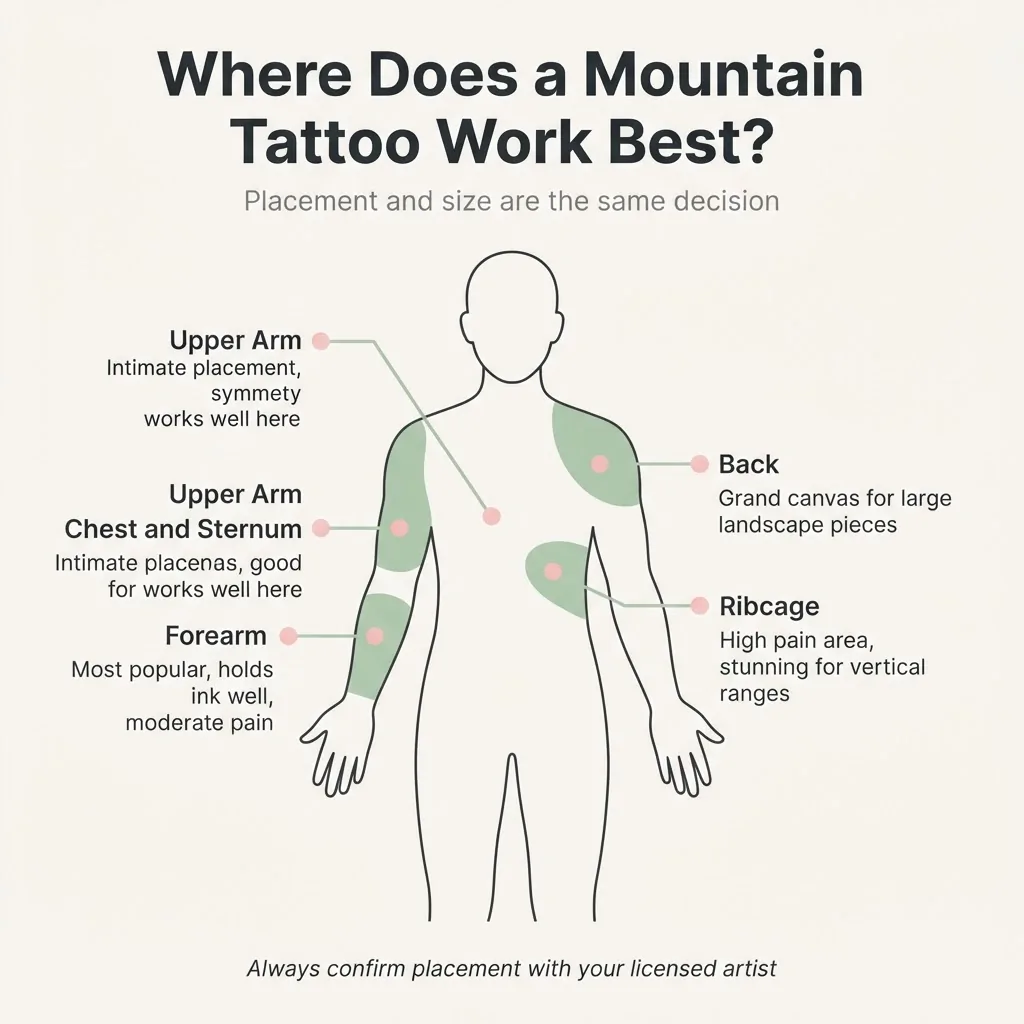
Upper arm and shoulder give you more canvas and a naturally curved surface that some artists will use to create the illusion of depth in a landscape. Upper arm placement is generally considered one of the more forgiving for both pain and healing.
Chest and sternum work beautifully for a single centered peak or a symmetrical mountain range spanning both sides. This is a more intimate placement — it tends to be more personal, more hidden, and more meaningful in that private way. Pain varies depending on proximity to the sternum bone itself.
Back and spine are the grand canvas for mountain tattoos. A full mountain range across the upper back or a vertical ridge running down the spine is genuinely striking. These are larger commitments in terms of session time and investment, but for a design you want to live with for life, the scale can be worth it.
Ribcage is one of the more painful areas, particularly as you get closer to the lower ribs and floating ribs. If you want a larger mountain composition on the ribs, Healthline’s tattoo pain chart is a helpful, medically reviewed resource for understanding why certain body areas feel more intense than others — this pain overview explains the relationship between bone proximity, nerve density, and skin thickness in plain language.
What to Bring to Your Consultation (and How to Brief a Landscape Artist):
A consultation is not a formality. It is the most important conversation in the entire process, and arriving prepared is the single biggest difference between a tattoo you love and one you feel lukewarm about five years later.
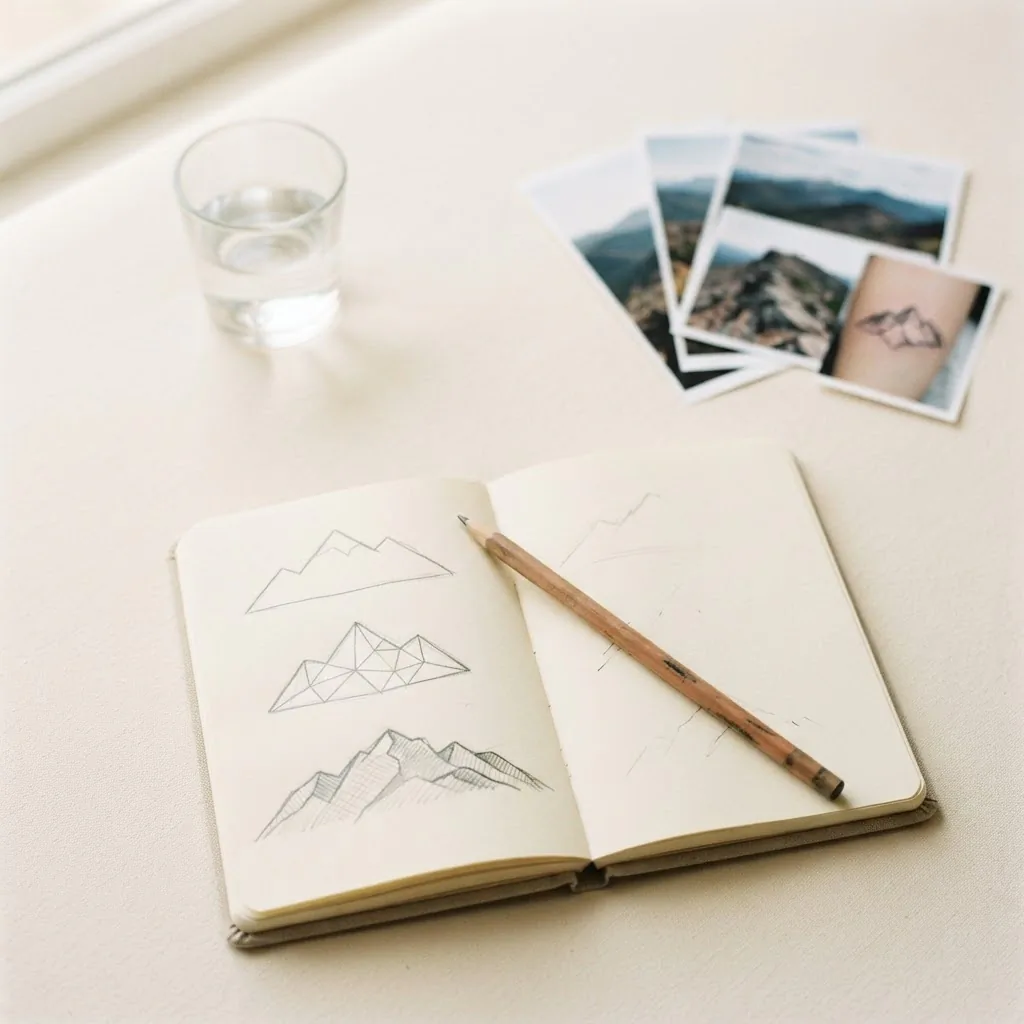
Here is what I bring and what I recommend:
Reference images, plural. Not just one. Bring three to five images that show different elements of what you like, from different angles. Not because you want the artist to copy any of them — you should say clearly that you don’t — but because the collection of what you respond to tells the artist far more about your aesthetic instincts than any single image. Show them a composition you like, a shading style you love, a placement that feels right to you, and one or two examples of the scale you’re imagining.
A note on what it means to you. This sounds soft but it is practically useful. Artists who specialize in meaningful personal work want to understand the story. Knowing that your mountain references a specific ridge you hiked with your late father, or the Cascades skyline from the town you grew up in, shapes the compositional choices they make.
Questions to ask the artist: Have you done this style on this placement before? Do you have healed examples I can see? How does this design hold up at this scale over ten years? What is your preferred aftercare protocol? How long will this session realistically take?
A clear sense of your budget floor. Asking “how much will this be” without context is hard for an artist to answer. Telling them “I am working with a budget of around X, is this design achievable at that investment, or should we adjust the size or complexity?” is a much more productive conversation.
Ink Safety and What You Actually Need to Know:
This is the part of the planning process that gets skipped most often, and it’s worth taking seriously. The FDA has published clear consumer guidance on tattoo safety that I think every first-timer should read before they book. One of the key points from the FDA’s own Think Before You Ink guidance is that tattoo inks are not FDA-approved for injection into skin, that contaminated inks — including sealed, unopened ones — have caused infections, and that allergic reactions can show up not just immediately after a tattoo but years later.
This is not meant to scare you away from getting tattooed. It is meant to remind you that the studio you choose and the artist’s hygiene protocols matter enormously. Look for a licensed artist working in a licensed, inspected studio. Ask if they use single-use needles. A reputable studio will never be offended by these questions.
If you have a history of keloid scarring, or if you tend to have sensitive skin or known allergies to dyes, it’s genuinely worth a conversation with a dermatologist before you book. The American Academy of Dermatology’s tattoo care and skin resource covers what to watch for after getting tattooed — including the signs of an allergic reaction, infection, and when to see a doctor — and is worth bookmarking.
What Healing Actually Looks Like:
The surface skin of a new tattoo typically goes through a few distinct phases. The first three to four days bring redness, some swelling, and a raw, tender feeling — this is normal. From around day four through day ten or so, the skin starts to peel and flake, and the tattoo may look dull or uneven underneath. This is the phase most people panic about unnecessarily. The peeling is the upper layers of skin releasing, not the ink leaving. By weeks three and four, most of the surface healing is done and the design starts to reveal its settled appearance.
Full skin healing, all the way through the deeper skin layers, takes closer to three to six months. This is why a touch-up appointment — if needed — is typically scheduled no earlier than eight weeks after the initial session.
Your artist will give you their specific aftercare instructions, and those instructions should be followed over any general advice you read online, including here. What I will say generally is that keeping the tattoo clean, out of direct sun during healing, and moisturized without over-saturating it are the universally agreed-upon basics.
Sun protection after healing matters a lot for longevity. This is especially true for watercolor and fine-line mountain tattoos where subtle detail and soft edges are central to the design. A healed tattoo is not protected just because it looks healed — UV exposure degrades ink over time, particularly lighter pigments.
How to Vet a Tattoo Artist for Landscape Work:
Every licensed tattoo artist has strengths. Not every licensed artist is the right artist for a mountain landscape tattoo. Landscape work, whether it is fine line, realistic, or watercolor, requires compositional ability that goes beyond technical tattoo skill. You are looking for someone who understands how to create depth, atmosphere, and visual story on a small canvas.
Look at healed work specifically, not just fresh tattoos. Fresh tattoos always look sharp. The real test of an artist’s ability is what their work looks like two years later, and most good artists will have healed shots in their portfolio or on their social feeds.
Check that the artist and studio are properly licensed in your state or region. Licensing requirements vary, but a quick search for your state’s health department or licensing board will tell you what to look for. This is a real health consideration, not a bureaucratic formality.
The Question Everyone Is Actually Asking:
Will I regret it?
Here is the honest answer: the people I know who regret their tattoos almost always trace it back to one of three things. They rushed the decision. They chose an artist primarily on price. Or they went in with a vague idea and let someone else make the design choices.
The people who love their mountain tattoos ten years later almost always did a version of the same things: they knew exactly what the design meant to them before they booked, they found an artist with a portfolio full of work in that specific style, and they gave the healing process the attention it needed. None of that is complicated. It just requires patience.
A mountain is one of the most honest symbols you can put on your body. It doesn’t promise you anything. It just says: I have been somewhere. I know what it costs to get to the top. I came back changed.
That’s worth taking your time to get right.