Snake Tattoos for Women: Styles, Placements, and Meanings
There’s something that happens the moment you start seriously imagining a snake tattoo on your body. It stops feeling like a passing thought and starts feeling like something you already know. That quiet certainty is usually where the real planning begins, and it’s also where the questions rush in: What style is right for me? Where will it actually live on my body? Will it still look stunning in fifteen years? And honestly — what does it say about me?
I’ve been collecting tattoos since I was eighteen, and the snake is one of those images that comes up again and again in the conversations I have with friends who are planning their next piece. It’s not just popular. It carries real weight. And choosing the right design, the right placement, and the right artist makes every bit of difference. This is everything I’d want to know before sitting in that chair.
Why Women Are Drawn to Snake Tattoos (And What They Actually Mean):
The snake has been woven through human mythology for thousands of years, and its meaning is genuinely layered depending on where you look. According to HowStuffWorks’ breakdown of snake tattoo symbolism across cultures, the image carries meanings as varied as protection, wisdom, rebirth, divine femininity, and healing depending on the cultural tradition you’re drawing from.
In ancient Greece, the snake coiled around the staff of Asclepius became one of the most enduring medical symbols in human history, representing healing and renewal. In Hindu tradition, snake symbolism is deeply tied to Kundalini energy and the divine feminine, a concept of power rising from within. In Japanese culture, which I’ll come back to, the snake is called hebi and is associated with protection, transformation, and in certain Shinto beliefs, the presence of divine messengers. In American Traditional tattooing, snakes have been bold, powerful design staples for close to a century, often paired with roses, daggers, or skulls as symbols of duality and resilience.
For a lot of women, the personal meaning behind a snake tattoo lands somewhere in the territory of transformation. The snake sheds its skin and emerges new. That is a genuinely powerful image to wear permanently when you’ve been through something that changed you, or when you’re stepping into a version of yourself that feels more true. It can also be about reclaiming something that has historically been used to code femininity as dangerous or deceptive and wearing it as exactly that: a symbol of your own power, not an apology for it.
If you’re unsure yet what the meaning will be for you, that’s okay. You don’t have to have a philosophical essay ready before you sit down with an artist. Many people find that the meaning deepens after the tattoo exists. Start with what draws you visually, and trust that the meaning will clarify.
12 Snake Tattoo Design Ideas Worth Exploring:
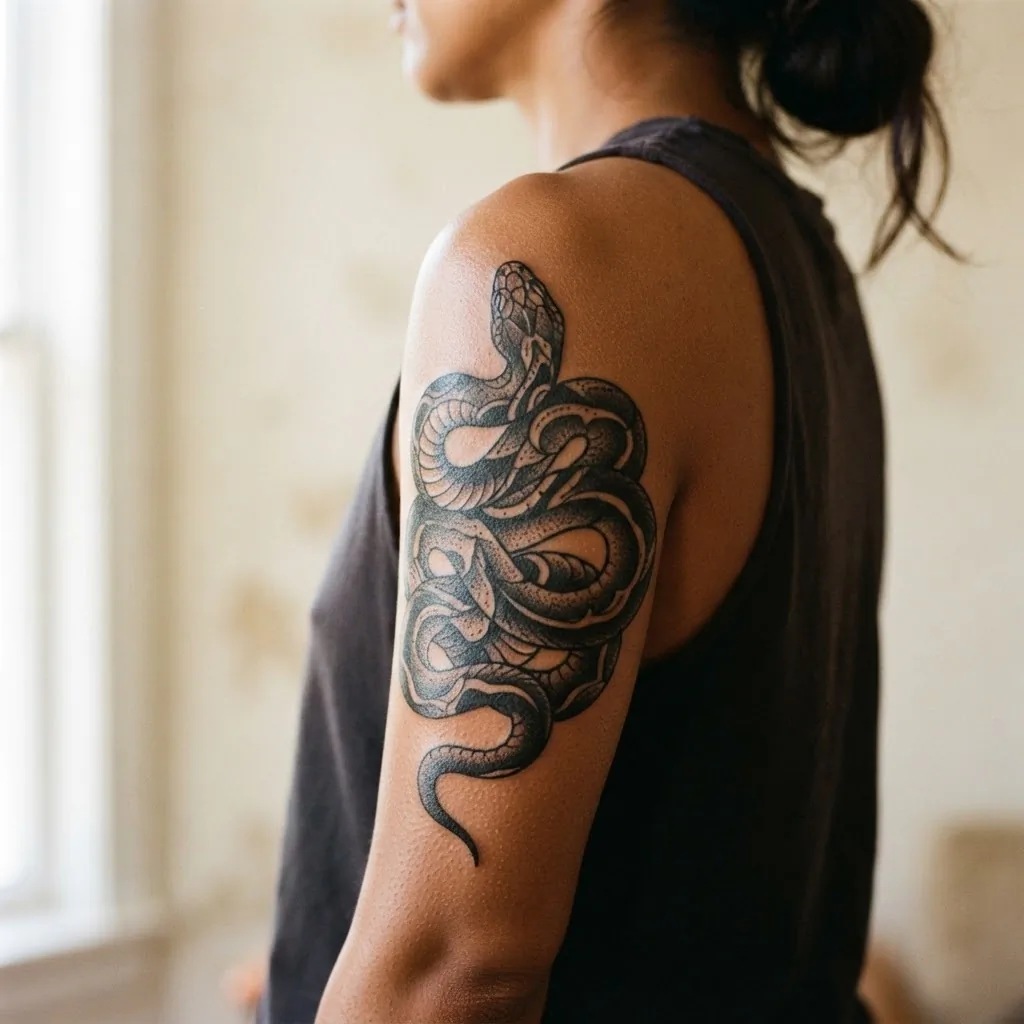
1. The Coiled Snake This is the most compact and versatile snake composition. A snake curled into itself reads as contained energy, something powerful at rest. It works beautifully in a circular format, which makes it ideal for the upper arm, shoulder, or thigh where there’s a broader surface to work with. In blackwork it reads bold and graphic. In fine line it becomes almost delicate.
2. The Elongated Wrap A snake stretched along the natural curve of a limb is one of the most requested designs for a reason. Wrapping around the forearm, bicep, or calf, the snake seems to move with your body. This is a design that benefits enormously from scale. Going too small loses the sense of motion.
3. The Spine Snake Running a single snake along the spine from the base of the neck toward the lower back is genuinely striking. The natural alignment of the spine gives the snake a perfect architectural line to follow. This placement reads different under a sheer top or a low back dress than it does fully revealed, and that versatility is part of its appeal. It tends to sit in a more intense pain range, which I’ll talk through below.
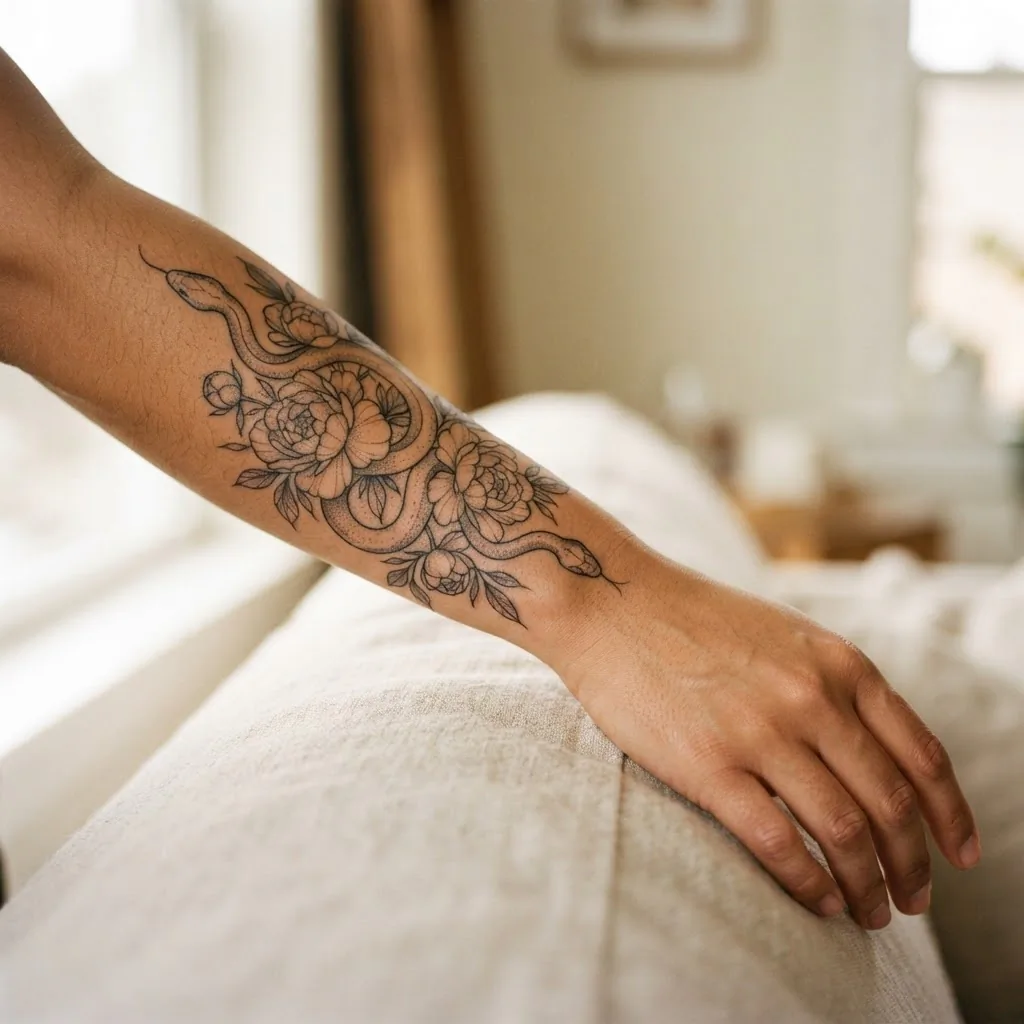
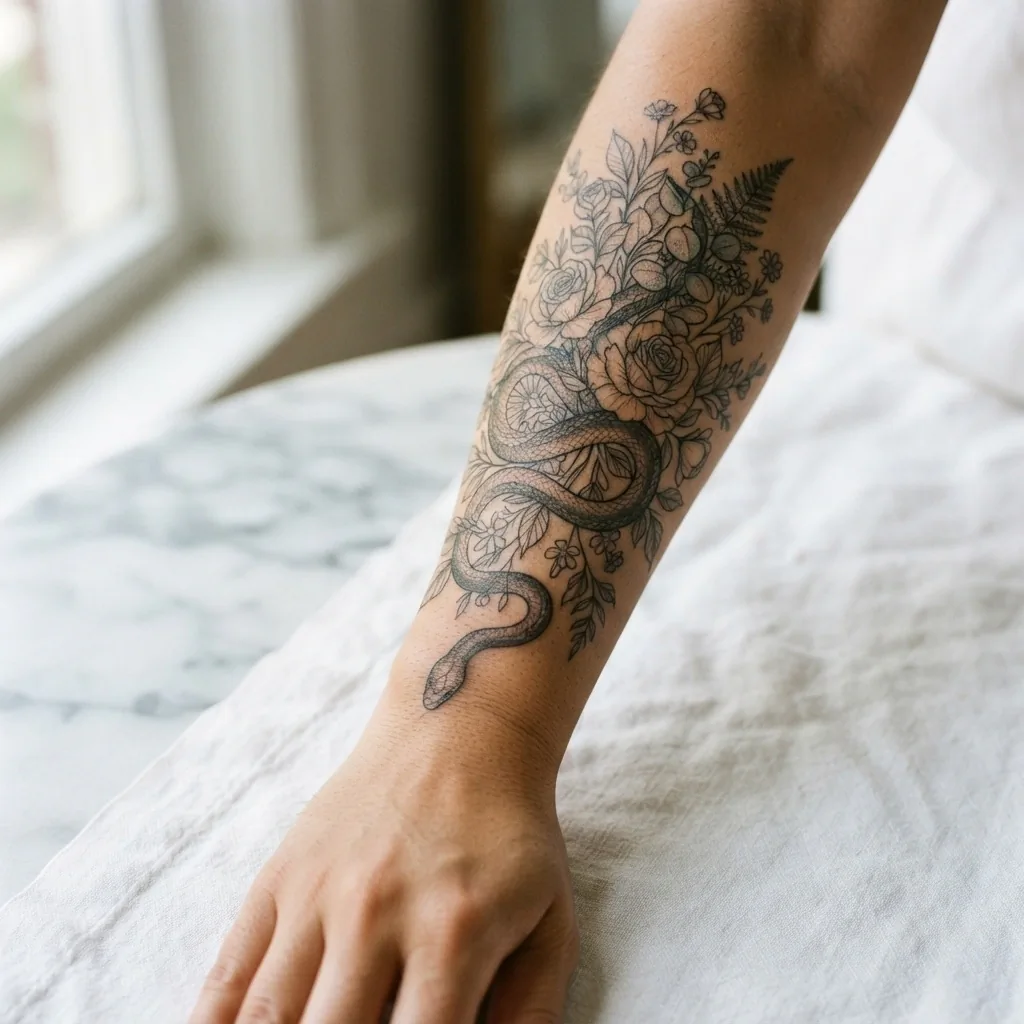
4. The Floral Snake A snake curling through peonies, roses, or wildflowers is probably the most versatile feminine take on the design right now. The contrast between the organic softness of petals and the scale texture of the serpent is visually compelling. This works in almost any style, from neo-traditional to fine line botanical.
5. The Snake and Dagger An American Traditional classic. The dagger and snake combination has been a staple of tattooing for generations, and it holds up. Done in bold traditional linework with solid fills, this is a design built to last. It reads strong without being aggressive, and it ages exceptionally well.
6. The Japanese Hebi This is a category deserving real attention. The hebi in Japanese tattooing is rich in cultural context. As Sunset Tattoo’s guide to snakes in Irezumi explains, the Hebi is associated with protection, transformation, and rebirth, with color choices carrying their own layer of meaning. A black Hebi suggests strength and mystery while red adds vitality and passion. Irezumi-style snake designs are typically bold, flowing, and designed to move with the body, often in full sleeve or back piece compositions, but scaled-down adaptations exist and work well when an artist understands the tradition.
7. The Ouroboros The ouroboros, a snake eating its own tail, is one of the oldest symbols in human history, appearing in ancient Egyptian artifacts and later in alchemical imagery. It represents the eternal cycle of endings and beginnings, the idea that destruction and renewal are the same motion. As a tattoo it reads immediately as intentional and considered. In circular form it works beautifully as an upper arm band or wrist piece, though wrist placements should be discussed carefully with your artist given how that skin ages and moves.
8. The Snake and Moon Pairing a crescent moon with a coiled or arching snake has become one of the most requested feminine snake compositions. The moon’s association with cycles, intuition, and the divine feminine amplifies what the snake already carries. This tends to work best in fine line or illustrative blackwork styles.
9. The Micro-Realism Snake Micro-realism is exactly what it sounds like: a small tattoo rendered in photorealistic detail, including accurate scale texture, shadow depth, and a sense that the snake is genuinely three-dimensional on the skin. This is technically demanding work that requires an artist with a verifiable portfolio specifically in that style. Size matters here more than almost anywhere else. Going too small means losing the detail that makes it work.
10. The Geometric or Linework Snake Some of the most striking snake tattoos are minimal. A single unbroken linework snake or a geometric interpretation using sacred geometry shapes as the frame for the serpent’s body has a contemporary, almost architectural feel. These tend to work beautifully in black ink only and age respectably when the line weight is kept at medium rather than hairline.
11. The Snake and Skull Classic imagery with a long history in both American Traditional and neo-traditional tattooing. The skull adds a layer of memento mori energy — the acknowledgment of mortality sitting alongside the symbol of renewal. This is a good design for someone who wants something that reads as a little more raw and unfiltered.
12. The Garden Snake Not every snake tattoo needs to project power or danger. A soft, naturalistic garden snake rendered in green watercolor or fine line botanical style has a completely different energy: curious, earthy, a little whimsical. If the aggressive or mystical interpretations feel like too much, this direction lets you have the image on your own gentler terms.
Which Style Actually Ages Well?
This is the question I wish more roundup articles answered honestly, because style choice and longevity are directly connected.
Bold linework, such as American Traditional, neo-traditional, and Irezumi-inspired designs, ages the best across the board. Thick outlines hold their edge. Solid fills keep their density. A well-executed traditional snake tattoo at forty years old still reads as exactly what it is. This is one of the reasons many experienced collectors still reach for bold styles even when they love fine line aesthetics.
Fine line and micro-realism require more careful planning. Hair-thin lines can spread slightly as the skin ages, and micro-detail can soften. This doesn’t mean you shouldn’t choose them. It means you need to work with an artist who specifically understands how to calibrate line weight for longevity, and you need to plan for the possibility of a touch-up after full healing. Asking your artist to show you healed examples of their fine line work, not just fresh photos, is one of the most important things you can do before committing.
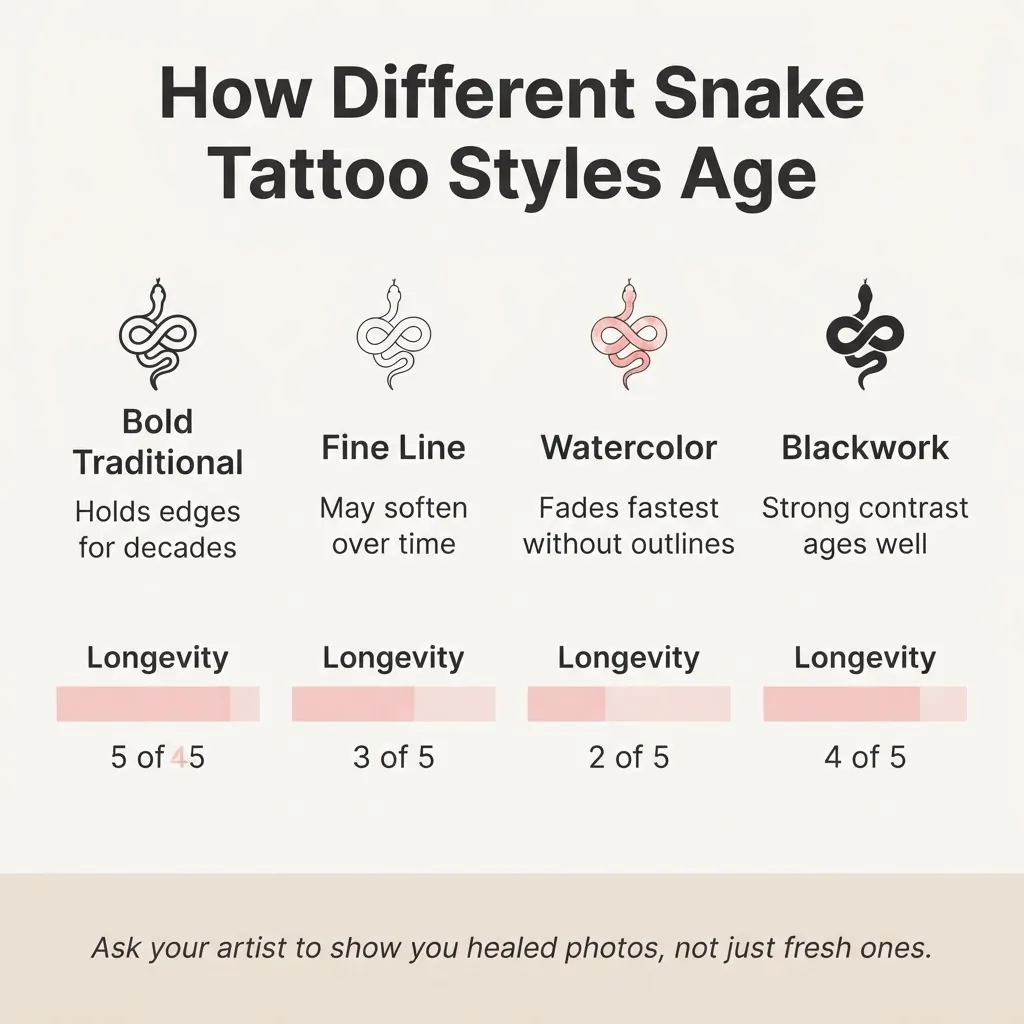
Watercolor tattoos, while beautiful fresh, are the most vulnerable over time. Soft washes without strong outlines tend to fade and blur faster than outlined designs. If you love the watercolor aesthetic, many artists now recommend pairing it with a subtle linework base to preserve the shape.
Placement and Pain: An Honest Map:
Placement decisions for a snake tattoo are about more than where it will look good today. You’re thinking about visibility, how it moves with your body, and what that area of skin feels like to tattoo.
According to medically reviewed pain information from Healthline’s tattoo pain guide, the least painful placements tend to be areas with more fat padding, thicker skin, and fewer nerve endings clustered near the surface. For snake tattoos specifically, this maps out as follows.
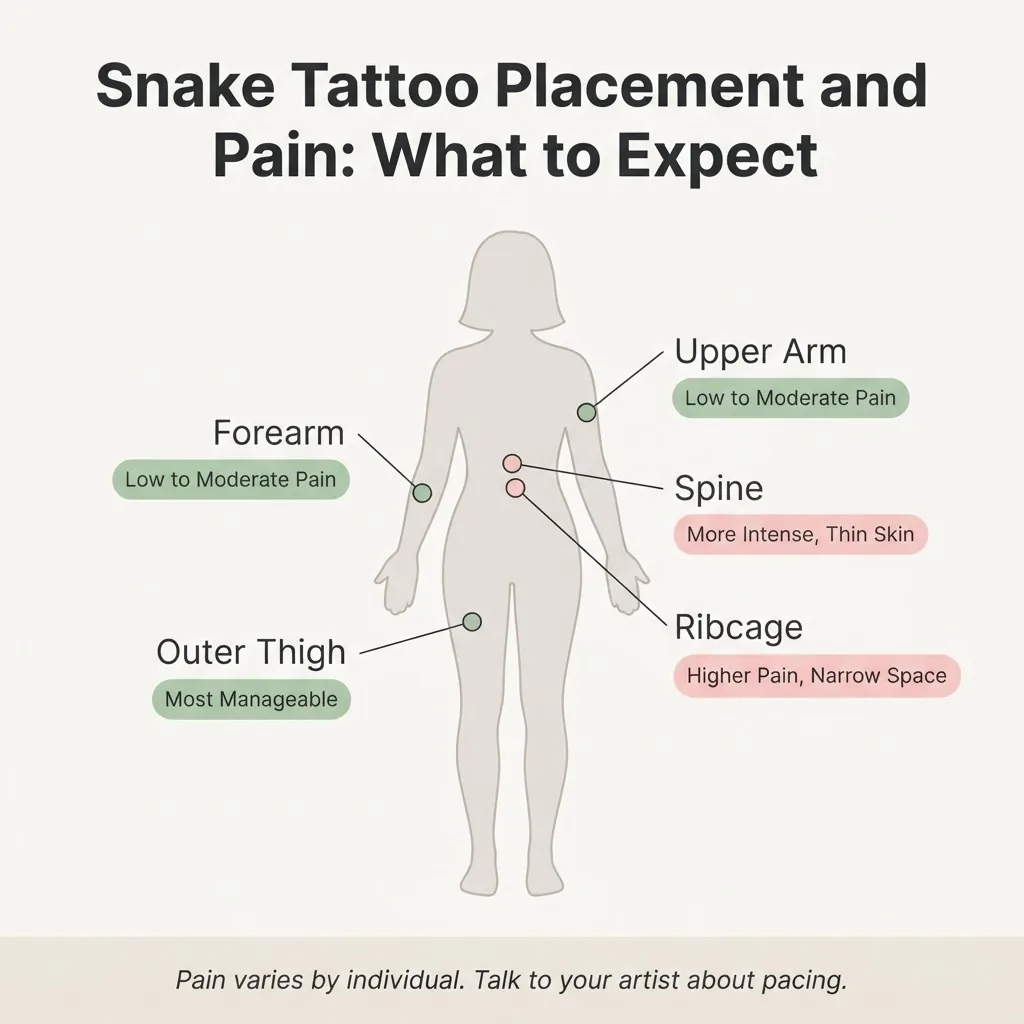
The outer thigh is widely considered one of the most manageable placements for longer sessions, which matters for a design with a lot of surface area. The forearm is another low-to-moderate area that most people describe as very tolerable, and it offers excellent visibility for an elongated snake composition. The upper arm and shoulder sit in a similar comfortable range.
The spine is genuinely more intense. The skin is thin directly over the vertebrae, and some areas along the spine can be sharply uncomfortable. It’s not undoable, and plenty of people manage it well, but it’s worth going in clear-eyed rather than surprised. The ribcage is similarly challenging. The inner thigh, inner bicep, and wrist are on the higher end of the pain scale. This doesn’t mean you can’t get a snake in any of those spots. It means you should talk with your artist about session length and pacing before you commit to a large piece in a sensitive area.
Pain tolerance is genuinely individual, and most artists are experienced at helping clients pace through a session comfortably. Communicating openly with your artist about any anxiety you have is always a good idea.
How to Research and Vet a Licensed Artist:
Finding the right artist for your snake tattoo is not a step to rush. A snake is a technically specific subject, especially if you want it to feel like it’s moving, and the artist’s work with curved organic forms, scale texture, and shading will define the result more than almost any other factor.
Start by searching for artists by style rather than just geography. If you want a Japanese Hebi piece, look for artists who regularly post irezumi-influenced work. If you want fine line botanical, find someone whose portfolio is full of healed fine line photos, not just fresh ones. Instagram and dedicated tattoo portfolio platforms make this searchable. Build a folder of references before you reach out to anyone.
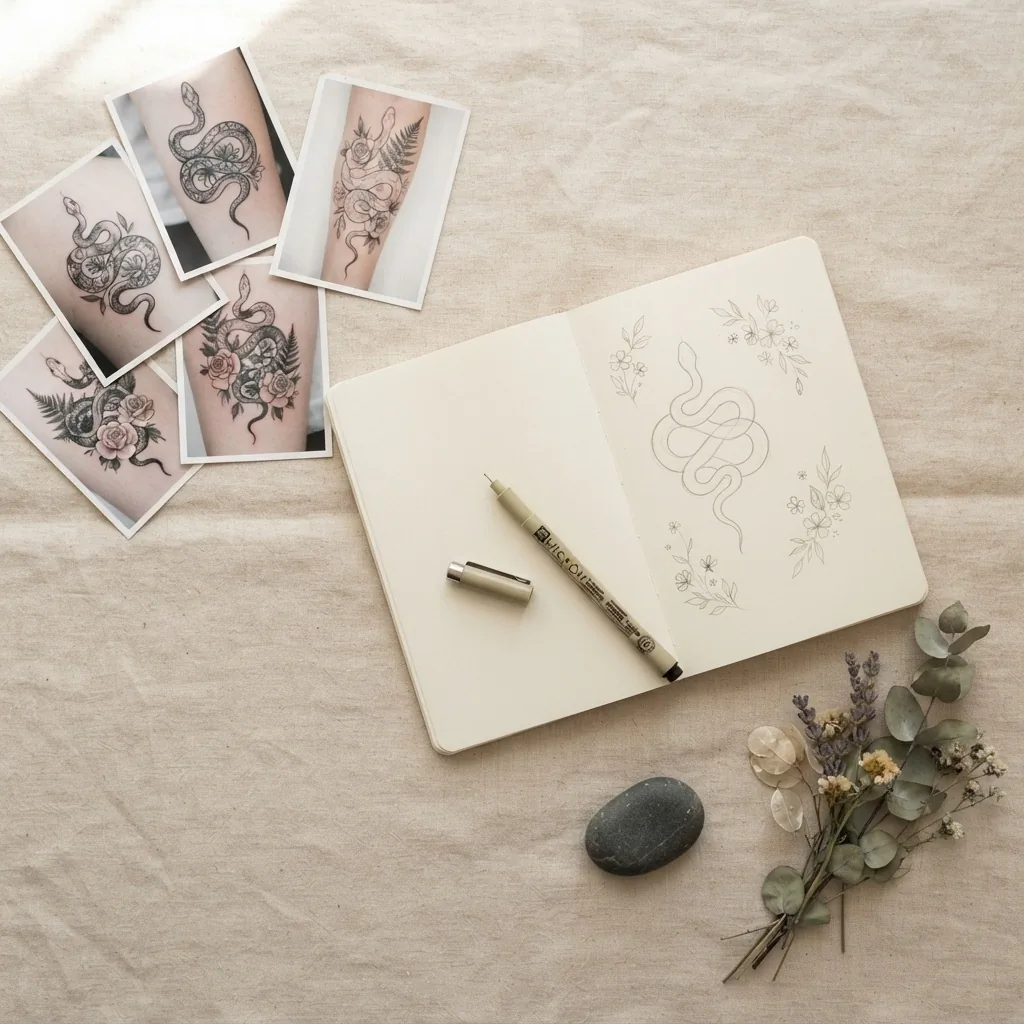
When you find artists whose portfolios excite you, look for healed work. Fresh tattoos always look sharp. Healed tattoos tell you how the artist’s lines hold, how the shading sits, and whether the design still communicates clearly weeks or months later. If an artist only posts fresh photos, that’s worth noticing.
Check that any artist you’re considering works out of a licensed studio. Licensing and hygiene standards for tattoo studios are regulated at the state or local level in the US, and those standards exist for your protection. Working with a licensed professional in a properly inspected studio matters for your health, not just the quality of your art.
Before you book, reach out for a consultation. A reputable artist will want to talk through your vision, look at your references, and ask about your skin, placement preferences, and any relevant health considerations. This conversation is where you should ask: Can I see healed examples of this style from your portfolio? What size do you recommend for this design in this placement? How many sessions do you anticipate? What are your aftercare instructions?
That last question is worth sitting with, because what happens after you leave the studio matters enormously.
What to Know About Safety, Healing, and Aftercare:
Getting tattooed is a skin procedure. Knowing what to expect on the health side helps you go in prepared and take care of yourself properly afterward.
The FDA’s consumer guide on tattoo safety notes that reactions can happen, ranging from the normal redness and swelling of fresh skin trauma to more significant responses like infection or allergic reaction to pigments. The FDA has confirmed that even sealed, factory-fresh ink can harbor bacteria in some cases, which is one of the reasons working with an experienced licensed professional who maintains strict hygiene standards is so important. If you notice swelling, warmth, a rash, or anything unusual that doesn’t seem to be settling within the first few days, contact your artist and a healthcare provider.
The American Academy of Dermatology also notes that skin reactions to tattoo ink can appear not just immediately but sometimes years after the tattoo is done, and because the ink is permanent, a reaction can persist. Red inks are the most common culprit, but any color can be involved. If you have sensitive skin, known allergies, or any skin conditions like eczema or psoriasis, it’s a genuinely good idea to talk with a dermatologist before getting tattooed.
Surface healing typically takes two to four weeks. Full dermal healing, the process happening deeper in the skin, can take two to three months or more. During that time your artist will give you specific aftercare instructions and those instructions are the ones to follow, not generic advice from the internet. Generally speaking, keeping the area clean, moisturized, and protected from direct sun during healing are the consistent themes across most professional aftercare guidance. A 2022 study published in PubMed Central confirmed that moisturizer application during the healing process is a common and beneficial practice for wound healing and comfort after tattooing. Once your tattoo is fully healed, consistent SPF protection is one of the best things you can do to keep the colors and lines sharp for years.
A Note on Cost:
Snake tattoo pricing varies widely based on size, complexity, style, session time, and the experience level of the artist. A small, simple snake might start around $150 to $250 at a reputable studio. A medium-sized detailed piece on the forearm or thigh, something with real compositional interest, tends to run $300 to $600 or more. A full spine snake, a sleeve-integrated hebi, or any piece requiring multiple sessions will be priced accordingly and can run into the thousands across sessions.
The important thing to understand is that price-shopping a tattoo is one of the least effective ways to make a decision you’ll be happy with for life. The price reflects the artist’s time, expertise, and overhead. A piece you love is worth paying for properly.
Building Your Reference Folder Before the Consultation:
Walking into a consultation with a well-curated folder of references is genuinely one of the most helpful things you can do for both yourself and your artist. This doesn’t mean showing up with forty screenshots and saying “make all of these.” It means bringing five to ten images that communicate the direction you’re drawn to, with some notes about what specifically draws you to each one.
Note the elements you love in each image: the way the snake curves, the absence or presence of color, the line weight, the mood of the piece, the placement on the body. Note what you don’t want too, even small things like “I don’t love when the mouth is open” or “I want it to feel soft rather than aggressive.” The more clearly you can communicate your vision, the more the artist can bring it to life in a way that’s specific to your body and their style.
A snake tattoo, done right, is one of those designs that still turns heads decades later. The planning stage isn’t the delay before the good part. It is part of the experience.
Before You Book:
Take your time with this. Save images for a few weeks. Revisit them. Notice what still excites you and what starts to feel less interesting. The designs that consistently pull you back are usually the right ones.
When you find an artist whose work genuinely moves you, book a consultation. Come prepared, ask real questions, and trust the conversation. The actual tattooing is something only a licensed professional can do, and the best outcomes happen when there’s genuine communication between you and the person doing the work.
There’s something quietly powerful about wearing a serpent on your skin. It has meant something across cultures for thousands of years, and the version you choose will mean something specific to you. Take the time to get that right.