Birth Flower Tattoos by Month: Meaning, Style, and Placement
There’s a moment a lot of people have when they’re building a tattoo inspiration board. They’ve saved seventeen different designs, they love all of them, and then they find one birth flower idea and something just clicks. It feels chosen rather than searched for. It means something before the ink is even on skin.
That feeling is exactly why birth flower tattoos have become one of the most requested floral styles right now. And it’s why I think they deserve more than a quick list with a few images. If you’re seriously considering one, you deserve to understand the meaning behind your flower, know what style will serve you best, think through placement and sizing, and walk into a consultation with a licensed artist feeling completely prepared.
That’s what this guide is for.
Why Birth Flower Tattoos Hit Different
Most people who fall in love with the idea of a birth flower tattoo do so because it solves the hardest question in tattooing: what does it mean? The answer is already there. Your birth month carries a flower, and that flower carries centuries of symbolic weight.
The tradition of assigning meaning to specific flowers goes back much further than most people realize. As Wikipedia’s comprehensive entry on the language of flowers explains, floriography, the practice of using flowers to communicate emotions and messages, has roots in Ottoman Turkey and gained enormous popularity throughout Victorian England and North America during the 19th century. Flowers were exchanged in carefully arranged bouquets, each bloom a coded message. The meanings that attach to your birth flower are not arbitrary. They reflect centuries of cultural significance.

That’s something worth knowing before you sit down with an artist. Your flower isn’t just pretty decoration. It’s carrying a story.
Your Birth Flower by Month: Meaning and Design Potential
Here’s a full month-by-month guide with the traditional flowers, their meanings, and what makes each one interesting to tattoo. Most months have two flowers, and you can use either one or let them inform each other.
January: Carnation and Snowdrop
The carnation is one of the most underrated tattoo flowers. It has a full, ruffled bloom with incredible detail potential, and its meanings vary beautifully by color. Pink represents admiration and gratitude, red speaks to deep love and devotion, and white carries themes of purity and good luck. In fine-line work, carnations translate into intricate layered petals. In botanical blackwork they have a strong, bold presence.
The snowdrop is January’s second flower, and it’s a striking contrast: a tiny, delicate white bell that droops slightly from a thin stem. It symbolizes hope and the ability to find light in the darkest part of the year. As a tattoo it’s particularly beautiful in a minimalist single-line style, or as a small accent piece.
February: Violet and Iris
Violets carry meanings of modesty, faithfulness, and everlasting love. Their five-petaled, asymmetrical shape makes them interesting in fine-line work, where an artist can capture the gentle veining of the petals. The iris is February’s second flower: a bold, architectural bloom associated with wisdom, hope, courage, and royalty. An iris has real scale and presence, which makes it a strong choice for larger placements like the upper arm, thigh, or forearm.
March: Daffodil (and Cherry Blossom in some traditions)
The daffodil is one of the most joyful flowers in the language of flowers. It represents new beginnings, fresh starts, and the return of warmth. Its trumpet-shaped center surrounded by petals is genuinely distinctive and works in almost every tattoo style. Daffodils carry an effortless energy that suits people who want a tattoo that feels optimistic and light.
Cherry blossom, sometimes assigned to March, brings Japanese symbolism into the picture. In Japanese culture, cherry blossoms represent the beautiful impermanence of life, an idea that pairs thoughtfully with the permanence of a tattoo. If you want to lean into that contrast and sit with it, cherry blossom is a deeply meaningful choice.
April: Daisy and Sweet Pea
Daisies symbolize innocence, new beginnings, and loyal love. They’re also one of the friendliest flowers to tattoo, with a simple structure that reads clearly even at a small size. A cluster of daisies, a single large daisy head, or a daisy with fine-line details are all strong options.

Sweet pea represents tender memories, bliss, and departure, which gives April people an interesting emotional choice between two very different moods.
May: Lily of the Valley and Hawthorn
Lily of the valley is one of the most beloved and recognizable birth flower tattoo choices. Those small, perfectly round white bells hanging from a curved stem are delicate, distinctive, and immediately recognizable. The meaning is equally lovely: luck, happiness, and the return of joy. Because of the tiny bells, sizing matters a great deal here. A skilled fine-line artist can capture real detail at around two to three inches, but smaller than that and the bells can lose their clarity over time.
June: Rose and Honeysuckle
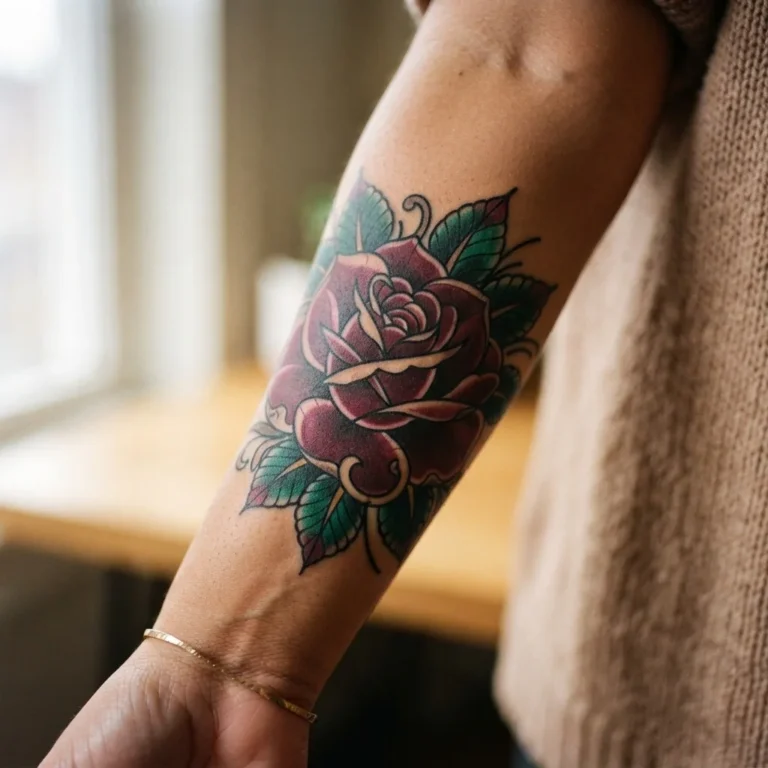
The rose needs no introduction, but that familiarity is worth working with rather than against. June roses carry meanings of love, passion, and beauty. The real design opportunity is in how you interpret it. A tightly closed rosebud reads differently than a full open bloom. A single stem feels different from a cluster. Fine-line roses at a small scale look elegant, but they require an experienced hand because roses have a lot of internal structure that can blur if the linework is too thin or too close together.
Honeysuckle represents devoted affection and happiness, and it has a graceful, winding form that lends itself beautifully to placements that follow a curve, like the collarbone, ankle, or behind the ear.
July: Water Lily and Larkspur
The water lily carries themes of enlightenment, peace, and resilience. Rising from water to bloom, it’s a natural symbol of overcoming difficulty, and that meaning resonates with a lot of people who want their tattoo to carry personal weight. In blackwork or fine-line, water lilies have beautiful symmetry. Larkspur represents levity, swiftness, and an open heart, with tall flower spikes that give it a dramatic verticality that suits longer placements like the spine or upper arm.
August: Poppy and Gladiolus
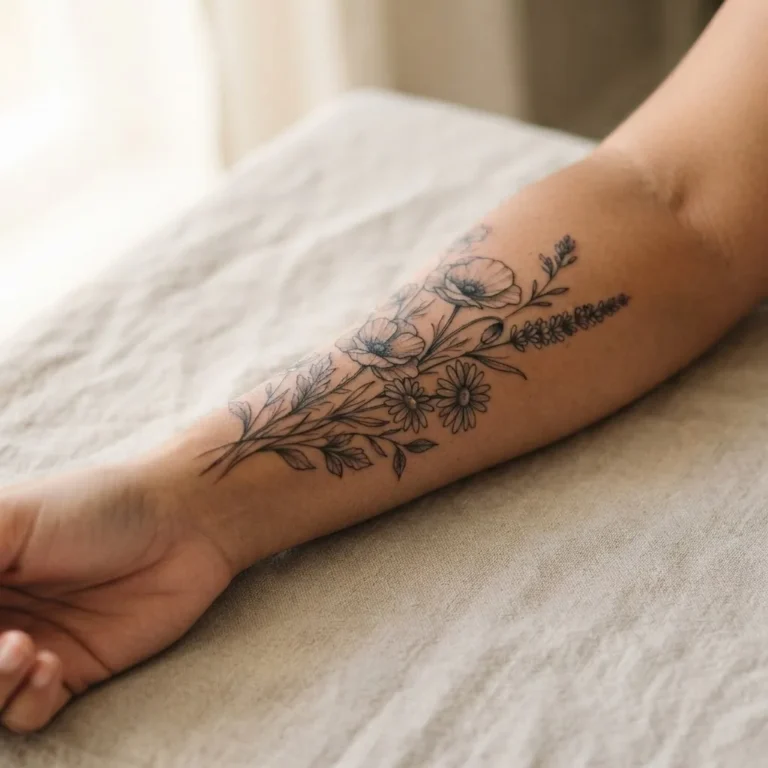
The poppy is one of the most versatile flowers in tattoo art. It carries meanings of remembrance, imagination, and restful sleep. The thin, slightly crinkled petals are beautiful in fine-line, and in color work, a red poppy is striking without being aggressive. Gladiolus represents strength of character, faithfulness, and moral integrity. Its tall stalk of layered blooms makes it a natural fit for vertical placements and longer compositions.
September: Aster and Morning Glory
Aster flowers look like small starburst daisies and represent wisdom, faith, and valour. They work well in clusters and translate beautifully in both fine-line and botanical styles. Morning glory carries themes of affection and a love of nature, with a trumpet-shaped bloom that has elegant, graphic potential.
October: Marigold and Cosmos
Marigold is strongly associated with warmth, creativity, and grief turned into memory. In many Latin American cultures it is the flower of remembrance, most visibly through its role in Día de los Muertos traditions. If you have cultural ties to that tradition, or if you’re drawn to themes of honoring people you’ve lost, marigold carries real depth. Cosmos represents order, harmony, and modesty. Its simple round petals and long stem make it a graceful, understated choice.
November: Chrysanthemum and Peony
The chrysanthemum is one of the most culturally layered birth flowers. In Eastern traditions it represents longevity, rejuvenation, and nobility. In Western contexts it can represent friendship and well-being. Its round, layered form is a gift for tattoo artists because the petals create natural depth. In blackwork or single-needle fine-line, chrysanthemums are especially striking.
The peony, sometimes given to November, is one of the most popular floral tattoo choices in general. It represents prosperity, good luck, and romance. A full peony in bloom, with its layers of soft petals, is a rich, lush design that benefits from some scale: at least two to three inches to hold its detail well.
December: Narcissus and Holly
Narcissus carries meanings of hope, wealth, and good fortune. The bloom itself, with its central trumpet and surrounding petals, is elegant and distinctive. Holly represents domestic happiness and protection, and its graphic combination of pointed leaves and round red berries translates beautifully in color or blackwork.
Choosing Your Style: What Works for Birth Flower Tattoos
The style you choose shapes everything: how the tattoo looks on day one, how it communicates meaning, and how it holds up over decades.
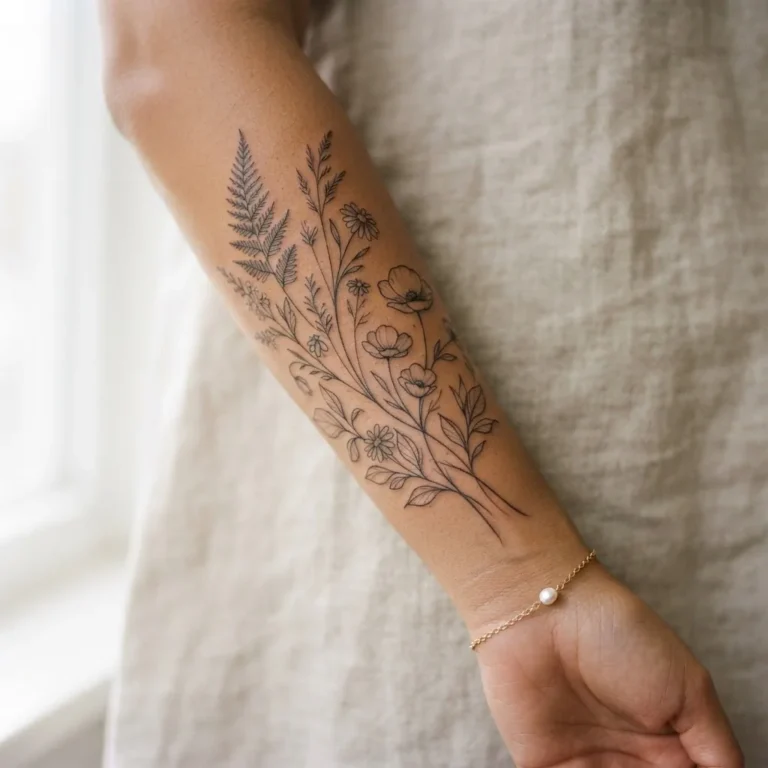
Fine-line is currently the most popular style for birth flower tattoos, and it’s genuinely beautiful when executed well. The delicate lines capture botanical detail in a way that feels modern and sophisticated. The honest part is that fine-line tattoos do change over time: lines soften, very thin strokes can spread slightly, and high-movement placements like wrists and fingers experience this change faster than more stable areas like the upper arm or thigh. A well-done fine-line tattoo on a good placement by a skilled artist still looks beautiful after years. The key is choosing your artist carefully and having a realistic conversation about sizing.
Botanical blackwork uses bolder, solid lines and shading to create a classic, illustrative look. It tends to age more predictably than very fine-line work because the lines have more substance. If you want something with strong presence and long-term staying power, a botanical blackwork approach is worth considering.
Minimalist and single-line styles strip the design down to its essential shape. They suit people who want something small, subtle, and quietly personal. These are also the styles that are most sensitive to sizing, because there’s very little design to hold the eye at a small scale.
Watercolor is beautiful in inspiration images but requires a specific conversation with your artist about how it heals and holds, because soft washes of color can change significantly as skin ages. Not every artist specializes in this style, so portfolio research matters even more.
For any style with significant color, it’s worth knowing that not all ink pigments behave the same. Dermatologists have documented that red tattoo pigments carry the highest risk of hypersensitivity reactions, including allergic contact dermatitis and lichenoid reactions, while black, blue, and green inks are associated with reactions far less frequently. This doesn’t mean you shouldn’t get a colorful flower tattoo. It means choosing a licensed, experienced artist who uses quality inks from reputable sources is genuinely important.
Placement and Sizing: The Decisions That Affect Everything
Placement is where the most under-researched decisions get made. People often choose a spot purely based on how a reference image looks, without thinking about how their specific body, skin, and lifestyle will interact with the tattoo.
The inner forearm is the most popular placement for birth flower tattoos, and for good reason. It’s visible when you want to show it, covers easily when you need to, and the skin is relatively stable, which is good for fine-line detail. It’s also a moderate pain area for most people.
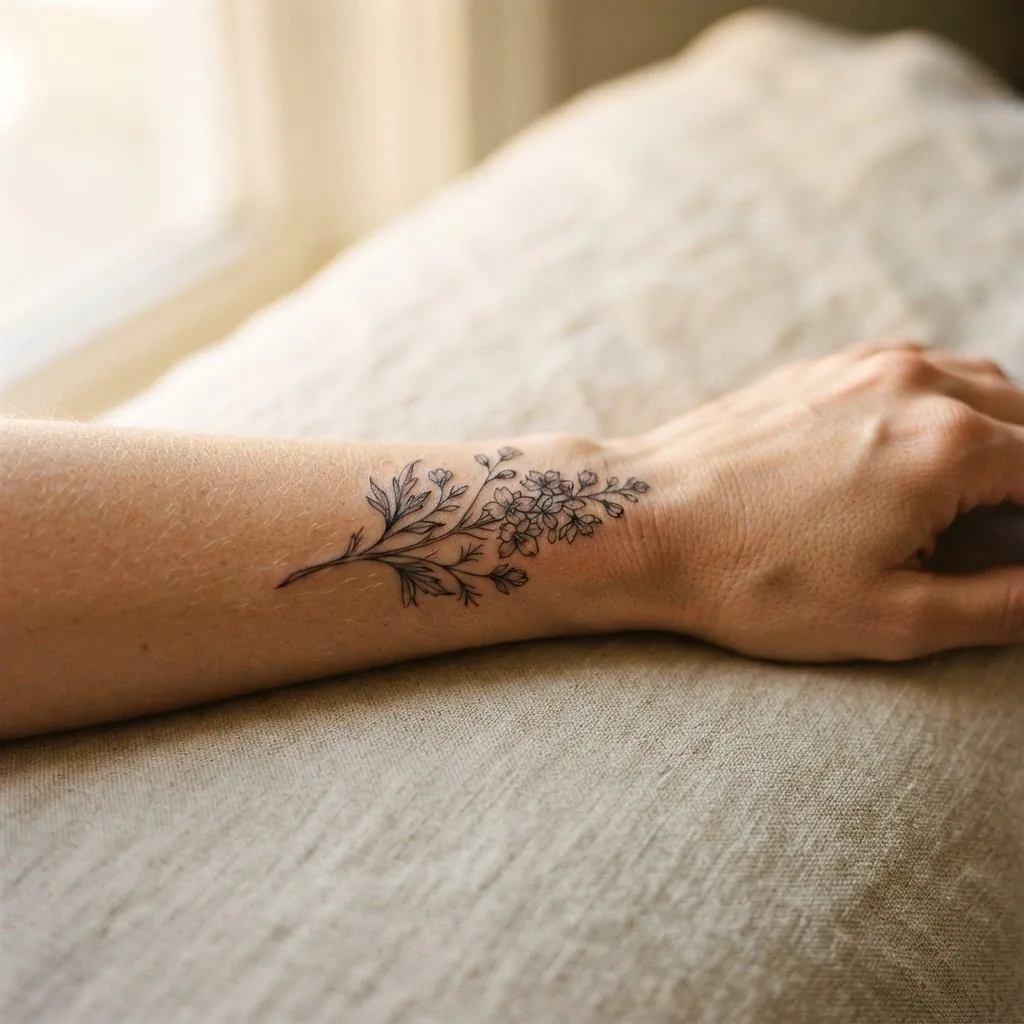
The wrist and collarbone suit smaller, more intimate pieces. Both areas are higher movement than the forearm and the wrist especially can affect how fine-line work ages. If you’re going small on the wrist, discuss sizing honestly with your artist and err on the side of slightly larger rather than smaller, especially for designs with internal detail like lily of the valley or carnation petals.
The upper arm and shoulder offer more canvas, lower pain for many people, and good longevity for the work. If you’re considering a multi-flower bouquet or a design with significant detail, this area gives an artist the room to do it justice.
The ribs and side are popular for longer, vertical compositions. They’re also one of the more intense areas for pain, because the skin sits closer to bone with less padding underneath. Many people describe it as manageable but sharp. If it’s your first tattoo, it’s not the place I’d recommend starting.
The thigh is genuinely underrated. It offers a large, relatively stable area with lower average pain than ribs or spine, and it suits both larger single blooms and longer compositions. Because it’s easily covered, it’s also a good choice for people in professional environments.

Sizing matters more than most beginners expect. A simple single-stem design can work beautifully at one and a half to two inches. But a design with significant internal detail, layered petals, or multiple flowers almost always needs more space to stay clear as it heals and ages. The general principle artists consistently apply is that a tattoo should look good not just on the day you get it, but after the skin has healed, and years from now. If you’re unsure about size, ask your artist to stencil two or three size options on the area before committing.

Combining Birth Flowers: Making the Design Truly Yours
One of the most meaningful approaches to a birth flower tattoo is combining multiple flowers into a single composition. People do this to honor a parent, a partner, a child, a best friend, or a sibling. A bouquet of two or three birth flowers from different months is one of the most personal tattoo designs you can get.
When you’re briefing an artist on a multi-flower piece, the clearest way to communicate is to come in knowing which flowers you want, what they mean to you, whether you want them woven together in a bouquet or arranged more distinctly, and what overall mood you want: soft and delicate, bold and graphic, or somewhere in between. Reference images are genuinely helpful here. Bring examples of compositions, not just individual flowers, so your artist can see the shape and spacing you’re drawn to.

Finding the Right Artist for the Job
Birth flower tattoos, especially fine-line ones, are not a style every artist does equally well. Your first research task is to find an artist whose portfolio genuinely includes healed floral work in the style you want, not just fresh photos taken immediately after the session. Fresh tattoos always look sharper than healed ones. Ask if the artist has photos of their work six months or a year after the session. That’s the truest picture.
Your artist should be working out of a licensed, inspected studio. Licensing and hygiene requirements vary by state, but a legitimate studio will use sterile single-use needles, wear gloves throughout, and have a clean, organized workspace. If anything about the environment makes you uncomfortable, trust that feeling. Your safety is the non-negotiable foundation of this whole process.
The FDA has noted that contaminated tattoo inks are a genuine risk, including in sealed or labeled containers, and that infections can result from inks carrying bacteria or other microorganisms. A licensed, experienced professional working in a regulated studio is your strongest protection against these risks. This is not a place to cut corners on cost.
Before booking, look for consistent positive reviews about cleanliness, communication, and the artist’s actual portfolio in your style. Instagram is a legitimate research tool here. DMs to artists asking about availability, consultation process, and whether they specialize in fine-line floral work are completely normal and welcome.
What to Expect at Your Appointment
Walking into your first session feels big, and it is. But preparation makes a real difference.
Eat a proper meal beforehand and stay well hydrated. Wear comfortable clothing that allows easy access to the area being tattooed. Bring a reference folder, whether on your phone or printed, with design inspiration, the specific flowers you want, placement examples, and style references. The more clearly you can show an artist what you’re imagining, the more likely the result reflects your vision.
During the session, your artist will place a stencil of the design on your skin and check the placement with you before anything permanent happens. This is the moment to speak up if the size, positioning, or orientation doesn’t feel right. Artists expect this conversation and want to get it right as much as you do.
Pain varies by person and placement. Most people describe a forearm or upper arm floral tattoo as uncomfortable and intense in moments but completely manageable. The sensation is different from what people often imagine beforehand. Short breaks are fine to ask for if you need them.
Caring for Your New Ink
Your artist will give you specific aftercare instructions, and those instructions are the ones you follow. General principles that most professionals and dermatologists consistently recommend include: keeping the fresh tattoo clean, avoiding submerging it in water (baths, swimming pools, oceans), and moisturizing with a gentle, fragrance-free product once initial healing allows. Once fully healed, UV protection matters significantly for maintaining your ink. The American Academy of Dermatology recommends applying a broad-spectrum sunscreen to healed tattoos when you’re in the sun, because UV light fades tattoo inks over time.
Full surface healing takes around two to four weeks for most people, though deeper layers continue healing for longer. Everyone heals differently, and individual factors like skin type, placement, and the complexity of the design can all affect the timeline. If you notice anything that concerns you during healing, such as prolonged swelling, redness that spreads, unusual discharge, or a rash, contact your artist and see a healthcare provider. Don’t wait and hope it resolves on its own.
A well-executed, well-healed birth flower tattoo is a beautiful thing. The time you take to make a careful decision, choose the right artist, and care for the work properly is what gets you there.
Your birth month gave you your flower. What you do with it is entirely up to you.