
I got my first tattoo at eighteen, and I still remember the exact moment the daydreaming turned into a decision. I had a folder of saved images, a flower I kept coming back to, and no real idea how to turn any of it into something I would wear forever. If that is where you are right now, quietly building a board and wondering which bloom is actually yours, you are in exactly the right place.
Floral tattoos are one of the most loved choices for a reason. Flowers are soft and strong at the same time. They carry meaning without shouting it. And they can be tiny and tucked away or bold and sprawling, which means there is a version for almost everyone. I am the friend people text before they book, and floral is the request I get most. So let me walk you through fourteen designs I genuinely love, what each one tends to mean, and the honest planning details that turn a pretty screenshot into a piece you will still be glad you got years from now.
My whole thing is simple. A good tattoo starts with good info. So we will dream a little, then plan a lot.
First, a quick word on why flowers work so well
Before we get to the list, it helps to know that people have been assigning meaning to flowers for a very long time. The “language of flowers,” where specific blooms stood in for specific feelings, has deep historical roots, and if you enjoy that kind of backstory I really like the way the editors at Britannica trace how floral symbolism developed across art history. You do not need a history lesson to pick a flower you love. But knowing your flower carries a little story can make the final piece feel even more like yours.
14 floral tattoo designs worth planning
1. The single-stem rose
The rose is the classic for a reason. It reads as love, but also passion, beauty, and even resilience once you factor in the thorns. A single stem laid along the forearm or the outer bicep is timeless, and it suits almost every style, from fine-line to bold blackwork. If you want something that feels safe in the best sense, this is it.

2. Peony in soft color or black and gray
The peony is my personal favorite to recommend when someone wants “feminine but not delicate.” It is big, ruffled, and full of movement. In many traditions it symbolizes good fortune, honor, and a kind of bold beauty. Because it has so many petals, it loves a little space, so think shoulder, thigh, or upper back rather than a tiny wrist.
3. Lotus with clean linework
The lotus grows up out of the mud and blooms clean, which is why it so often stands for rising through hard things, renewal, and calm. It has beautiful natural symmetry, which makes it a lovely choice for center placements like the sternum or the back of the neck.
4. Wildflower cluster
If you cannot pick just one flower, you are allowed to not pick. A loose gathering of wildflowers gives you variety and an effortless, gathered-from-a-meadow feel. This is a great way to combine a few meaningful blooms into one composition. It also grows well into a larger piece later if you fall in love with the process.
5. Birth-month flower
This is one of my favorite meaningful micro-tattoos. Every month has an associated flower, so you can honor yourself, a child, or someone you love with a bloom instead of a name or date. A stacked set of birth-month flowers for your people is a quietly beautiful family tattoo.
6. Delicate daisy
Daisies read as innocence, cheerfulness, and simplicity. A small daisy is one of the friendliest first tattoos out there. Just know that very tiny, very detailed flowers ask more of both the artist and the aging process, which I will get into below.
7. Forget-me-not
Small, blue, and sweet, the forget-me-not carries remembrance and lasting love. It is a gentle, popular choice for a memorial piece that does not feel heavy. A little sprig on the ankle or inner arm is understated and lovely.
8. Poppy
Poppies are dramatic and a little bit moody. Depending on the tradition they can mean remembrance, peace, or restful sleep. They photograph beautifully in bold red or in graphic black and gray, and they suit an illustrative or neo-traditional style well.
9. Sunflower
Sunflowers are pure warmth. They stand for adoration, loyalty, and optimism, and they are genuinely hard to dislike. Because a sunflower has a strong central shape and clear petals, it holds up nicely at a medium size on the forearm or calf.
10. Cherry blossom
Cherry blossoms carry the idea that beauty is fleeting and precious. A branch of blossoms drifting up the forearm or along the collarbone has gorgeous movement. This is a great design to discuss with your artist as a custom flow rather than a stamp, so it follows your body.
11. Lavender sprig
Lavender is calm in plant form. It suggests serenity, healing, and devotion, and its slim vertical shape is perfect for spots where you want something narrow, like the inner arm, the spine, or behind the ear.
12. Magnolia
Magnolias feel elegant and a touch vintage. They often represent dignity and a quiet, enduring strength. Their large, smooth petals give an artist room for soft shading, which makes them a beautiful choice if you love a botanical, illustrative look.
13. Lily of the valley
Tiny bell-shaped blooms on a curved stem, lily of the valley reads as sweetness, humility, and a return of happiness. It is delicate and romantic, and it works beautifully as a small trailing piece.
14. Botanical line-work bouquet
Last, my soft spot: a fine-line botanical bouquet that looks like a page from an old plant guide. It combines a few flowers and leaves into one continuous, airy composition. It feels personal and modern, and it is endlessly customizable with your own meaningful blooms.
How to choose the flower that is actually yours
With fourteen options in front of you, here is how I help friends narrow it down. Start with meaning, then feeling, then style. Ask what you want this flower to say, then notice which images make your chest feel a little warm when you look at them, and only then worry about whether it should be fine-line or bold, color or black and gray.
One honest note. A design that is popular is not automatically a design you will love forever. The goal is not to get the trendiest flower. It is to get the flower that will still feel like you when the trend has moved on. Sit with your top choice for a few weeks before you book. If it still feels right, that is a good sign.
Placement and sizing, the realistic version
This is where competitors usually go quiet, so let me be the friend who tells you the truth.
Bigger flowers need room. A peony or a full rose crammed into a two-inch space loses its detail fast. If you love an intricate, many-petaled bloom, give it a canvas like the upper arm, thigh, shoulder, or back. Save the tiny wrist and finger spots for simpler shapes like a small daisy, a sprig, or a single bud.
Think about the shape of the flower versus the shape of the space. A cherry blossom branch or a lavender sprig is long and narrow, so it flows beautifully down a forearm, a spine, or a shin. A round, symmetrical lotus sits happily in a centered spot like the sternum or the back of the neck.
And here is the detail almost no gallery mentions: how a tattoo ages depends partly on placement and size. Very fine, very small lines placed on high-friction areas like hands, fingers, and feet tend to blur and fade sooner. If you want crisp detail to last, a slightly larger design in a lower-friction spot is the smarter bet. A good artist will tell you this too, which is exactly why you want a good artist.
Let’s talk about pain, calmly
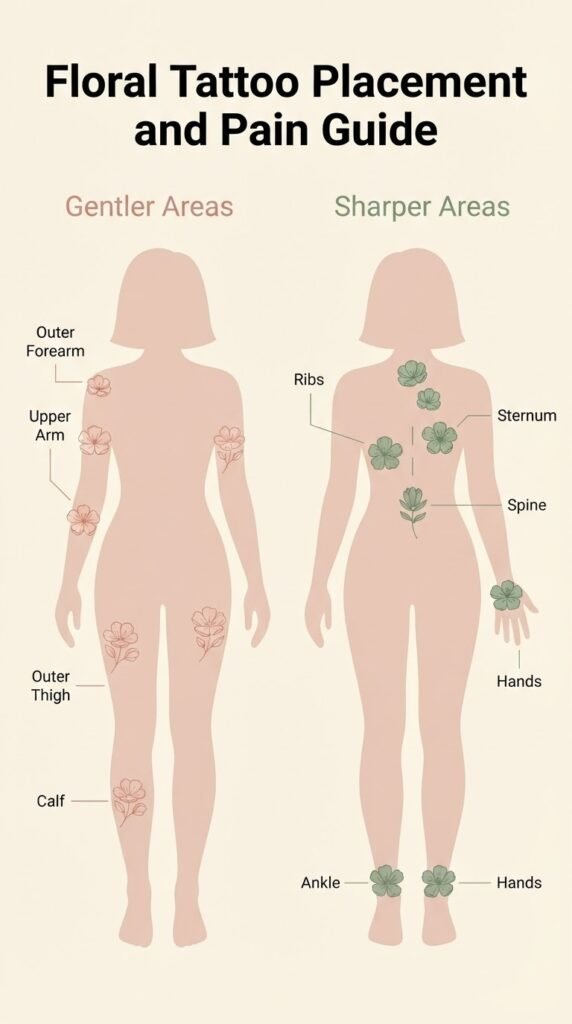
Pain is the question everyone is too shy to ask, so I will just say it plainly. Yes, it hurts, but it is very doable, and where you place your flower changes the experience a lot.
Generally speaking, areas with more muscle or padding, like the outer forearm, outer thigh, calf, and upper arm, tend to be more comfortable. Areas with thin skin over bone or lots of nerve endings, like the ribs, sternum, spine, ankle, feet, hands, and inner arm, tend to be sharper. This is a broad pattern, not a promise, because everyone’s body is different and everyone’s day is different. A well-rested, well-fed, well-hydrated you will handle it far better than an anxious, empty-stomach you.
If pain is your main worry, pick a comfortable placement for your first piece and keep the session short. Confidence built on an easier first experience carries you a long way into your second.
What floral tattoos cost, and why cheap can be a red flag
I will not quote you a specific number because pricing varies enormously by region, artist experience, size, detail, and color. What I can tell you is how to think about it. Most artists charge either an hourly rate or a flat price for the piece, and most have a shop minimum for tiny work. A skilled, licensed artist who books out months in advance is not cheap, and that is the point. This is permanent, and it is a medical-adjacent procedure on your skin.
If a price feels surprisingly low, slow down. Underpricing can be a sign of inexperience or corners being cut on hygiene. You are not just paying for a drawing. You are paying for training, a sterile environment, and skill that lasts decades on your body.
How to find and work with a licensed professional
This is the part I care about most, because a beautiful design in the wrong hands is heartbreaking, and getting tattooed is a job for trained, licensed professionals, full stop. I will never tell you to try this at home, and no reputable artist would either.
Start with the portfolio, not the price. Look for an artist whose healed work, not just fresh photos, matches the style you want. Someone who is brilliant at bold color might not be your person for airy fine-line botanicals, and vice versa. Match the artist to the flower.
Check licensing and hygiene. Licensing rules are set by state and local authorities, and they vary by location, so look up your area’s requirements and confirm the shop and artist meet them. In a good studio you will see single-use needles, fresh gloves, sealed equipment, and a genuinely clean space. This matters more than almost anything else, because contamination is a real risk. The FDA notes that infections and allergic reactions to inks are documented, and that even sealed, “sterile” labeled inks can harbor bacteria, which you can read straight from the source in the FDA’s consumer guidance on tattoo safety. You want someone who takes all of this as seriously as you do.
Book a consultation and bring the right things. Bring your reference images, but frame them as inspiration, not a photo to copy. Copying another artist’s exact design is poor etiquette and often produces worse results anyway. Bring the meaning behind your choice, your placement idea, your size range, and your questions. Then let the artist do what they are trained to do, which is turn your idea into a custom design that fits your body.
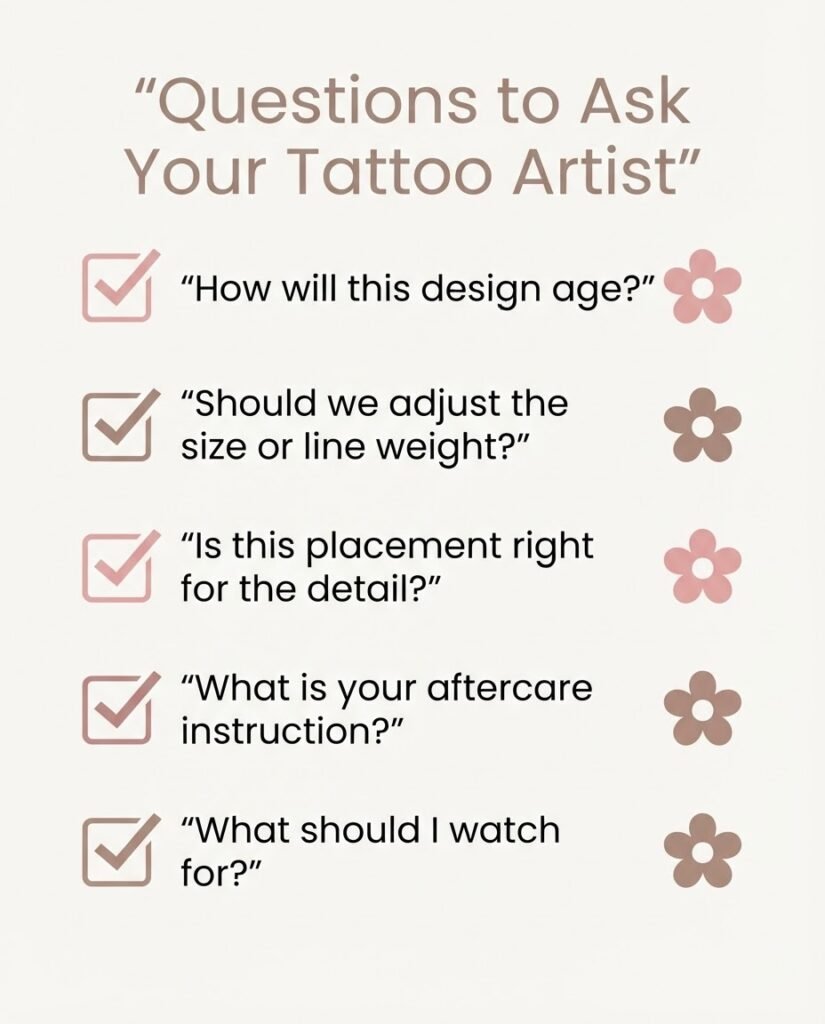
Good questions to ask include: How will this design age? Would you tweak the size or line weight for longevity? Is this placement a good fit for the detail I want? What is your aftercare instruction, and what should I watch for? A professional will welcome these questions, not brush them off.
Healing and aftercare basics, straight from the experts
Aftercare is where a beautiful tattoo is won or lost, and it is not complicated, but it does ask for consistency. Your artist’s instructions always come first, because they know exactly what they did to your skin. What follows is general context, not a replacement for what they tell you or for medical care.
Healing timelines depend on size and location. Smaller pieces on the arm can settle in a couple of weeks, while larger work can take a few months on the surface and, as Cleveland Clinic’s dermatology guidance on tattoo healing explains, several more months for the deeper layers of skin to fully recover. Expect some redness, mild swelling, itching, flaking, and light scabbing along the way. That is normal healing, not a problem.
The general consensus on early care is gentle and simple: keep it clean by washing with a mild fragrance-free soap, moisturize lightly, avoid picking or scratching scabs, skip soaking in tubs, pools, and hot tubs, and stay out of the sun while it heals. On that last point, the dermatologists at the American Academy of Dermatology’s guide to caring for tattooed skin recommend a water-based lotion rather than heavy petroleum products, and protecting a healed tattoo with broad-spectrum sunscreen because UV light fades ink over time.
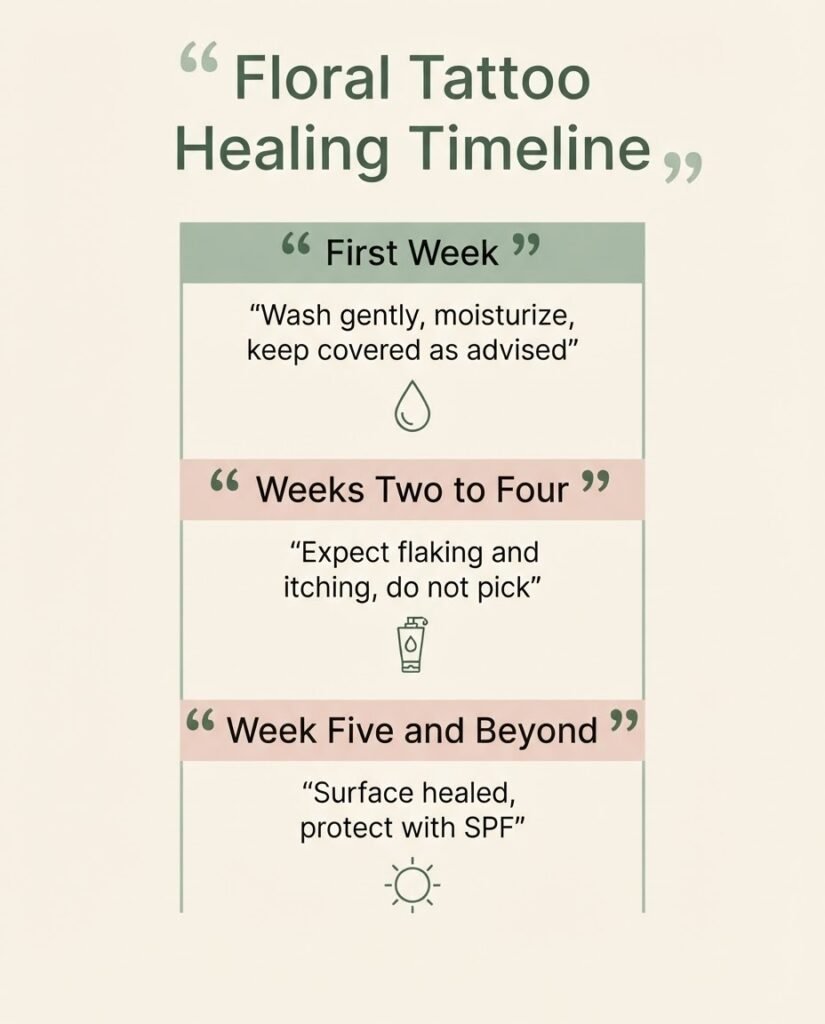
Sun protection is honestly the single best long-term favor you can do your floral piece.
When to check with a doctor
Serious problems are uncommon with professional, hygienic work, but you should know the signs, because caring for yourself is part of caring for your art. Contact a healthcare professional if you notice a fever, skin that feels hot to the touch, spreading or worsening redness, pain that increases instead of easing, foul odor, or unusual drainage. Those can point to an infection, and the overview from Cleveland Clinic on tattoo infection is a clear, reliable place to understand what to watch for. A rash or persistent bumps can signal an allergic reaction to a pigment, which a dermatologist should evaluate. One more small but useful fact: if you ever need an MRI, mention your tattoo, since a small number of people feel brief swelling or warmth in the area. None of this is meant to scare you. It is just the informed-planner mindset that keeps a great tattoo great.
A note on permanence, honestly
Floral or not, a tattoo is designed to last a lifetime and is difficult to remove. Removal exists, but it is not a simple undo. It is a series of laser sessions that is expensive, uncomfortable, and not guaranteed to erase everything, as the AAD’s overview of laser tattoo removal lays out plainly. I am not telling you this to add pressure. I am telling you because knowing it is what lets you relax. When you have chosen a flower you love, in a size and spot that suits it, made by an artist you trust, permanence stops being scary and starts being the whole point.
The people I know with the fewest regrets are not the ones who agonized the longest. They are the ones who gathered good information, made a confident choice, and then let themselves fully enjoy it. That is what I want for you. Pick the bloom that makes your chest go warm, plan it with care, hand it to a professional, and then wear it like it was always meant to be yours. Because once you have done the thinking, it was.