Family Tattoos: How to Choose a Design You Won’t Regret
There is a specific kind of feeling that comes before a family tattoo. It is not the casual excitement of flipping through a flash sheet. It is quieter than that, more certain in some ways and more nervous in others. You already know you want this. You know who it is for and what it means. What you do not yet know is how to get from that feeling to a design you will look at twenty years from now and still feel good about.
That is exactly where I want to meet you.
I have been the person my friends text before they book, for years now. And the family tattoo conversations are always the most loaded ones, in the best possible way. Nobody texts me saying “I want a family tattoo, whatever, help.” They text me with full paragraphs about their grandmother’s garden, their kids’ birthdays, the bird their late father used to whistle. The meaning is never the problem. The translation is where people feel stuck.
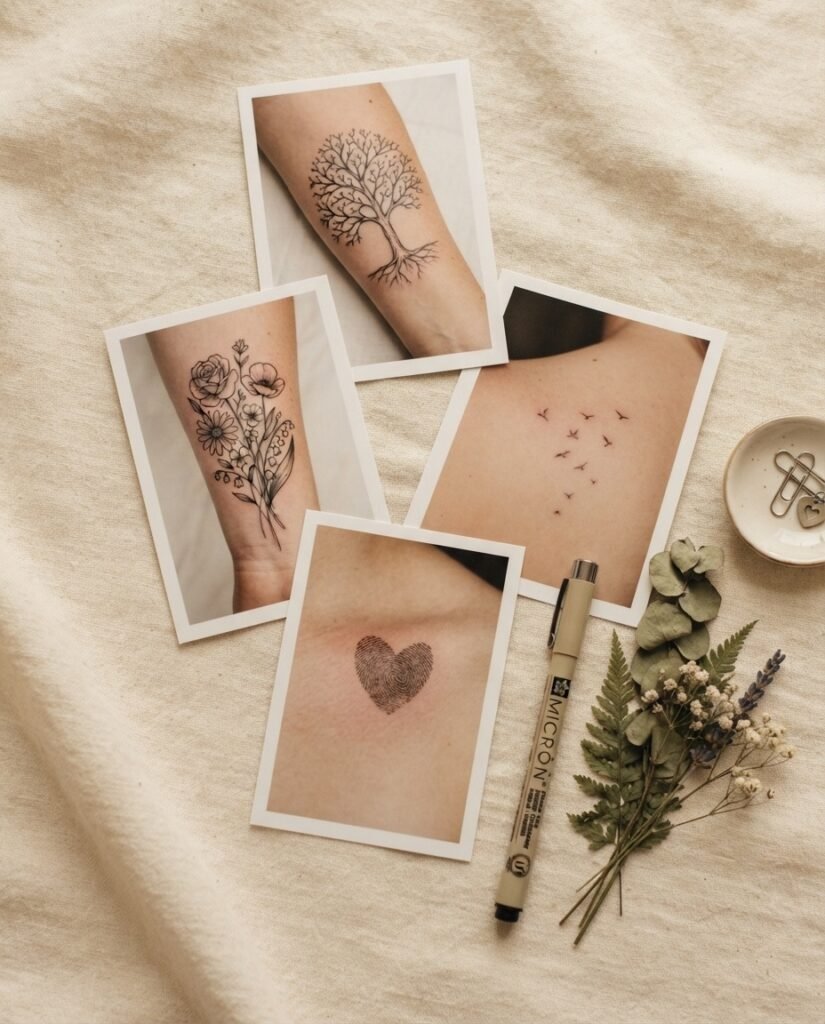
This article is about that translation: twelve design directions worth exploring, honest guidance on styles and placement, and everything you need to know to walk into a studio consultation feeling informed, clear, and genuinely ready.
Why Family Tattoos Deserve More Than a Five-Minute Decision
I want to say this gently but directly before we get into the designs: family tattoos sit in a specific category of permanence that deserves some extra thought time.
A peer-reviewed 2022 study published in the National Institutes of Health’s PMC database on tattoo demographics, motivations, and regret found that the main reasons people regret tattoos include personality change and lifestyle shifts, and that getting a first tattoo at a younger age is associated with higher regret rates. Here is what I find genuinely comforting about that finding: it is not the subject of the tattoo that causes most regret. It is the rush. Family is rarely something people move away from in meaning. A rushed design or a poor artist choice is far more likely to be the source of regret than the fact that you honored your mom.
The good news is that slow, intentional planning is exactly what this article is designed to help you do.
What “Family Tattoo” Actually Covers (More Than You Think)
The phrase “family tattoo” gets used as a catch-all, but it covers a wide range of intentions, and knowing which category you are in helps enormously when you sit down with an artist.
Tribute to a specific person (a parent, grandparent, sibling, child) is one of the most common. This might be a portrait, a symbol associated with that person, their handwriting, a date, or a motif they loved.
Honoring a bond or a family unit is slightly different. Here you are not singling out one person but representing the whole: your family of origin, the family you have built, or the chosen family that has held you.
Memorial tattoos for a person who has passed are their own emotional category entirely. The stakes feel higher because the person can no longer weigh in, and many people want to get it perfect before they book. I will address this specifically later.
Matching or coordinating tattoos with family members, done separately or together, have their own set of considerations around design cohesion and timing.
Knowing which of these you are doing shapes every choice that follows.
12 Family Tattoo Design Directions Worth Exploring
These are not instructions or templates. They are starting points, conversation-starters between you and your future artist. Think of each one as a door, not a destination.
1. The Family Tree
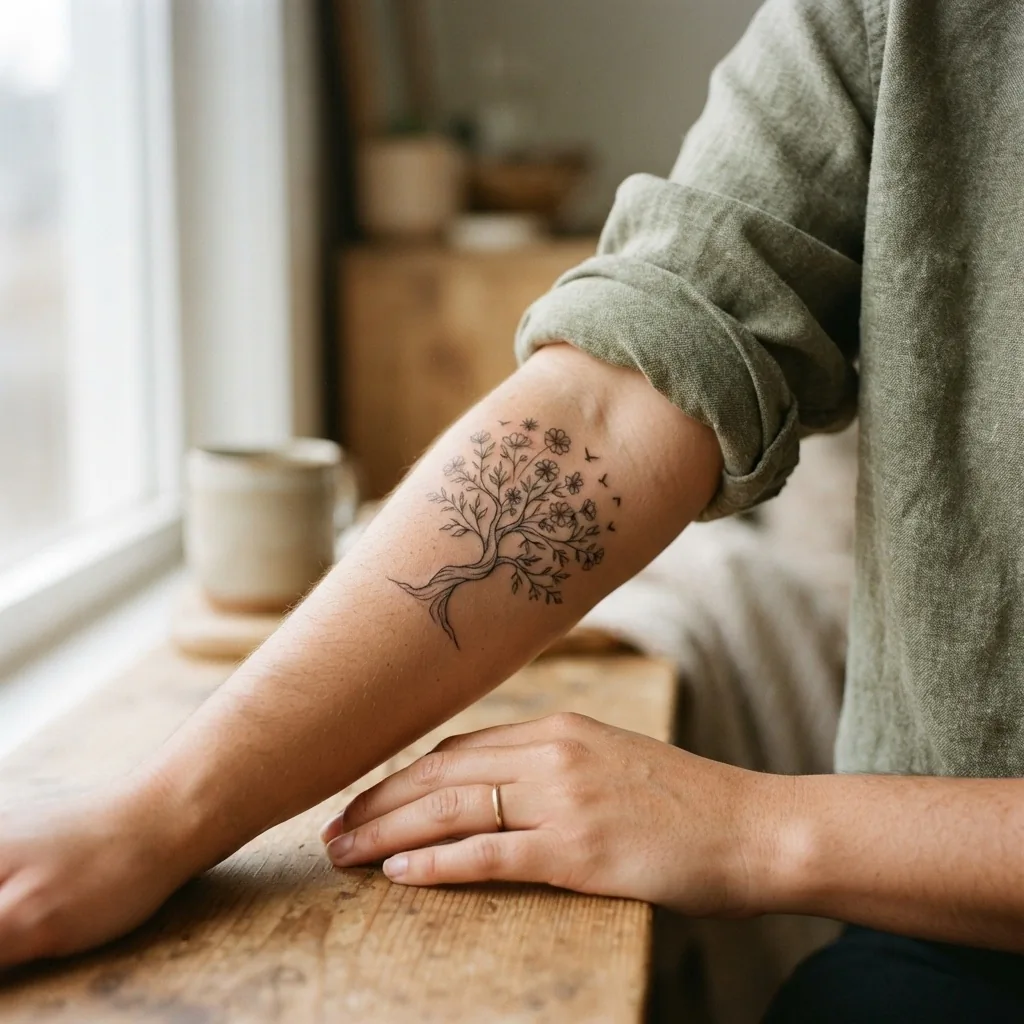
The family tree is one of the oldest and most universally understood symbols of lineage, roots, and connection. The roots represent where you came from. The branches reach forward. The strength of the trunk is the family itself. Fine-line illustrative family trees work beautifully on the upper back, the ribcage, or the inner forearm. If you want to incorporate names, your artist can weave them into the roots or the branches without it reading as a typical script tattoo.
One thing to think about with family trees: complexity scales up quickly. A family tree that tries to include every branch can become visually chaotic at small sizes. Your artist can help you decide which elements carry the meaning and which are decorative noise.
2. Birth Flowers for Each Family Member
Every birth month has a corresponding flower, and a bouquet or a small cluster of blooms, one per family member, is one of the most elegant and personal family tattoo concepts I keep seeing. January’s carnation sits next to April’s daisy next to September’s aster. Together they tell your story without spelling it out. This concept works in fine-line botanical style or in a looser, more illustrative approach.
The bonus here is that it is completely scalable. You can start with two or three flowers for your children and leave visual space to add more if your family grows. Talk to your artist about intentional negative space when planning for this kind of future addition.
3. Handwriting or a Signature
If your parent, grandparent, or a family member who has passed left any written record, a birthday card, a letter, a recipe, even a grocery list, their actual handwriting converted into a tattoo is one of the most quietly powerful tributes I have seen. There is something about seeing a loved one’s handwriting on your skin that no font can replicate.
Artists who work in fine-line script lettering can reproduce handwriting with remarkable accuracy. Save the original scan or high-resolution photo of the handwriting and bring it to your consultation. The condition of the original affects what the artist can do.
4. Coordinates of a Meaningful Place
The GPS coordinates of where you grew up, where a family member lived, where your child was born, or a place you all love together. Coordinate tattoos read as clean, modern, and quietly personal. Most people who see them would not immediately know what they mean, and that kind of private meaning appeals to a lot of people getting family tattoos.
Coordinate tattoos look clean in thin serif lettering or minimalist sans-serif. They age well because the linework is simple and the letterforms are large enough to stay legible. Placement on the inner wrist, collarbone, or upper arm all work well.
5. A Portrait
A portrait tattoo of a family member, done well, is one of the most striking and personally meaningful pieces a person can have. The critical word is “done well.” Portrait tattoos are one of the most technically demanding styles in the industry, and the gap between an artist who genuinely specializes in portraiture and one who dabbles in it is enormous.
If you are drawn to portrait work, please spend significant time reviewing your artist’s specific portrait portfolio before booking. Look for healed examples, not just fresh ones. Healed portraits look different from fresh ones and give you a more accurate picture of the artist’s long-term result. This is worth taking extra time for.
6. Minimalist Family Symbols
A simple row of birds in flight, one for each family member. A set of mountain peaks. Three small moons. A cluster of stars. These kinds of minimalist symbol compositions can represent a family with no words, no names, and no literal imagery. They are personal in meaning and visually clean.
These designs tend to be favorites for people who want something that feels meaningful to them but does not broadcast its significance to the world. They also tend to work at smaller sizes better than intricate compositions.
7. A Roman Numeral Date
A birth date, a date of passing, a wedding anniversary, the year a family was formed. Roman numerals read as graphic and timeless in a way that Arabic numerals often do not, and they work beautifully in a range of lettering styles. This is one of the most versatile options because it layers naturally with other design elements if you ever want to build out a larger piece.
8. Celtic Knot or Cultural Heritage Symbols
If your family has strong cultural roots, heritage symbols can carry extraordinary depth. Celtic knot patterns represent eternity and interconnection. Māori tribal patterns carry specific ancestral meaning. Scandinavian runes have family and protection symbolism. Indigenous and East Asian artistic traditions have their own rich visual languages.
A word I want to offer here with genuine care: when a symbol or design comes from a specific cultural tradition that is not your own heritage, it is worth having an honest conversation with your artist about meaning and context. A good artist will guide you thoughtfully and help you find a design direction that honors both the spirit of what you want and the cultural weight of the imagery.
9. A Fingerprint Heart or Motif
A fingerprint is, literally, unique to one person. Using a family member’s actual fingerprint (or your own) as the foundation of a design is one of the most intimate and irreplaceable tattoo concepts. The most common approach is a fingerprint in the shape of a heart, but artists can work the print into other shapes or use it as a textural element within a larger design.
This requires either a clear ink stamp or a high-resolution scan of the fingerprint. Your artist will tell you exactly what format they need. If you are honoring someone who has passed, many funeral homes keep fingerprints on record, and some families have thought to take prints before a loved one passed.
10. A Botanical Element Tied to Memory
Not everyone resonates with birth flowers. Sometimes the meaningful plant is the lavender your grandmother grew, the sunflowers your mom always kept on the kitchen table, or the oak tree in the backyard of your childhood home. A specific botanical element tied to a specific family memory is an incredibly personal design direction.
The beauty of this approach is that the meaning is entirely yours and entirely opaque to anyone else. Only you know why that particular flower matters.
11. A Bird or Animal with Family Meaning
Certain birds carry strong family symbolism across many cultures: the swallow for safe return home, the crane for longevity and fidelity, the hummingbird often associated with the presence of loved ones who have passed. Animals matter too: a bear protecting her cubs is one of the most universally understood symbols of parental love.
If a specific animal had meaning in your family, through a beloved pet, an inside story, or a symbol your family used, that personal connection almost always outweighs the generic symbolic meaning.
12. A Family Portrait or Silhouette Composition
This is different from a photorealistic portrait. A silhouette composition, a family of four walking, children on a parent’s shoulders, figures facing a sunset, captures a feeling and a moment rather than an exact likeness. These work beautifully in blackwork or fine-line illustrative style and tend to age more gracefully than highly detailed photorealistic portrait work.
If there is a specific moment your family holds dear, a vacation, a tradition, a recurring scene from childhood, a silhouette interpretation of that scene can be one of the most moving things an artist creates.
Thinking About Style: What Looks Beautiful Now and What Holds Up Later
This is one of the most under-discussed parts of family tattoo planning, and I think it is one of the most important.
Every tattoo style ages differently, and since a family tattoo is something you will carry forever, it is worth understanding what you are choosing before you commit to a style.
Fine-line tattoos are stunning when fresh. Delicate, almost drawn-on-skin. They have become enormously popular in the last several years, especially for floral and botanical work. The honest reality is that fine-line work softens and spreads over time. Very fine lines that are close together can blur into each other after several years, particularly if the tattoo is in a high-friction area or gets significant sun exposure.

This does not mean you should not choose fine-line. It means you should choose an artist who works in fine-line confidently, understand that the tattoo will look softer over time, and commit to protecting it from the sun.
Blackwork and bold line styles age more predictably and hold their contrast well. If longevity and clarity decades from now feel important to you for this particular piece, leaning slightly bolder in your linework is worth discussing with your artist.
Script and lettering tattoos, which many people consider for names or dates, are also worth thinking about carefully in terms of size. Very small script on soft tissue areas (inner wrist, ankle) tends to blur over time. Your artist can tell you the minimum readable size for a specific letterform in a specific location. Trust that guidance.
Watercolor-style tattoos are visually beautiful but tend to fade faster than other styles, especially without a clear black outline to anchor them. If your heart is set on a watercolor family piece, ask your artist specifically about longevity and what they do to build in staying power.
The Healthline tattoo pain chart is a commonly referenced tool, and while pain is genuinely subjective, Healthline’s medically reviewed breakdown of tattoo pain levels by body placement is a useful starting point for understanding which areas tend to be more sensitive (ribcage, sternum, inner arm, ankle) and which tend to be more manageable (outer upper arm, calf, upper back). Pain is not a reason to avoid a placement you love, but it is worth knowing what to expect before your appointment rather than being surprised.
Placement: Where Should a Family Tattoo Live?
There is no single right answer, and the best placement is the one that fits your specific design, your body, your life, and your intentions for the piece.
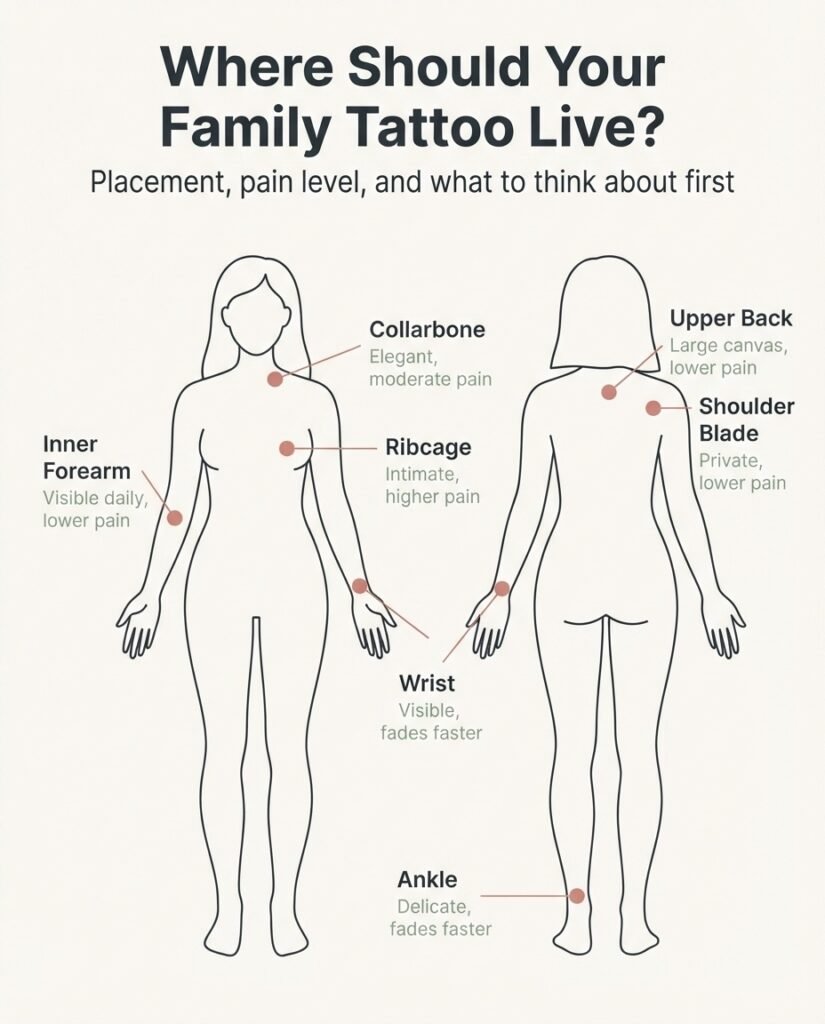
That said, here are the honest considerations I walk through with friends when they ask me this question.
Visibility and your everyday life matter more than people initially expect. A family tattoo on your forearm is something you will see every single day. Many people love that. Some people, a few years in, find it more emotionally heavy than they anticipated in certain moments. A placement that is meaningful but not constantly in your direct line of sight (upper back, shoulder blade, ribcage) can feel like carrying something precious and close without it being constantly visually present. Neither is wrong. Both are worth thinking about.
How the design scales is determined in part by placement. A detailed family tree needs enough surface area to breathe. A minimalist coordinate or a small botanical needs only a few square inches and can live beautifully on the inner wrist, collarbone, or behind the ear.
Future plans are worth mentioning to your artist at the consultation. If you might want to add to this piece later (another birth flower when another child arrives, a new branch on the family tree), designing with intentional space from the beginning makes additions far cleaner.
The ribcage is one of the most popular spots for meaningful personal tattoos. It is intimate, usually covered, and provides a long canvas for horizontal or vertical compositions. It is also genuinely one of the more painful placements, because the skin is thin, close to bone, and moves with breathing during the session. Not prohibitively painful for most people, but worth knowing.
The inner forearm is popular, relatively lower on the pain scale for most people, and gives great surface area for many family tattoo designs. It is also quite visible, which is something to consider for both personal and professional reasons.
Fingers, hands, and feet are areas where many tattoo artists will have candid conversations with you about longevity. These high-friction, high-movement areas mean tattoos fade and spread faster than almost anywhere else on the body. A family tattoo in one of these locations may need touch-ups more frequently.
Finding the Right Artist for This Specific Tattoo
A family tattoo is not a piece I would ever take to just any available artist, and I would say the same to any friend asking my advice. This is not about being precious about it. It is about the practical reality that the style, scale, and emotional weight of this piece deserve someone who has genuinely done this kind of work before.
Tattoo artists in the United States are licensed and regulated at the state and local level, not federally. Requirements vary by state. For example, the Florida Department of Health’s tattoo artist licensure page shows that licensed artists must complete specific training and applications before practicing. Your state’s health department will have its own equivalent requirements. Before booking anywhere, confirm that both the artist and the studio hold current, valid permits. These are not bureaucratic formalities. They represent bloodborne-pathogen training and hygiene standards that protect your health.
Beyond licensing, here is how I think about finding the right artist for a family piece specifically:
Start with style. Search for artists who specialize in the specific style you want, fine-line botanical, portrait, blackwork illustrative, script lettering. An artist who does exceptional geometric work is not automatically the right choice for a delicate birth flower bouquet.
Look at healed work. Fresh tattoos look crisp and vivid on every artist’s Instagram. Healed work tells you what you actually get to live with. Ask your artist directly if they have healed photos of similar pieces.
Read reviews and look for red flags. Sanitation, professionalism, how they handle consultations, whether they make clients feel heard and comfortable. These matter as much as technical skill.
Book a consultation before you commit to a session. Most artists who do meaningful, planned work offer consultations. Use it. This is where you describe your vision, show your reference images, and get a sense of whether this person understands what you are trying to communicate.
What to Bring to Your Consultation
The consultation is one of the most underused tools available to tattoo clients, and for a family tattoo specifically, it is genuinely important.
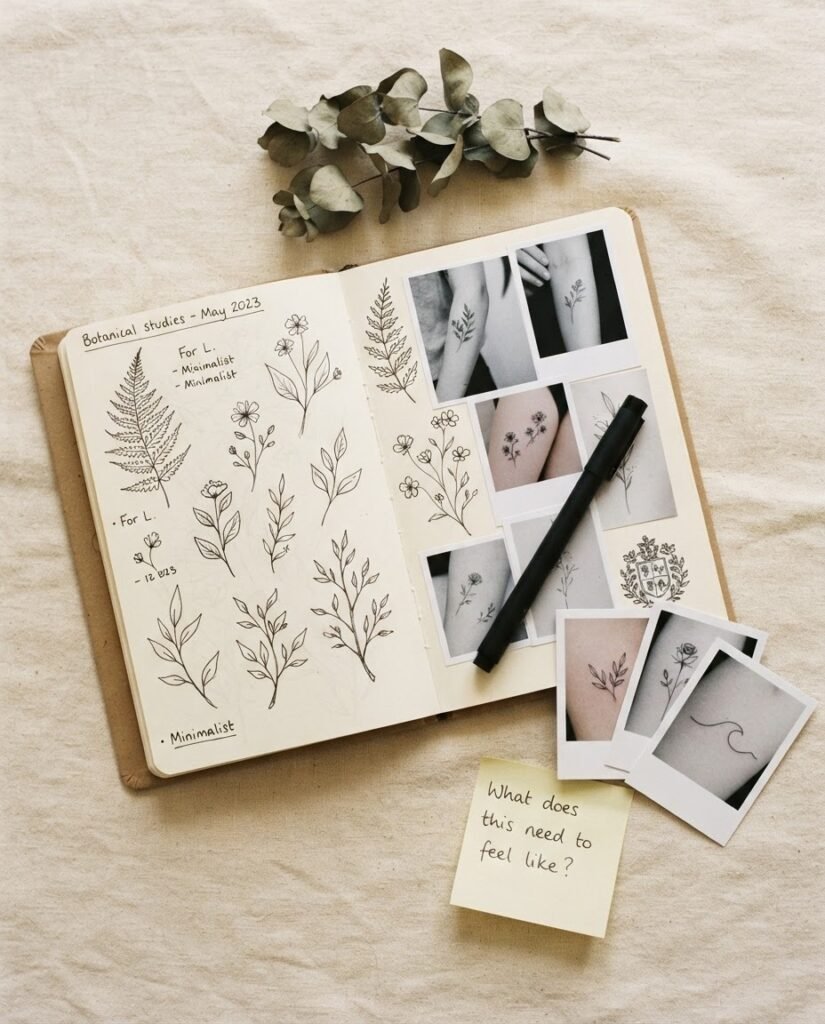
Bring reference images, plural. Not just one image of the exact thing you want, but a range of visuals that capture the feeling, the style, the mood. A loose collection of images helps an artist understand your aesthetic instincts better than one precise reference ever could.
If your design involves a specific person’s handwriting, signature, fingerprint, or photograph, bring those files in the highest quality format you have. Ask the artist in advance what format works best for them.
Write down the story. Not to read aloud necessarily, but to have it clear in your own head. Who is this for? What does it need to capture? What does it absolutely cannot miss? What would make you feel like it got it right? Having this clear before you sit down with an artist means the conversation is far more productive and you are less likely to leave the consultation feeling like you left out something important.
Bring a budget range and a size range. Artists will give you an honest read on what is achievable in your budget and whether your size expectations match your design complexity.
A Few Honest Words About Memorial Tattoos
If you are honoring someone who has passed, I want to say something directly: there is no timeline you have to follow. The idea that you should get the memorial tattoo before the grief has settled, to honor them quickly, is not one I subscribe to at all. Some people find the planning and the piece itself to be part of their healing process, and that is beautiful. Other people need a year or two before they feel ready to make that permanent decision, and that is equally valid.
The one practical note: if you are hoping to use a loved one’s handwriting, fingerprint, or photograph, gather and preserve those source materials now, while they are accessible. You do not need to book the tattoo today. But having the materials ready means the option is open whenever you are ready.
Understanding Ink, Skin, and Safety
The FDA notes that tattoo ink safety is an evolving area, with documented reports of infections from contaminated inks and allergic reactions to certain pigments. Red, yellow, and other colored inks have historically been associated with a higher rate of allergic reactions than black ink. This does not mean you should avoid color. It means you should be at a licensed studio where the artist uses quality inks, and you should be aware of how your skin is responding in the days and weeks after your session.
If you have a history of sensitive skin, eczema, psoriasis, or known allergies, mention these to your artist before your session and consider speaking with a dermatologist beforehand.
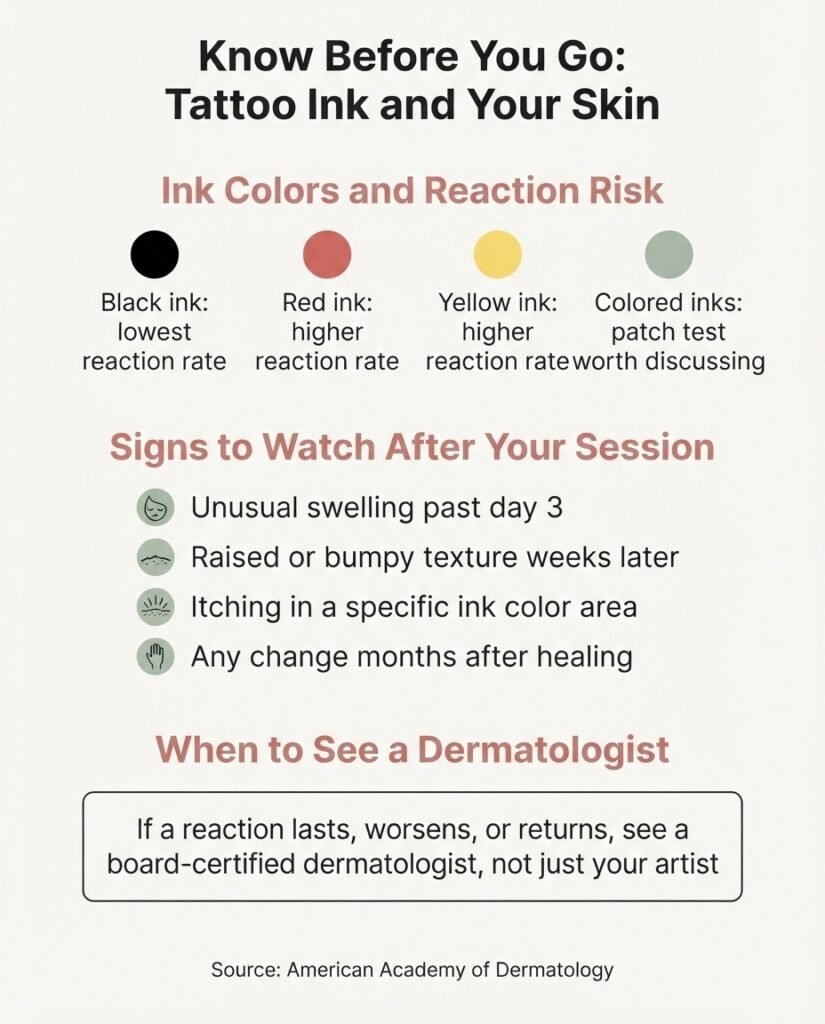
This is not an unusual request, and a good artist will take it seriously.
According to the American Academy of Dermatology, unexpected skin reactions to tattoos can include delayed allergic reactions that appear months or even years after the tattoo was done, often in specific ink colors. If you notice unusual swelling, itching, raised texture, or any changes to your tattooed skin at any point, the AAD recommends seeing a board-certified dermatologist rather than trying to manage it yourself.
Knowing this ahead of time is not meant to frighten you. The vast majority of people with professionally done tattoos have no complications. But being an informed client means you know what to watch for, and you know who to call if something feels off.
Aftercare: The Part That Protects Everything You Just Invested In
Your artist will give you specific aftercare instructions, and those instructions are the ones you follow, full stop. They know what products they used, how your skin responded, and what your specific piece needs.
In general terms, the American Academy of Dermatology’s guidance on caring for tattooed skin emphasizes keeping the area clean, moisturized with a fragrance-free product as directed, out of direct sun, and away from soaking water (pools, baths, ocean) during the healing period. Surface healing typically takes two to four weeks. Deeper skin layers continue to settle for several months, and the tattoo may look cloudy or slightly dull during this time before it clarifies into its healed appearance.
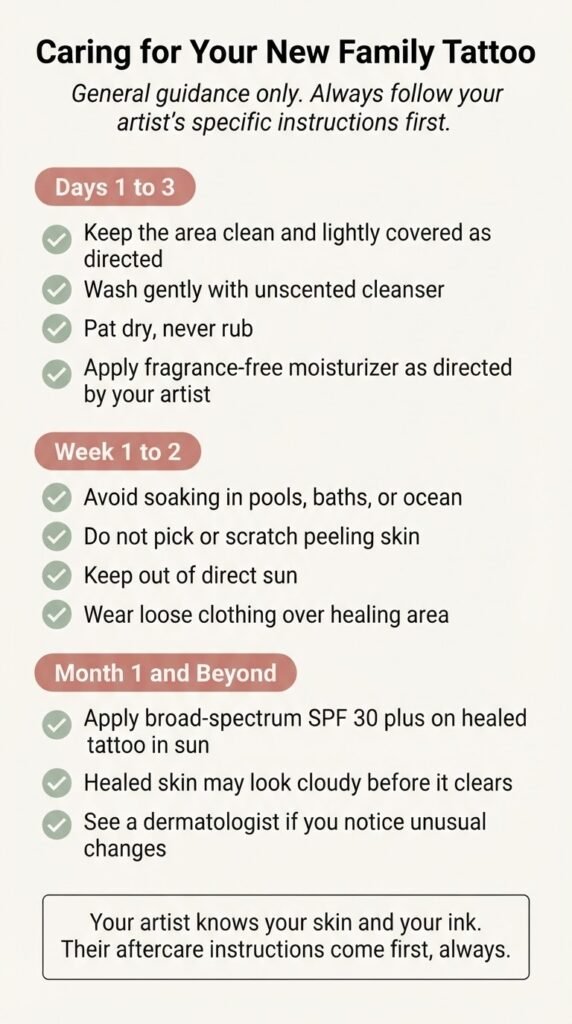
Sun protection on a healed tattoo is one of the most impactful long-term decisions you can make. UV light fades ink, particularly lighter and more vibrant colors. Once your tattoo is fully healed, applying a broad-spectrum SPF 30 or higher whenever the tattoo is exposed to sun can significantly extend how vivid it looks over years.
The Question I Get Asked Most
“How do I know I am making the right choice?”
Here is my honest answer: you will not have perfect certainty before you book. That is not what the planning process gives you. What it gives you is clarity, and clarity is a different thing from certainty. Clarity means you know what the tattoo is for, you know what design direction feels true to that meaning, you have found an artist whose work you genuinely trust, and you have sat with the idea long enough that the excitement has not faded.
When all of those things are true, you are ready.
A family tattoo, done thoughtfully and by the right hands, can be one of the most quietly joyful things you carry. Not because it tells everyone something, but because it tells you something, every time you see it.
Take your time. Find your person. Walk in knowing exactly what you want and why.
That is what good info is for.
