Symbolic Tattoo Ideas: 15 Designs and the Stories Behind Them
I remember sitting with my sketchbook for weeks before my first tattoo at eighteen, circling words and images and asking myself the same question every night: does this actually mean something, or does it just look good? I didn’t want a tattoo that was pretty on the outside and empty in the middle. I wanted one that would still tell the truth about me at thirty, at forty, and beyond.
That’s the real reason people search for symbolic tattoos. It’s not about following a trend. It’s about finding the design that already belongs to you and just needs to be named. Most of my friends text me before they book, and the most common thing they say isn’t “what’s cute right now.” It’s “I know how I feel, I just don’t know which symbol says it.”
This guide is for you if you’re in that place. We’ll walk through 15 meaningful symbolic tattoo designs, where they come from, what they carry, how they work in different styles, and how to make sure the one you choose is genuinely yours. By the end, you should feel a lot clearer about what to bring to your consultation.
One note before we begin: tattoos are for adults (18 or the legal minimum in your area), and everything in this guide is designed to help you work with a licensed professional artist, never on your own. That’s how good tattoos happen.
Why Symbols Make Such Powerful Tattoos
Humans have been marking their skin with symbols for a very long time. The Smithsonian Magazine notes that the history of tattoos stretches back thousands of years across nearly every culture on earth, with the oldest physical evidence found on Ötzi the Iceman, a Neolithic man whose tattooed body is approximately 5,300 years old. Across Indigenous traditions, ancient Egypt, Japan, Polynesia, and beyond, symbols applied to skin have marked identity, protection, status, spiritual journey, and belonging.
What makes a symbol so enduring as a tattoo choice is the compression it offers. A single image, done well, can hold a whole chapter of your life in a few square inches of skin. That’s both its power and its challenge: you have to choose the right symbol, in the right style, at the right moment in your life.

According to a 2023 Pew Research Center survey, 32% of Americans now have at least one tattoo, and about 24% of tattooed people report regretting at least one. The most consistent driver of that regret isn’t the style or the pain. It’s not spending enough time with the decision before booking. That’s why the “sit with it” principle matters so much: if a symbol still feels right after three to six months, that’s a very good sign.
How to Read This List
For each of the 15 designs below, I’ve included: what the symbol means and where that meaning comes from, the styles that suit it best and why, placement ideas and how size affects the reading of the design, and anything worth knowing about cultural context or sensitivity. The goal isn’t to tell you which one is correct. It’s to help you find the one that already feels like yours.
The 15 Symbolic Tattoos
1. The Lotus Flower
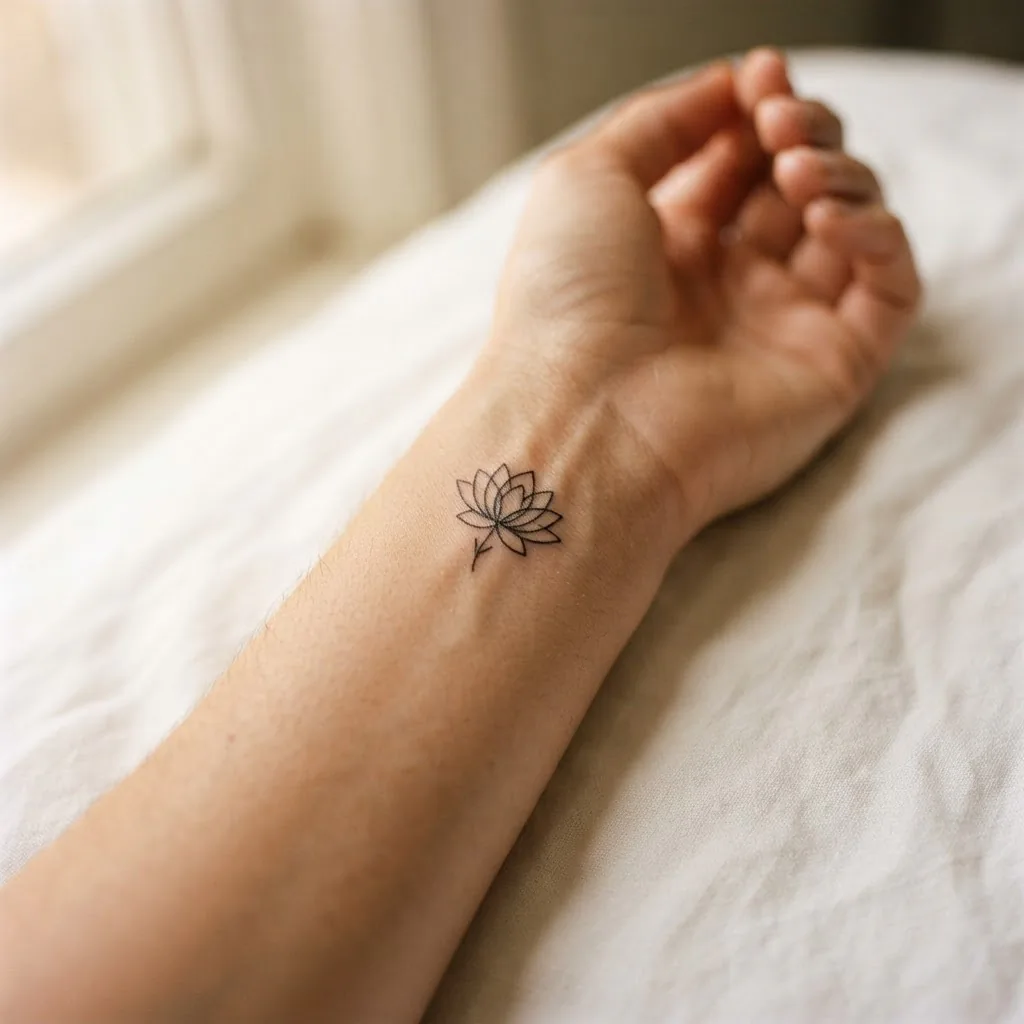
Few symbols in the tattoo world carry as much layered meaning as the lotus. In Buddhist and Hindu traditions, the lotus grows from muddy, murky water and blooms pristine above the surface. It represents spiritual awakening, the ability to rise through difficulty, and the purity of what you become after struggle. In Hinduism, deities like Lakshmi and Saraswati are often depicted seated on lotus blossoms, representing divine beauty and unfolding consciousness.
For many people who choose a lotus tattoo, the meaning is deeply personal. It says: I went through something hard and I came out the other side. I’ve seen lotus tattoos carry stories of recovery, grief, anxiety, and transformation. The symbol holds all of it without having to spell anything out.
Style-wise, the lotus works beautifully across a wide range, from single-needle fine line to geometric, dotwork, and more saturated illustrative styles. Fine line lotuses are popular on the wrist, inner forearm, and collarbone and can look striking in very small sizes. Larger, more detailed lotus designs are common on the upper back, ribcage, and thigh, where there’s more canvas for petal structure to shine. Be aware that very fine line work in small sizes can soften and blur over years, particularly in high-movement or high-sun areas, so talk to your artist about sizing and line weight if longevity matters to you.
One thing worth knowing: the lotus does appear frequently in Hindu and Buddhist spiritual contexts, so if this symbol isn’t part of your own cultural or spiritual background, it’s worth approaching with awareness and respect. Many artists are happy to discuss this in consultation.
2. The Arrow
An arrow only moves forward when it is first pulled back. That’s the core of what makes arrow tattoos so enduring as a symbol of resilience and direction. Being pulled back represents hardship, pressure, or a season of difficulty. The release is the journey forward.
Arrow tattoos also carry meanings of focus, purpose, and intention. Some people choose a single arrow to represent moving forward after a difficult chapter. A bundle of arrows (drawn from the Iroquois Confederacy symbol) represents strength in unity, often chosen to represent family or a found community.
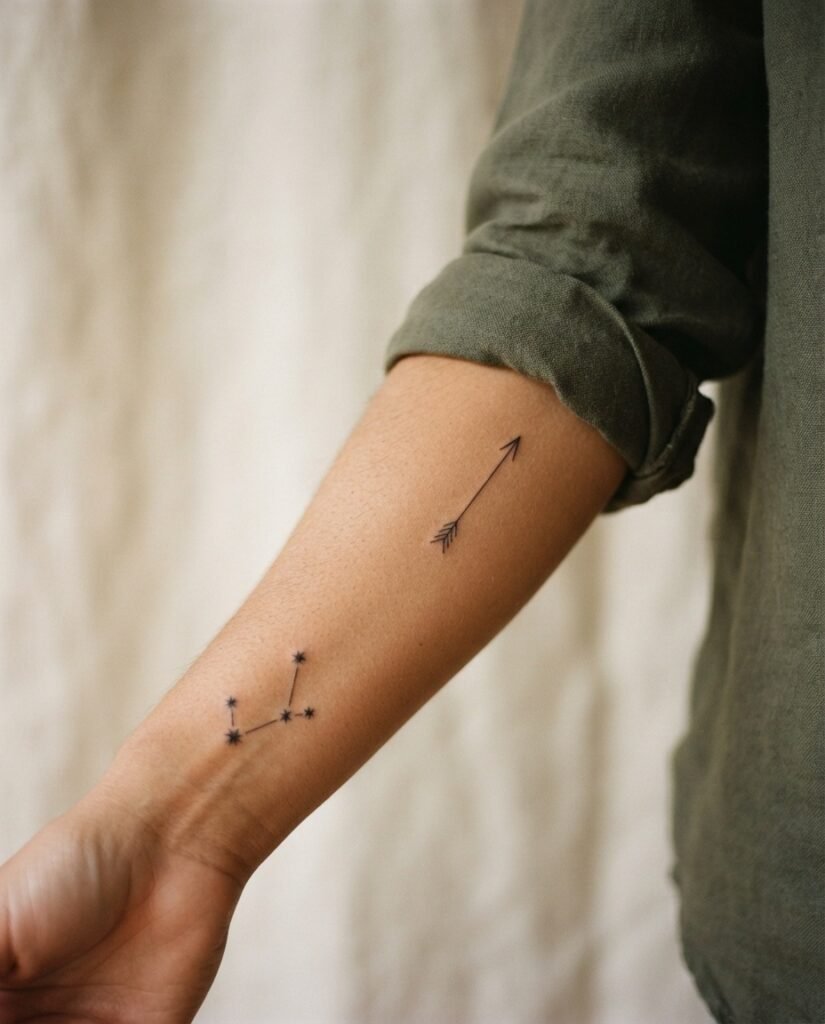
The arrow is one of the most versatile symbolic designs for style. A single-line minimalist arrow works beautifully on the inner forearm or wrist. Geometric or dotwork arrows translate well to the upper arm or calf. Fine line botanical arrows with floral elements woven around the shaft have become a popular choice for something that blends symbolic weight with organic softness.
Sizing matters a lot here. A small, simple arrow can be incredibly clean and powerful. An oversized arrow with complex detailing demands more skin real estate to land well. Your artist can help you find the right proportions for your chosen placement.
3. The Semicolon
This one is different from the others on the list because it was created as a specific act of solidarity and hope. Project Semicolon was founded in 2013 by Amy Bleuel to honor her father’s death by suicide and to create a symbol of hope for people living with depression, anxiety, addiction, and suicidal ideation. In grammar, a semicolon is used when an author could have ended a sentence but chose to continue it instead. In this movement, that author is you. Your story isn’t over.
The semicolon tattoo became one of the most quietly powerful symbols of the 2010s, worn by people who wanted to carry a reminder of their own survival or of someone they loved. It has since expanded to represent resilience across all kinds of mental health struggles.
Because of its origins and the weight it carries for so many people, the semicolon is worth approaching thoughtfully. If it resonates with your story, it can be an extraordinarily meaningful choice. It works in nearly any style and any size, from a tiny behind-the-ear placement to a larger piece incorporating it into a more complex design. It’s one of the few symbolic tattoos where the smallest version is often the most powerful.
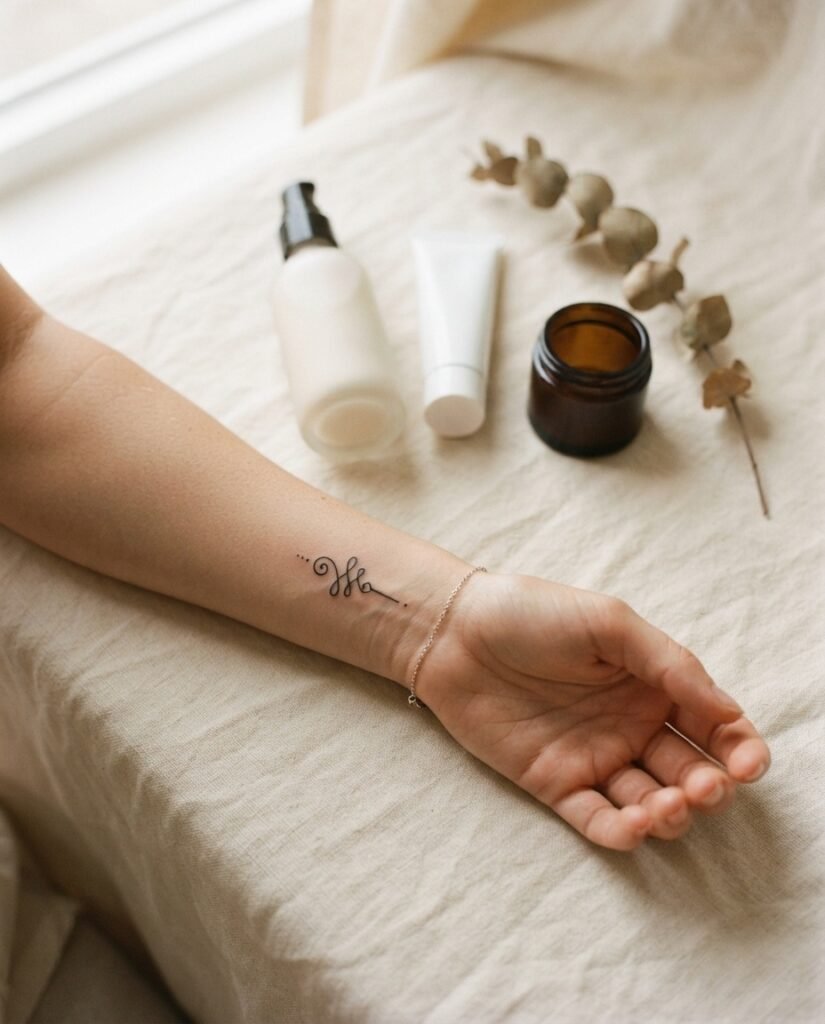
4. The Lotus and Unalome Combined
The unalome is a symbol that appears in both Buddhist and Hindu traditions. It depicts the path to enlightenment, a spiral at the base representing the confusion and chaos of early life, a series of loops and zigzags representing the wandering and lessons of the human journey, and a straight line rising upward representing the clarity and peace of enlightenment reached.
Combined with a lotus at the top, it becomes one of the most evocative visual narratives in the tattoo world: the journey and its destination in a single elegant image. The unalome gained widespread popularity in Western tattoo culture through the 2010s and remains a consistent top choice for people marking personal transformation.
Cultural context matters here. The unalome originates from Theravada Buddhist tradition and is considered sacred in its original context. Many people from outside those traditions choose it after genuine study and connection to the symbol’s meaning. Many artists, particularly those with knowledge of its origins, are happy to discuss this. As with the lotus, bringing awareness and respect to the conversation is the right move.
Style-wise, unalomes are most commonly done in fine line or single-needle work. The delicate, intricate lines of the symbol genuinely suit minimal, precise execution. They’re popular on the sternum, spine, upper arm, and inner forearm, where the vertical orientation of the design can be used to beautiful effect.
5. The Anchor
The anchor has one of the longest histories in Western tattoo culture. Sailors wore anchors to mark crossing the Atlantic or serving in the merchant marine, and the symbol carried a very real meaning of being held steady in storms. Today, the anchor has evolved beyond its nautical origins to represent stability, groundedness, and what keeps you tethered to yourself or to those you love.
Many people choose an anchor to represent a person, a place, or a value that grounds them. It can represent a relationship, a home, a faith, or simply the internal quality of steadiness they want to carry forward.
The anchor translates particularly well to traditional (old school) tattoo style, with bold outlines and limited color palette, a style known for its exceptional aging. That thick-line traditional approach holds up beautifully over decades. Minimalist fine line anchors are also popular but will soften more noticeably over time, especially in smaller sizes. The wrist, inner forearm, ankle, and upper arm are all strong choices for anchor placement depending on the size and style you choose.
6. The Infinity Symbol
The infinity symbol (the horizontal figure-eight, technically called a lemniscate) is one of the simplest symbolic tattoos and one of the most adaptable. It represents endlessness, continuity, and the idea that certain things, like love, connection, or a bond between people, have no end.
It’s one of the most popular choices for couple or friendship tattoos, often customized with names, dates, or small design elements woven through the loops. In a more personal context, it can represent a commitment to oneself or to a value that the wearer wants to carry always.
Because it’s so simple in its base form, execution quality matters enormously. A poorly done infinity symbol is very noticeable. In skilled hands, a fine line or slightly thicker minimalist version is quiet, elegant, and holds up well in moderate sizes. It works best on flatter areas: inner forearm, wrist, collarbone, ankle, or back of the neck.
7. The Mountain
The mountain has become one of the most beloved modern symbolic tattoos, and for good reason. Mountains represent challenge, perseverance, and the reward of the view from the top. They carry a sense of awe and scale, a reminder that the biggest climbs lead to the most extraordinary places.
For people who’ve pushed through something enormous, or who simply feel deeply connected to nature and the idea of striving, the mountain lands with quiet power. It’s also one of the most style-flexible symbolic designs. Geometric mountain ranges in blackwork or dotwork are modern and graphic. Fine line mountain silhouettes feel more airy and minimal. Watercolor-influenced mountain designs can be breathtaking, though it’s worth understanding that watercolor tattooing requires a very skilled artist and the color saturation tends to soften more noticeably over years without the defining outlines that traditional styles rely on.
Placement typically works well on the forearm, upper arm, calf, or across the collarbone, where the horizontal spread of a mountain range can be used to full effect.
8. The Sun and Moon
The sun and moon together are one of the oldest symbolic pairings in human iconography. They represent duality, balance, and the idea that opposing forces can exist in harmony. Day and night. Logic and intuition. Masculine and feminine energies. Rest and action. The pairing says: I contain multitudes, and I’m at peace with that.
Individually, a sun tattoo tends to represent energy, clarity, vitality, and new beginnings. A moon, and particularly a crescent moon, is widely associated with femininity, intuition, cycles, and transformation. Together, they’re often chosen by people who feel the tension between different parts of themselves and want to honor both.
The sun and moon work in nearly every tattoo style, from ornate fine line illustrative work to bold blackwork. They’re among the most popular placements for sternum, upper back, and wrist designs. One thing to consider: celestial designs in very fine line with significant negative space will blur over time more than designs with consistent line weight and filled areas. Talk to your artist about building in enough structure for the design to age gracefully.
9. The Wave
A single curling wave carries meaning that speaks to anyone who’s felt carried by forces beyond their control, and chosen to ride rather than resist. The wave can represent going with the flow, trusting the process, connection to the ocean and to nature, and the beautiful unpredictability of life.
Japanese wave designs (rooted in the iconic great wave imagery popularized by Hokusai) bring a rich art historical tradition to the symbol. Modern minimalist waves in single-line style are among the most popular contemporary tattoo designs, clean and simple but surprisingly emotional.
Waves work well on the wrist, forearm, ankle, and shoulder. They also work beautifully as part of a larger composition if you’re thinking about a piece that will eventually grow.
10. The Feather
Feathers carry meaning across many different cultures, though the specific traditions vary significantly. In general, feather tattoos represent freedom, lightness, the ability to let go, and a connection to the spiritual. In many Indigenous North American traditions, feathers carry very specific ceremonial and spiritual significance tied to specific birds, nations, and contexts.
This is an important point: if you’re drawn to a feather design rooted in a specific Indigenous tradition, it’s worth doing genuine research and approaching those cultural connections with care and respect. A knowledgeable artist can guide you toward a design that honors the symbol appropriately.
More universal feather symbolism, including the general concept of lightness and freedom, is something many people connect to personally and deeply. The quill feather, the peacock feather, and abstracted feather designs are popular choices that don’t draw directly from specific ceremonial traditions.
Feathers work well in fine line, particularly on the inner forearm, calf, and shoulder, where their elongated shape can be used to strong visual effect.
11. The Mandala
The word “mandala” comes from Sanskrit, meaning circle. Mandalas are used in Hindu and Buddhist spiritual practice as visual meditation tools representing the universe, wholeness, and the connection between the self and the infinite. They are intricate geometric patterns built around a central point, with every element radiating outward in perfect symmetry.
As tattoos, mandalas are among the most visually striking geometric designs available, and they hold real spiritual meaning for many who choose them. They represent wholeness, balance, and the journey inward.
Mandalas are among the most technically demanding tattoo designs. The precision required for clean, symmetrical geometric work is considerable, and this is very much a piece where the artist’s portfolio should show clear, consistent examples of healed mandala work before you book. Ask specifically to see healed pieces, not just fresh ones, because fine geometric lines show their aging more visibly than other styles.
Common placements include the forearm, upper arm, back, sternum, and knee. Sizing matters a lot: a mandala needs enough space for its detail to read clearly, and sizing it too small often leads to fine lines merging into each other over time.
12. The Heartbeat Line / EKG Wave
The EKG or heartbeat line is one of the most quietly powerful modern symbolic tattoos. At its simplest, it says: I am alive. For people who’ve been through serious illness, medical trauma, or loss, it carries a depth that a hundred words couldn’t match. For others it represents love, vitality, and the preciousness of the present moment.
What’s beautiful about this symbol is how personalizable it is. Some people incorporate the exact waveform from their own EKG printout. Others add initials, dates, or coordinates at the end of the line. Some combine it with a symbol that appears mid-line, like a heartbeat that flatlines and then rises into a mountain, or a heartbeat that transforms into a bird. These layered designs work particularly well on the wrist, inner forearm, and collarbone.
13. The Eye of Horus
Rooted in ancient Egyptian mythology, the Eye of Horus (also called the Wedjat eye) is one of the oldest protective symbols known. It represents protection, healing, royal power, and the ability to see clearly, both outwardly and inwardly. In Egyptian mythology, Horus lost his eye in battle and had it restored, making the symbol additionally associated with healing and restoration.
The Eye of Horus works beautifully in many styles, from fine line illustrative to blackwork and geometric. It reads well in medium to larger sizes and works well on the upper arm, forearm, chest, and back. Very small versions can lose their detail over time, so your artist’s guidance on minimum sizing is worth taking seriously.
14. The Olive Branch
The olive branch is one of the most universally recognized symbols of peace, and it carries that meaning across Greek mythology, the Hebrew Bible, and into modern secular usage. For many people, it also represents reconciliation, the ending of conflict, and moving into a calmer chapter of life.
In tattoo form, the olive branch is often done in fine line botanical style, which suits its delicate structure beautifully. A spray of small olive leaves with their distinctive oval shape, sometimes accompanied by tiny olives, is a design that reads as both elegant and quietly meaningful. It pairs well with other botanical elements or stands alone with equal grace.
Placements that work beautifully include the inner forearm, upper arm, ankle, and collarbone. Fine line botanical work in these areas tends to age better when sized slightly larger than you might initially think you want, giving the lines room to settle and remain legible over time.
15. Celestial and Star Symbols
Stars, constellations, and celestial symbols have long represented guidance, hope, and the vastness of what lies beyond ordinary life. The North Star specifically has been a navigation symbol for centuries, representing true north, finding your direction when you’re lost. Birth constellations (the arrangement of stars at the time of your birth) have become increasingly popular as deeply personal, quietly identifiable symbols that carry meaning for the wearer without announcing it loudly to everyone else.
Constellation tattoos are one of the most elegant ways to wear a symbol that belongs entirely to your specific moment of arrival in the world. They read as minimalist and refined while carrying real personal weight. Fine line and single-needle work suits constellation designs perfectly. Placement on the forearm, shoulder, calf, and back of the neck works beautifully.
The challenge is that very fine dot-and-line constellation designs can fade more noticeably over time. A skilled artist who specializes in this style will know how to execute them for longevity, so looking specifically for artists whose portfolios show healed constellation work is worth your time.
Choosing the Right Style for a Symbolic Tattoo
Once you’ve landed on a symbol, the style is the next decision that will shape everything, including how the piece ages. Fine line and single-needle work are enormously popular right now, and they suit symbolic tattoos beautifully. But it’s worth knowing that fine line tattoos are more vulnerable to softening and fading over time than bolder styles, particularly in areas exposed to sun or friction. Traditional (old school) and neo-traditional styles use bold outlines and well-saturated fills that are well documented for holding their structure over decades.
This doesn’t mean you shouldn’t choose fine line. Many fine line symbolic tattoos look stunning even after years. It just means placement, sizing, artist skill, and sun protection all matter more with that style. Your licensed artist is your best source of advice here because they can look at your specific skin tone, the location you’re considering, and the design complexity and give you an honest assessment of how it will age.
Where You Put It Matters as Much as What It Is
Placement shapes the emotional register of a symbolic tattoo as much as the design itself. A semicolon tucked behind the ear is private and intimate, something you chose for yourself. A lotus stretched across the forearm is a daily reminder you see every time you reach for something. A constellation on the collarbone is visible in a summer dress and easily covered in a job interview. None of these choices are wrong. They’re just different, and thinking them through before you sit down is part of making a tattoo you’ll love.
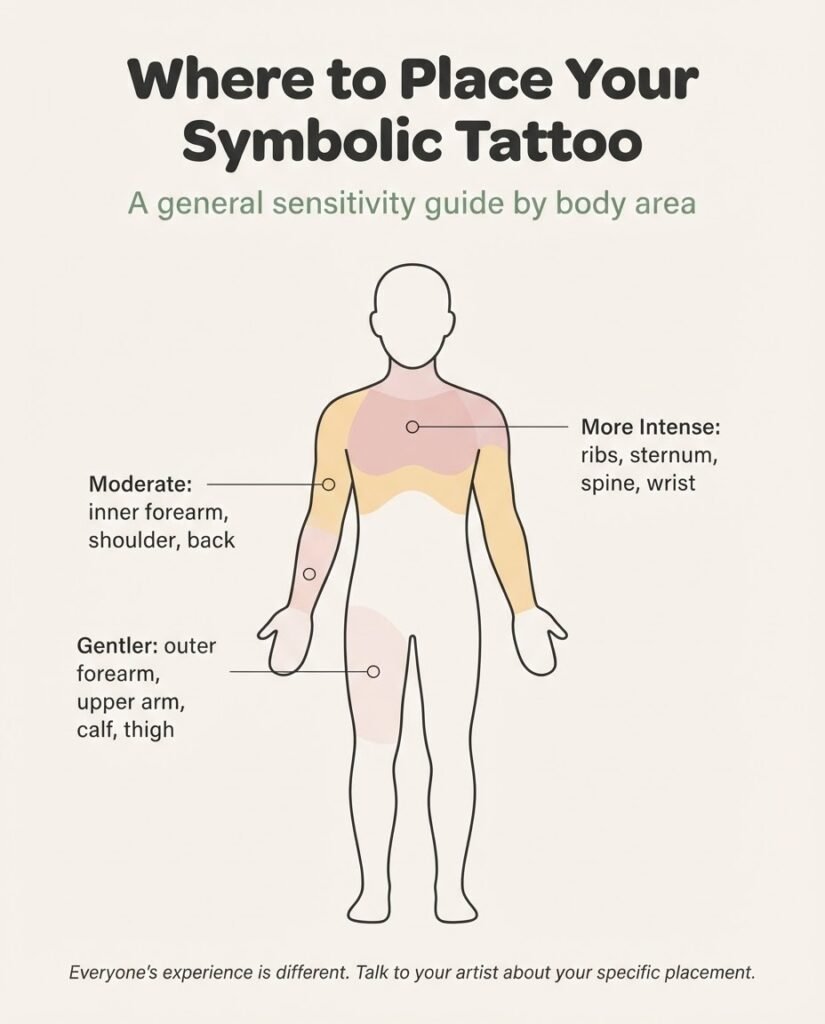
As a general orientation: areas closer to the bone, with thinner skin, and with more nerve endings tend to be more intense. Ribs, spine, sternum, inner forearm near the elbow, and the tops of feet are areas many people find more challenging. Upper arm, outer forearm, calf, and thigh tend to be better tolerated. But everyone’s experience is genuinely different, and a good artist won’t dismiss your questions about this.
Preparing for the Conversation With Your Artist
The consultation is where your symbol becomes your tattoo, and it’s one of the most underrated parts of the process. When you reach out to book or during your consultation, here’s what helps:
Bring reference images, not just one, but three to five. Show examples of the symbol itself and examples of the style you’re drawn to, even if they’re different designs. Tell your artist what the symbol means to you and why you chose it. That context genuinely changes how a skilled artist approaches the design, especially if they’re creating something custom.
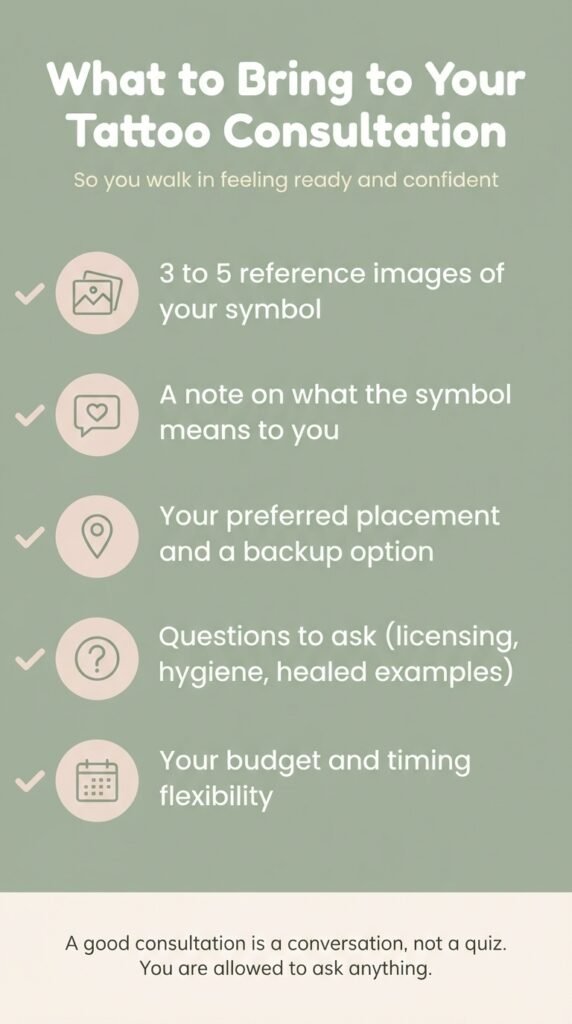
Tell them where you want it and ask them honestly whether that placement works for the size you have in mind. Ask to see healed examples of similar work from their portfolio, not just fresh photos.
Ask about the studio’s licensing, hygiene practices, and autoclave sterilization. A licensed, reputable studio will answer these questions without hesitation, and you have every right to ask. The CDC’s NIOSH division has published clear guidance on bloodborne pathogen standards for tattoo studios, and knowing that your artist and studio meet those standards is part of making a safe, informed choice.
A Few Things Worth Knowing Before You Book
Cost is a real part of the conversation. Shop minimums typically run between $50 and $100, and small symbolic pieces often land in the $100 to $300 range depending on the artist, complexity, and location. Highly sought-after artists may charge considerably more and may have waitlists. Don’t let price pressure you toward an artist you’re not fully confident in. A tattoo is permanent and good work is worth saving for.
On the subject of ink, the FDA has published detailed information about tattoo ink safety that’s worth understanding before your appointment. The FDA’s consumer update on tattoo safety notes that no tattoo pigment has been formally approved for injection into the skin, that contamination can occur even in sealed ink containers, and that allergic reactions, most commonly associated with red pigments, can develop at the time of tattooing or even years later. If you have known skin sensitivities or allergies, discussing them with your artist and your dermatologist or doctor before booking is a genuinely smart step.
On the subject of healing, most tattoos move through the initial surface healing process in two to four weeks, though deeper skin layers continue to settle over several months. The American Academy of Dermatology’s guidance on caring for tattooed skin recommends washing gently with fragrance-free soap, applying a water-based moisturizer when skin feels dry, and avoiding petroleum-based products that can draw out ink. That said, your artist’s specific aftercare instructions are your primary guide. They know the ink they used, the technique they applied, and the healing protocol that works best for their work. Follow their instructions first.
If anything looks wrong during healing, such as persistent redness, unusual swelling, a rash, or signs of infection, contact your artist and a healthcare professional.
Don’t wait to see if it resolves on its own.
The Most Important Thing: Give It Time
Before you book, sit with your symbol. Put an image of it somewhere you see daily. Sleep on it for a few months, not because you need to earn the right to want it, but because a symbol that still feels right after three to six months of living with it is almost certainly the right one. The friends I’ve seen most happy with their tattoos, years later, are the ones who knew, really knew, that they’d found the right thing before they ever walked into the studio.
That’s the whole point of collecting good info first. Not to slow you down, but to make sure that when you do walk in, you walk in with complete confidence.
