12 Small Tattoo Ideas With Meaning You’ll Love for Years
I got my first tattoo at eighteen, and I still remember standing outside the studio talking myself into walking through the door. What settled my nerves was not the design being perfect. It was knowing why I wanted it. That is the thing I have learned after collecting a good few pieces and becoming the friend everyone texts before they book: the meaning is what makes a small tattoo feel big.
So if you have a secret Pinterest board full of tiny designs and a little voice asking “but will I still love this in ten years,” you are exactly the person I wrote this for. Below are 12 small tattoo ideas with real meaning, plus the honest planning details most idea lists skip, like how tiny tattoos age, where they hurt more, what to expect from a professional artist, and how to keep a common symbol from feeling generic. My whole motto is that a good tattoo starts with good info, so let’s give you the info.
One thing up front. Getting tattooed is for adults, 18 and older (or your area’s legal minimum), and it is always a job for a trained, licensed professional. This piece is about dreaming and planning. The actual work belongs in a clean, licensed studio, every single time.
First, a gentle reality check on “small”
Small tattoos are wonderful. They are also a little more demanding than people expect, and I would rather you know that now than be surprised later.
Fine lines and tiny details do not stay razor-sharp forever. Skin is alive, ink settles, and over years lines can soften and spread slightly. That is normal, not a failure. A simple design with a bit of breathing room between the lines tends to age more gracefully than something crammed with detail at postage-stamp size. Very small script and very fine dot work are the most likely to blur, which is why many people plan for a touch-up somewhere down the road.
Permanence is the whole point and the whole responsibility. Tattoos are designed to last a lifetime and are genuinely difficult to remove. If you ever did want one gone, dermatologists are clear that laser removal is the most effective route, and even then, as the American Academy of Dermatology explains in its plain-language overview of what laser tattoo removal actually involves, it usually takes multiple sessions and cannot always erase a tattoo completely. I am not telling you this to scare you off. I am telling you so you choose something you love on purpose.
Now for the fun part.
12 small tattoo ideas with meaning
I have grouped these loosely from most classic to a little more personal. As you read, notice which ones make your chest do a small “oh.” That reaction is worth paying attention to.

1. The semicolon. Small, quiet, and heavy with meaning. A semicolon marks a place where a sentence could have ended but didn’t. It was popularized by Project Semicolon, the mental health nonprofit founded in 2013, and for many people it stands for survival, resilience, and “my story isn’t over.” Because it is so recognizable, it reads instantly to others who know it, which can feel like solidarity or like something very private, depending on placement.
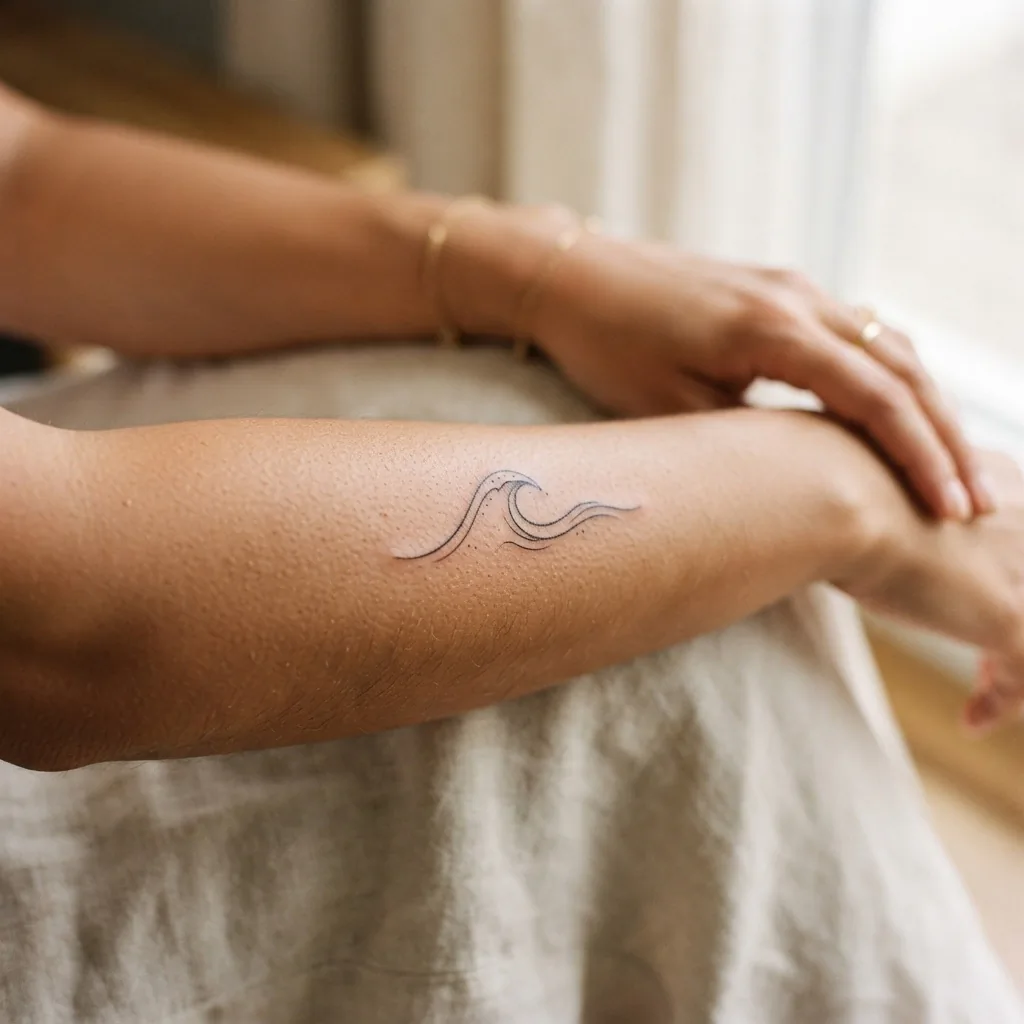
2. A single wave. A minimalist wave speaks to change, going with the flow, resilience, and a love of the ocean. It is one of the friendliest designs to get small because a clean curved line holds up well over time.
3. Mountains. A tiny mountain range can mean overcoming something, a love of the outdoors, ambition, or a specific place that changed you. Living in Portland, I am surrounded by people with a little Mount Hood on their forearm, and there is a reason it never goes out of style.
4. A tree or a set of roots. Trees carry growth, family, grounding, and strength. Roots specifically can honor where you come from. Keep the linework simple if you go small, because dense foliage is exactly the kind of detail that blurs first.
5. Sun and moon. Balance, duality, the light and dark of a full life. You can do just a sun, just a crescent moon, or a small pairing. This one is endlessly personalizable, which helps it feel like yours and not a stock icon.
6. A bird or a swallow. Freedom, a new chapter, safe returns home. Swallows historically symbolized coming back safely, which is why so many people get them to mark a journey or a fresh start.
7. An arrow. You can only shoot an arrow by pulling it backward first. That “setback before the launch” meaning makes arrows a favorite for people marking a hard season they came through. They also age beautifully because they are basically clean straight lines.
8. A heartbeat or EKG line. A short heartbeat line can honor a person, a passion, or simply being alive. A meaningful twist is to shape a single peak into something personal, like a tiny mountain or a heart, so it does not look like a generic clip-art pulse.
9. Roman numerals or a date. A birth, an anniversary, a day your life turned. Numerals feel timeless and stay legible small, though closely stacked thin numbers can benefit from a touch-up over the years.
10. Coordinates. The latitude and longitude of a place that matters, a hometown, where you met someone, where you felt most yourself. It looks like a quiet string of numbers and means the world to you, which is the whole point.
11. A birth flower. Instead of a generic rose, get the flower tied to your birth month, or a loved one’s. It carries built-in meaning and looks intentional. Delicate florals do best with a little size and simple shading rather than tiny dense petals.
12. A single word in real handwriting. “Breathe,” a name, a word in a language that matters to your family, or a word traced from a loved one’s actual handwriting. The handwriting version is deeply personal and, I think, one of the most meaningful small tattoos you can get. Keep the word short and the letters not too thin so it stays readable for years.
How to make a common symbol feel like yours
Here is the honest tension with a “meaningful” tattoo. The most popular symbols are popular for good reason, but you do not want yours to feel interchangeable with a thousand others. A few ways I coach friends through this:
Anchor the symbol to your own story, not the general meaning. A wave is nice. A wave for the summer you learned to surf after a hard year is yours. Combine two simple elements, like a mountain inside a circle, or a birth flower with a single initial. Choose placement that means something. And lean on real personalization, like actual handwriting or actual coordinates, which no one else can duplicate. Meaning is not in the icon. It is in the story you attach to it.
Placement and sizing, told honestly
Placement changes how a small tattoo looks, ages, and feels to get.
Flatter, less flexible areas like the inner forearm, the outer upper arm, the calf, and the shoulder tend to hold detail longest and are generally more comfortable to sit through. High-movement, high-friction, or thin-skin spots like fingers, feet, the inner wrist, and behind the ear often fade faster and may need touch-ups sooner. Fingers especially are famous for not holding ink well.
On pain, I will be straight with you because that nervous question comes up in almost every text I get. Pain is personal and no chart is gospel, but there are general patterns. Areas with more cushion, like the outer upper arm, forearm, and thigh, are usually described as more tolerable. Bony or thin-skinned areas close to the bone, like ribs, sternum, ankle, feet, fingers, and the inner elbow, tend to be reported as more intense. The good news with a small tattoo is that even a spicier spot is over quickly. A tiny design is often a matter of minutes.
Size matters more than beginners expect. If you want fine detail, give it room. Shrinking a detailed design too far is the number one reason a tattoo looks muddy years later. When in doubt, a professional artist will tell you the smallest size your specific design can be while still aging well. Trust that guidance.
The part that actually protects you: choosing a licensed professional
This is where I get a little serious, because it matters most. The best meaning in the world does not help if the tattoo is done unsafely. Tattooing is regulated at the state and local level, artists are typically required to complete bloodborne pathogen training, and studios must meet hygiene standards. If you want to see how seriously public health agencies treat this, the Network for Public Health Law’s overview of tattoo regulation lays out the licensing, training, and sanitation expectations clearly, and it is a good reminder of why a licensed shop is non-negotiable.
Rules vary by location, so check your own. Health departments publish their requirements, and they are usually easy to find. Texas, for example, spells out its studio licensing rules through the Texas Department of State Health Services, and most states and cities have a comparable page. It is also where you will confirm the firm 18-and-over rule that applies to the tattoo itself.
Here is how I vet an artist before I ever book:
I look at their portfolio for work in the exact style I want. Someone brilliant at bold traditional may not be your best pick for delicate fine-line, and vice versa. I check that the studio and artist are licensed, and I read reviews with an eye for cleanliness and professionalism. I make sure they take a consultation, because good artists want to understand your idea before needle meets skin. And I pay attention to how they communicate. You should feel respected and unrushed, never pressured into a design or a size.

What to bring to a consultation, and what to ask
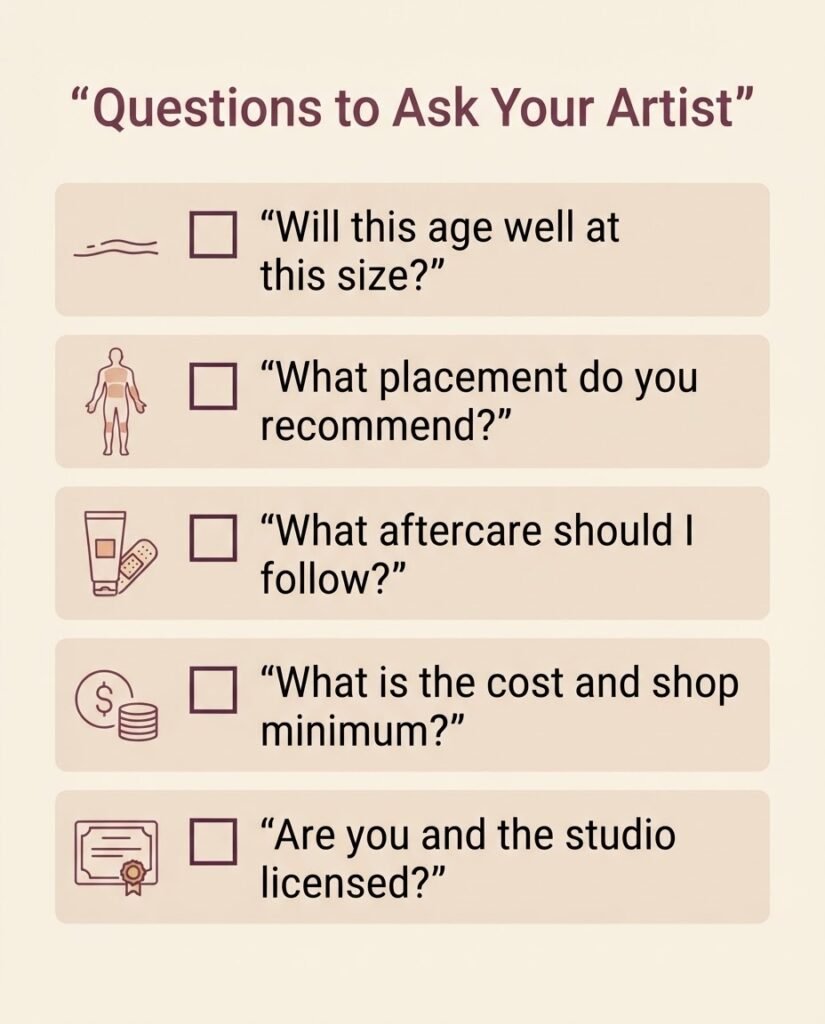
A consultation is your moment to turn a saved pin into a real plan, and it is genuinely one of my favorite parts of the process. Bring reference images (yours and a few examples of the artist’s own work you love), a note on placement and rough size, and a short version of the meaning so they can help you honor it.
Questions I always suggest asking: Is this design going to age well at this size, and would you recommend it any bigger or simpler? What placement do you think suits it best? What is the aftercare you want me to follow? What is the cost, and is there a shop minimum? That last one surprises first-timers. Small does not always mean cheap, because studios have a minimum price to cover their time and sterile setup, and skilled artists are worth it.
Safety basics I want you to actually know
I promised you good info, so here is the honest health picture, kept calm and simple.
Because tattoo inks are not tightly regulated the way medications are, reactions can happen. The FDA, which oversees tattoo inks as cosmetics, has a genuinely useful consumer page on what to know before you get inked that covers the real risks: infection from contaminated ink or unhygienic conditions, allergic reactions to pigments that can persist because the ink is permanent, and a rare, brief MRI note (some people feel minor swelling or warmth at a tattoo during an MRI, so tell your provider you have one). A clean, licensed studio dramatically lowers the infection risk, which loops right back to why choosing your artist well is the most important decision you will make.
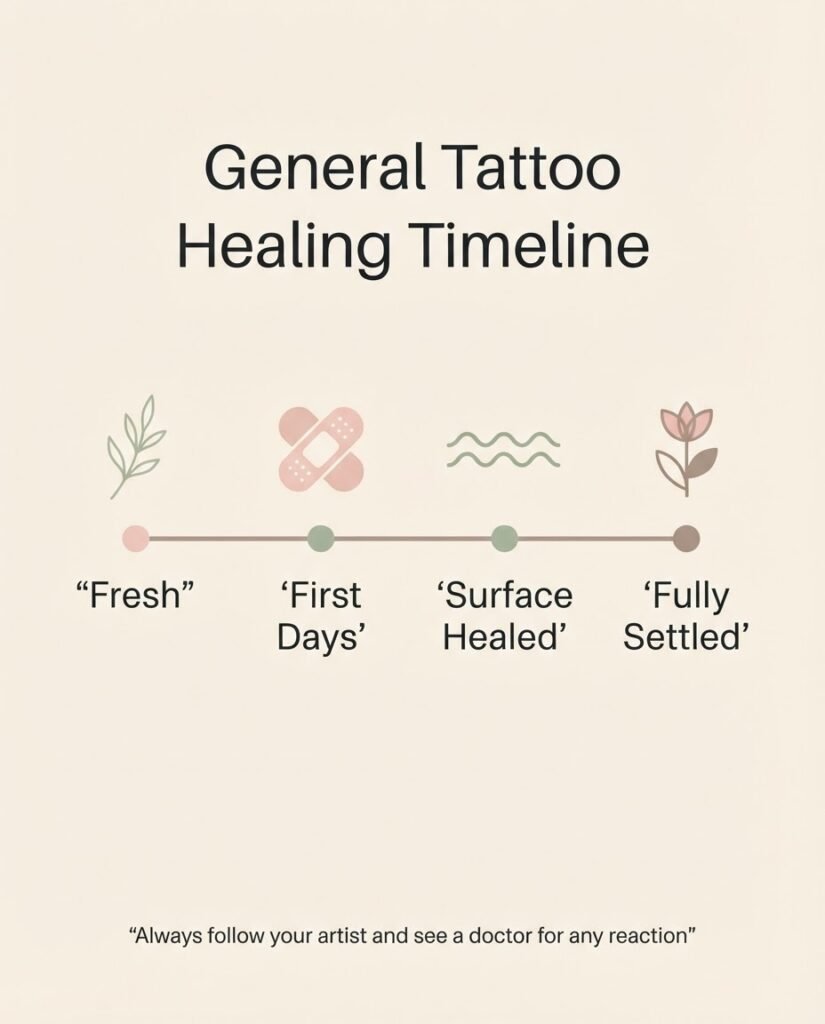
Aftercare is where a lot of small-tattoo regret actually comes from, because a beautifully done piece can heal poorly if it is neglected. Your artist’s instructions always come first, since they know exactly what they used on your skin. Beyond that, the general dermatologist consensus is gentle and consistent: the AAD’s guide to caring for tattooed skin recommends keeping it clean, using fragrance-free products, avoiding petroleum-based products that can pull at the ink, and protecting healed tattoos from the sun. Most tattoos look healed on the surface within a couple of weeks, though deeper skin takes longer to fully recover. If you ever see spreading redness, swelling, a rash, or you run a fever, do not wait it out. Contact your artist and see a doctor or a board-certified dermatologist. I am not able to diagnose anything, and neither is any blog, so please treat professional care as the real answer for any reaction.
Bringing it all together
A small tattoo can carry as much meaning as anything the size of your whole back. The magic is not in how tiny or trendy it is. It is in choosing something honest to you, sizing and placing it so it ages well, and putting it in the hands of a licensed professional who takes your idea as seriously as you do.
If you are still in the daydreaming stage, stay there as long as you like. Save the pins. Sit with the ideas. Notice which meaning keeps coming back to you. And when you are ready, walk into that studio the way I wish I had my very first time: not nervous, but sure. You know the design, you know why, and you know the person holding the machine earned your trust. That is a tattoo you will love for years.