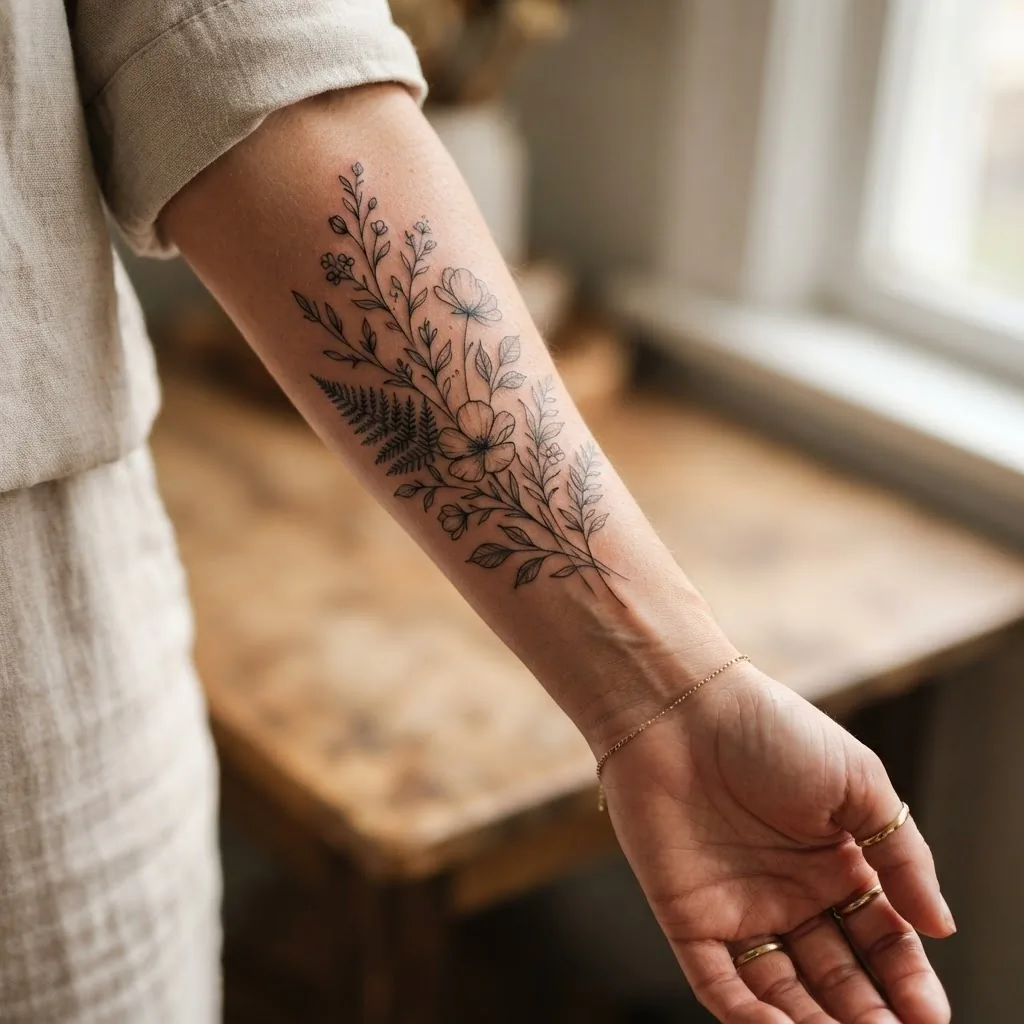
I got my first tattoo at eighteen, and I still remember standing in front of the mirror afterward feeling like I’d unlocked a little secret about myself. A good few pieces later, I’ve become the person all my friends text before they book. The message is almost always the same. “Riley, I love this delicate one I saw, but will it still look good in ten years?” If that’s the question circling in your head right now, you’re in exactly the right place.
Fine line tattoos have a quiet magic to them. They’re soft, elegant, and easy to fall in love with on a Pinterest board. They also come with a few honest things worth knowing before you commit, because thin lines behave a little differently than bold ones over time. So I’m going to give you both halves of the picture: eight design ideas I think are genuinely worth saving, and the real planning knowledge that turns “I think I want this” into “I know I want this.”
My whole philosophy is simple. A good tattoo starts with good info. Let’s get you some.
First, what actually makes a tattoo “fine line”?
Fine line work is defined by thin, delicate, precise lines, often created with very fine needle groupings. The result is airy and detailed, more like a pen sketch on skin than a bold traditional piece. It leans minimalist, which is a big part of why it reads as so elegant and modern.
Here’s the honest tradeoff, and I promise I say this because I want you happy in a decade, not to scare you off. Thin lines carry less ink than bold ones, so they can soften or lighten over the years more noticeably than a chunky old-school tattoo. That’s not a flaw, it’s just physics and biology. Skin renews, sun does its thing, and delicate detail is more delicate. The good news is that placement, sizing, and choosing the right artist make an enormous difference in how gracefully a fine line piece ages. We’ll cover all three.
The 8 fine line ideas worth saving
1. Delicate botanicals and birth flowers
Botanicals are the heart of fine line. A single stem, a sprig of lavender, a wildflower, or your birth month flower renders beautifully in thin line work. Birth flowers are my favorite “meaningful but not obvious” choice, a January carnation or an October marigold carries a story only you have to explain. Because florals have natural negative space, they age a little more forgivingly than designs packed with tiny detail.
2. Celestial: moons, stars, and constellations
Crescent moons, scattered stars, and your zodiac constellation are endlessly popular for a reason. They’re simple, symbolic, and they suit small placements like behind the ear or the inner wrist. If you love the constellation idea, give the dots a touch more space than you think you need. Points that sit too close together can blur into each other as the tattoo settles and ages.
3. Minimalist script or a single word
A word, a date, a short phrase, or initials in a fine hand feels intimate and timeless. Script is where sizing honesty really matters, though. Very tiny lettering with lots of close lines is the most likely thing to blur over the years, so I always tell friends to go a little bigger than the reference photo and to keep the font clean rather than ultra-thin and swirly.
4. Fine line animals and pet portraits
Single-line or sketch-style animals are gorgeous, from a tiny bird in flight to a line-drawing of a beloved pet. These work as a wonderful memorial or tribute piece. Line-style portraits ask a lot of the artist’s skill, so this is a design where you really want someone whose healed portfolio proves they can do it.
5. Symbolic micro-tattoos
This is the “blink and you’d miss the meaning” category: a tiny wave for someone who loves the ocean, a small mountain range, coordinates of a meaningful place, a semicolon, a heartbeat line. Micro-tattoos are lovely, but the smaller and more detailed you go, the sooner detail can soften. A slightly larger, simpler version of the same idea will usually look better for longer.
6. Geometric shapes and fine line mandalas
Clean geometry, thin triangles, subtle line-based mandalas, and abstract shapes feel modern and calm. Geometry can be unforgiving because our eyes notice when a straight line isn’t straight anymore, so again, this rewards an experienced fine line specialist and a placement that doesn’t stretch or crease heavily.
7. Ornamental and jewelry-style pieces
Think delicate “bracelet” or “anklet” tattoos, fine chains, or ornamental filigree that decorates the body like jewelry. These look stunning on the wrist, ankle, or collarbone. One honest note: fingers, hands, and feet are high-friction, high-wear spots, so jewelry-style ink there tends to fade faster and often needs touch-ups.
8. Fine line florals combined with script
If you can’t choose, combining a small botanical with a name or word gives you a personal, layered piece that still feels light. This is a beautiful memorial or milestone tattoo. Just keep the whole composition from getting too crowded, because breathing room is what keeps fine line looking crisp as it ages.

Placement and sizing: the part that quietly decides everything
If there’s one thing I wish every first-timer knew, it’s that placement and size aren’t just aesthetic choices. They shape how your tattoo ages and how much it’ll hurt.
For longevity, the friendliest spots for fine line tend to be areas with less friction, less sun exposure, and less stretching: the inner forearm, the outer forearm, the upper arm, the calf, and the back of the shoulder. High-movement, high-friction zones like fingers, hands, feet, and the inner wrist look amazing on day one but usually fade sooner. That doesn’t mean don’t do it. It means go in knowing touch-ups may be part of the deal.
On sizing, my honest rule of thumb: go a touch bigger than your reference photo, especially for anything with fine internal detail, close-together lines, or small text. A design that’s crisp at two inches can turn muddy at one inch as it settles and ages over the years. A good artist will tell you the smallest size your specific design can safely be. Listen to them.

Let’s talk about pain, honestly
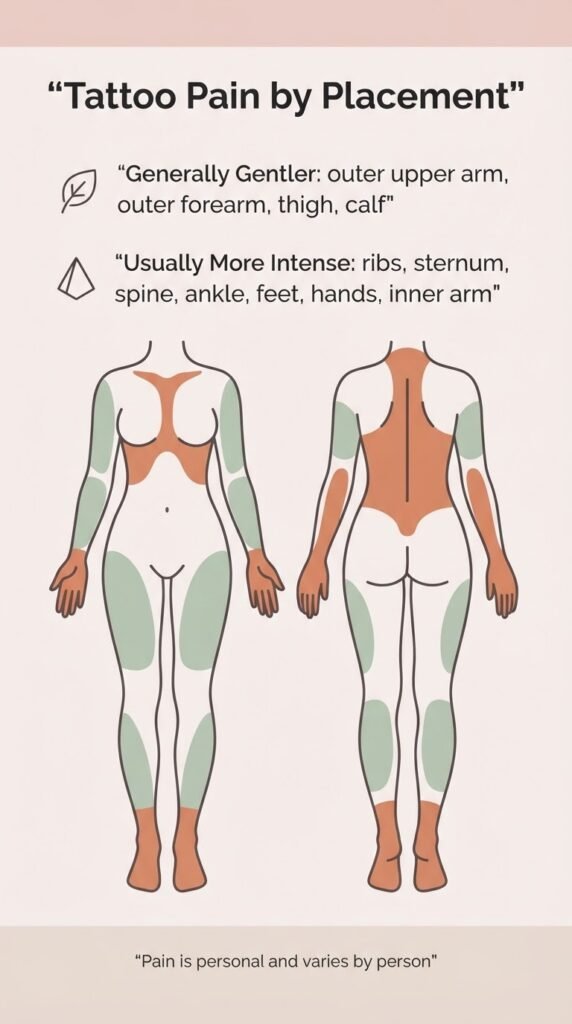
Pain is the number one thing my friends whisper about, so let’s take the mystery out of it. Everyone experiences it differently, but there are reliable patterns based on where you’re getting tattooed. As the pain overviews from health resources like Healthline’s tattoo pain guide explain, the areas that tend to hurt most are the ones with thin skin, more nerve endings, and bone close to the surface.
In general, fleshier, more padded areas like the outer upper arm, outer forearm, thigh, and calf are on the gentler end. Bonier, thinner-skinned spots like the ribs, sternum, spine, ankle, feet, hands, and inner arm tend to be more intense. Fine line pieces are usually small and quick, which works in your favor, a tiny wrist design is a very different experience from a large rib piece. If nerves are your main hesitation, choosing a friendlier placement for your first one is a completely valid strategy.
The safety facts I’d want a friend to know
I keep Prettovia’s tattoo content firmly in the “inspiration and planning” lane, because the actual tattooing is a job for trained, licensed professionals, full stop. But being informed about the health side is part of walking in confident, so here’s the accurate version, no fear-mongering.
Getting tattooed is a needle procedure, so hygiene is everything. According to the FDA’s tattoo and permanent makeup fact sheet, the main risks include infection from unsterile equipment or contaminated ink, allergic reactions, and difficulty with removal later. The FDA also notes that while it treats tattoo inks as cosmetics, the actual practice of tattooing is regulated at the local level, which is exactly why checking your artist’s and studio’s licensing matters so much.
Reactions are worth understanding too, especially with color. Dermatology references like DermNet’s overview of tattoo-associated skin reactions note that red pigments, particularly those made from mercury sulfide, cause the most reactions among tattoo inks. That’s useful to know if you’re drawn to a design with a lot of red. It’s not a reason to avoid color, just a reason to mention any allergies or sensitive skin history to your artist and to talk to a doctor or dermatologist if you have a reaction that doesn’t settle.
One more that surprises people: tattoos and MRIs. As Jefferson Health explains, some people with tattoos have reported minor swelling or a warm sensation during an MRI, though this is rare and usually harmless. The takeaway isn’t to skip a scan your doctor recommends. It’s simply to tell the radiologist you have tattoos.
And on permanence: fine line tattoos are permanent, and removal is a real undertaking, not an undo button. The American Academy of Dermatology’s page on laser tattoo removal is honest that removal typically takes multiple sessions, costs real money, and can’t always fully clear a tattoo. I’m not telling you this to scare you. I’m telling you so you choose a design you love now, on purpose.
How to find and vet a licensed artist (this is the real secret)
Here’s the truth I’ve learned over years of collecting: the single biggest factor in loving your tattoo isn’t the design. It’s the artist. A great fine line specialist will make a simple idea sing, and a mismatched one can make a beautiful idea disappoint.
Start by searching for artists who specifically specialize in fine line, because it’s a genuine skill set, not every talented artist works this way. Study their portfolio, and here’s the pro move: look for photos of healed work, not just fresh, glossy day-of shots. Fresh tattoos always look crisp. Healed photos tell you how their fine lines actually hold up. Public health resources like this Network for Public Health Law overview of tattoo regulation explain that licensing, bloodborne pathogen training, and studio standards vary by state and locality, so it’s completely reasonable to confirm your artist and studio are licensed where you live and to expect a clean, professional setup with single-use needles and fresh gloves.
Green flags I look for: a clean, organized studio, an artist happy to answer questions, clear aftercare guidance, and no pressure to book on the spot. If anything feels rushed, secretive, or sketchy about hygiene, walk away. There is always another artist.

What to bring to your consultation and what to ask
A consultation is where a vague idea becomes a plan, and it’s also where your nerves usually melt. Bring your reference images (a small, curated set beats a chaotic board of fifty), a clear sense of placement and rough size, and any must-keep details. Then let the artist bring their expertise, sometimes their tweak to your idea is the thing that makes it perfect.
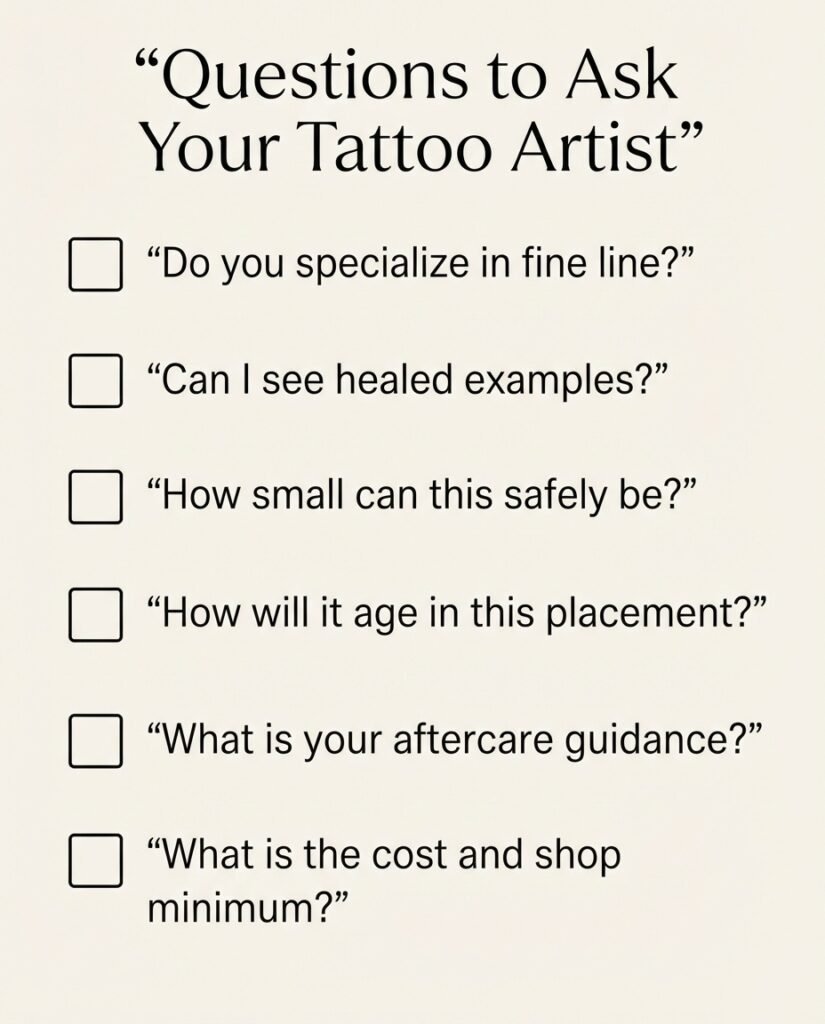
Questions I’d ask: Do you specialize in fine line? Can I see healed examples of work like this? What’s the smallest this design can safely be? How do you expect this to age in this placement? What’s your aftercare guidance? And on the practical side, what’s the cost, and do you have a shop minimum? Fine line can seem like it “should” be cheap because it’s small, but you’re paying for skill and time, and most studios have a minimum regardless of size.
What to expect during the session
For a small fine line piece, the whole thing is often quicker than people expect. Your artist will clean and prep the skin, place a stencil, and confirm the position with you before starting, this is your moment to speak up if the placement isn’t quite right. Then it’s the tattooing itself, which for delicate work is usually a series of short, precise passes. Most people find the sensation very manageable, especially for small designs in friendlier spots. You’re allowed to breathe, ask for a break, and take your time.
General aftercare basics (that always defer to your artist)
Your artist’s specific aftercare instructions always win, because they know exactly what they did and what products they recommend. Consider this the general backdrop, not a replacement.
The consensus from dermatologists is gentle and simple. The American Academy of Dermatology’s guidance on caring for tattooed skin recommends keeping the area clean, washing gently with a mild fragrance-free cleanser, and moisturizing with a fragrance-free lotion while it heals, plus avoiding sun exposure and not picking at scabs. They specifically note that petroleum-based products can affect how ink settles, which is why so many artists steer you toward a lighter, fragrance-free option. For fine line especially, long-term sun protection is your best friend. Once fully healed, regular SPF on the tattoo genuinely helps those delicate lines stay crisp for years.
If you ever notice signs of infection, a rash that won’t calm down, or a reaction that spreads or lingers, don’t tough it out or rely on a blog. Check in with your artist and see a doctor or dermatologist. That’s not overreacting, that’s being a smart, informed person taking care of a piece of art you’re going to wear for life.
You’re allowed to take your time
If you’re still in the daydreaming stage, that’s not indecision, that’s wisdom. Most tattoo regret doesn’t come from getting a tattoo. It comes from rushing into one without good information. So save the ideas that keep pulling you back, sit with the ones that mean something, and when a design still feels right weeks later, that’s your answer.
Fine line tattoos are a beautiful way to wear something delicate and personal. Go in knowing how the style ages, choose a placement and size that set you up to love it long-term, and put your trust in a licensed artist whose healed work you admire. Do that, and you won’t just get a pretty tattoo. You’ll get one you’re still glad you chose a decade from now. That’s the whole goal, and you’re already doing it right by planning.